How to Choose Kids Sunglasses Frame Sizes by Face Shape?
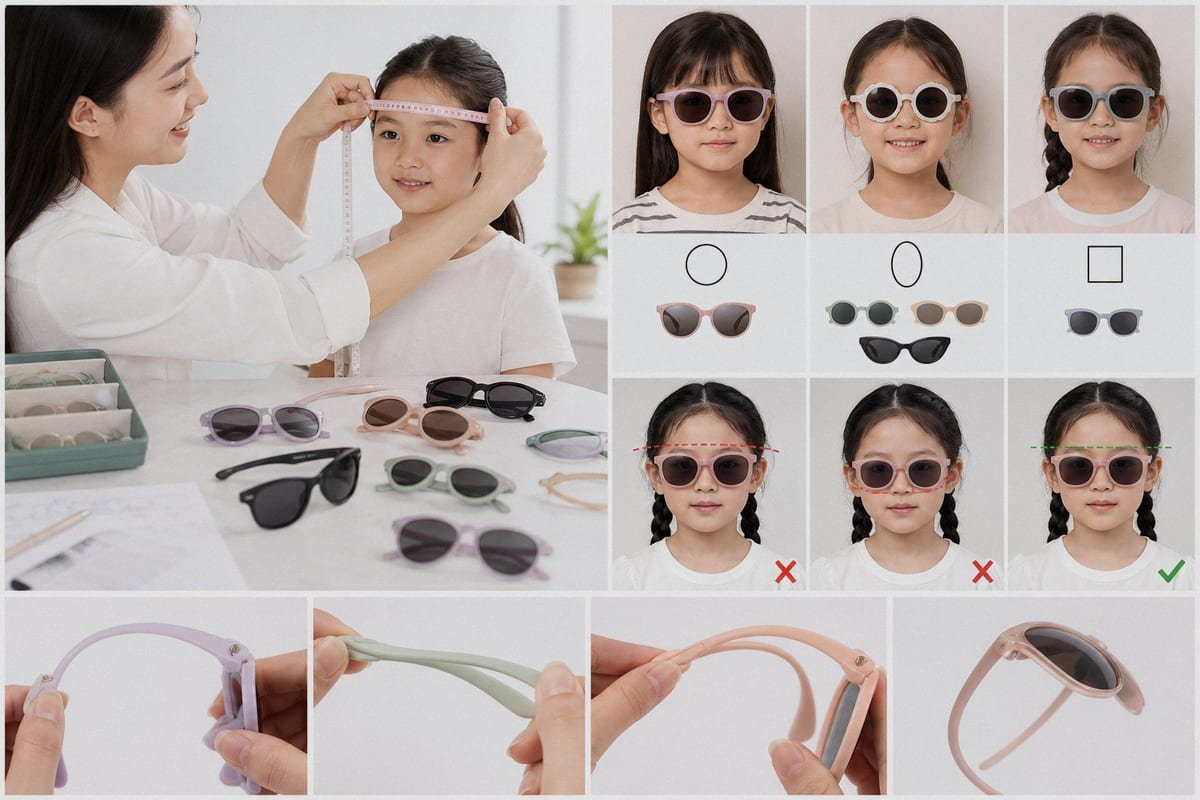
Choosing kids sunglasses frame sizes by face shape confuses many buyers I meet. Frames slip, pinch, or look oversized, and returns pile up. On our production line, we solve this daily.
To choose kids sunglasses frame sizes by face shape, first measure the child’s temple-to-temple face width to set the frame size, then pick a lens shape that balances the face: angular frames for round faces, rounded frames for square faces, and most styles for oval faces.
Size comes first. Shape comes second. In this guide, I will walk you through both steps, share the measurements we use in our Taizhou factory, and explain why frame material matters just as much.
How do I measure my child's face to find the right sunglasses frame size?
During a fitting session with a European baby-brand buyer last year, we lined up six sample heads on the table. The lesson was clear: age charts are guesses, but measurements never lie.
Measure the child's face width from temple to temple with a soft tape, then add 5–10 mm to estimate a comfortable total frame width. Check lens width, bridge width, and temple length on any existing pair that fits well, since those numbers are usually printed inside the temple arm.
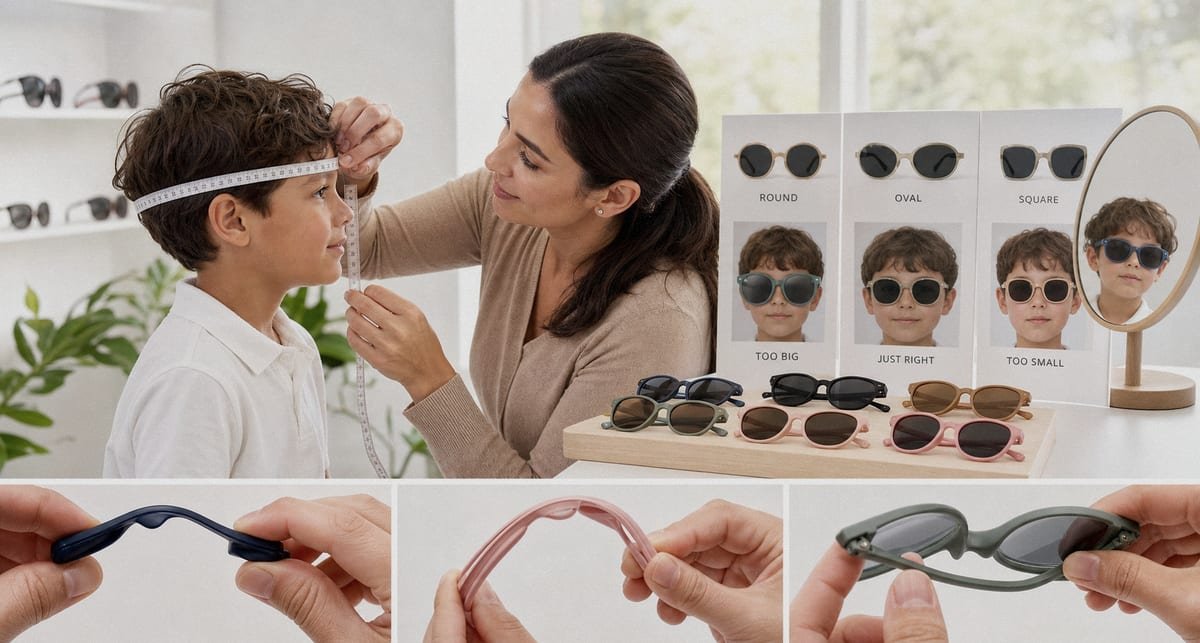
The three numbers that matter are レンズ幅 1, ブリッジ幅 2, and temple length. You will often see them printed inside a frame like 45-16-125. Each number affects fit in a different way. Lens width controls how wide the front sits. Bridge width decides how the frame rests on the nose. Temple length determines whether the arms reach comfortably behind the ears.
A Simple Four-Step Measuring Process
- Wrap a soft tape across the child's face from one temple to the other.
- Add 5–10 mm to that number. This is your target total frame width.
- If the child already owns glasses that fit, read the numbers inside the temple.
- Compare those youth frame dimensions to the size chart of the new sunglasses.
年齢ベースのチャート are a useful fallback when you have no glasses to compare. Here is the general progression we see across our ~800 existing styles:
| 年齢範囲 | 一般的なレンズ幅 | Typical Bridge Width | 一般的なテンプルの長さ |
|---|---|---|---|
| 35〜37 mm | 14〜15 mm | 13–14 mm | 105–115 mm |
| 1–2.5歳 | 37–38 mm | 110〜115 mm | 110~120 mm |
| 5〜4歳 | 40–42 mm | 115〜120 mm | 115~125 mm |
| 4–7歳 | 43–45 mm | 120〜128 mm | 120~130 mm |
| 7–10歳 | 45–47 mm | 16~17 mm | 125~135 mm |
| 10–16歳 | 47–52 mm | 16~18 mm | 130–140 mm |
Charts vary slightly between brands, and that is normal. There is no universal standard. The pattern is what matters: frame width grows steadily with age, but the child's actual face width always beats age alone. Many young children also have flatter nasal profiles 3, so a shallow or well-shaped bridge stops the frame from sliding down. In our sampling room, we always check the bridge fit before anything else, because a beautiful frame that slides is a frame that gets returned.
Which frame shapes work best for round, oval, or square kids' face shapes?
One trade-off we weigh constantly when developing new styles is contrast versus comfort. A shape that flatters a face on paper still fails if the child refuses to wear it.
Rectangular and wayfarer frames suit round faces by adding definition. Round and oval frames soften square faces and strong jawlines. An oval face shape works with most styles, while a heart-shaped face looks balanced with lighter, bottom-weighted, or lower-profile frames.
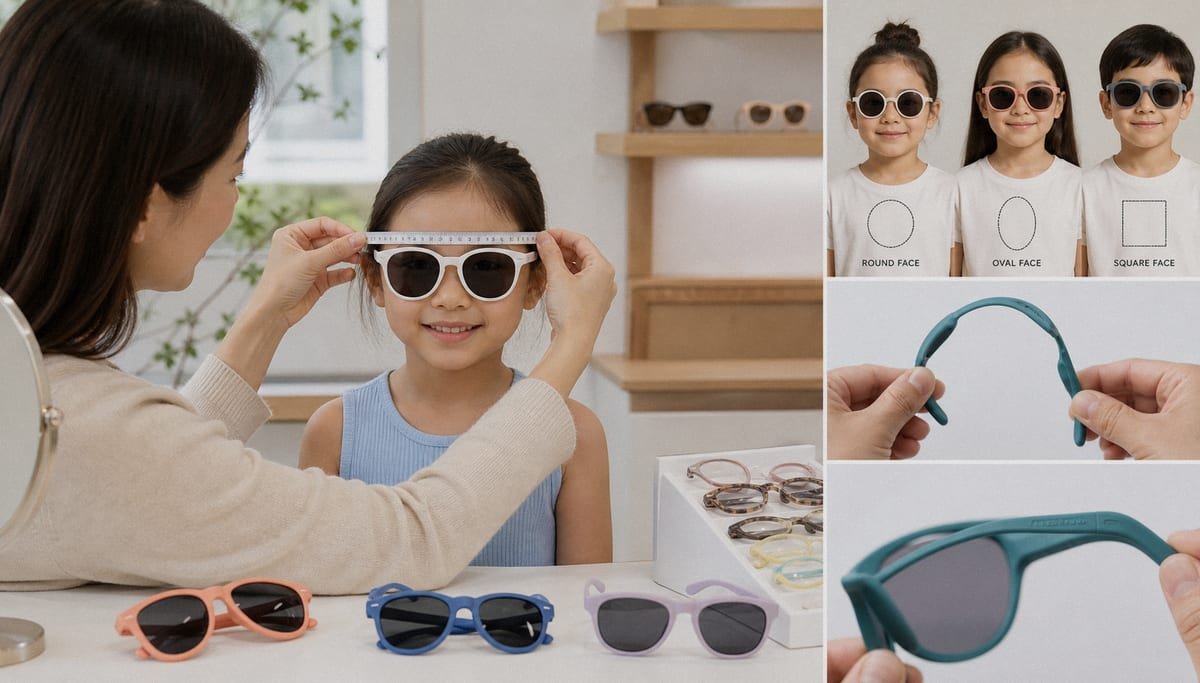
The core idea is contrast. Angular frames add structure to soft, rounded features. Curved frames soften sharp, angular features. Once you understand that principle, the guidelines below become easy to apply — and easy to bend when a child simply loves a certain style.
| 顔の形 | Recommended Frame Shapes | 効果 |
|---|---|---|
| 丸い | Rectangular, square, wayfarer | Angles create contrast and make the face appear longer |
| 四角い | Round, oval | Curves soften a broad jawline and strong angles |
| 楕円 | Most shapes; medium-sized frames | Natural balance means almost anything fits; avoid oversized fronts |
| Heart-shaped | Lighter, low-profile, bottom-balanced | Draws attention downward to balance a wider forehead |
These Are Guidelines, Not Rules
I want to be honest here, because we say the same thing to every brand we work with. Face-shape advice is a balancing tool, not a rulebook. Optical stylists agree there are no hard and fast rules. A confident child in the "wrong" shape looks better than an unhappy child in the "right" one.
Our pastel round frame — a periwinkle-blue front with mint-teal temples — is a good example. On paper, round frames suit square faces. In practice, it sells well across every face shape, because toddlers' features are still soft and the compact, organic silhouette flatters almost everyone. Meanwhile, our wraparound sport shields with mirrored gradient lenses work on nearly any face shape too, since the wide single lens follows the head's curve rather than framing the face in one geometric outline.
So refine by shape, but never let shape override fit or the child's own preference.
How do I know if a frame is too big or too small for my child's face?
A distributor in Australia once returned a sample batch with a single photo: a toddler wearing junior-sized frames, lenses resting on his cheeks. That photo now hangs in our QC room as a reminder.
A frame is too big if the lenses touch the cheeks, the eyes sit inside the inner half of each lens, or the frame slides when the child moves. It is too small if the temples press the head, the eyes sit near the outer lens edges, or red marks appear on the nose.
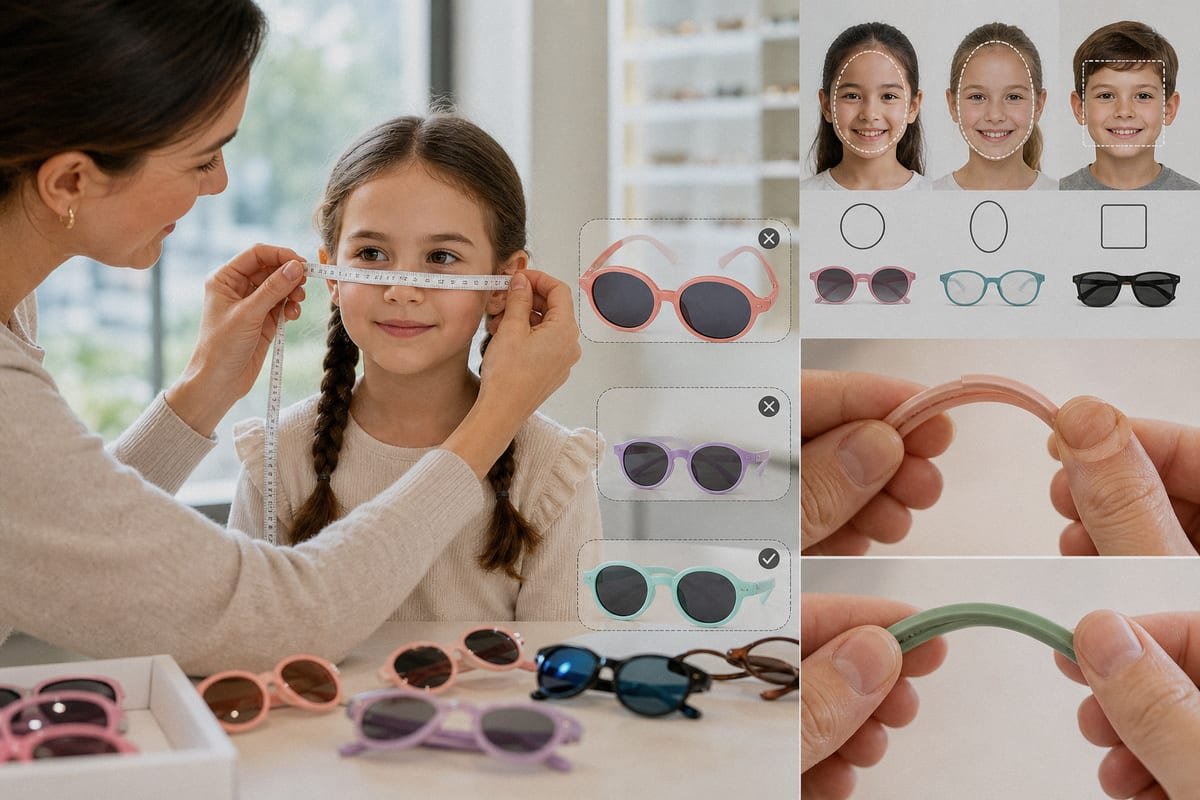
Fit checks take less than a minute, and they save weeks of frustration. Here is the checklist we use during our own sample approvals, adapted for parents and product teams.
Signs the Frame Is Too Big
- The lenses rest on the cheeks or touch the eyebrows.
- The eyes appear pushed toward the nose within each lens.
- The frame slides down when the child looks down or runs.
- The temples extend far past the ears with a visible gap at the sides.
Signs the Frame Is Too Small
- The temple arms bow outward or press into the sides of the head.
- The child's eyes sit close to the outer edge of the lenses.
- The bridge pinches and leaves red marks on the nose.
- Eyelashes brush against the lens surface.
The Ideal Fit
Eyes should sit near the center of each lens. The frame front should follow the width of the face, ending roughly at the temples. The bridge should rest evenly without pinching. Temple arms should curve gently behind the ears and hold the frame level. For sunglasses specifically, coverage matters more than with optical frames: lenses should shield the eyes fully from sunlight without touching skin. That is why UV400保護 4 only delivers its full value when the frame actually covers the eye area properly. For babies and very active toddlers, an adjustable head strap adds stability and keeps a correctly sized frame from ending up in the sandbox.
If a child is between sizes, we generally advise sizing toward the better bridge fit rather than the wider front, because a stable bridge keeps the optical center of the lenses aligned with the eyes.
Why should I choose flexible TR90 or TPEE frames for growing kids' faces?
Fifteen years of making 子供用アイウェア 5 taught our team one blunt lesson: rigid frames and active kids do not mix. That is why our factory standardized on TPEE 6 and TR90 long ago.
Flexible TR90 and TPEE frames bend, twist, and flex without snapping, so they survive drops, pulls, and rough play. They are lightweight, comfortable for all-day wear, safer on impact than rigid plastics, and they tolerate a child's face growth far better than stiff frames.
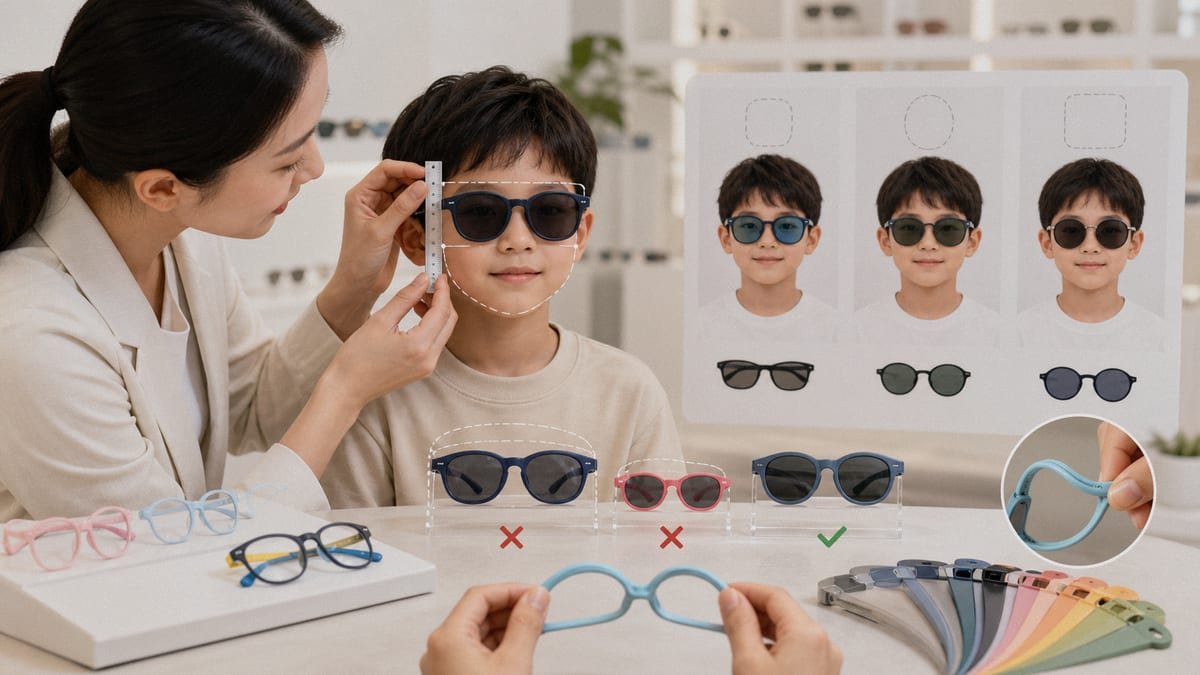
Children are not gentle with eyewear. They sit on frames, pull them off with one hand, and stuff them into backpacks. A rigid frame cracks under that treatment, and a cracked frame near a child's eyes is a genuine safety hazard. Flexible materials absorb that abuse instead of failing.
TPEEテンプル
| 素材 | 柔軟性 | 中程度から重い | 安全プロファイル | 最適な用途 |
|---|---|---|---|---|
| TPEE | Extremely flexible, near-unbreakable in normal use | 非常に軽い | Soft on impact, gentle on skin | Baby and toddler sunglasses |
| TR90 | Highly flexible with strong shape memory | 非常に軽い | Resists cracking and shattering | Kids' optical frames and sunglasses |
| TR90 + TPEE テンプル | Stable front, soft flexible arms | 軽い | Combines structure with comfort | Active kids, all-day wear |
| 標準的な硬質プラスチック | 低い柔軟性 | 中程度 | 悪い、壊れやすい | Not recommended for young children |
Why Flexibility Helps With Growth and Comfort
Flexible temples expand slightly as a child's head widens, which extends usable lifespan across growth phases. The same softness that makes TPEE feel like flexible silicone frames also means no pressure points behind the ears during long wear. In our workshop, we flex-test samples repeatedly before approving production, because a temple that fatigues after a few hundred bends will fail in a real child's hands within months.
Material choice also supports the lens. Whether a brand specifies 偏光レンズ 7 for kids or standard UV400 tinted lenses, the lens can only protect if the frame stays on the face. Lightweight, flexible fronts hold their shape after twisting, so the lenses stay properly aligned with the eyes. These materials are also environmentally friendlier than many traditional plastics and gentle on sensitive young skin — a detail our brand customers in Japan and Europe ask about more every year.
結論
Poorly sized kids' sunglasses get abandoned, and unprotected eyes pay the price. Measure the face first, refine by face shape, verify fit, and choose flexible materials. We build every frame around exactly that sequence.
脚注
1. ISO maintains standards for eyewear measurements such as lens width used in frame sizing. ↩︎
2. Background reference on eyewear anatomy terms like bridge width and lens width. ↩︎
3. Anthropometry background explains facial measurement variation referenced for nasal bridge fit. ↩︎
4. WHO explains UV radiation risks that UV400-rated lenses are designed to block. ↩︎
5. CDC resource on children’s vision health supports claims about kids’ eyewear durability needs. ↩︎
6. Background on thermoplastic elastomers, the material class TPEE belongs to. ↩︎
7. FDA consumer guidance on choosing sunglasses lenses, including polarized options, for eye protection. ↩︎



 English
  Español de México
  Deutsch
  Français
  日本語
日本語  العربية
  Português do Brasil