How to Balance Light Transmittance and Yellow Tint in Kids’ Blue-Light Glasses?
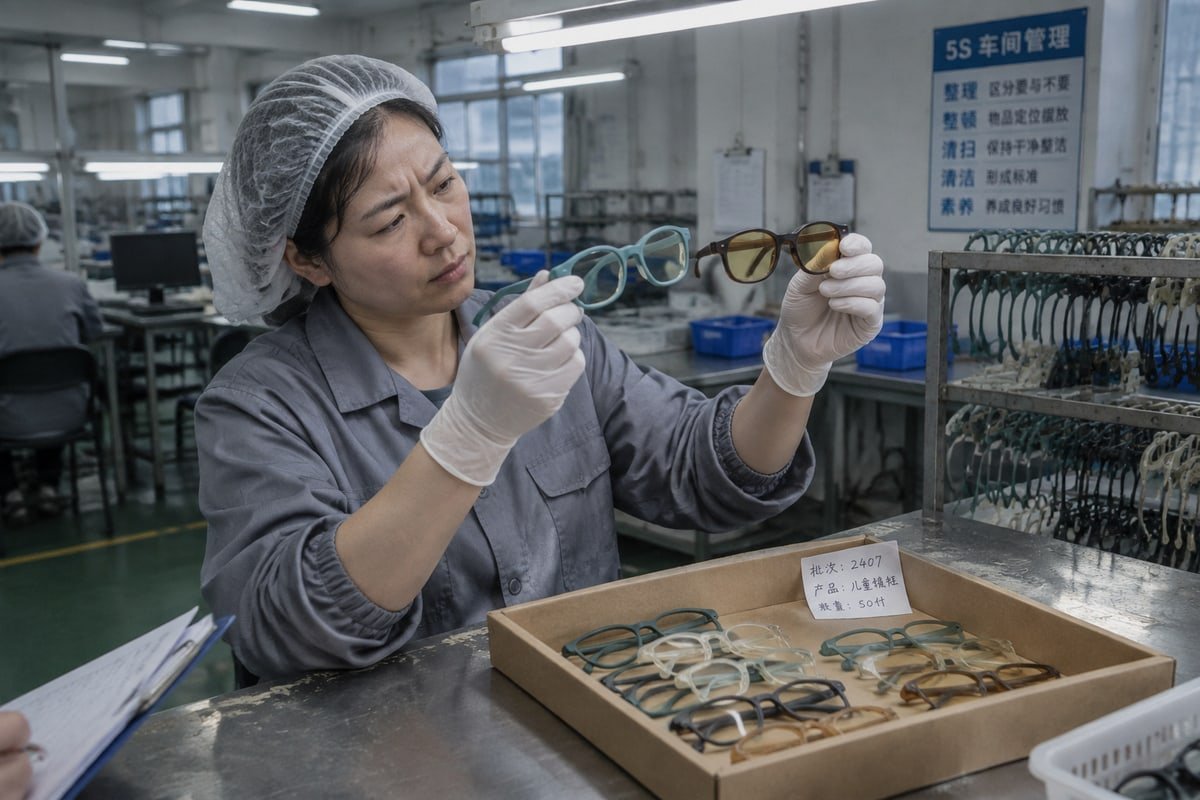
Light transmittance and yellow tint in kids’ blue-light glasses trips most buyers we meet spectral transmission report 1. Too much tint, kids refuse them; too little, claims ring hollow. Our line proves balance works.
Balance light transmittance and yellow tint in kids’ blue-light glasses by choosing the lightest tint the child will wear daily: near-clear lenses with 10–20% filtration in the 400–450nm band and high visible light transmission for school, reserving amber tints above 50% filtration for evening use.
That is the short answer. The longer answer depends on your use case, your lens supplier, and your quality checks. I will walk through each part below, using what we have learned building kids’ eyewear in Taizhou.
How do I know if my kids' blue-light lenses are blocking enough blue light without distorting colors?
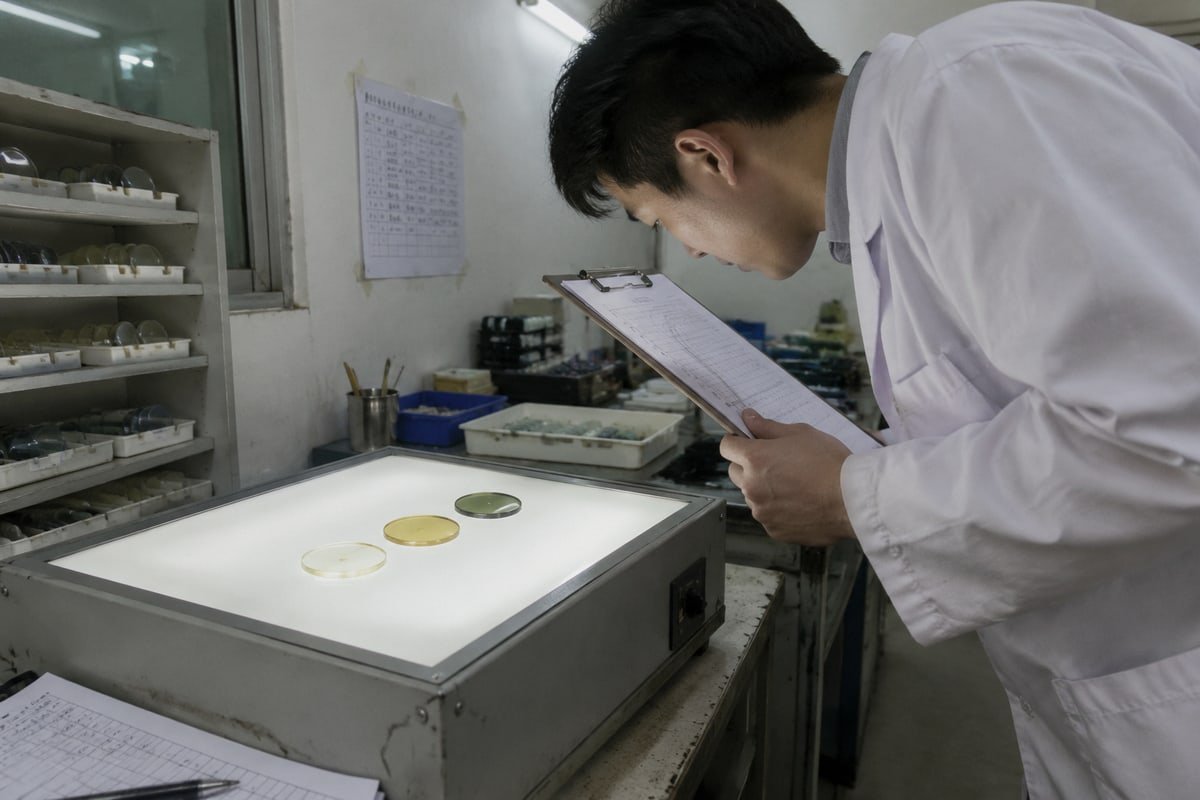
Last spring, our QC team lined up three lens batches on a lightbox in our Taizhou workshop. Two looked identical. One blocked far less blue light.
You know kids' blue-light lenses block enough blue light without distorting colors when the supplier's spectral transmission report shows targeted absorption in the 415–455nm blue light hazard band, high transmission around 480nm, a color rendering index near 95% or higher, and white paper still looks white through the lens.
The problem with "blocking enough" is that the eye cannot measure it. A lens can look yellow and block little. A lens can look almost clear and block a fair amount in the right band. So I always start with the curve, not the color.
Read the transmission curve, not the marketing claim
Every lens supplier we work with can give us a spectral transmission chart. It plots how much light passes through at each wavelength. For children's lenses, I look at three zones. The first is 415–455nm. This is the band most often labeled the blue light hazard range, and it is the target for filtration. The second is around 480nm, sometimes called blue-turquoise light. This band helps regulate a child's サーカディアンリズム 2 and supports normal pupil response, so I want it mostly untouched during the day. The third is the whole visible range, because total 可視光線透過率 3 tells you how much the lens dims the world.
| Wavelength zone | What it affects | What I want on a kids' daytime lens |
|---|---|---|
| 415–455nm | Glare, reported digital eye strain, retinal stress | Clear dip in transmission, not a cliff |
| ~480nm (blue-turquoise) | Circadian rhythm, alertness, pupil development | High transmission, close to the rest of the curve |
| 500–700nm (green to red) | Color balance, brightness | Flat and high, so colors stay true |
The white-paper test
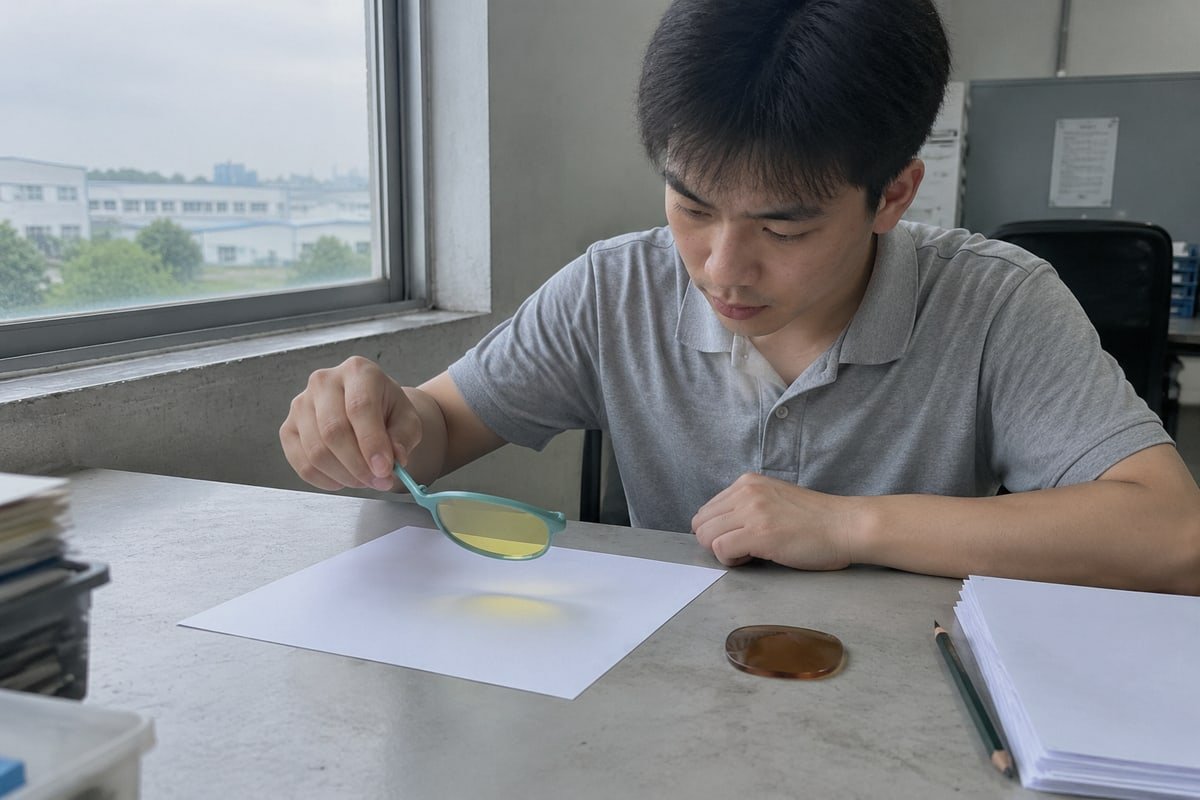
Numbers matter, but so does what a parent sees. So we also do a simple check on every pre-production sample. We hold the lens over white printer paper under daylight-balanced light. If the paper turns cream or butter yellow, the color distortion is too strong for school wear. If it stays white with only a faint warmth, the lens is in the right zone for all-day use. Our pale-yellow lens in the matte teal frame passes this test. A darker amber gaming lens would not, and that is fine, because it is built for a different job.
A lens that blocks more is not automatically a better lens for a seven-year-old. It just shifts the trade-off toward protection and away from natural color. The rest of this article is about where to set that dial.
What lens tint level should I choose to balance protection and natural color perception for children?
Every tint decision on our line is a trade: each extra percentage of HEV light filtration costs a little optical clarity and adds a little yellow.
Choose a near-clear lens with roughly 10–20% blue-light filtration for children's daytime and school wear, since it keeps natural color perception and high visible light transmission. Reserve light yellow tints for long screen sessions and amber lenses above 50% filtration only for the two hours before bedtime.
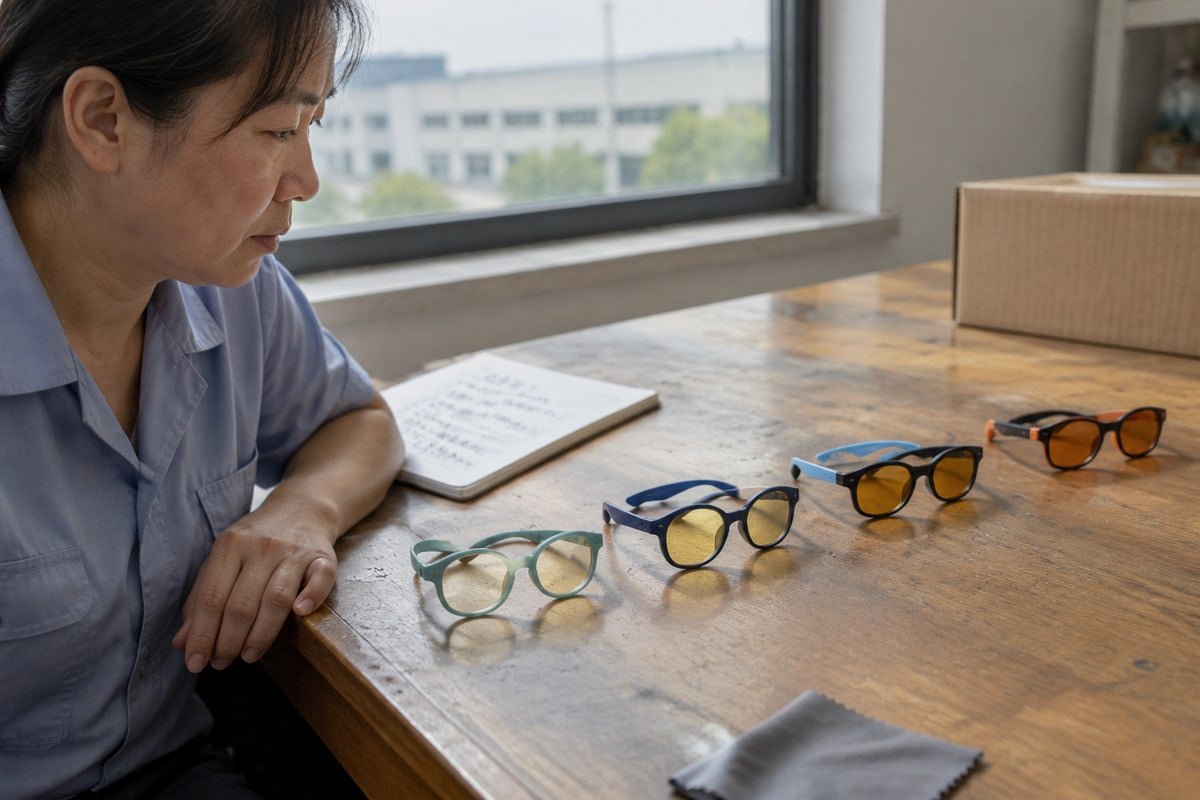
Here is how I lay out the options for buyers who ask which tint to put in their first collection.
| Tint level | Approximate blue-light filtration | Visible color shift | に最適 |
|---|---|---|---|
| Near-clear (coating or light pigment) | 10–20% in 400–450nm | Almost none | School days, homework, appearance-sensitive kids |
| Light yellow | Roughly 20–40% | Faint warmth, still wearable indoors | Long tablet sessions, moderate glare control |
| Medium amber | Above 50% | Obvious yellow, colors look warm | Evening use, kids very bothered by brightness |
| Orange / dark amber | 非常に高い | Strong distortion | Bedtime only, not for daytime wear |
The pattern is simple. Once filtration climbs above 50%, a noticeable yellow or amber tint is almost unavoidable. Below 20%, the lens can stay nearly clear.
The evidence objection, and why it changes your choice
Buyers sometimes push back: "If a 2023 Cochrane review 4 found little or no benefit for digital eye strain or sleep, why sell these at all?" I take that seriously. Major eye-care groups do not recommend blue-light glasses as a medical necessity for children. Some clinical commentary even notes that very strong filters did not beat neutral lenses for eye-strain symptoms.
My answer is that the evidence does not kill the category. It changes the promise. We tell partners to market comfort, glare control, and a calmer bedtime routine, not disease prevention. And once the promise is comfort, the lightest tint the child will actually wear wins every time. A heavy amber lens that lives in a drawer delivers nothing.
Two nuances specific to children
First, circadian rhythm. Evening screens can contribute to melatonin suppression, so stronger filtering makes the most sense in the two-hour window before sleep. Second, the myopia-protection balance. Indoor over-filtering may reduce the high-contrast visual input growing eyes need. Both nuances point the same way: clear during learning hours, tinted only near bedtime. A time-of-day protocol like this is easy for brands to explain and easy for parents to follow.
How can I test light transmittance quality before placing a bulk order with my manufacturer?
A procurement manager from Australia once asked me to prove our pale-yellow lens matched its spec sheet before she committed to a container.
Test light transmittance quality before a bulk order by requesting pre-production samples, asking for a spectral transmission report from a spectrophotometer, checking visible light transmission and the 415–455nm curve, comparing samples against a retained golden sample, and running simple white-paper and screen-glare checks yourself.
That buyer was right to ask. Light transmittance and yellow tint in kids' blue-light glasses cannot be judged from a catalog photo. Here is the process we now recommend to every partner, and it is the same one we use inside our own 5S-managed workshop.
A five-step pre-order check
- Ask for the lens spec sheet first. Before samples ship, request the target filtration band, the target visible light transmission, and the lens material. Polycarbonate lenses are the common choice for kids because they are impact resistant, but they need a good hard coat for scratch resistance.
- Request a spectral transmission report. A spectrophotometer reading shows the real curve of the actual lens batch. Look for the dip in 415–455nm and a healthy curve around 480nm.
- Compare against a golden sample. We keep an approved reference lens for each program. Every new batch is checked next to it under the same light. You should ask your supplier to retain one too, and to ship you a matching one.
- Check the anti-reflective coating. A quality 反射防止コーティング 5 lifts total transmission and cuts screen glare, which offsets the slight dimming a blue-light filter adds. Hold the lens under a strip light and look for a faint residual reflection color instead of a bright white glare.
- Do the practical checks. Hold the lens over white paper. Look at a tablet through it. Then look at a child's face through it, because parents will do exactly that in store.
What to ask, and what a good answer sounds like
| Question to your supplier | Weak answer | Strong answer |
|---|---|---|
| "How much blue light does it block?" | "A lot" or "up to 90%" | A percentage tied to a specific wavelength band |
| "Will the tint match across batches?" | "Yes" | Description of pigment lot control and golden-sample comparison |
| "Can you send a curve?" | "We don't have one" | A report from the lens supplier for the actual batch |
| "Which lens material?" | Not specified | Named material, plus hard coat and AR coating details |
Because we already hold around 800 existing frame styles, most partners can sample a full model with the exact lens spec within days rather than waiting on a new mold. That makes this check cheap. Skipping it is what gets expensive.
Why do some blue-light lenses look more yellow than others, and does that affect my brand's product quality?
The lesson we learned the hard way: two "clear" blue-light lenses from different pigment batches can look different shades of yellow side by side.
Some blue-light lenses look more yellow because they absorb more blue light through in-mass pigments rather than a thin reflective coating, and because pigment concentration, lens material, and thickness vary between batches. For your brand, uneven yellow reads as poor quality, so tint consistency matters as much as filtration level.

There are two basic ways to filter blue light in a lens, and they look different on the shelf.
Coating versus in-mass absorption
A coated lens reflects part of the blue band off its surface. It stays nearly clear. You often see a faint blue or violet sheen on it, like the navy-blue frame in our line with its slightly blue reflective coating. Filtration is modest, usually in that 10–20% range, and color perception stays natural.
An in-mass lens has blue-absorbing pigment mixed through the material. It can block more, but the pigment itself is what you see as yellow. Our matte teal model uses a pale in-mass tint, so it carries a soft warmth that parents can see but children barely notice. Push the pigment load higher and you get amber.
| 方法 | How it filters | Typical look | Main risk for a brand |
|---|---|---|---|
| 表面コーティング | Reflects a slice of blue light | Nearly clear, faint blue sheen | Coating wear, reflections in photos |
| In-mass pigment | Absorbs blue light in the lens body | Pale yellow to amber | Batch-to-batch tint variation |
| Hybrid (pigment plus AR) | Absorbs, then AR lifts transmission | Light warmth, low glare | Higher cost, needs tighter QC |
Why consistency is the real quality signal
A parent comparing two pairs in a store will not know that one has 15% filtration and the other 18%. They will notice if one looks yellower than the other. That is what we control. Pigment lots are matched, lens thickness is kept within our normal tolerance, and every batch is set against the ゴールデンサンプル under the same lightbox. Light transmittance and yellow tint in kids' blue-light glasses is not just an optical question for us. It is a brand-consistency question, and it is why we position ourselves as a long-term partner rather than a low-price supplier.
What is coming next
Newer selective filtration lenses use nanostructured layers to block the HEV band while holding a color rendering index above 95%. They aim to deliver stronger filtering with almost no visible yellow. They cost more today. But for brands that want a clear daytime lens and a warmer bedtime lens in the same collection, this is where I expect the market to go. It also fits nicely with our two-tone clip-on models, where a polarized clip covers outdoor sun and the base optical lens handles indoor screens.
結論
Heavy tint makes kids abandon glasses; weak filtering makes claims hollow. Choose the lightest tint children actually wear, verify the curve, and we'll build it consistently.
Interested in sourcing the products mentioned in this article? See details and request a quote here:
脚注
1. ISO standards define the international requirements and testing protocols for spectral transmission in protective eyewear. ↩︎
2. The NIH provides authoritative research on how specific blue light wavelengths influence the human circadian rhythm. ↩︎
3. NIST establishes the primary measurement standards for visible light transmission in optical and material sciences. ↩︎
4. Cochrane is the primary institutional source for the 2023 systematic review on blue-light filtering lens efficacy. ↩︎
5. The AAO provides clinical guidance on how an anti-reflective coating improves visual clarity and reduces screen glare. ↩︎


 English
  Español de México
  Deutsch
  Français
  日本語
日本語  العربية
  Português do Brasil