Can Silicone Nose Pads and Temple Tips on Kids’ Blue-Light Glasses Cause Skin Allergies?

Red marks on a child’s [nose bridge](https://okayeyewear.com/what-if-kids-optical-frames-cause-redness-allergic-reactions/) alarm parents. Silicone nose pads and temple tips on kids’ blue-light glasses get blamed in our factory inbox more often than the lenses.
Silicone nose pads and temple tips on kids’ blue-light glasses rarely cause true allergies. Most reactions are contact irritation from sweat, friction, pressure, or trapped debris. Genuine allergic contact dermatitis is possible, but nickel hardware, PVC blends, phthalates, dyes, or coatings are more likely triggers than medical-grade silicone itself.
That short answer hides a lot of detail. The rest of this article walks through how to tell irritation from allergy, which materials to ask for, how to test samples, and which certifications actually prove skin safety.
How do I know if my child is allergic to the silicone parts on their glasses?
A procurement manager once emailed us photos of a red patch on a child’s nose bridge, asking whether our TPEE frame was the cause. Fit was the real issue.
True allergy shows as itching, redness, swelling, small bumps, or scaling exactly where pads or temple tips touch the skin. Symptoms return with every wear and fade when glasses come off. Simple pressure marks fade quickly and do not itch. A dermatologist patch test confirms the trigger.
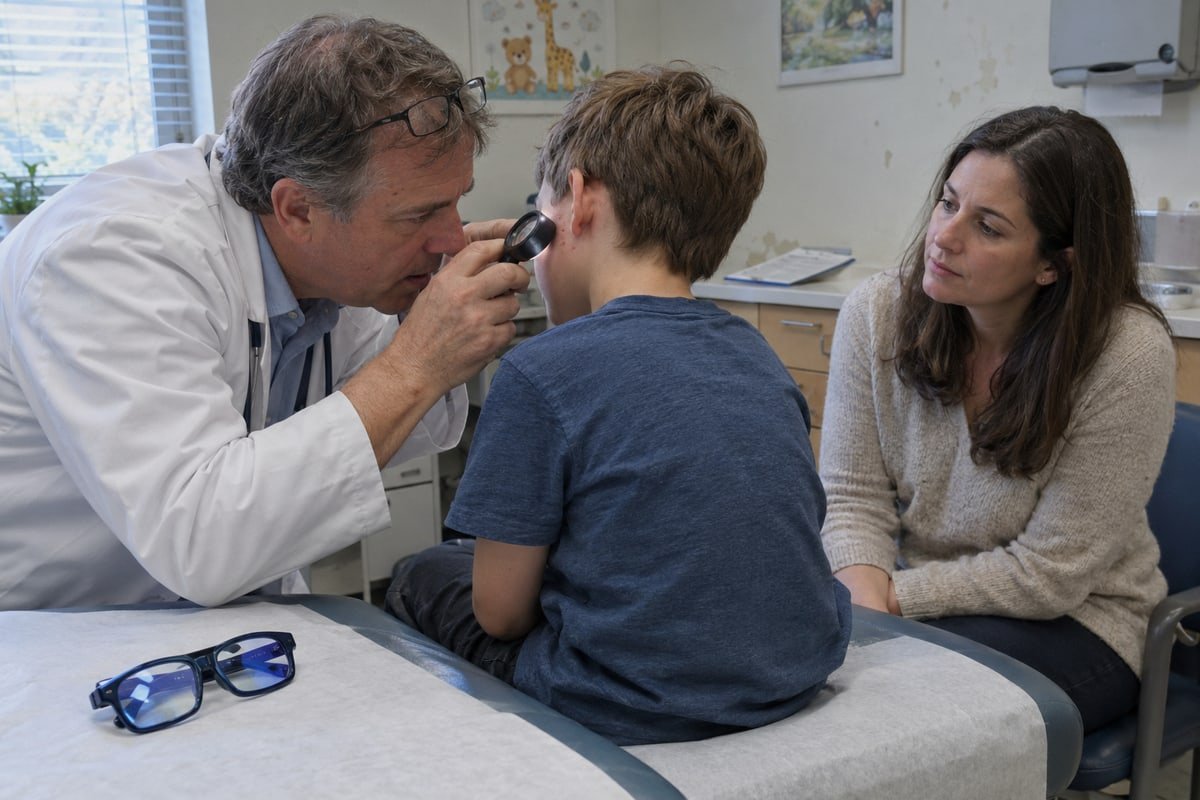
The hard part is that irritation and allergy look similar at first glance. Both show up at the bridge of the nose or behind the ears. Both make a child scratch. The difference is in the timing, the texture, and what happens when you take the glasses away.
Irritation versus allergy at a glance
| Sign | Contact irritation (most common) | Allergic contact dermatitis (less common) |
|---|---|---|
| タイミング | Appears after long wear, sweat, or heat | Appears hours to a day after wear, keeps returning |
| 柔らかく、ゴムのような、非常に柔軟 | Sore, pressed, sometimes shiny | Itchy, sometimes burning |
| Look | Flat red pressure marks on bridge or behind ears | Redness plus bumps, scaling, blisters, or swelling |
| After removal | Fades in a short time | Lingers, then flares again on next wear |
| 場所 | Follows pressure points and heavy spots | Follows the exact outline of pad, tip, or metal part |
| Fix | Adjust fit, clean pads, reduce weight | Identify the trigger material and remove it |
The three pseudo-allergies we see most
First, pressure urticaria. Heavy blue-light lenses on a frame that pinches the bridge can raise a red welt that looks chemical but is purely mechanical. Pediatric frame fitting usually solves it. Second, trapped debris. Sweat, sebum, and dead skin cells build up between the pad and the skin. That layer irritates by itself. It can also host microscopic fungal biofilms on porous silicone surfaces, which cause localized inflammation. Daily cleaning with pH-neutral soap is the fix. Third, molding burrs. Cheap compression-molded silicone often carries a tiny ridge along the parting line. That ridge causes micro-tears, and broken skin becomes more reactive to everything.
When a real allergy is likely
子供たちには atopic dermatitis 1, eczema, or a history of contact dermatitis react more easily. If the rash is itchy, bumpy, and follows the exact shape of a pad or a metal pad arm, think nickel allergy 2 first. Nickel-containing alloys in pad arms, screws, and hinges are the most common cause of eyewear rash in sensitive wearers. If the rash blisters, spreads, or keeps coming back after a fit adjustment, see a dermatologist for patch testing. That test separates nickel, rubber additives 3, and silicone additives. The blue-light coating on the lens is almost never involved. It does not touch skin.
What safer material options can I request instead of standard silicone nose pads?
Every time we spec a bridge, we weigh softness against cleanability. A soft pad feels great on day one. A smooth integrated TR90 bridge stays cleaner for months.
Safer options include liquid silicone rubber (LSR) pads, integrated TR90 or TPEE bridges with no metal arms, vinyl or ceramic pads, titanium pad hardware, and nickel-free screws. Ask for phthalate-free, PVC-free, BPA-free thermoplastic elastomers with documented material test reports rather than a bare hypoallergenic label.
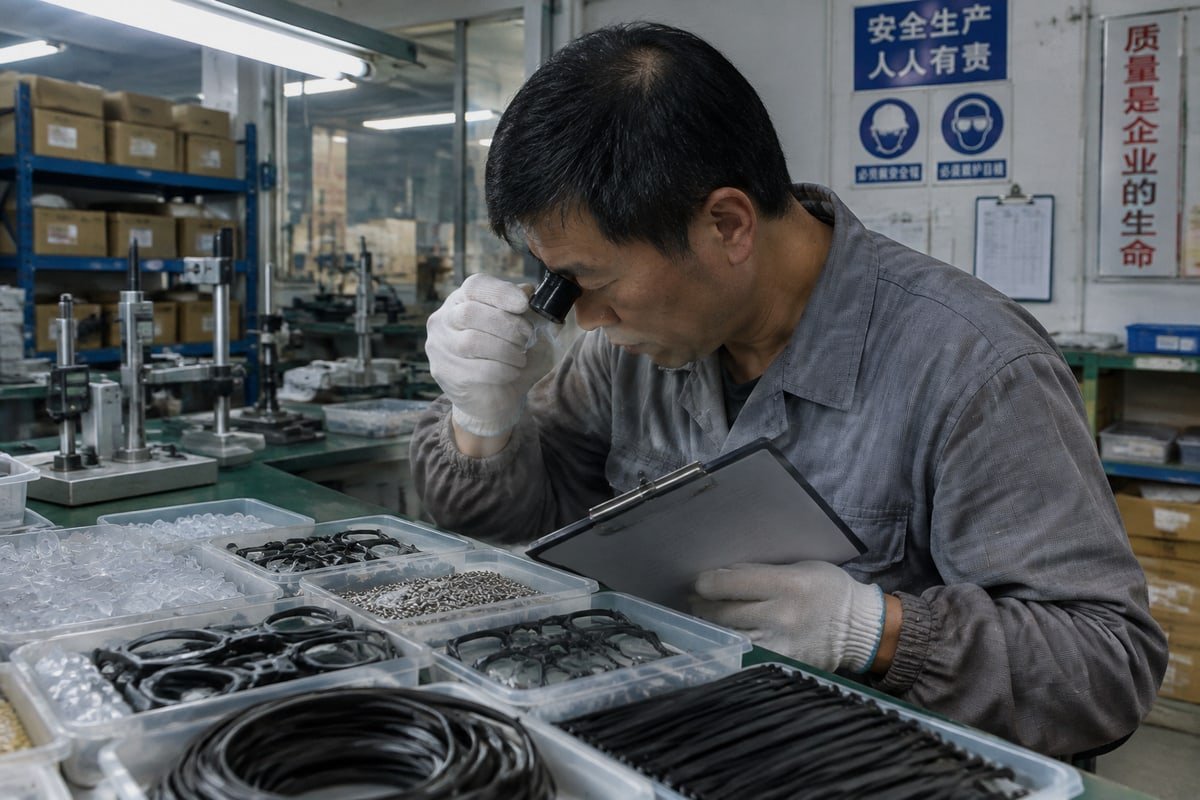
Buyers often ask us for a single "best" material. There is no single answer. The right choice depends on the frame style, the child's age, and how the pads attach. Start with this comparison.
| オプション | それは何ですか | Skin-safety strength | Watch-outs |
|---|---|---|---|
| Standard compression-molded silicone | Low-cost molded pad | Soft, cushions weight | May contain catalysts, VOCs, PVC or phthalate blends, parting-line burrs |
| Liquid silicone rubber (LSR) | Injection-molded medical-grade silicone | Fewer residual chemicals, smoother surface | Higher tooling cost |
| Air-bag silicone pads | Hollow, pressure-spreading pads | Reduces pressure marks on bridge | Still silicone; check additives |
| Integrated TR90 / TPEE bridge | Bridge molded as part of the frame | No metal arm, no nickel, no seam to trap debris | Not adjustable; fit must be right from the start |
| Vinyl pads | Soft PVC-based pad | Alternative if a child reacts to silicone | Verify phthalate-free plasticizers |
| Ceramic pads | Hard, inert pad | Very low reactivity, easy to clean | Less cushioning for small noses |
| Titanium or nickel-free hardware | Pad arms, screws, hinges | Removes the most common allergen | Confirm with nickel-release testing |
Why the blend matters more than the word silicone
Medical-grade silicone is rarely a true allergen. The problem is what gets mixed in. Many pads sold as silicone are actually blended with PVC or softened with phthalates to cut cost. Those additives are far more likely to sensitize a child than pure silicone. Cheaper compression-molded silicone also keeps chemical catalysts and volatile organic compounds 4 that LSR processing largely eliminates. So when you request silicone, request LSR and ask what plasticizers were used.
The objection we hear: "Just swap the pad"
Some buyers assume soft nose pad replacements will end every complaint. Often they will not. If nickel in the pad arm is the trigger, the new pad sits on the same metal and the rash returns. That is why many of our roughly 800 existing kids' styles use a fully molded TR90 or TPEE bridge. The frames in the matte teal and navy soft-touch ranges have no metal pad arm at all. The skin only meets the frame polymer. Thermoplastic elastomers like TPEE also stay flexible without the rubber additives that make some elastic tips sensitizing.
What about silicone-sensitive children?
A small number of children do react to silicone or to coatings on plastic frames. For those cases, vinyl or ceramic pads and an uncoated, BPA-free frame material are the usual route. Hypoallergenic eyewear materials are a menu, not a single product, and the safest frame is the one whose whole material stack has been checked.
How can I test a new pair of kids' glasses for skin sensitivity before a full production run?
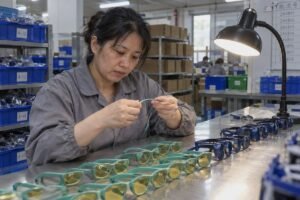
Before we release a pre-production sample, our QC team runs a finger along every temple tip parting line. A burr you can feel will scratch a child's skin.
Request pre-production samples, inspect parting lines and hardware, then run a two-week wear trial with a small panel of children, including some with eczema. Log redness, itching, and location daily. Pair this with third-party lab tests for nickel release, phthalates, and skin irritation before approving the full order.
Lab reports tell you what a material contains. A wear trial tells you how it behaves on a real face during real play. You need both. Here is the sequence we recommend to brand teams before they sign off on a bulk run.
A practical five-step pre-production check
- Clean the samples first. Residual chemical vapors from lens coating processes can settle on temple tips during manufacturing. Wash every sample with pH-neutral soap and water before anyone wears it. Otherwise you may test a factory residue, not the material.
- Inspect by hand and by eye. Feel for parting-line burrs on pads and tips. Check any screws, hinges, or pad arms. Ask whether those metals are nickel-free. If a clip-on is included, check its hinge contact points too.
- Fit before wearing. Have the panel's frames adjusted so the bridge does not pinch and the tips do not press behind the ears. A badly fitted sample will produce pressure marks that look like a failed material.
- Run the wear trial. Two weeks, normal daily wear, including sport or outdoor play so sweat is part of the test. Include at least a few children with known sensitive skin, with parental consent.
- Log and compare. Use the same log for every child so patterns show.
| Log field | What to record | なぜそれが重要なのか |
|---|---|---|
| Wear hours | Total hours per day | Longer wear raises irritation risk |
| 場所 | Bridge, behind left ear, behind right ear | Pinpoints which part touches the spot |
| Look | Redness, bumps, scaling, blister | Separates pressure from allergic reaction symptoms |
| タイミング | During wear, after removal, next morning | On-off pattern suggests contact dermatitis |
| Cleaning | Cleaned today, yes or no | Rules out sweat and biofilm build-up |
Reading the results
If one child shows a flat mark that fades after removal, refit. If a child shows itching or bumps in the outline of a pad or metal part, stop and investigate that part. Send that component for testing rather than guessing. Our 5S-managed workshop keeps sample batches traceable, so we can tell a buyer which resin lot and which mold produced a given sample. That traceability is what makes a trial result actionable.
Which certifications should I ask my supplier for to confirm skin-safe materials?
We learned early that a hypoallergenic claim on a product page carries no weight with a serious European buyer. Test reports do. So we stopped leading with adjectives.
Ask for EN 71-3 or CPSIA/ASTM F963 toy-safety reports, REACH SVHC and phthalate results, EN 1811 nickel-release testing on any metal parts, ISO 10993-10 skin irritation and sensitization data or FDA 21 CFR 177.2600 compliance for silicone, plus ISO 12312-1 or ANSI Z80.3 for lenses.
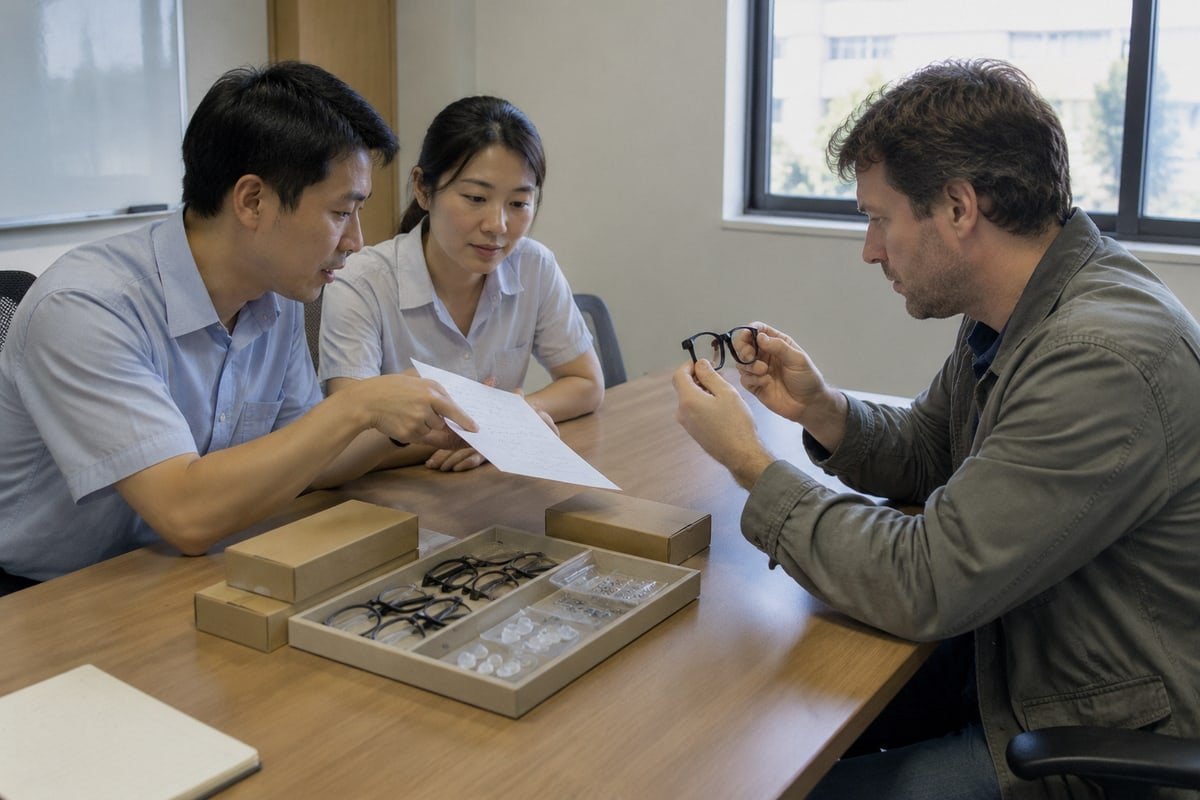
No single certificate covers a whole pair of glasses. A frame, a pad, a screw, and a lens are different materials, tested under different rules. The table below shows which document answers which question, so you can ask for the right one for each part.
| Standard or report | フレーム内のレンズ保持 | Which part it applies to |
|---|---|---|
| EN 71-3 | Migration of heavy metals from materials | Frame, pads, tips (EU children's products) |
| CPSIA / ASTM F963 | Lead, phthalates, and general toy safety | Frame, pads, tips (US market) |
| REACH Annex XVII and SVHC screening | Restricted substances, including phthalates and nickel release limits | All components (EU) |
| EN 1811 / EN 12472 | Nickel release, including after wear and corrosion | Screws, hinges, pad arms, clip-on hardware |
| ISO 10993-10 (or ISO 10993-23) | Skin irritation and sensitization | Pads, tips, any long-contact material |
| FDA 21 CFR 177.2600 / USP Class VI | Silicone rubber purity for repeated contact | LSR or medical-grade silicone pads |
| ISO 12312-1 / AS/NZS 1067 / ANSI Z80.3 | Optical and UV performance, impact | Lenses, including blue-light and polarized clip-ons |
| ISO 9001 | Factory quality management system | The supplier, not the product |
Read the report, not the label
A useful report names the testing lab, the test date, the exact material or part number, and the result against a numeric limit. For nickel, the REACH limit 5 is a release rate of 0.5 micrograms per square centimeter per week. A report that just says "pass" without that number is weaker. Also check that the tested sample matches the material you are buying. A report for one resin grade does not cover a different colour batch with different pigments.
What we ask buyers to ask us
When a kids' brand from Australia, Japan, or Europe approaches us, we expect questions about TPEE and TR90 substance testing, about whether our BPA-free plastics apply to the lens as well as the frame, and about the metal in any screw. We treat these as normal. A factory with 15 years of eyewear experience should be able to answer them without hesitation. If a supplier only offers marketing words like skin-friendly or medical-grade silicone with no lab paper behind them, treat that as a gap, not a guarantee. Full OEM/ODM support means the documentation follows the product, not the other way round.
結論
Rashes cost brands returns and trust. Blame the wrong part and the problem returns. Choose safer materials, test samples properly, and demand real reports before ordering.
Interested in sourcing the products mentioned in this article? See details and request a quote here:
脚注
1. Authoritative NIH overview of atopic dermatitis, a common condition increasing skin sensitivity in children. ↩︎
2. Clinical information from Mayo Clinic regarding nickel allergy, a frequent cause of contact dermatitis from eyewear. ↩︎
3. Mayo Clinic guide to allergy testing, used to identify specific triggers like rubber or silicone additives. ↩︎
4. EPA technical overview of volatile organic compounds, which can remain as residues in molded silicone parts. ↩︎
5. Official ECHA resource for substances restricted under REACH, including nickel release limits for consumer products. ↩︎

 English
  Español de México
  Deutsch
  Français
  日本語
日本語  العربية
  Português do Brasil