How to Avoid Negative Reviews and Returns for TR90 Kids Sunglasses?
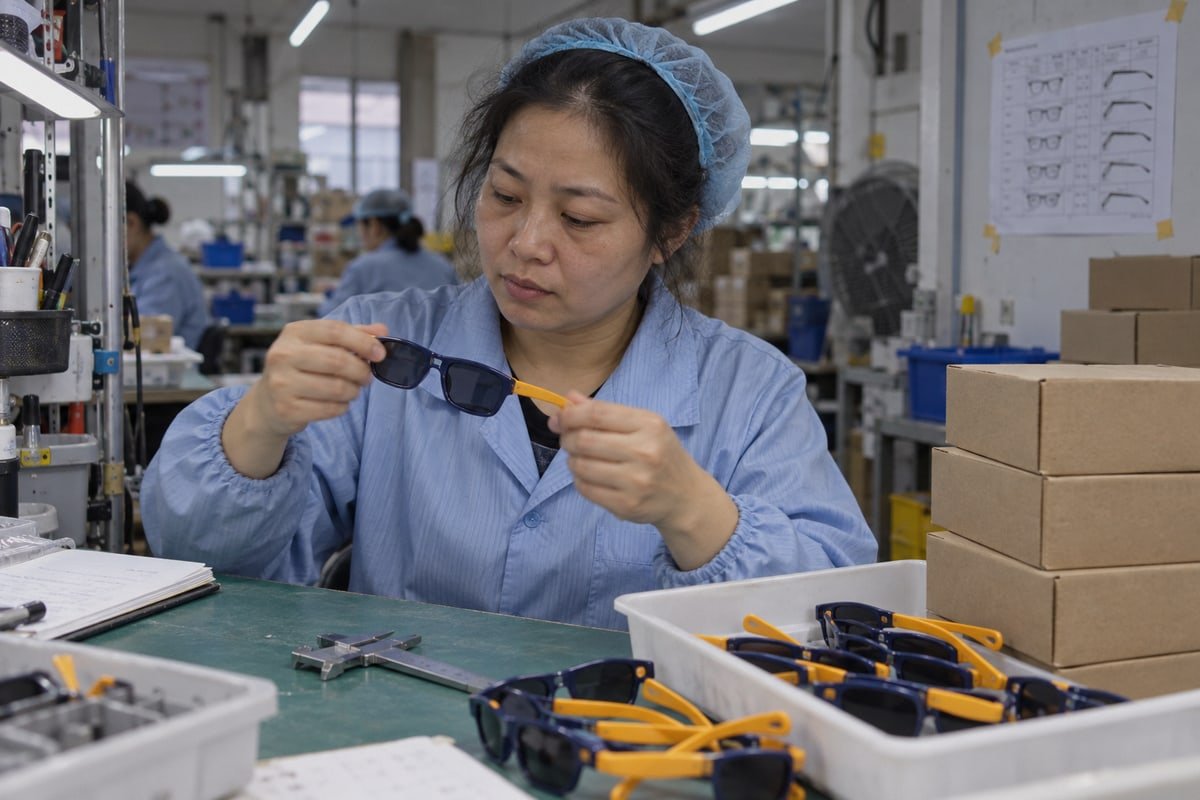
Negative reviews and returns for TR90 kids sunglasses can quietly erase a launch’s margin. On our Taizhou production line, we trace most of them to fit, hinges, and vague claims.
To avoid negative reviews and returns for TR90 kids sunglasses, verify fit with millimeter measurements, demand genuine TR90 with UV400 protection, test hinges and temple flex before shipment, choose a factory that proves sample-to-bulk consistency, and print clear sizing and care details on the packaging.
TR90 itself is rarely the villain. Parents send frames back when they slide, pinch, crack at the hinge, or look nothing like the listing photo. Below, I walk through the four places where those failures start and how a brand can close each gap before the first order ships.
How can I make sure TR90 kids sunglasses fit comfortably so parents don't complain about fit issues?
The hardest lesson from our first years making kids' frames was simple. An age label on the box does not tell a parent whether the frame will stay on.
Ensure comfortable fit by publishing an accurate size chart in millimeters for lens width, bridge, and temple length, using bendable temple arms and soft nose bridges, testing frames on children during movement, and offering an adjustable silicone strap for toddlers, instead of relying on age ranges alone.
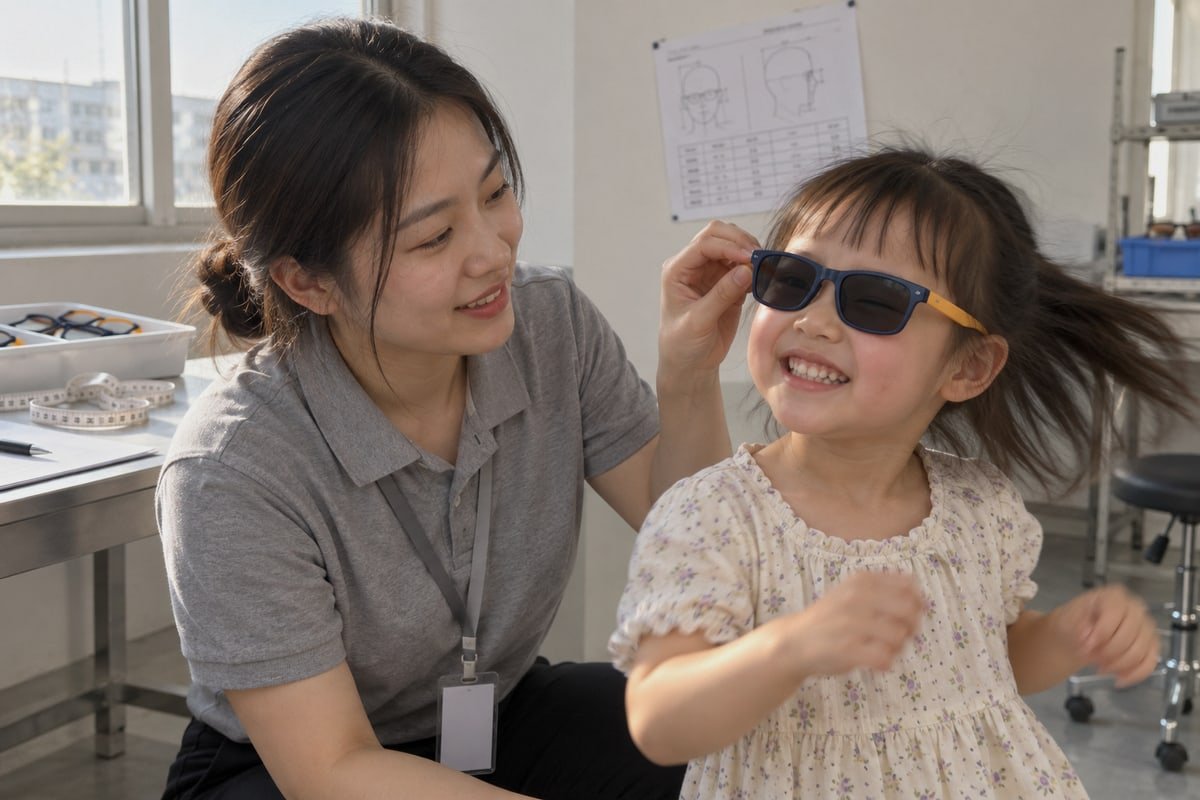
Fit is the first filter for negative reviews and returns. A frame that is too wide will slide down the nose no matter how good the material is. A frame that is too narrow presses behind the ears within minutes. Both problems end with the child pulling the glasses off and the parent writing a complaint.
Measure the frame, not the marketing
We ask every buyer to work from five numbers. Age ranges help a shopper find the right page. Millimeters help them make the right choice. When we develop a new style, we fit it on children of different ages before we approve the tooling. That step catches frames that run large despite a "kids" label, which is one of the most repeated complaints in online reviews.
| 測定 | それが制御するもの | Complaint when it is wrong |
|---|---|---|
| 全体のフレーム幅 | Whether the frame hugs or floats on the face | "Slides down constantly" |
| Lens width and height | Eye coverage and side light leakage | "Too big for her face" |
| 鼻梁の幅 | Nose contact and pressure points | "Pinches the nose" |
| テンプル長 | Ear hook position and grip | "Presses behind the ears" |
| Temple curve and tip flex | Stability during running and jumping | "Falls off when he plays" |
Design for motion, not for a photo
Children do not sit still. The wraparound sport frame in our range, with its slightly curved temples and matte rubberized feel, exists because parents told us straight frames fell off during play. Bendable temple arms in TPEE grip gently without clamping. For toddlers, an adjustable silicone strap turns an average fit into a secure one. We also favor a matte, soft-touch finish for children with sensory sensitivities, since glossy plastic can feel irritating on the skin.
Test wear before you list
Put the sample on a child. Ask them to jump, shake their head, and look down at their shoes. If the frame moves or leaves a red mark after ten minutes, the fit needs work. Comfort is not a luxury feature in kids' eyewear. It is a return-prevention feature.
What quality checks should I request from my manufacturer to prevent defective TR90 sunglasses reaching customers?
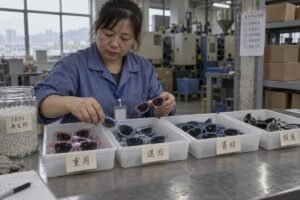
Last month our QC team pulled a navy frame with yellow-orange temples off the line because one hinge loosened after repeated open-close cycles.
Request incoming material verification with an MSDS confirming genuine Grilamid TR90 or certified PA12, UV400 lens transmission checks, hinge open-close and temple bend tests, lens seating and torsion inspection, surface finish and logo review, and a signed pre-shipment report comparing bulk units against the approved sample.
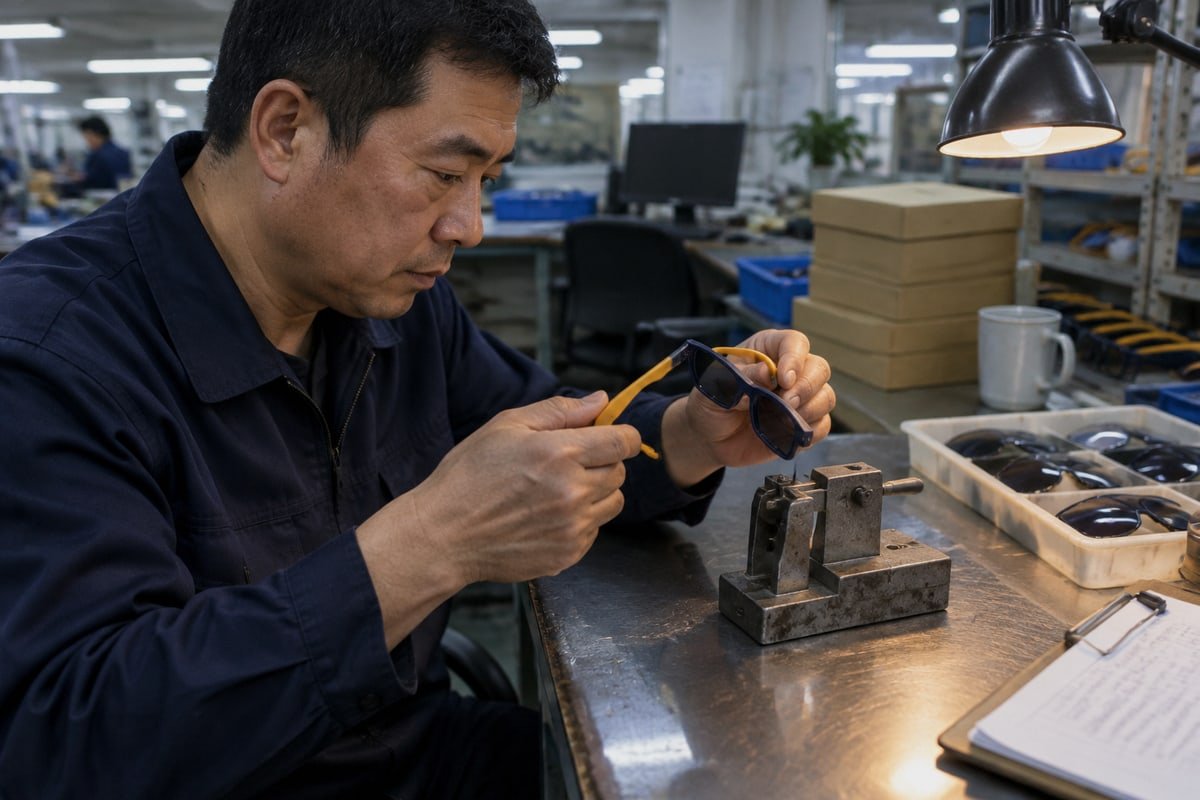
Defects rarely announce themselves. A hinge that feels fine on day one develops micro-cracks after a month of a five-year-old folding it backwards. A lens that looks clear in the sample box scratches in the first week at the beach. These are the slow failures that turn into negative reviews and returns long after the shipment has cleared. Good QC catches them early, and a buyer has every right to ask for it in writing.
The four-stage check we run
- Incoming material. We confirm the resin batch against its MSDS. Genuine TR90 is a flexible memory polymer 1 that returns to shape without creasing. Cheaper "TR90-like" substitutes often whiten or crack at the bend point. If a supplier cannot name the material source, that is the first warning sign.
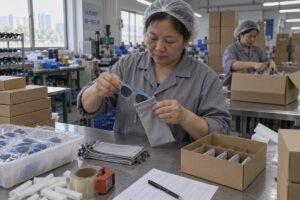
- In-process inspection. During assembly, inspectors check that the frame does not twist after lens installation and that the lens sits fully in its groove. A lens that pops out under thumb pressure is a shatterproof design in name only.
- Function testing. Temples are bent and released. Hinges are opened and closed repeatedly. Spring hinges or flexible temple designs suit younger children better than basic barrel hinges, because rough handling is guaranteed.
- Pre-shipment comparison. Random units from the bulk order are laid side by side with the signed sample. Color, finish, logo clarity, and lens tint must match.
| チェック | 方法 | Failure it prevents |
|---|---|---|
| Material identity | MSDS review, bend-and-recover test | Cracking, whitening, color fade |
| UV400保護 2 | Lens transmission meter | Dark but non-protective lenses |
| Hinge integrity | Repeated open-close cycles | Loose or cracked hinges |
| レンズの取り付け | Pressure and torsion check | Lens pop-out, frame twist |
| Surface and coating | Visual and scratch inspection | Scratched lenses, peeling temple tips |
| Bulk consistency | Sample-to-batch comparison | "Looks different from the photo" |
Realistic durability claims start at QC
Impact resistant lenses and a flexible frame give a real advantage on the playground. But flexible does not mean indestructible. When we write product copy with clients, we describe resilience and comfort, not lifetime damage-proof performance. Overpromising is its own return risk. One more small detail helps too: a backside anti-reflective coating on the lenses cuts internal reflections that cause "ghosting" complaints from kids who struggle to explain what they are seeing.
How do I choose a reliable TR90 supplier to avoid inconsistent quality and costly returns?
A procurement manager from Japan once asked me a blunt question during a factory visit: how do I know the tenth container will feel like the first sample?
Choose a TR90 supplier that is a real factory rather than a trading company, has a long eyewear track record, documents material sources, runs a structured workshop, offers existing styles to test the market, communicates clearly, and can prove that bulk production repeatedly matches approved samples.

The youth sunglasses market is crowded and growing. One projection puts it at 4.3 billion US dollars 3 by 2026 with a 6.5 percent CAGR. More competition means more listings side by side, and a single batch of inconsistent frames can sink a brand's rating while competitors move ahead. Supplier choice is where most of that risk is decided.
Factory or trading company
The core question is control. A trading company sources from whichever workshop quotes lowest this month, so the second order may come from a different mold and a different resin. A real factory owns the process from raw material to packing. Our own workshop runs about 120 workers under 5S management, backed by 15 years of eyewear experience, and that structure is what makes repeatability possible.
| 要因 | Trading company | Real factory |
|---|---|---|
| Material control | Depends on subcontractor | Verified at incoming inspection |
| Sample-to-bulk consistency | Hard to guarantee | Same mold, same line, same team |
| Technical communication | Relayed second-hand | Direct with engineers |
| Custom OEM/ODM changes | Slow and costly | Colors, logos, lenses, packaging in-house |
| Style library | Limited to what partners offer | Around 800 existing styles to start from |
The cheap-quote objection
Buyers sometimes tell me a lower quote "looks the same." I understand the pressure. But an unusually low price usually hides one of three things: a substitute resin, thinner hinge components, or no real QC stage. Any of those shows up later as refund requests. The frame feel, finish, and durability must be repeatable, not just achievable once for a sample.
Lower risk without a mold investment
New brands often assume they must invest in custom tooling to get a distinctive product. Our approach is different. A buyer can pick from roughly 800 existing styles, from a black oval retro shape to a dual-tone wayfarer, then customize colors, logos, lens options, and packaging. That lets a brand test the market with modest quantities and validate fit and reviews before committing to a new mold. We ship to buyers in more than 20 countries this way, and the ones with the fewest returns are always the ones who tested first.
What packaging and product information can I include to reduce misunderstandings that lead to negative reviews?
Every extra insert in a box adds cost, and we weigh that against the price of a single one-star review that mentions unclear sizing.
Include a millimeter size chart, explicit UV400 or 100% UVA/UVB labeling, the frame material name, realistic durability wording that describes flexible memory polymer rather than unbreakable claims, care instructions, a UV indicator card, and warranty terms, so parents know exactly what they bought before opening.
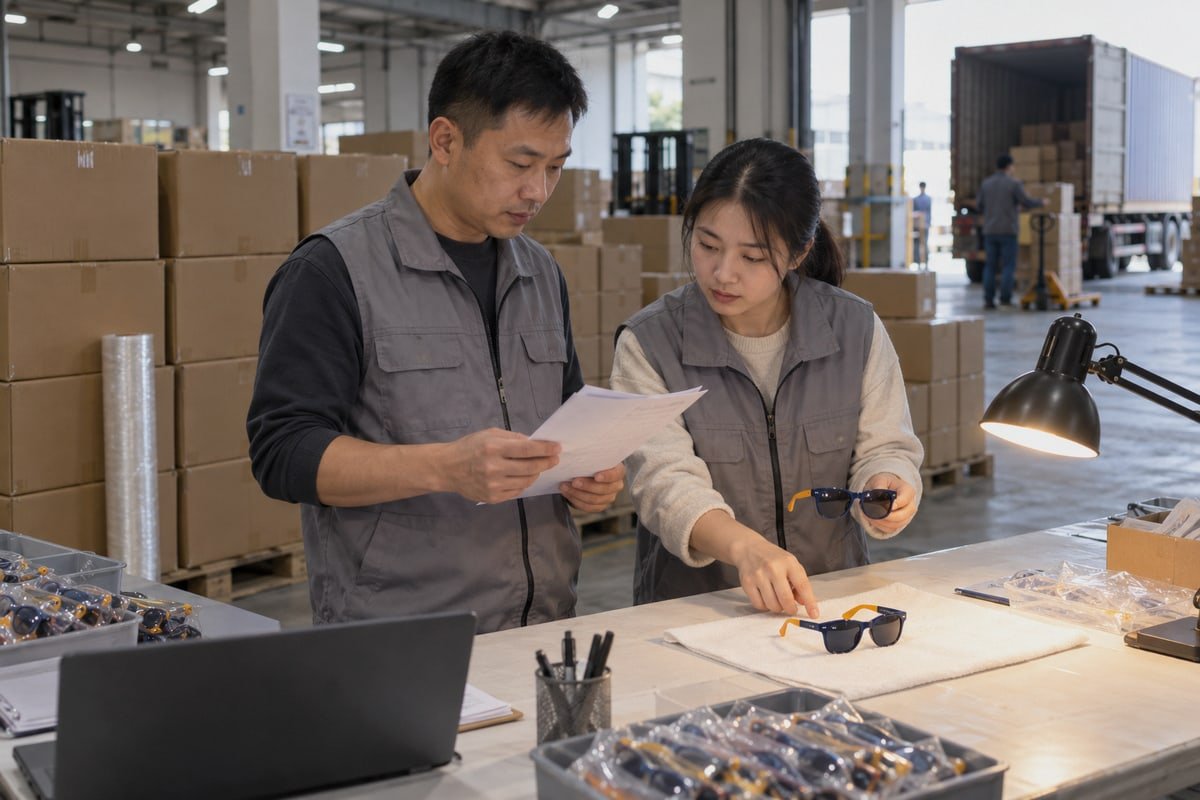
Many negative reviews are not about the product at all. They are about the gap between what the parent expected and what arrived. Packaging and listing content are the cheapest tools a brand has to close that gap. In our OEM/ODM work, we build retail-ready presentation for clients, and the same few elements keep proving their value.
Protection claims must be specific
"UV protection" without a number is too vague and reads as evasive. Any children's sunglasses listing should state UV400 protection or 100% UVA/UVB clearly on the box and the product page. Parents who later realize the lenses were dark but not protective write the angriest reviews of all. If the style uses 偏光レンズ技術は 4, explain what that does in one plain sentence: it cuts glare from water and roads. A reusable UV indicator card in the box gives parents immediate proof that the lenses work.
Material and safety wording parents trust
State the material by name. BPA-free frames made from a hypoallergenic material matter to parents of children with sensitive skin, so say so directly instead of writing "premium plastic." Describe the frame as a flexible memory polymer that bends and recovers. Do not promise it will survive anything.
| Packaging element | Misunderstanding it prevents |
|---|---|
| Millimeter size chart with age guide | "Runs too large for a kid" |
| UV400 / 100% UVA/UVB label | "Not sure these actually protect" |
| Material name and safety notes | "Is this safe for my child's skin?" |
| Realistic flex statement | "It broke, but it said unbreakable" |
| Care card for lenses and temple tips | "Scratched in a week" |
| Warranty or replacement terms | "No help when they got lost" |
Show scale before purchase
A frame that looks compact in a studio photo can look oversized on a small face. Photos of the sunglasses on children, 360-degree videos, or AR try-on tools show real scale. A lost-or-broken replacement policy also lowers the perceived risk for parents of active kids and builds long-term trust. Small design notes, such as bridge venting that limits lens fogging during play, are worth mentioning too, because a child who rejects fogged glasses becomes a parent who returns them.
結論
Negative reviews and returns for TR90 kids sunglasses come from fit gaps, weak QC, unreliable suppliers, and vague labels. Fix those four, and TR90 delivers.
Interested in sourcing the products mentioned in this article? See details and request a quote here:
脚注
1. Official manufacturer specifications for Grilamid TR90, detailing its memory polymer properties and flexibility. ↩︎
2. FDA authoritative information on ultraviolet radiation and the necessity of protective eyewear standards. ↩︎
3. Statista market data providing global eyewear industry valuation and growth projections. ↩︎
4. Technical explanation of how polarized lenses function to reduce glare for safety and comfort. ↩︎

 English
  Español de México
  Deutsch
  Français
  日本語
日本語  العربية
  Português do Brasil