Is Fogging on Kids’ Sunglasses a Coating or Usage Problem?
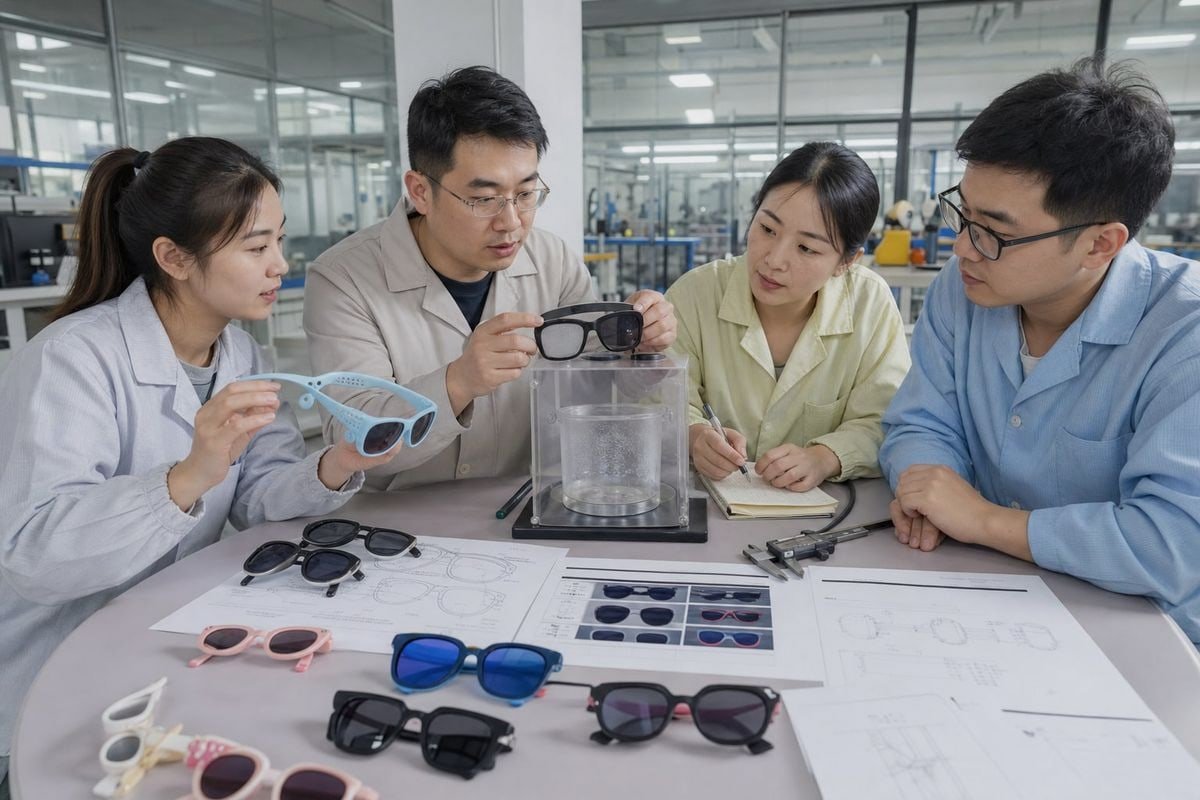
Fogging on kids’ sunglasses triggers returns, angry reviews, and refund requests fast TR90フレーム 1. I have seen buyers panic over it, and on our production line in Taizhou, we field this question every humid season.
Fogging on kids’ sunglasses is usually a usage and environment problem, not a coating defect. Condensation forms when warm, moist air meets a cooler lens. Coating quality only determines how well the lens resists fog; dirty, worn, or missing anti-fog coatings simply make it worse.
So the real question is not “who is to blame.” It is how to tell the two causes apart, and what you can do about each one. Let me walk you through it.
How can I tell if fogging is caused by a coating defect or by how my customers use the sunglasses?
A buyer from Australia once sent me a video of a fogged lens as "proof" of a defect. Our QC team tested the same batch and found the coating was working perfectly.
Check the pattern. Fog that appears only during sports, humid weather, or temperature changes points to normal condensation. Fog that is constant, persists after cleaning, or comes with peeling and haze points to coating failure. A breath test that clears in seconds confirms a working coating.
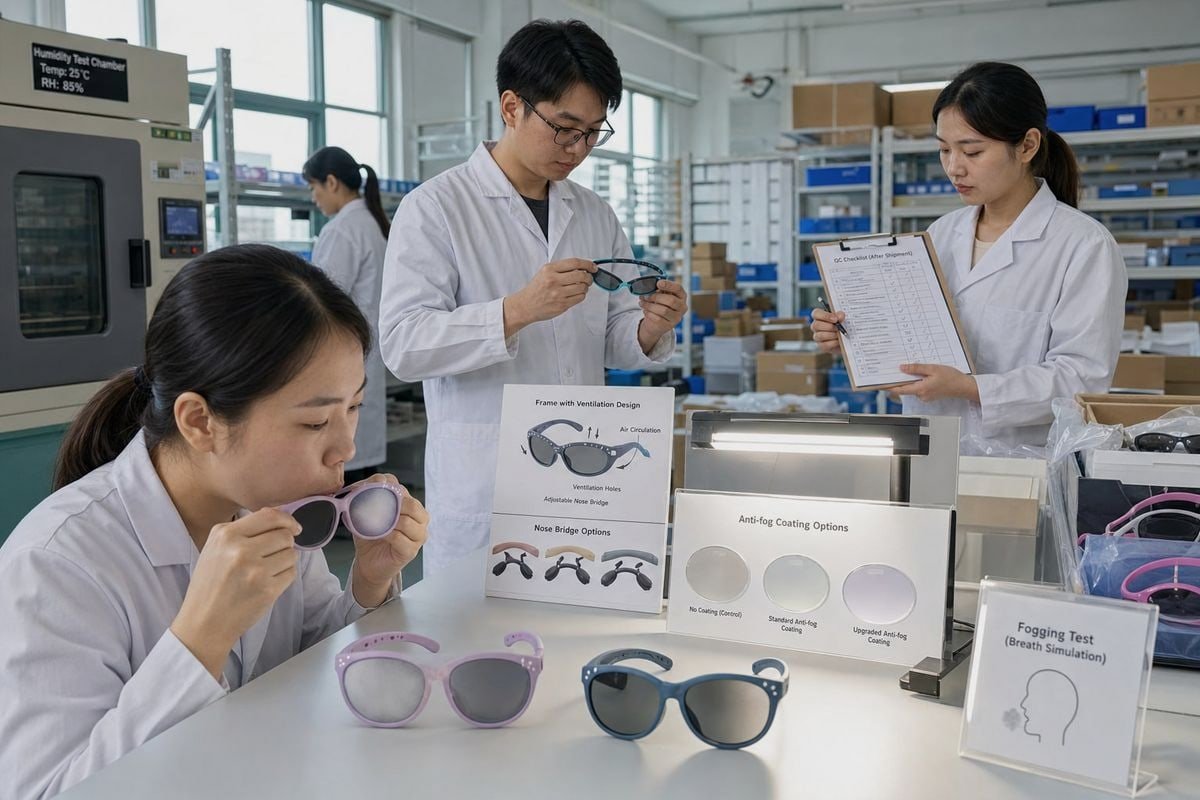
Fog is not a mysterious film. It is condensation. When a lens is colder than the surrounding moist air, water vapor 2 turns into microdroplets on the surface. Those droplets scatter light. Vision goes cloudy. That is physics, and no coating can cancel physics completely.
Children hit the fogging recipe harder than adults. They run more. They sweat more per body size. Their faces are smaller, so lenses sit closer to the skin and the breath path. They also switch environments constantly: classroom to playground, air-conditioned car to hot parking lot. Each transition is a condensation event.
A simple decision tree for complaints
When a customer complaint lands on your desk, run it through this logic before blaming the product:
| Symptom | Likely Cause | 意味 |
|---|---|---|
| Fog only during activity, humidity, or temperature swings | Usage and environment | Normal condensation; not a defect |
| Fog persists after a proper cleaning | Residue, scratches, or coating wear | Surface condition issue |
| Fog started after harsh cleaning or abrasion | Coating damage by the user | Care instructions needed |
| Constant fog with peeling or haze on clean lenses | Coating or lens failure | Legitimate quality claim |
The breath test
Ask the customer to breathe gently on the lens. If the fog clears within roughly three to five seconds, a hydrophilic coating is doing its job. If fog lingers as visible droplets on a clean, undamaged lens, either there is no anti-fog coating at all, or it has degraded. In our experience, many "defect" complaints turn out to be sunglasses that were never specified with anti-fog in the first place. Parents assume the feature exists, then blame the coating for missing.
Also check the cleaning history. Sunscreen, skin oils, and dry paper towels leave residue or micro-scratches that ruin anti-fog behavior. That is a care problem, not a factory problem.
What anti-fog coating options should I request from my manufacturer to reduce complaints?
Choosing a coating is a trade-off we discuss with buyers weekly. Cheaper temporary treatments look fine at sampling, but they wash out long before a season of playground use ends.
Request a permanent hydrophilic anti-fog coating applied during lens manufacture, ideally combined with a hard coat for scratch resistance. Permanent coatings outlast temporary sprays and factory-applied wipes, which fade after weeks. Always confirm the coating survives your target market's cleaning habits and humidity levels.
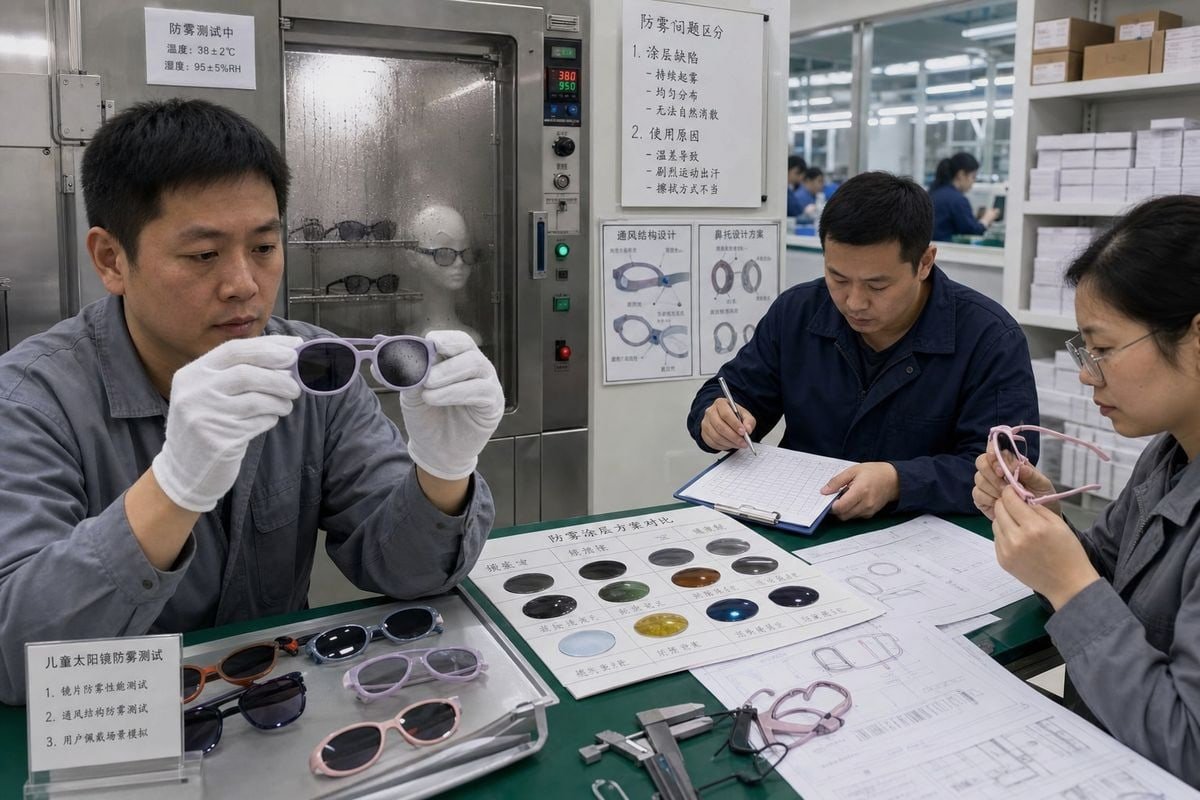
Anti-fog coatings work by lowering the surface tension 3 of the lens. Instead of beading into light-scattering droplets, moisture spreads into a thin, transparent film. The child still gets condensation, but they can see through it. That is the whole trick. The differences between coating types come down to how long that trick lasts.
Comparing the main options
| Coating Type | Durability | コストへの影響 | 最適 |
|---|---|---|---|
| Permanent hydrophilic coating (in-mold or dip-applied) | Lifespan of the lens with proper care | 中程度 | Active kids, sports lines, premium brands |
| Factory-applied temporary treatment | Weeks to a few months | 低 | Budget lines, promotional products |
| Aftermarket sprays or wipes (user-applied) | Hours to days | None to factory | Not a factory solution; a stopgap |
| Dual-sided anti-fog on wraparound shields | Highest performance | Higher | Cycling and ski styles with close face fit |
For sport wraparound styles, like the single-shield designs we produce with mirrored gradient lenses, I recommend anti-fog on the inner surface at minimum. The wraparound shape hugs the face, which is great for coverage but traps warm exhaled air. The inner surface is where fog forms.
Questions to put in your spec sheet
- Is the anti-fog coating permanent or a temporary surface treatment?
- Which lens surface carries it: inner, outer, or both?
- How does it interact with UV400, polarized, and mirror layers?
- What cleaning methods does the coating tolerate?
- Can you show a before-and-after steam demonstration on a production sample?
One more practical point. Many kids' sunglasses on the market carry UV保護 4 or polarization but no anti-fog coating at all. If your product page never mentions anti-fog, parents may still expect it. Decide deliberately whether the feature is in or out, then price and describe the product accordingly.
Could ventilation and frame design help prevent fogging issues in children's sunglasses?
During one development project for a sports line, our engineers reshaped a nose bridge three times. Each millimeter of gap changed how fast the test lenses cleared after a steam exposure.
Yes, ventilation and frame design are often more decisive than the coating itself. Airflow gaps at the brow and nose bridge, a slight lens standoff from the face, and breathable temple design let warm, moist air escape before it condenses on the lens.
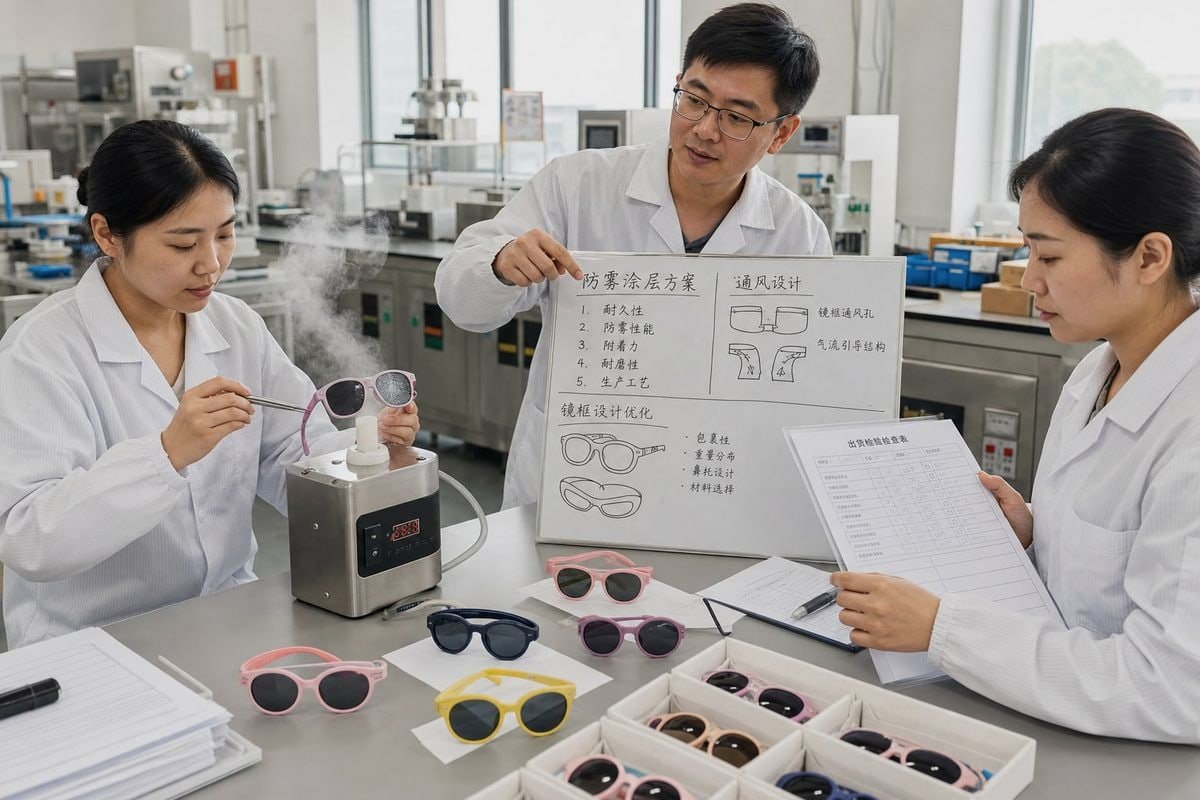
Remember the fogging recipe: warm moist air, cold lens, limited airflow. Coatings address the lens surface. Frame design attacks the other two ingredients. In many real-world cases, fit and airflow matter as much as any coating.
Kids' faces are smaller than adult faces. That places the lens closer to the skin and directly in the path of exhaled breath. A frame that seals tightly against a child's cheeks and brow creates a warm, humid pocket behind the lens. Fog becomes almost guaranteed the moment the child runs or breathes hard.
Design elements that fight fog
There are several levers a designer can pull, and we use most of them across our flexible TPEE and TR90 styles:
- Brow venting. Small gaps or channels along the top edge let rising warm air escape instead of pooling behind the lens.
- Nose bridge standoff. A bridge that holds the lens slightly off the face creates a chimney effect. Air flows up and out.
- Lens curvature. Wraparound shields need deliberate vent placement, because their coverage naturally restricts airflow.
- Flexible materials. TPEE temples and TR90フレーム 5 flex to fit varied face shapes without clamping tight. A frame that grips gently, rather than sealing against the skin, leaves micro-gaps that ventilate naturally. It is also safer and more comfortable for children, which is why we build most styles this way.
- Lightweight construction. Lighter frames sit more gently, slide less, and need less tightening, which preserves airflow gaps.
Fit is a moving target with kids
A frame that vents well on a seven-year-old may sit differently on a four-year-old. When buyers order across a wide age range, I suggest splitting sizes rather than forcing one frame to cover all ages. A too-large frame slips down, closes the nose gap, and fogs faster. Good sizing is quiet anti-fog engineering.
What quality control steps can I ask my supplier to take to avoid fogging complaints after shipment?
A lesson from fifteen years of eyewear production: complaints are cheapest to prevent at the workshop stage. Our 5S-managed factory treats anti-fog verification as part of standard lens inspection, not an afterthought.
Ask your supplier for steam or breath testing on coated lenses, coating adhesion checks, humidity cycling on samples, incoming lens verification, and clear written care instructions in the packaging. Also require pre-shipment inspection reports that specifically confirm anti-fog performance, not just cosmetic quality.
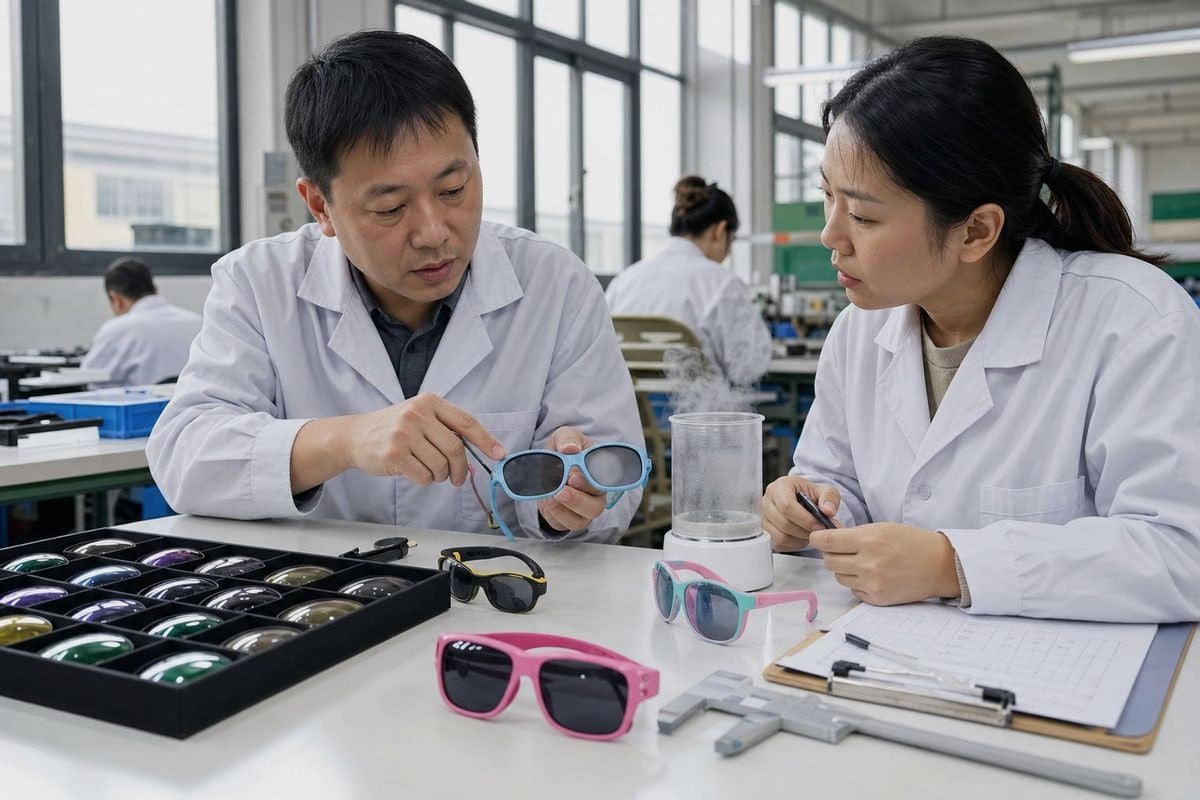
Most 出荷前検査 6 check scratches, hinges, and packaging. Very few check anti-fog performance unless the buyer asks. So ask. A supplier who takes 子供用アイウェア 7 seriously will not resist; we build these checks into our own workflow because a returned container costs everyone more than an extra QC step.
A practical QC checklist for your supplier
| QC Step | When It Happens | What It Catches |
|---|---|---|
| Incoming lens verification | Before assembly | Uncoated or wrongly coated lens batches |
| Steam or breath test sampling | During production | Coatings that fail to spread moisture |
| Coating adhesion and rub test | During production | Coatings that wipe off with normal cleaning |
| Humidity and temperature cycling | Sample approval stage | Coatings that degrade under repeated thermal stress |
| Fit and airflow check on child head forms | Sample approval stage | Frames that seal too tightly and trap moist air |
| Pre-shipment inspection with anti-fog line item | Before loading | Batch-level coating failures |
Do not skip the paperwork and packaging
Two documents prevent more complaints than any single test. First, a clear spec sheet that states whether anti-fog is included, which surface carries it, and its expected durability. Ambiguity here is where disputes are born. Second, printed care instructions inside the retail packaging. Tell parents to rinse with lukewarm water and mild soap, avoid paper towels and dry wiping, and skip harsh cleaners. Improper cleaning is one of the top killers of anti-fog coatings, and a small insert card shifts that risk away from your brand.
Finally, keep golden samples. When a complaint arrives months later, comparing the returned unit against a sealed reference sample settles the coating-versus-usage question in minutes.
結論
Fogging drains trust and profit fast. But now you can diagnose it: condensation from usage is normal, coating failure is rare, and design, coating choice, and QC prevent most complaints.
脚注
1. Background on nylon-based TR90 material properties used for flexible, breathable eyewear frames. ↩︎
2. Background science on water vapor explains why condensation forms on cooler lens surfaces. ↩︎
3. Explains the physics principle anti-fog coatings manipulate to prevent droplet formation on lenses. ↩︎
4. WHO fact sheet explains UV radiation risks, relevant to sunglasses UV protection claims for children. ↩︎
5. Background on thermoplastic materials used in flexible frame construction referenced in the article. ↩︎
6. WTO reference on preshipment inspection standards relevant to supplier quality control practices. ↩︎
7. US consumer product safety authority overseeing standards relevant to children’s eyewear products. ↩︎



 English
  Español de México
  Deutsch
  Français
  日本語
日本語  العربية
  Português do Brasil