How to Track Production Progress When Sourcing Kids’ Optical Frames to Avoid Delays?
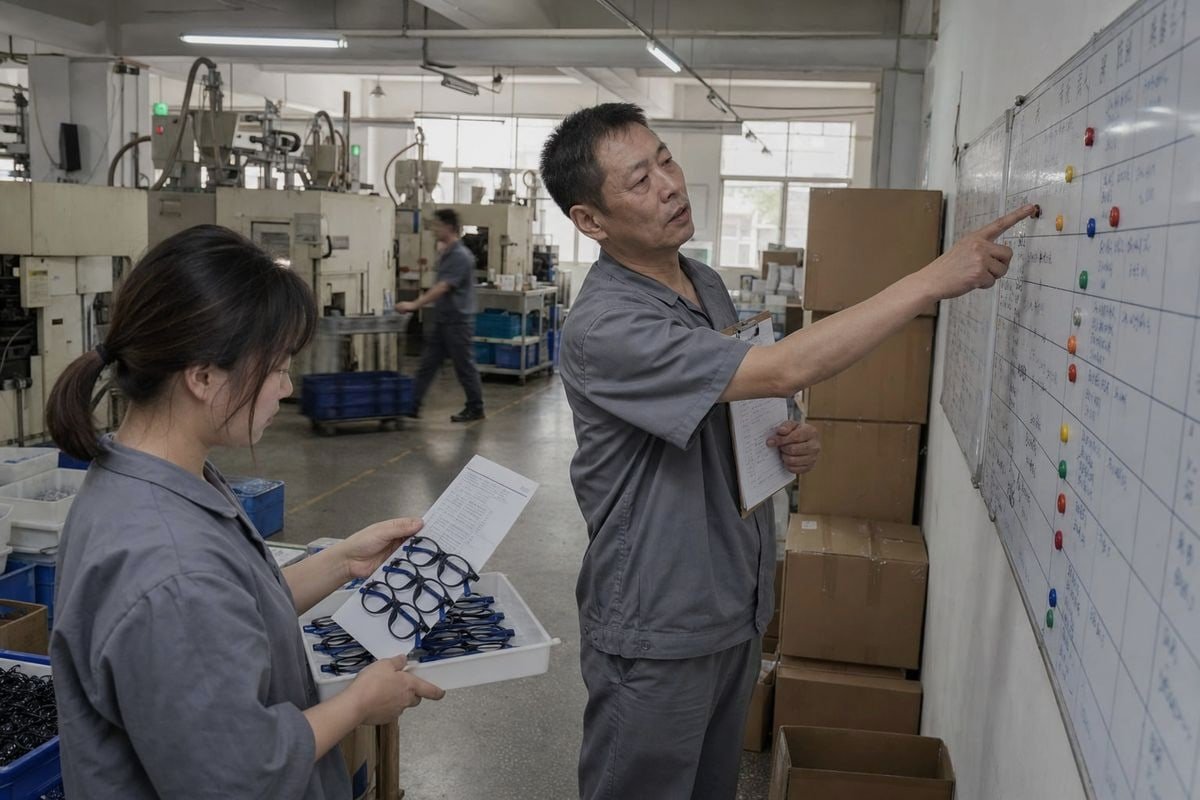
Learning to track production progress when sourcing kids’ optical frames saved several of our buyers from missed launch dates. On our TR90 1 production line, we see where orders slip.
To track production progress when sourcing kids’ optical frames, break the order into milestones—sample approval, materials, molding, assembly, QC, packing, shipping—then require weekly photo-evidence updates, WIP tracking reports, and a named factory contact, escalating immediately when any milestone slips past its committed date.
That is the short answer. The rest of this article shows you exactly how to build that system, step by step, based on what actually happens inside an eyewear factory.
What tools or reports can I request to monitor my order in real time?
A procurement manager from Australia once asked me for "just an ETA." Three weeks later, she asked for our full milestone report instead—and our team at OKAY EYEWEAR was glad she did.
You can request a digital order tracking portal, a milestone-based production calendar, weekly WIP tracking reports, photo and video evidence from the factory floor, QC inspection reports with defect counts, and pre-shipment inspection documents with packing photos and carton counts.

Most buyers only ask for a delivery date. That turns your order into a black box. The better approach is to demand supply chain visibility 2 through specific documents at specific stages. Any professional factory can provide these; a factory that refuses is telling you something important.
The core reports to request
| Tool or Report | What It Shows | When to Request It |
|---|---|---|
| Production milestone calendar | All key dates from material prep to shipment | At order confirmation |
| WIP tracking report 3 | Quantities completed at each stage per week | Weekly during production |
| Photo/video evidence | Physical proof of molding, assembly, polishing | At each milestone |
| QC inspection report | Defect counts, rework status, pass rates | After in-line and final QC |
| Pre-shipment inspection file | Packing photos, carton counts, labels | Before freight handoff |
| Shipping confirmation | Tracking number, departure date, ETA | At handoff to forwarder |
Why WIP aging matters most
The single most useful metric is WIP aging. Ask your supplier how long your batch has been sitting in each stage. If frames linger in molding or polishing longer than the factory's normal cycle for that material, a delay is already forming—even if the "official" ship date has not moved. In our workshop, TR90 injection and TPEE temple assembly each have a normal duration. When a buyer asks us for stage-level quantities, we can answer within a day because our 5S-managed workshop logs them anyway. Structured reports beat manual check-ins because they remove "optimistic" reporting. A photo of your actual frames on a tray is much harder to fudge than a reassuring email.
How often should I expect production updates from my optical frame manufacturer?
There is a real trade-off we weigh with every client: too many check-ins slow our production team down, but too few leave buyers anxious. Fifteen years of exporting has taught us where the balance sits.
Expect a formal update once per week during active production, plus milestone-triggered updates at sample approval, material arrival, production start, in-line QC, final inspection, and shipment. For complex or long-lead orders, add a brief mid-week confirmation during the final two weeks.

Weekly cadence is the sweet spot for most kids' optical frame orders. It is frequent enough to catch slippage early, but not so frequent that your supplier spends more time reporting than producing. However, cadence alone is not enough. The updates must be tied to your manufacturing timeline, not to the calendar alone.
Milestone-triggered beats calendar-only
A calendar-only update says "still in production." A milestone-triggered update says "molding for 3,000 units finished Tuesday; assembly starts Thursday." The second one is measurable. You can compare it against the committed production calendar and calculate whether the ship date still holds. When we run OEM orders for kids' brands in Europe and Japan, we agree on the milestone list before the deposit is paid. That way, "any news?" emails almost disappear.
Adjust frequency by order phase
Not every phase needs equal attention. Here is the cadence we recommend to buyers:
| Order Phase | Update Frequency | Format |
|---|---|---|
| Sample approval process | At each sample round | Photos plus measurement sheet |
| Material procurement | Once, on arrival | Material confirmation photo |
| Mass production | Weekly | WIP report plus photos |
| QC and rework | At inspection completion | Full QC report |
| Packing and shipping | Every 2–3 days | Packing photos, booking status |
One caution: some buyers push for daily updates. In our experience, this strains the relationship and produces rushed, low-value replies. Structured weekly reports with hard milestone confirmations give you better lead time management 4 than constant chasing ever will.
What early warning signs indicate my order might be delayed?
Years ago, a distributor's order taught me a lesson I still repeat: the frames were "on schedule" for five straight weeks, then suddenly three weeks late. The warning signs had been there—nobody was reading them.
Early warning signs include delayed raw material confirmation, vague or repeated "still in production" updates, missing or reused photos, slipping sample approval rounds, WIP quantities stuck at the same stage across two reports, postponed QC dates, and slower replies from your supplier contact.
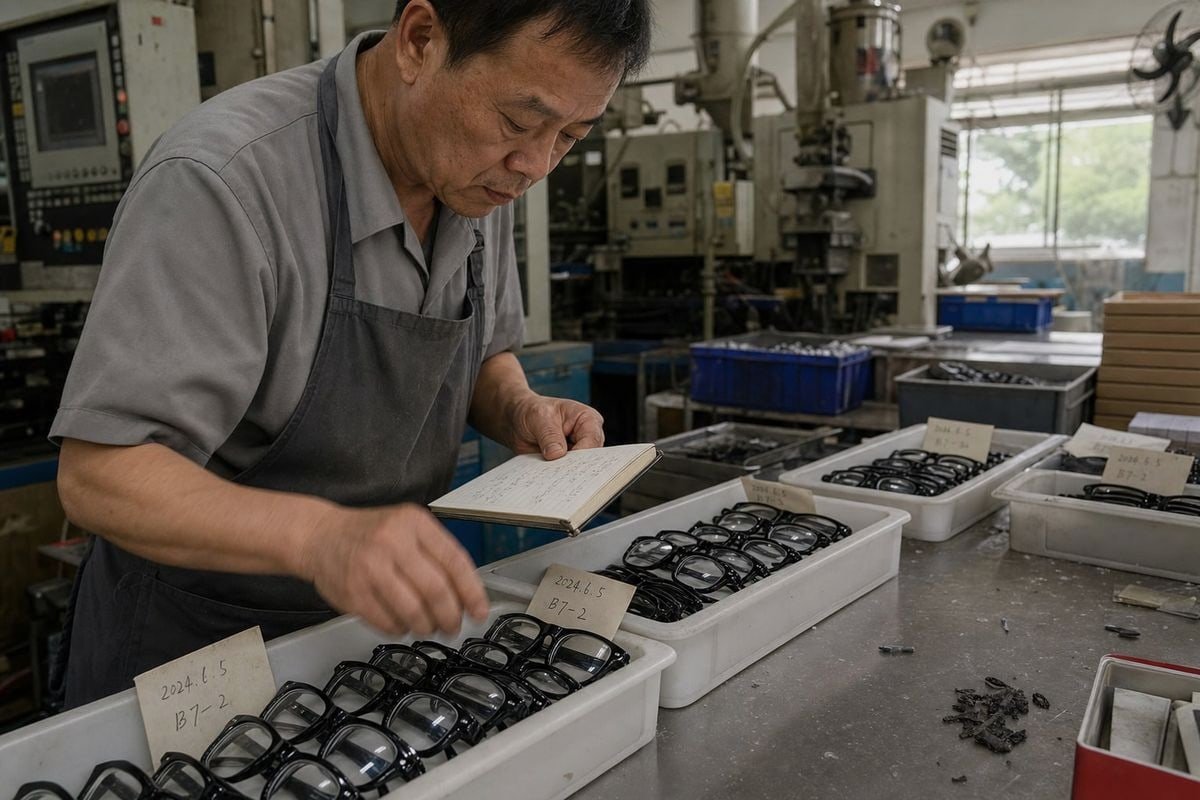
Delays rarely appear from nowhere. They accumulate quietly upstream, then explode at the ship date. If you know what to watch, you can act four to six weeks before the crisis.
Watch the upstream signals first
Most eyewear delays start with raw materials. Acetate, TR90 pellets, TPEE, hinges, and demo lenses all come from upstream suppliers. If your factory cannot confirm material arrival by the agreed date, treat it as a red flag—not a footnote. Ask directly: has the material physically arrived at your factory? A photo of the material with your PO number settles it.
The seven signals ranked by severity
- Material arrival slips — the earliest and most predictive signal.
- Sample approval rounds keep extending — every extra round pushes mass production back; lock specifications at least 30 days before production starts.
- WIP quantities freeze — the same numbers on two consecutive reports mean the line has stalled.
- Photos stop arriving or look recycled — evidence gaps usually hide problems.
- QC inspection dates get postponed — often a sign of quality issues being reworked quietly.
- Answers become vague — "everything is fine" without specifics is not fine.
- Response times stretch — a supplier avoiding you is a supplier with bad news.
For children's frames specifically, watch the QC stage hardest. Kids' eyewear carries safety-sensitive checks—hinge durability, flexibility, finish smoothness—and failed batches trigger rework that standard adult frames rarely face. A "small" defect in a child's product is never small downstream.
How can I build a communication schedule that keeps my supplier accountable?
When we onboard a new brand client at our Taizhou factory, the first document we co-write is not the spec sheet—it is the communication plan. Orders with a plan run smoother on both sides.
Build accountability by agreeing on a milestone calendar before paying the deposit, assigning a named contact on each side, fixing a weekly update day with a set report format, requiring photo evidence at every checkpoint, and defining escalation steps with response deadlines in advance.
Accountability is not about pressure. It is about clarity. When both sides know exactly what will be reported, when, by whom, and what happens if a date slips, nobody has to chase anybody. Here is how to set it up.
Step one: lock the framework at order confirmation
Before production begins, agree in writing on the milestone dates, the weekly update day, the report format, and the evidence required at each stage. Include a hard-lock date for design specifications and sample approval—ideally 30 days before mass production—so late changes cannot cascade through the schedule. Confirm which eyewear safety standards 5 apply in your market, and ask what testing evidence the factory can supply; requirements differ by country, so verify your local rules rather than assume.
Step two: define the escalation ladder
When a milestone slips, do not just ask for a new ETA. Ask three questions: What is the specific blocker—materials, tooling, labor, QC, or logistics? What is the recovery plan? What is the revised, committed date? Then escalate on a schedule:
| Trigger | Action | Deadline |
|---|---|---|
| Milestone missed by 1–2 days | Written explanation plus recovery plan | Within 24 hours |
| Recovery plan not delivered | Escalate to sales manager or factory owner | Within 48 hours |
| Second consecutive milestone missed | Video call plus revised full calendar | Within 3 days |
| QC failure or major rework | Full defect report, corrective action, re-inspection date | Before rework begins |
Step three: keep it two-way
Accountability works both ways. Approve samples on time, answer questions fast, and pay milestones promptly. A factory audit 6 or a visit—in person or by video—early in the relationship also builds the trust that makes honest reporting easier. Our best long-term buyers treat us as project partners, and their orders show it: fewer surprises, better lead time management, and launches that land on schedule.
Conclusion
Track milestones, evidence, and exceptions—not just dates. With weekly reports, photo proof, early warning signals, and a clear escalation plan, your kids' optical frame orders arrive on time.
Footnotes
1. Background reference explaining thermoplastic materials like TR90 used in eyewear manufacturing. ↩︎
2. Wikipedia explains the core concept of tracking goods through production and logistics stages. ↩︎
3. ISO 9001 quality management standard underpins work-in-progress tracking and reporting practices. ↩︎
4. Wikipedia explains lead time conc
More Articles You Might Like
August 5, 2026
Bio-Based vs Regular Cellulose Acetate: What's the Difference for Kids' Frames?
August 5, 2026
How Recyclable Are Kids' Optical Frame Materials, and What Eco-Friendly Alternatives Exist?
August 5, 2026
Do Kids Optical Frames Whiten or Age in Storage, and How to Control Warehouse Conditions?
Looking for a Reliable Kids Eyewear Partner?
Explore 800+ ready styles and full OEM/ODM support tailored to your brand.
Get in Touch English
  Español de México
  Deutsch
  Français
  日本語
日本語  العربية
  Português do Brasil