How Do Risk Liabilities Differ: Supplier Test Reports vs Independent Lab Testing for Kids’ Optical Frames?

Buyers ask me about [supplier test reports](https://okayeyewear.com/how-verify-supplier-test-report-genuine-kids-sunglasses/) vs independent lab testing for kids’ optical frames almost weekly. Paperwork looks fine until customs, a retailer, or a lawyer questions it — then everything unravels.
Supplier test reports vs independent lab testing differ mainly in liability: supplier reports are self-produced evidence with weak legal standing, while independent accredited lab testing satisfies CPSIA third-party requirements, supports a due diligence defense, and shifts your children’s frame compliance risk onto verifiable, defensible documentation.
Let me break down where each type of report protects you, where it fails, and how to build a testing workflow that actually holds up.
How do I know if my supplier's test reports are actually enough to protect my brand legally?
A procurement manager from Australia once forwarded me a competitor's "test report" for review. It was two years old, covered a different SKU, and came from an unaccredited factory lab.
Supplier test reports alone are rarely enough legal protection. Under CPSIA, children's products require testing by a CPSC-accepted accredited testing laboratory before you can issue a Children's Product Certificate. A supplier's in-house or generic report does not satisfy that legal obligation for your brand.

The core distinction is simple: supplier reports are self-produced evidence, while independent lab reports 1 are independently verified evidence. Courts, regulators, and retailers treat these very differently. In our fifteen years making children's frames in Taizhou, I have seen honest factories hand over reports that were still legally useless for the buyer — not out of bad faith, but because the report was never designed to prove that buyer's product complied in that buyer's market.
Five checks before you trust any supplier report
Run every report you receive through these questions:
- Is the lab accredited? Look for ISO/IEC 17025-style accreditation, and for the US market, confirm the lab appears on the CPSC-accepted laboratory list.
- Does the report match your exact SKU? Reports are frequently generic or reused across different frames, colors, and material batches.
- Is it recent? An old report cannot cover current production. Material sources drift over time.
- Does the scope match your market? A CPSIA report does not cover EU REACH obligations, and vice versa. One supplier report rarely covers all destinations cleanly.
- Is there a chain of custody? Who selected the sample? A report on a hand-picked golden sample proves little about mass production.
| Report element | Weak version | Legally useful version |
|---|---|---|
| Lab status | Factory in-house lab | CPSC-accepted, ISO/IEC 17025 accredited testing laboratory |
| Product match | Similar frame, different SKU | Your exact SKU, material, and colorway |
| Test date | 1–2+ years old | Current production batch |
| Scope | Generic quality checks | CPSIA lead and phthalates testing, market-specific standards |
| Sample selection | Supplier-selected | Documented chain of custody |
If a factory cannot produce recent third-party reports for children's eyewear 2, treat that as a sourcing red flag, not a negotiating point. When we quote OEM projects, we expect buyers to ask for this documentation — the serious ones always do.
What liability am I exposed to if I skip independent lab testing on children's optical frames?
The trade-off I discuss most with new brand owners is this: saving a few hundred dollars on testing versus carrying an open-ended legal and commercial exposure. It is never a close call.
Skipping independent testing exposes you to CPSIA penalties, customs seizures, marketplace delisting, retailer rejection, recall costs, and product liability lawsuits. As importer of record, you carry full legal responsibility, and without third-party evidence you lose the due diligence defense that mitigates negligence claims.
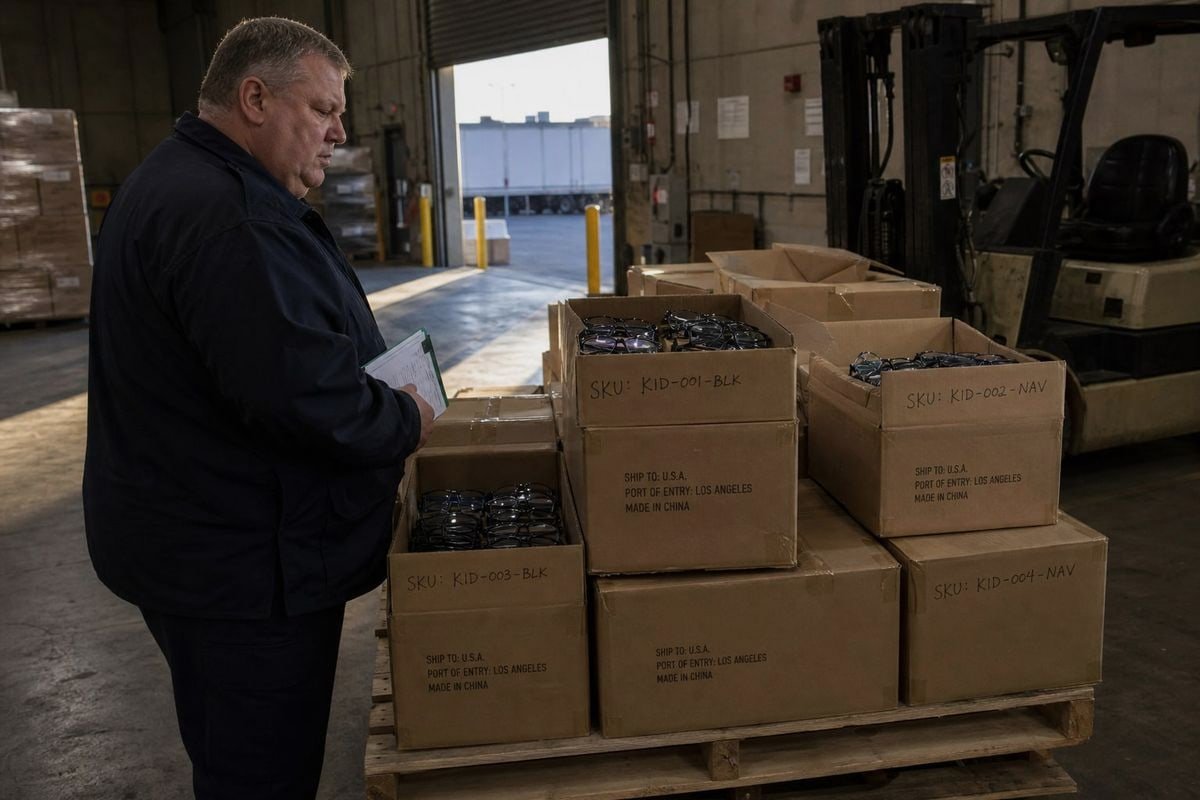
The liability picture has several distinct layers, and buyers often underestimate how independent they are from each other. Passing one layer does not protect you at the next.
The layers of exposure
Regulatory liability. In the US, kids' optical frames sit in a demanding position. CPSIA governs them as children's products 3, covering lead limits and phthalates. Separately, the FDA classifies optical frames as Class I medical devices, and 21 CFR 801.410 requires verified impact resistance — the drop ball test. Independent labs provide the drop ball documentation that survives customs audits; supplier reports often fail exactly there. In our export experience, US-bound shipments face scrutiny on both fronts, and a gap in either can trigger holds.
Litigation liability. If a child is injured and a claim is filed, independent lab testing supports a due diligence defense. Courts tend to view supplier-only reports as self-serving evidence with limited weight. Your product liability insurance carrier may also question coverage or raise premiums if you cannot show independent verification of children's products.
Commercial liability. Major e-commerce platforms are moving toward Direct-to-Lab verification models, where test results transmit directly from an accredited lab to the platform's compliance portal. Uploaded supplier PDFs will simply stop being accepted. Retailer audits work similarly — a failed audit means delisting and, often, chargebacks.
Material change liability. A subtle but dangerous risk: minor changes in paint, resin, or hinge components between batches can invalidate old reports entirely and trigger immediate non-compliance. This is why batch testing requirements exist. I have watched a buyer's older report become worthless overnight because their factory quietly switched a temple-tip silicone supplier. Emerging bio-based and recycled materials make this worse, since non-standard plasticizers are often not covered by traditional supplier test templates at all — creating greenwashing liability on top of safety risk.
Which certifications should I insist on from my manufacturer before I trust their in-house test reports?
A German importer once told me their vetting rule: "Show me your third-party reports first; then we can talk about your in-house lab." Our team now leads every children's frame quotation with exactly that documentation.
Insist on recent third-party reports from a CPSC-accepted, ISO/IEC 17025 accredited testing laboratory covering CPSIA lead and phthalates, impact resistance, and relevant ASTM safety standards, plus a valid Children's Product Certificate framework and material certificates for each frame component — not just one frame-level document.

In-house testing has a legitimate role — I will defend that below — but it never replaces market-specific third-party certification. Here is what to demand, organized by purpose.
The document stack, by market and purpose
| Document | What it proves | Who should issue it |
|---|---|---|
| CPSIA test report | Lead and phthalates compliance for US children's products | CPSC-accepted accredited lab (SGS, Intertek, Bureau Veritas, TÜV) |
| Children's Product Certificate | Legal declaration based on valid third-party testing | You, the importer — supported by the lab reports |
| Drop ball / impact report | 21 CFR 801.410 impact resistance for optical frames | Independent lab |
| ISO 12870 standard report | Frame durability, bridge deformation, hinge endurance | Independent lab |
| REACH / EN 71 documentation | EU chemical and mechanical safety scope | Accredited lab for EU-bound goods |
| Component material certificates | Traceability for each resin, silicone, and coating | Material supplier, verified by factory |
Report versus certificate versus declaration
Buyers frequently confuse these three. A test report contains actual measured values and methods — it is the most informative document. A certificate is often just a pass/fail summary. A declaration is a claim, sometimes with nothing behind it. Always ask for the full report. When we develop TR90 frames with TPEE temples for OEM clients, we supply component-level material documentation precisely because a single frame-level paper hides where problems usually start: coatings, decorative paints, and soft-touch temple tips.
One more nuance: performance claims are not safety compliance. A blue-light transmission report, for example, supports a marketing claim but does nothing for CPSIA. Some buyers see "certified" on a spec sheet and assume child safety is covered. It usually is not — many optical-performance claims are self-regulated with no mandatory certification behind them.
How can I balance third-party lab costs with the risk of relying only on supplier-provided documentation?
Early in my career here, I assumed cost-conscious buyers would always resist testing budgets. The lesson I learned was the opposite: the best long-term partners budget for testing from day one and negotiate everything else.
Treat supplier reports as free pre-screening and budget roughly $300–800 per SKU for independent testing covering CPSIA, REACH, and impact tests. Test before first commercial shipment, after any material or design change, and periodically for high-volume production — this converts an open-ended liability into a fixed, predictable cost.
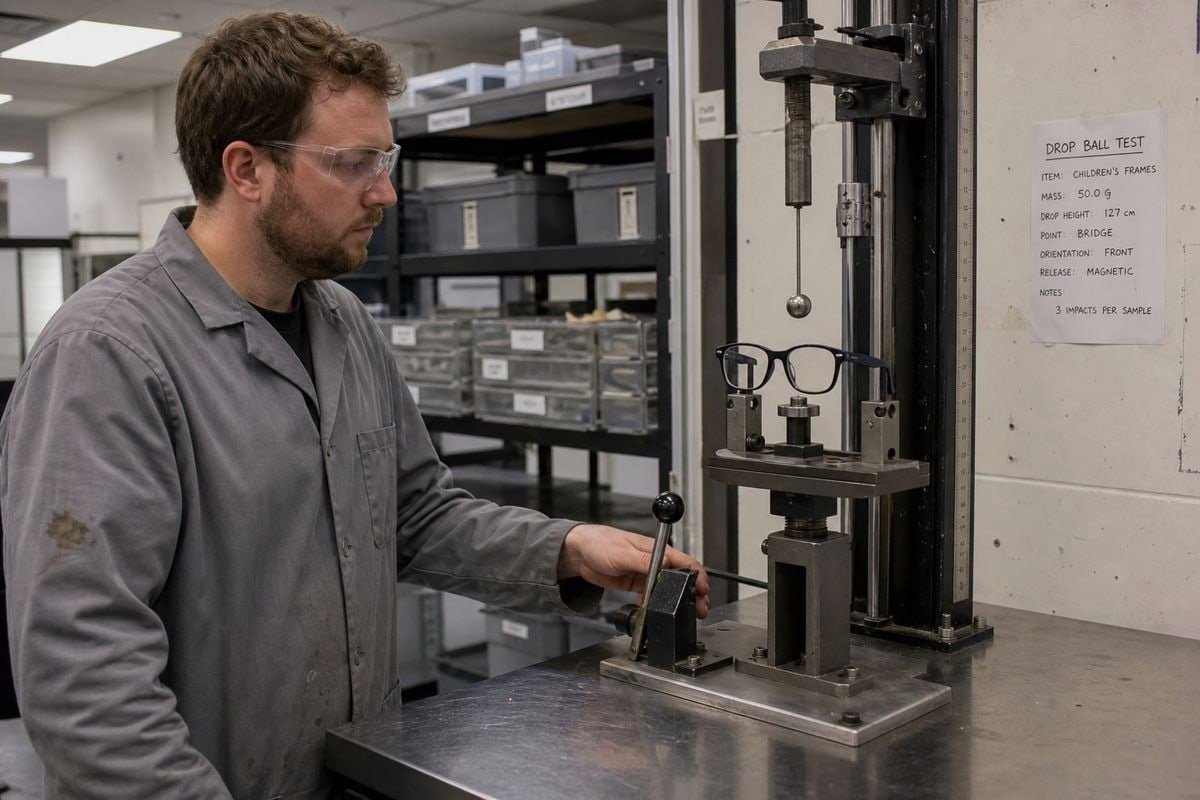
The math is straightforward. A $300–800 per-SKU testing package is a rounding error against the cost of a single customs seizure, a marketplace delisting, or one product liability claim involving a child. But you do not need to test everything constantly. You need a workflow.
A practical four-stage testing workflow
- Supplier vetting. Use supplier test reports and third-party certification history to compare factories. A factory with recent accredited-lab reports for children's eyewear is signaling real compliance capability. This stage costs you nothing.
- Sampling and trial order. Start with a small trial order before scaling. Use the pilot to confirm both product quality and documentation consistency. Review component material certificates here.
- Pre-shipment independent testing. Before your first commercial shipment, commission your own accredited lab test on production samples with a documented chain of custody. This is the non-negotiable step for children's frames sold under your brand.
- Ongoing verification. Retest after any material, coating, or design change, and on a periodic batch schedule for continuing production. High-volume brands are beginning to use AI-driven material drift monitoring to catch subtle raw-material changes that pass internal checks but would fail independent chemical analysis.
Where each report type earns its keep
| Decision point | Supplier report sufficient? | Independent test required? |
|---|---|---|
| Comparing factory quotes | Yes — screening tool | No |
| Approving pre-production samples | Yes — with component certificates | Optional |
| First commercial shipment | No | Yes — non-negotiable |
| After material or design change | No | Yes |
| Retailer or platform onboarding | Rarely accepted | Yes — increasingly Direct-to-Lab |
| Defending a liability claim | Weak evidence | Core of due diligence defense |
Here is the supplier-side objection I hear, and it deserves a fair answer: in-house testing is faster, cheaper, and genuinely useful for routine quality control. I agree — our own 5S-managed workshop runs continuous internal checks on flexibility, hinge cycling, and dimensional tolerance, and this catches problems long before any lab would. But usefulness is not liability protection. Internal QC keeps production consistent; independent testing proves legal conformity. A brand needs both, and confusing one for the other is the single most common documentation mistake I see in this industry. The trend is clear too: buyers increasingly treat supplier reports as starting evidence, not final proof, and the coming shift toward Digital Product Passports will make static PDF reports obsolete in favor of cryptographically verified, lab-transmitted safety data.
Conclusion
Supplier reports screen factories; independent accredited testing protects your brand. For children's optical frames, treat third-party verification as the default — before shipment and after every material change.
Footnotes
1. Official CPSC guidance on the requirement for third-party testing to ensure children’s product safety. ↩︎
2. CPSC resource outlining safety requirements and mandatory testing for children’s products and eyewear. ↩︎
3. Official CPSC hub for children’s product safety regulations and business guidance. ↩︎
More Articles You Might Like

August 5, 2026
Bio-Based vs Regular Cellulose Acetate: What's the Difference for Kids' Frames?

August 5, 2026
How Recyclable Are Kids' Optical Frame Materials, and What Eco-Friendly Alternatives Exist?
August 5, 2026
Do Kids Optical Frames Whiten or Age in Storage, and How to Control Warehouse Conditions?
Looking for a Reliable Kids Eyewear Partner?
Explore 800+ ready styles and full OEM/ODM support tailored to your brand.
Get in Touch English
  Español de México
  Deutsch
  Français
  日本語
日本語  العربية
  Português do Brasil