How Does Printing and Painting Affect Kids’ Sunglasses Safety, and What to Look For?
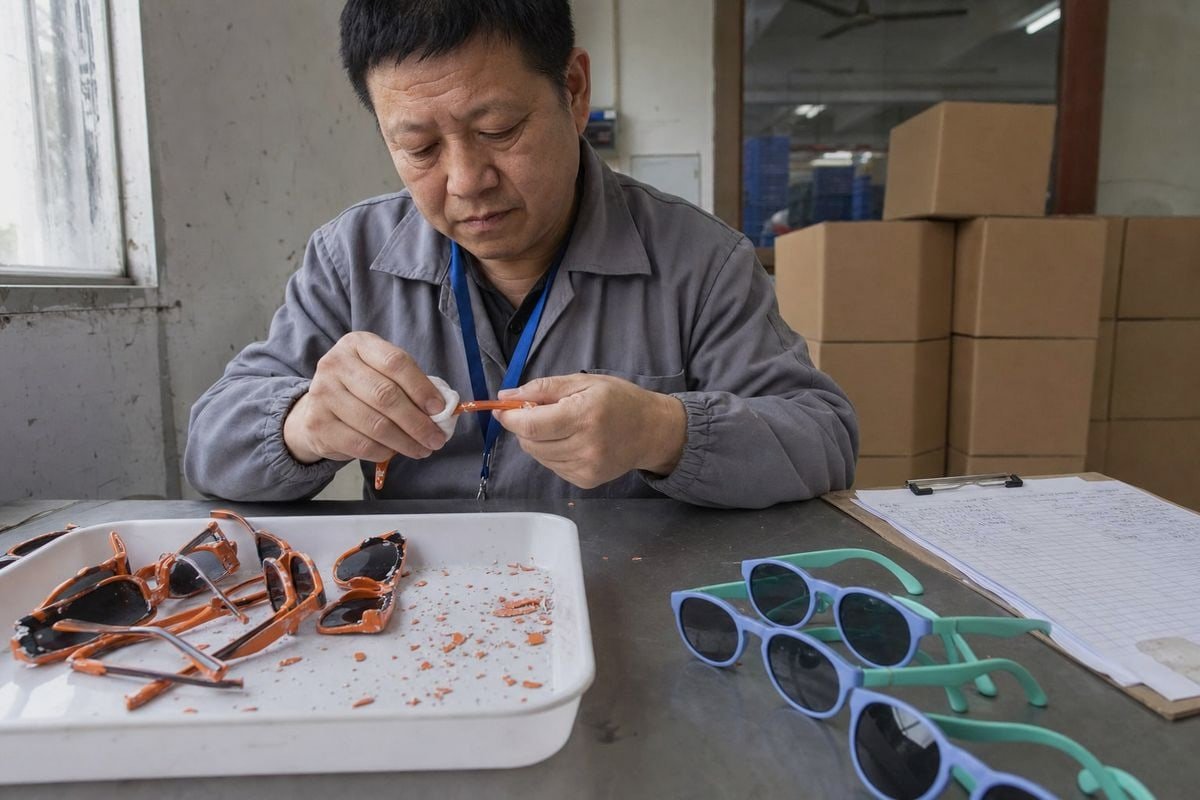
Kids’ sunglasses safety often comes down to something buyers overlook: the paint CPSIA total lead 1. On our production line in Taizhou, I have rejected entire batches because a coating failed our rub test.
Printing and painting affect kids’ sunglasses safety in two ways: chemically, if inks or coatings contain lead, phthalates, or harsh solvents, and physically, if paint peels, chips, or distorts lenses. Look for CPSIA-compliant coatings, UV400 lenses, non-toxic material declarations, and third-party test reports before buying.
That is the short answer. But if you source children’s eyewear for a brand, you need more detail. Let me walk you through what actually matters, step by step.
What printing and painting methods should I choose for safe kids' sunglasses?
A buyer from Australia once asked me why we quoted two prices for the same frame color. The answer was the decoration method. Not all coatings are built the same.
Choose water-based paints, UV-cured printing, or in-mold coloring for kids' sunglasses. These methods bond securely, resist chipping, and avoid heavy solvent residues. Avoid solvent-heavy spray paints and cheap heat-transfer decals, which can off-gas, weaken frame polymers, and flake off during normal use by children.
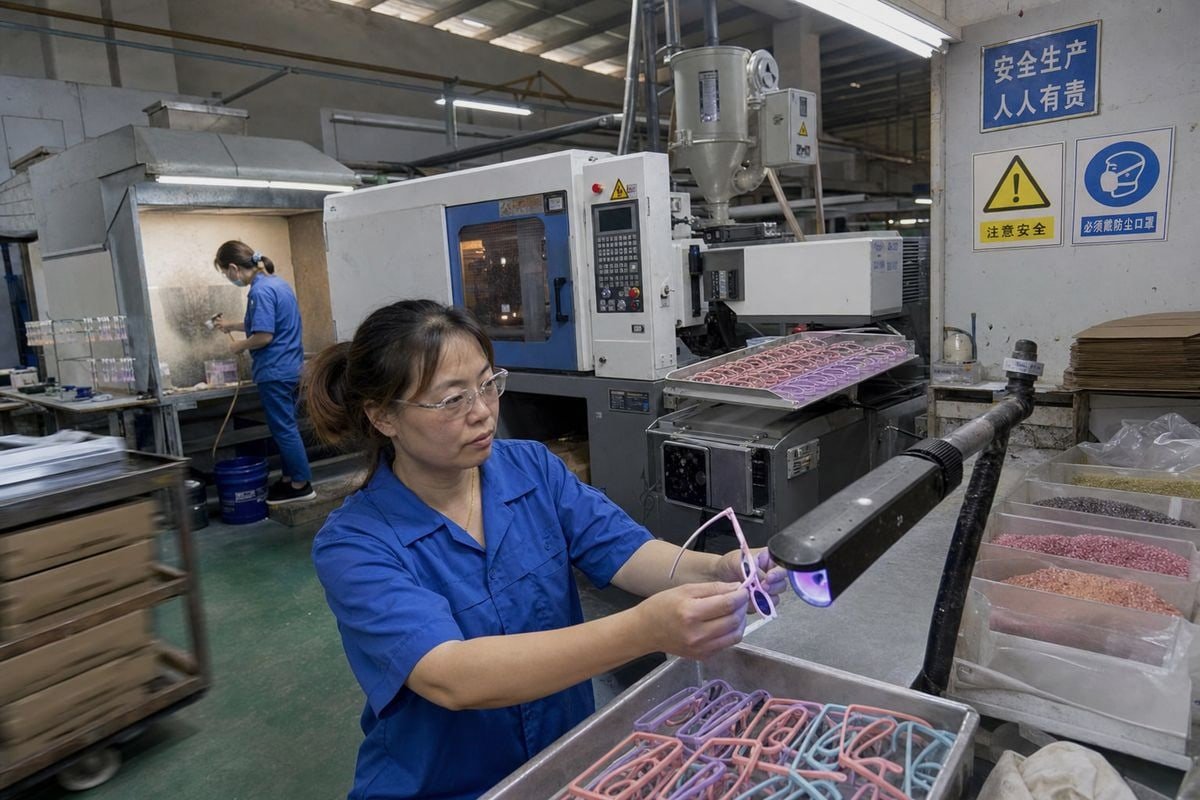
The decoration method decides two things at once: how durable the finish is, and what chemicals sit against your child's skin. In our fifteen years making children's eyewear, we have tested most of the common options on TPEE and TR90 2 frames. Some hold up beautifully. Others fail within weeks of real use by an active five-year-old.
Comparing common decoration methods
| Method | How it works | Safety profile | Durability on kids' frames |
|---|---|---|---|
| In-mold coloring | Pigment mixed into the raw material before molding | Best — no surface layer to chip | Excellent |
| UV-cured printing | Ink hardened instantly under UV light | Good — low solvent residue, strong bond | Very good |
| Water-based paint | Sprayed and dried, low-VOC formula | Good when certified non-toxic | Good with topcoat |
| Heat-transfer decals | Printed film pressed onto the frame with heat | Fair — edges can lift and peel | Moderate |
| Solvent-based spray paint | Traditional spray with chemical solvents | Weakest — VOC off-gassing, chip risk | Varies widely |
Why in-mold coloring is our first recommendation
When the color is part of the material itself, there is nothing to peel. Nothing to swallow. Nothing to test for surface lead 3. That is why most of our roughly 800 existing styles use through-colored TR90 and TPEE rather than painted shells. If a client wants a printed character or logo, we push them toward UV-cured printing on a small area, away from the lens optical zone, and we always confirm the ink passes children's product chemical limits first.
One more point. Flexible materials like TPEE bend constantly in a child's hands. A rigid paint layer on a flexible frame will crack sooner or later. The decoration method must match the material underneath. That is a detail cheap novelty sunglasses almost always get wrong.
How can I make sure the paint or coating on my kids' sunglasses is non-toxic?
Early in my career, I learned a hard lesson: a supplier's verbal promise of "non-toxic paint" means nothing. Documentation and testing mean everything. We now test every new coating batch.
Verify non-toxic coatings by requesting third-party test reports against CPSIA lead limits, phthalate restrictions, and EN 71-3 migration standards. Check for clear non-toxic labeling, avoid products with strong chemical odors, and prefer suppliers who disclose their paint and ink formulations in writing.

Children are not small adults. They mouth objects. They push glasses up their nose with fingers they then put in their mouths. They wear sunglasses against soft, sensitive skin for hours in summer heat. So the chemical bar for kids' sunglasses safety must be higher than for adult fashion eyewear.
The chemicals that matter most
The main offenders in low-quality coatings are heavy metals and plasticizers. Lead is the headline risk. US recalls of children's sunglasses have specifically involved surface paint with excessive lead, and regulators treated it seriously enough to demand immediate removal from children. Cadmium, certain phthalates 4, and residual solvents round out the list.
| Substance | Where it hides | Why it matters for kids |
|---|---|---|
| Lead | Bright surface paints, especially yellows and reds | Toxic even at low doses; children absorb it through mouthing |
| Cadmium | Pigments and stabilizers | Heavy metal linked to long-term organ harm |
| Phthalates | Soft coatings, decals, flexible inks | Restricted in children's products under CPSIA |
| VOC solvents | Solvent-based paints and adhesives | Irritate eyes, skin, and airways at close range |
Practical checks you can do yourself
First, smell the product. A strong chemical odor out of the packaging is a red flag for solvent residue. Second, read the labeling. Vague claims like "safe materials" without a standard reference are weaker than "complies with CPSIA" or "tested to EN 71-3 5." Third, ask for the actual test report, not a certificate summary. At our factory, we keep reports on file for the coatings and inks we use, because serious buyers in Europe, Japan, and Australia always ask. If your supplier hesitates to share documents, treat that hesitation as your answer.
Could peeling or chipped paint on my child's sunglasses become a safety hazard?
During a 5S audit of our workshop last spring, our QC lead pulled a competitor's sample from our benchmark shelf. The paint flaked at a fingernail's touch. That sample became a training tool.
Yes. Peeling or chipped paint on kids' sunglasses is a genuine safety hazard. Flakes can be swallowed or inhaled by young children, chipped coatings may expose or release restricted chemicals like lead, and peeling usually signals poor manufacturing quality throughout the entire product.
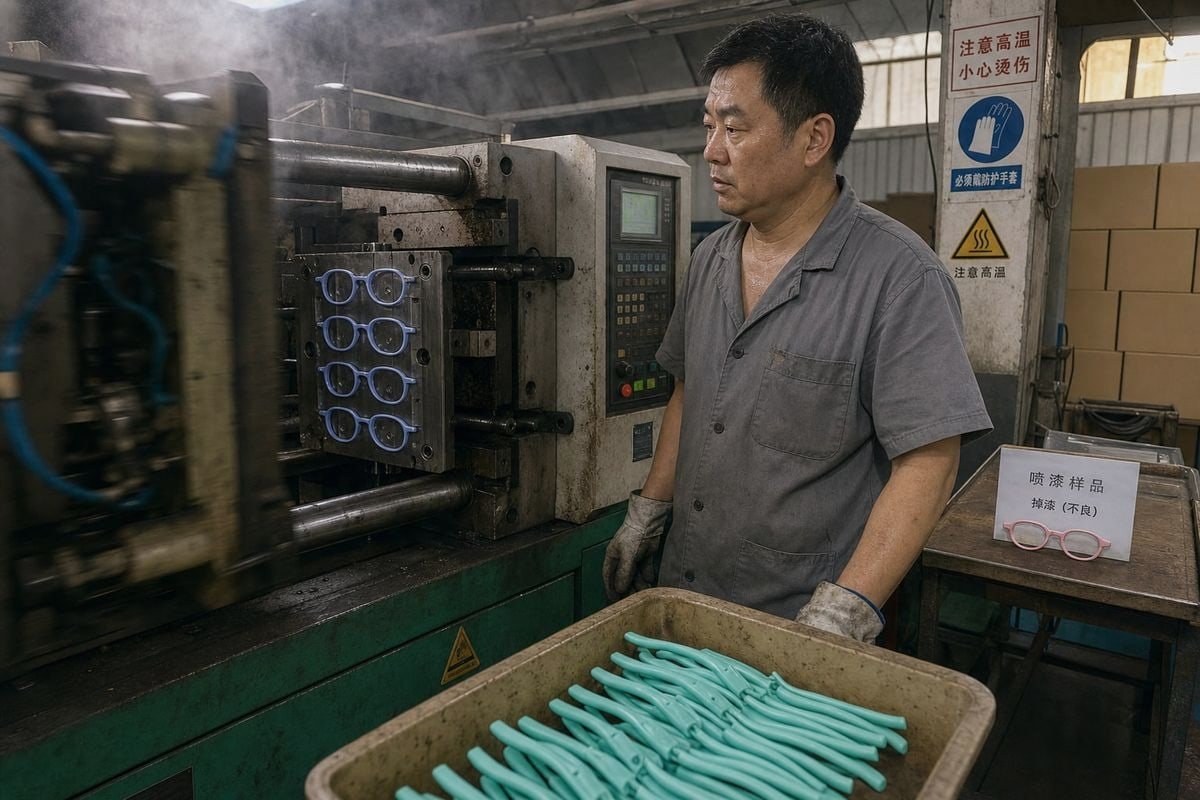
Peeling paint is never just cosmetic. I want to break down why, because buyers sometimes dismiss it as a minor quality complaint rather than a safety issue.
Three separate risks in one symptom
First, there is the ingestion risk. Paint flakes are small, light, and easy for a toddler to swallow or breathe in. If that flake contains lead or cadmium, the risk multiplies. Public health guidance on children and coatings is consistent on this point: mouthing behavior makes flaking surfaces far more dangerous for young kids than for adults.
Second, there is the signal risk. Paint adhesion is one of the cheapest corners a factory can cut. In our experience, a frame that fails a simple tape or rub test almost always fails elsewhere too — loose hinges, uneven lens mounting, weak UV coatings. Peeling paint is the visible tip of an invisible quality problem.
Third, there is the wear pattern of children themselves. Kids drop sunglasses, sit on them, chew the temple tips, and stuff them into sandy backpacks. A coating that survives a showroom will not necessarily survive a six-year-old. That is why we build flexibility into both the material and the finish, and why we run rub, tape, and flex tests on decorated TPEE and TR90 parts before shipment.
What to do if you find chipped paint
- Take the sunglasses away from the child immediately.
- Do not sand, scrape, or repaint the frame yourself.
- Check whether the product has been recalled by searching the brand and model.
- Contact the seller for a replacement or refund.
- If a young child may have mouthed flaking paint, mention it to your pediatrician.
What certifications should I request from my supplier to confirm painted frames are safe?
Trade-offs come up in every sourcing call I take. Buyers want low prices and full documentation. My honest advice: never trade the documents away. Paperwork is cheaper than a recall.
Request third-party test reports covering CPSIA total lead and phthalate limits for the US, EN 71-3 and CE conformity for Europe, plus UV400 verification to ANSI Z80.3 or ISO 12312-1. For impact claims, ask for ASTM F659 or equivalent lens testing documentation.
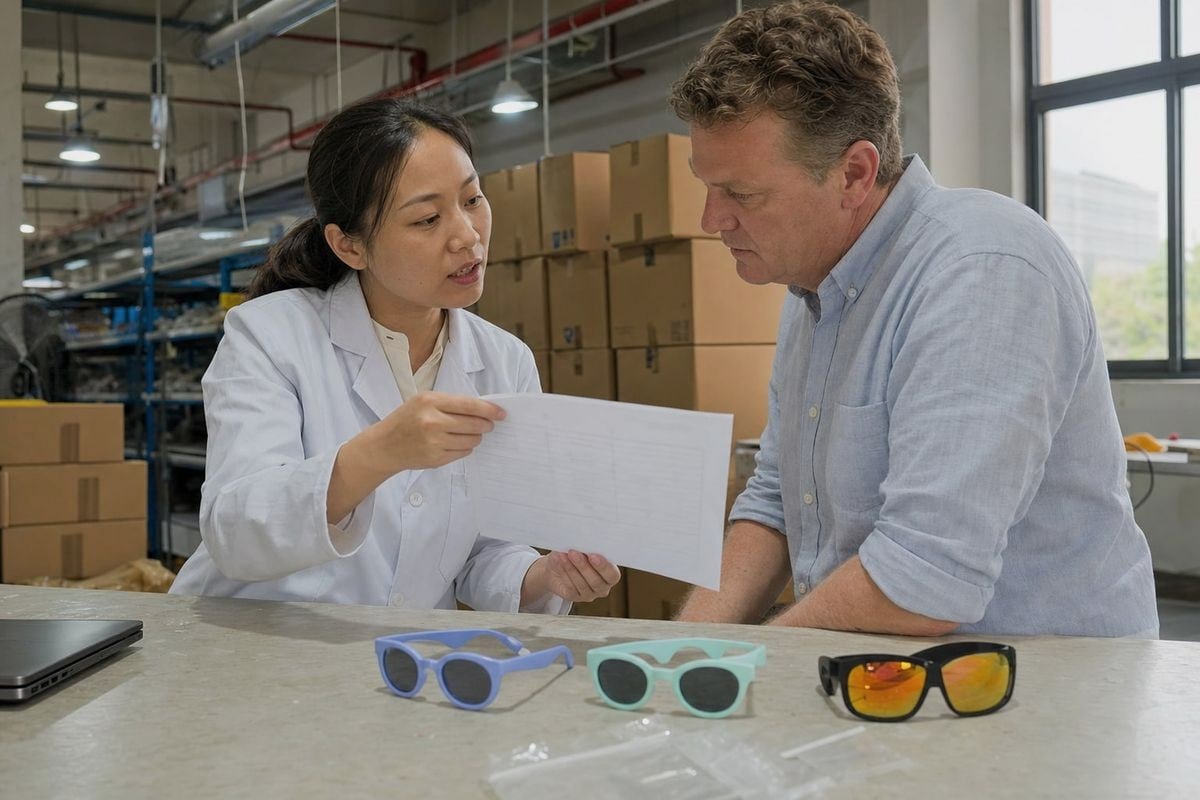
Certifications confuse many first-time eyewear buyers because two different systems overlap on one product. Chemical safety rules govern what the frame and paint are made of. Optical safety rules govern what the lenses do. A compliant painted frame with weak lenses is still an unsafe product, and vice versa. You need both columns covered.
The certification map for decorated kids' sunglasses
| Standard | Region | What it covers | Ask your supplier for |
|---|---|---|---|
| CPSIA (lead & phthalates) | USA | Chemical limits in children's product coatings | CPSC-accepted lab test report |
| EN 71-3 | EU | Migration of heavy metals from materials | Third-party migration test report |
| CE marking / ISO 12312-1 6 | EU | Sunglass UV and optical performance | Declaration of Conformity plus test data |
| ANSI Z80.3 | USA | Nonprescription sunglass UV and optics | Lab report confirming UV400 performance |
| ASTM F659 7 or Z87.1 | USA | Impact resistance of lenses | Impact test documentation if claimed |
How to read supplier paperwork critically
Ask three questions of every document. Does the report name an accredited third-party lab, not just the factory's own lab? Does the tested sample match your actual product — same frame material, same paint color, same ink? Reports for a different colorway can hide a problem, because pigments differ chemically batch to batch. And is the report recent? Coating suppliers change formulas, so a three-year-old report proves little about today's production.
When we run OEM projects with custom colors and printed logos, we retest whenever the decoration changes, not just once per style. Serious buyers from our twenty-plus export markets expect that, and it is the standard I would hold any supplier to — including us.
Conclusion
Decoration can quietly turn cute kids' sunglasses into a hazard. Check the coating chemistry, reject peeling paint, demand real test reports, and partner with suppliers who prove safety in writing.
Footnotes
1. Official source for CPSIA lead and phthalate limits mentioned in article ↩︎
2. Background concept for the thermoplastic frame material referenced repeatedly ↩︎
3. CDC guidance on lead exposure risks relevant to children ingesting paint flakes ↩︎
4. EPA resource explaining phthalate chemicals restricted in children’s products ↩︎
5. Background reference for the European toy safety migration standard cited ↩︎
6. Official ISO standard page for sunglasses UV and optical requirements ↩︎
7. Official ASTM standard page for impact resistance lens testing mentioned ↩︎
More Articles You Might Like

August 1, 2026
Should Factory Handle Kids Sunglasses Packaging & Labeling, or Use a Designated Supplier?

August 1, 2026
Own Warehouse vs Supplier Direct Fulfillment: Which Cuts Return Costs for Kids Sunglasses Brands?

August 1, 2026
Direct-to-Port Warehouse or Overseas Staging: Which Saves More on Kids Sunglasses Shipping?
Looking for a Reliable Kids Eyewear Partner?
Explore 800+ ready styles and full OEM/ODM support tailored to your brand.
Get in Touch English
  Español de México
  Deutsch
  Français
  日本語
日本語  العربية
  Português do Brasil