How to Prevent Cross-Region Diversion in a Kids Sunglasses Distribution Agreement?
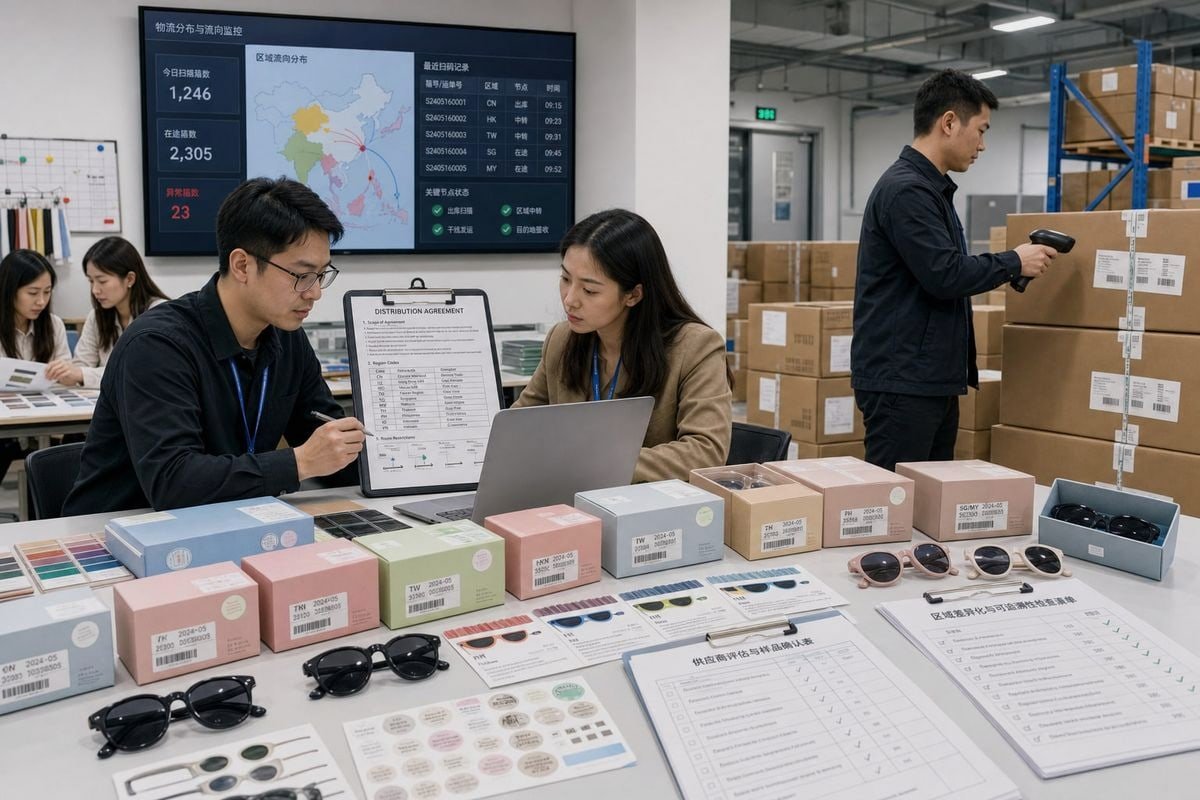
A kids sunglasses distribution agreement can collapse fast when gray market goods 1 flood a partner’s territory. I have watched buyers on our production line lose [exclusive markets](https://okayeyewear.com/how-negotiate-exclusive-regional-distribution-rights-kids-sunglasses-china/) to leaked stock — and the fix starts before shipping.
To prevent cross-region diversion in a kids sunglasses distribution agreement, define the territory precisely, prohibit direct and indirect out-of-territory sales, restrict online marketplace listings, require order-level reporting and audit rights, serialize products by distributor, and make diversion a material breach with termination and damages.
Diversion is both a legal problem and an operational one. A clause alone will not stop it. You need a layered system. Below, I break that system into four practical parts.
What terms should I include in a distribution agreement to legally restrict cross-region selling?
One of our European buyers once found his exclusive styles on a marketplace two countries away. His contract said "Europe" — nothing more. That vague word cost him a full season of sales.
Include a precise territory clause, an exclusivity statement, a ban on active and passive out-of-territory sales, a no-known-resale clause, online marketplace restrictions, sub-distributor flow-down obligations, reporting and audit rights, and a material breach clause with termination, liquidated damages, and injunctive relief.

The strongest agreements do not rely on one sentence. They build territorial exclusivity clauses 2 into a control system. Vague territory language is one of the leading causes of parallel imports disputes 3, so precision comes first. Name countries, states, or regions by objective boundaries. State clearly whether the appointment is exclusive, sole, or non-exclusive. Ambiguity here creates enforcement problems later.
The core clauses, in plain English
| Clause | What it does | Why it matters for kids eyewear |
|---|---|---|
| Territory clause | Defines the region exactly, including exclusions | Kids sunglasses are lightweight and easy to ship across borders |
| No-outside-sales clause | Bans selling or soliciting outside the territory without written consent | Blocks direct exports by the distributor |
| No-known-resale clause | Forbids selling to buyers the distributor knows will resell elsewhere | Diversion usually flows through wholesalers, not direct exports |
| Anti-transshipment provisions | Prohibit routing goods through third countries | Closes the indirect shipping loophole |
| Online sales clause | Controls website and marketplace listings | E-commerce bypasses geographic boundaries digitally |
| Sub-distribution clause | Requires approval and flow-down of all restrictions | Keeps your authorized dealer network intact downstream |
| Breach and remedies clause | Makes diversion a material breach; adds a liquidated damages clause | Gives you fast, credible remedies instead of long disputes |
Balance restriction with legality
Territorial restrictions are standard, but competition and resale rules differ by jurisdiction. In our experience exporting to 20+ countries, buyers get the best results when a local attorney reviews the restraints. Draft by territory and channel, not by broad blanket bans. Also consider a referral mechanism: out-of-territory inquiries get passed back to you or to the correct regional partner. That keeps distributors cooperative instead of tempted.
There is a trade-off we discuss with almost every private-label client: traceability adds a small cost per unit, but skipping it means you can never prove which partner leaked the stock.
Track diversion through product serialization, batch codes mapped to each distributor, order-level reporting of customer names and shipment destinations, audit rights over warehouses and records, marketplace monitoring, and test purchases of suspect listings to trace serial numbers back to the source.
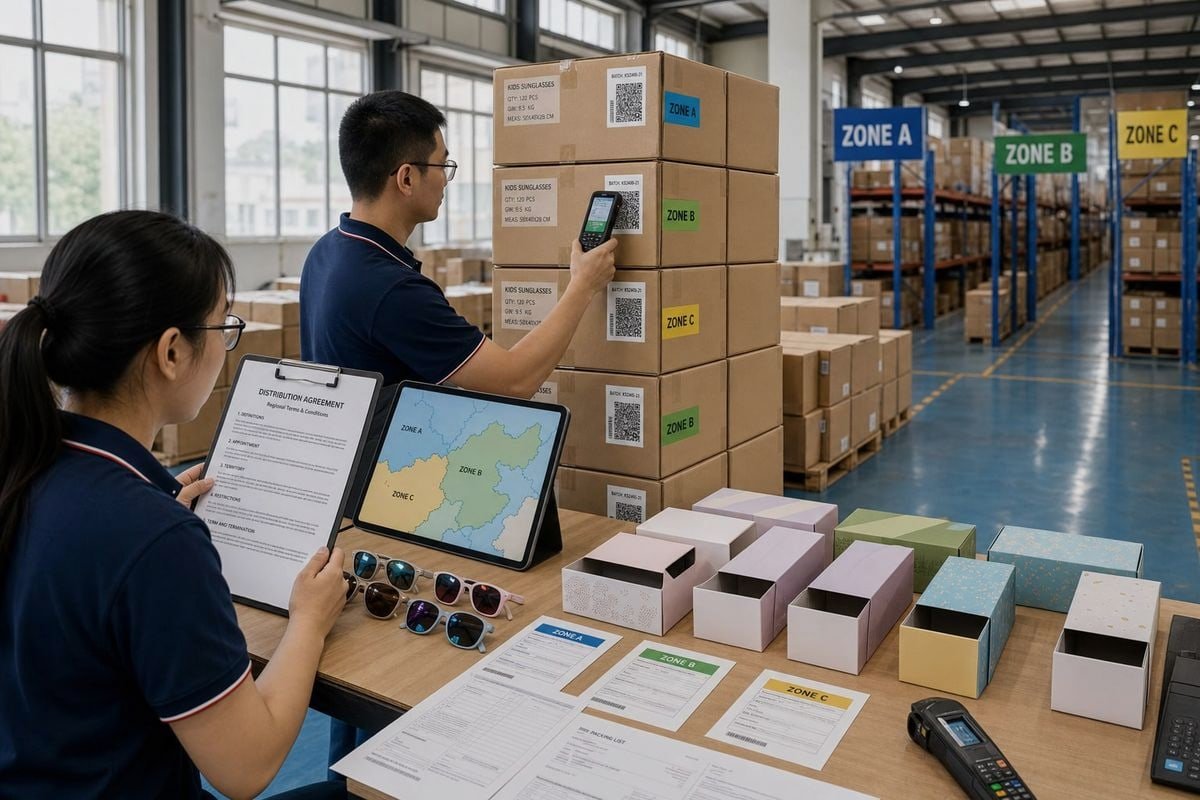
A contract prohibition is only credible if you can catch violations. Enforcement depends on data. Our factory can print or laser batch codes 4 on inner temples during production, and that single step turns a suspicion into evidence. When each distributor receives a unique code range, one test purchase tells you exactly where a leaked pair originated.
A practical tracing workflow
- Assign identifiers at production. Use product serialization or batch codes tied to each purchase order and distributor.
- Require reporting. The agreement should oblige distributors to report orders, customer identities, shipment destinations, and any unusual bulk inquiries.
- Monitor marketplaces. Scan Amazon, eBay, and regional platforms weekly for your SKUs in unauthorized regions.
- Buy and inspect. Purchase suspect listings, check the batch code, and match it to a distributor.
- Audit. Exercise contractual audit rights over books, order records, and sub-distributor arrangements before leakage becomes systemic.
Covert and overt marking options
| Method | Visibility | Best use |
|---|---|---|
| Printed batch code | Visible | Routine traceability and warranty checks |
| Laser micro-engraving | Semi-visible | Durable marking on TR90 frame 5s |
| Invisible UV-ink marking | Covert | Field audits without alerting the diverter |
| QR-code digital passport | Visible, scannable | Warranty registration tied to region of first scan |
Some brands also run a retailer reporting program, rewarding authorized local sellers who flag diverted batch codes in their territory. Your own dealer network becomes your monitoring network.
What role can custom branding and packaging play in preventing regional diversion?
A children's brand from Australia once asked us why their region-specific packaging mattered so much. Six months later, that packaging helped them spot diverted stock in a single photo from a retail partner.
Custom branding and packaging deter diversion by making regional versions visibly different — localized language, region-coded packaging, market-specific colorways, and warranty cards valid only in the authorized region — so gray market goods become easy to identify and less attractive to buyers.
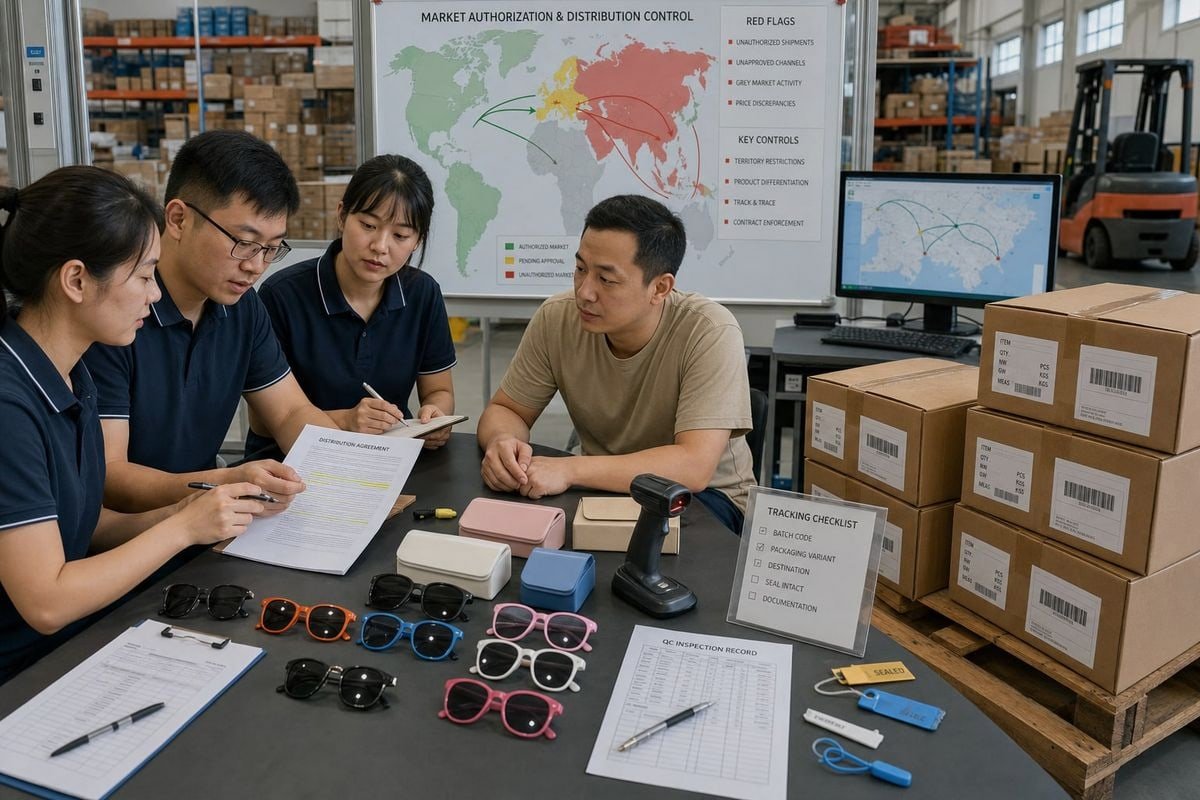
Packaging is an underrated brand protection strategy. When every market gets identical product in identical boxes, diverted stock is invisible. When each region has visible differences, diversion becomes self-defeating because the goods look obviously out of place.
Create material differences by region
The strongest approach uses "material difference 6" logic. Products sold outside authorized channels lack the features local buyers expect, which weakens the gray market goods offer. Practical options include:
- Localized packaging. Print safety information, sizing guides, and care instructions in the local language. A Japanese-language box sitting in a German store signals diversion instantly.
- Region-coded artwork. Small color bands, icons, or SKU suffixes tell your team the intended market at a glance.
- Warranty differentiation. Warranty cards and after-sales support apply only to products sold through the authorized dealer network in that region. A geofenced QR registration can flag pairs first scanned outside the assigned territory.
- Market-specific colorways. On our line, we routinely run the same TR90 frame in different color-block combinations for different clients and regions — like a powder-blue and mint-teal two-tone for one market and a bolder mirrored-lens sport shield for another. Diverted units then compete poorly against the locally tailored range.
- Compliance labeling. Children's product regulations differ by market. Region-correct compliance marks make diverted stock legally awkward to sell, which is a strong deterrent on its own.
Packaging alone will not stop a determined diverter. But combined with pricing discipline — including a Minimum Advertised Price policy that narrows arbitrage margins — it removes most of the profit and all of the camouflage.
How do I choose a manufacturing partner who supports region-specific product differentiation?
Fifteen years of OEM work in Taizhou has taught our team a simple lesson: diversion control starts at the factory, because differentiation you cannot produce consistently is differentiation you cannot enforce.
Choose a factory with genuine OEM/ODM depth — custom colors, lenses, logos, and packaging per region — plus batch-level traceability, low minimums via existing molds, consistent quality control, and the communication discipline to manage multiple regional versions without mix-ups.
Not every supplier can support a selective distribution 7 system. Some factories run one version of one product and resist variation. Others promise customization but mix batches on the line, which destroys your traceability. Before you commit, evaluate the partner against the capabilities that actually enable regional differentiation.
What to look for, capability by capability
| Capability | Why it matters | What to ask |
|---|---|---|
| Existing style library | Lets you build regional variants without heavy mold investment | How many ready styles can be color-customized per region? |
| Material expertise | Flexible TPEE and TR90 keep kids' frames safe and durable across variants | Can the same frame run in different regional colorways with equal quality? |
| Lens options | UV400 or polarized tiers can differentiate regional SKUs | Can lens tints or coatings vary by market? |
| Custom packaging | Region-coded, retail-ready presentation deters diversion | Do you print localized boxes, warranty cards, and inserts in-house or with vetted partners? |
| Batch traceability | Serialization links each shipment to a distributor | Can you mark batch codes or apply UV-ink markings during production? |
| Order segregation | Prevents regional versions from mixing | How does your workshop separate concurrent regional runs? |
In practice, our clients test the market with existing frames from a large style library, then add region-specific colors, logos, and packaging as volumes grow. That path keeps mold costs low while still giving each territory a distinct product. Ask for pre-production samples of every regional version, and confirm the factory documents which batch codes ship on which purchase order. A partner who treats traceability as routine paperwork — not a special favor — is the partner who protects your territories.
Conclusion
Cross-region diversion drains exclusive territories quietly until trust collapses. Combine precise contract clauses, serialized traceability, regional differentiation, and a capable factory partner — prevention is a system, not a single clause.
Footnotes
1. Defines gray market goods and their impact on authorized distribution networks. ↩︎
2. Authoritative standards for international distribution and territorial exclusivity agreements. ↩︎
3. Explains the legal nature of parallel imports which cause distribution disputes. ↩︎
4. Global standards for using batch codes to enable supply chain traceability. ↩︎
5. Technical specifications for TR90, the primary material used in high-quality children’s eyewear. ↩︎
6. Explains the ‘material difference’ exception in trademark law used to block parallel imports. ↩︎
7. Explains the legal and operational framework of selective distribution used to protect brand integrity. ↩︎
More Articles You Might Like

August 1, 2026
Should Factory Handle Kids Sunglasses Packaging & Labeling, or Use a Designated Supplier?

August 1, 2026
Own Warehouse vs Supplier Direct Fulfillment: Which Cuts Return Costs for Kids Sunglasses Brands?

August 1, 2026
Direct-to-Port Warehouse or Overseas Staging: Which Saves More on Kids Sunglasses Shipping?
Looking for a Reliable Kids Eyewear Partner?
Explore 800+ ready styles and full OEM/ODM support tailored to your brand.
Get in Touch English
  Español de México
  Deutsch
  Français
  日本語
日本語  العربية
  Português do Brasil