How Do I Know If Kids’ Optical Frames Need a Prop 65 Warning Label?
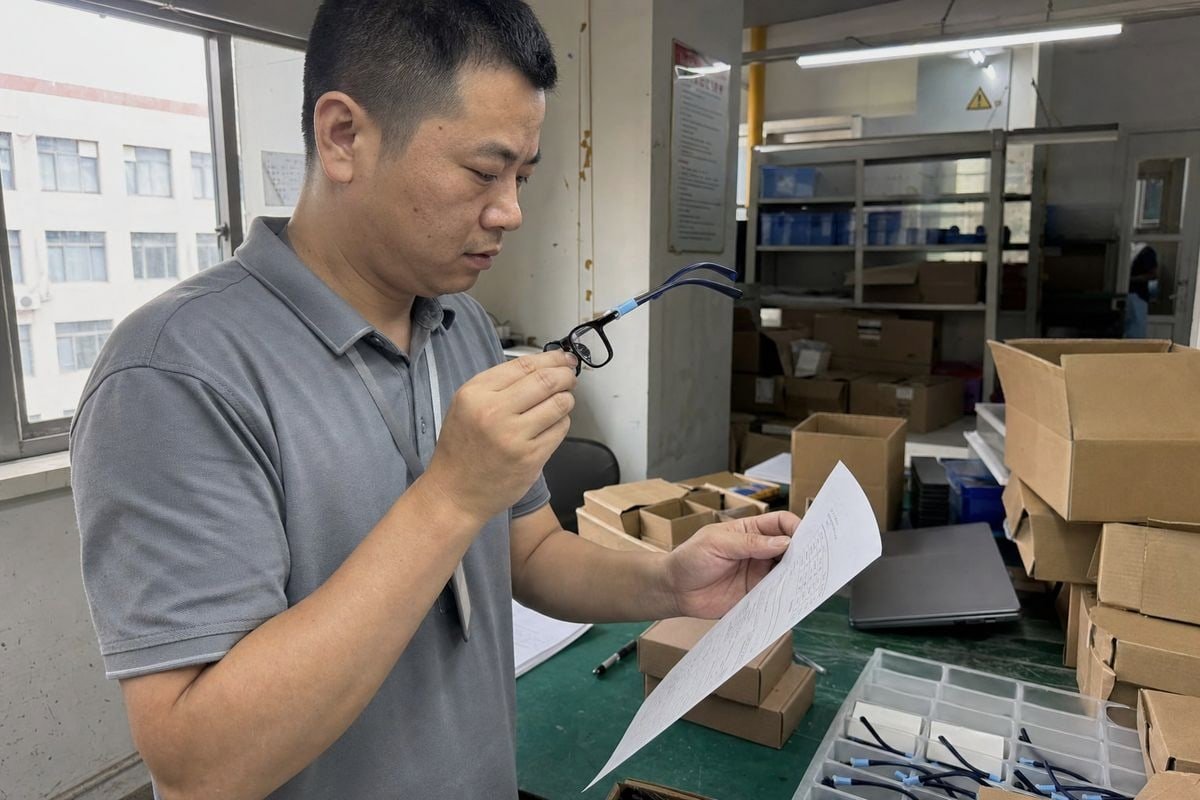
Buyers ask us about [Prop 65 warning labels for kids’ optical frames](https://okayeyewear.com/how-know-if-kids-sunglasses-require-prop-65-warning-label/) almost weekly California Proposition 65 1. Get it wrong, and your shipment could face legal notices, lost retail listings, or worried parents abandoning carts.
Kids’ optical frames need a Prop 65 warning label only if they can expose the wearer to a California Proposition 65 listed chemical above the applicable safe harbor levels. If testing shows exposure stays below those chemical exposure limits, no warning is legally required.
That answer sounds simple. In practice, the details matter. Let me walk you through how we handle this question on our own production line, step by step.
How do I determine if my kids' optical frames fall under Prop 65 regulations?
A procurement manager from Australia once asked me why her US distributor demanded Prop 65 paperwork when her brand never sells in California directly Bisphenol A (BPA) 2. Her online retail partners did, and that changed everything.
Your kids' optical frames fall under California Proposition 65 if they are sold to California consumers, your business has 10 or more employees, and the frames could expose users to listed chemicals during normal wear or foreseeable handling above regulated thresholds.
Prop 65 is an exposure-based disclosure law, not a product ban phthalates in soft PVC components 3. That distinction is the first thing I explain to new buyers. The law does not say "this frame is dangerous." It says businesses must warn Californians before exposing them to chemicals on the OEHHA list 4 that are known to cause cancer or reproductive harm. The list is maintained by OEHHA, California's Office of Environmental Health Hazard Assessment, and it grows every year accredited third-party laboratory 5. That is why we re-check our material declarations annually rather than treating compliance as a one-time task.
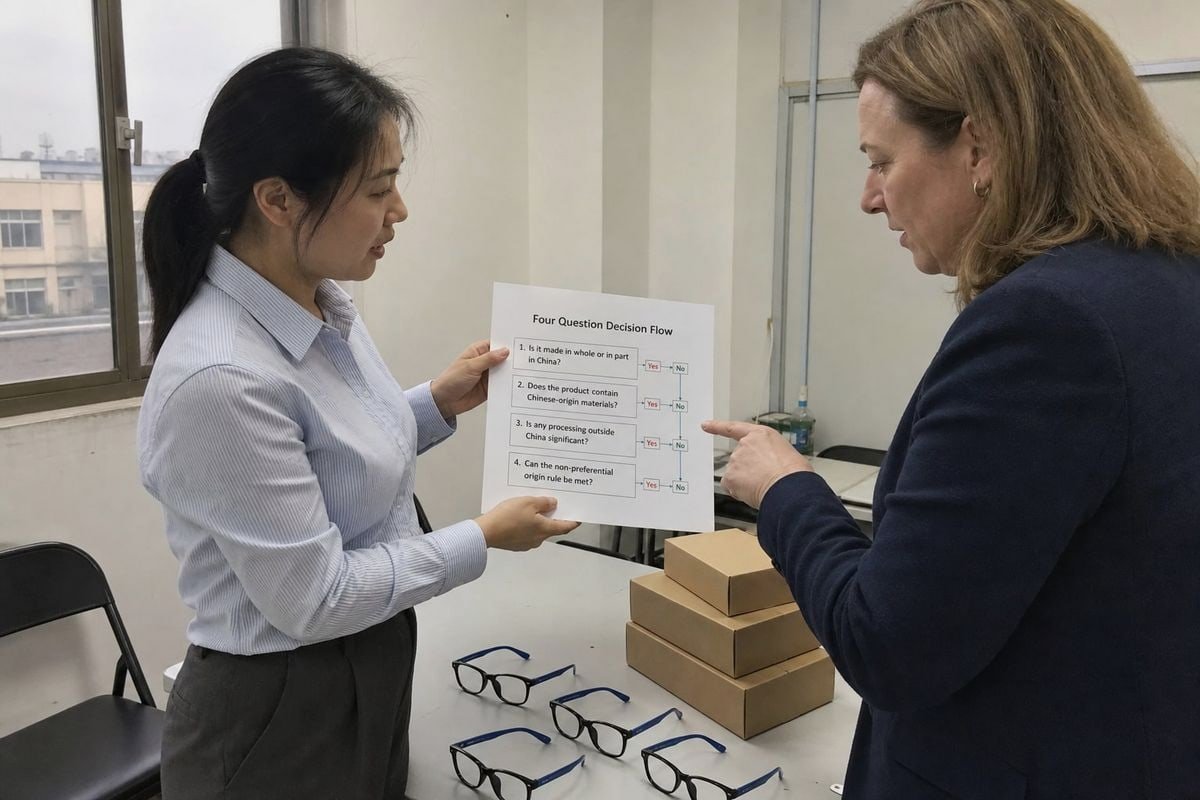
Here is the decision path we walk through with clients:
The four-question test
- Do you sell into California? This includes direct sales, distributors, and ecommerce orders shipped to California addresses.
- Does your business have 10 or more employees? Smaller businesses are exempt, but most brands working with importers exceed this quickly.
- Does any component contain a listed chemical? Check the frame front, temples, nose pads, hinges, coatings, inks, and even packaging.
- Does normal use create exposure above safe harbor levels? Presence alone does not trigger the warning. Exposure above the threshold does.
| Question | If Yes | If No |
|---|---|---|
| Sold into California? | Continue assessment | Prop 65 does not apply |
| 10+ employees? | Continue assessment | Exempt from warning requirements |
| Listed chemical present? | Assess exposure levels | No warning needed |
| Exposure above safe harbor? | Provide a clear and reasonable warning | No warning required, keep records |
One nuance many buyers miss: if you sell online to California consumers, the warning must appear on the product page or through a clearly marked hyperlink before purchase — not just on the physical frame or its packaging. We remind every ecommerce client of this, because a compliant hangtag alone will not protect an online listing.
What materials in kids' optical frames typically trigger Prop 65 warning requirements?
Material selection is where we spend the most engineering time at our Taizhou factory. Fifteen years of building children's eyewear has taught us that the frame material decision made on day one determines the compliance headaches on day three hundred.
The most common Prop 65 triggers in kids' optical frames are Bisphenol A (BPA) in polycarbonate lenses and some plastics, nickel in metal hinges and hardware, phthalates in soft PVC components, and lead or cadmium in low-grade coatings, inks, and surface treatments.

Every component on a child's frame deserves scrutiny, not just the obvious plastic front. In our experience exporting to 20+ countries, the risky parts are often the small ones: a metal hinge core, a printed logo, a soft temple tip. The Vision Council's eyewear compliance materials have specifically flagged BPA exposure in eyewear components, which is why polycarbonate lenses get so much attention in this conversation.
Component-by-component risk map
| Component | Typical Material | Listed Chemical Concern | Practical Risk Level |
|---|---|---|---|
| Frame front | TR90, acetate, polycarbonate | BPA in some polycarbonates | Low to moderate |
| Temples & tips | TPEE, silicone, PVC | Phthalates in cheap PVC | Moderate if PVC is used |
| Hinges & screws | Metal alloys | Nickel, sometimes lead | Moderate |
| Nose pads | Silicone, PVC | Phthalates | Low with silicone, higher with PVC |
| Coatings & paints | Lacquers, platings | Lead, cadmium | Low with certified suppliers |
| Printing inks & packaging | Various inks, plastics | Lead, phthalates | Often overlooked |
Why our material choices matter here
This is one reason we standardized on TR90 and TPEE across most of our roughly 800 existing styles. TR90 is a lightweight nylon-based polymer, and TPEE is a flexible thermoplastic elastomer. Neither depends on BPA-based chemistry or phthalate plasticizers the way soft PVC does. Take the two frames we recently developed: a glossy black kids' frame with navy-blue TPEE temples and silicone cable ear hooks, and a translucent pink acetate-style frame with matte silicone temple tips. In both cases we deliberately chose silicone over PVC for the soft-touch parts, because silicone avoids the phthalate question entirely.
Presence still does not equal a warning. A trace of nickel in a hinge screw buried inside the temple may create negligible skin exposure. That is why exposure assessment, not a simple ingredient list, drives the final labeling decision.
How can I get my kids' optical frames tested for Prop 65 compliance before importing?
Before one of our European optical clients placed their first container order, they asked us to route pre-shipment samples through a third-party lab. That request cost two weeks and saved them months of uncertainty. We now recommend the same sequence to every new buyer.
Send production-representative samples to an accredited third-party laboratory such as SGS, Intertek, Bureau Veritas, or TÜV, request chemical screening against the current OEHHA list for your materials, and compare results with safe harbor levels before your goods leave the factory.

Testing before importing is far cheaper than relabeling after arrival. Here is the process we help buyers run, based on how we prepare our own TR90 kids optical frames and TPEE sunglasses for regulated markets.
A practical five-step testing workflow
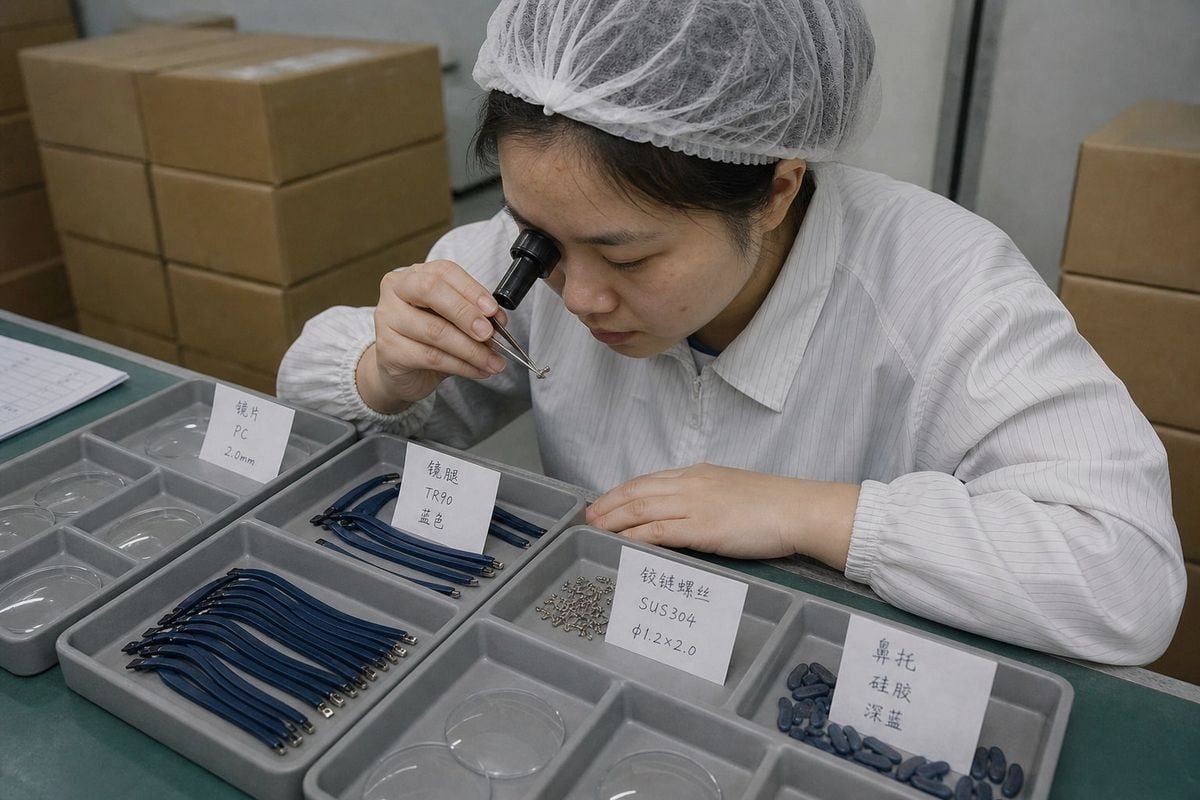
- Build a bill of materials. List every substance: frame polymer, temple material, lens type, hinge alloy, coating, ink, and packaging. Your factory should provide this without hesitation. We prepare it as standard documentation.
- Screen against the OEHHA list. Match each material against currently listed chemicals. Focus on the usual eyewear suspects: BPA, phthalates, nickel, lead, and cadmium.
- Select targeted tests. Do not pay for a thousand-chemical panel. Test for the chemicals plausibly present. For a polycarbonate lens, test BPA migration. For metal parts, test nickel release and lead content.
- Assess exposure, not just content. Prop 65 hinges on chemical exposure limits during normal use. A lab or compliance consultant can model skin-contact exposure and compare it to no-significant-risk levels. In rare cases, a formal Safe Use Determination from OEHHA can settle whether a specific exposure needs a warning.
- Document everything. Keep test reports, material declarations, and exposure assessments on file. If exposure sits below the thresholds, this documentation is your defense for shipping without a warning.
One important caution: Prop 65 is separate from and often stricter than federal rules like CPSIA 7. A children's frame that passes CPSIA lead limits can still raise a Prop 65 question, because California's thresholds and chemical list differ. We treat them as two distinct checkboxes in our eyewear manufacturing compliance file, never one.
Timing matters too. Test golden samples before mass production, then spot-check production batches. Material suppliers occasionally change formulations without notice, and an annual re-test catches drift before it reaches your customers.
What should I do if my supplier can't confirm Prop 65 compliance for my frames?
A hard lesson from our early export years shaped how we run our 5S-managed workshop today: silence from a raw-material vendor is itself an answer. When a supplier cannot confirm what is in their material, you must assume the risk sits with you.
If your supplier cannot confirm Prop 65 compliance, either commission independent third-party testing yourself, apply a compliant precautionary warning label, switch to a supplier who provides chemical declarations and test reports, or remove the product from California sales channels.
You have four realistic paths, and each carries a different cost profile. Let me break them down the way I do when a buyer calls me with this exact problem.
Your four options compared
| Option | Upfront Cost | Long-Term Risk | Best For |
|---|---|---|---|
| Test independently | Moderate lab fees | Low, with documentation | Ongoing programs with committed volume |
| Apply precautionary warning | Very low | Sales impact on parents | Short-term fixes, mixed inventory |
| Switch suppliers | Sourcing time and sampling | Lowest overall | Brands building for the long term |
| Exit California channels | Lost revenue | None in California | Rarely practical for US-focused brands |
The precautionary warning route deserves honest discussion. Many national sellers slap Prop 65-style warnings on everything to reduce legal risk across all fifty states. It works legally, but there is a real trade-off: a scary-looking warning on a child's product can crush conversion rates. Parents see the word "WARNING," the yellow triangle symbol, and the "can expose you to" language required since 2018, and many walk away — even when the actual exposure is negligible. In the children's category, we have watched buyers turn "No Warning Required" status into a genuine competitive advantage on their product pages instead.
That is why option three, changing suppliers, is usually the strongest move for a serious brand. A capable factory should hand you material safety declarations, third-party test reports, and a full component breakdown as routine paperwork. We provide these for our TR90 and TPEE frames because our B2B clients — children's brands in Japan, Europe, and Australia — treat children's product safety documentation as a purchase condition, not a bonus. If your current supplier treats these requests as unusual, that tells you something about their other quality controls too.
Whatever path you choose, put compliance requirements into your purchase agreements. Require chemical declarations from raw-material suppliers, define who pays for testing, and specify warning-label responsibility for both physical packaging and online listings. Clear contracts prevent the finger-pointing that starts when a 60-day legal notice arrives.
Conclusion
Kids' optical frames need a Prop 65 warning only when listed-chemical exposure exceeds safe harbor levels. Test early, document thoroughly, choose clean materials, and partner with a factory that proves compliance.
Footnotes
1. Official overview of California’s Safe Drinking Water and Toxic Enforcement Act. ↩︎
2. Fact sheet on Bisphenol A, a common chemical listed under Prop 65. ↩︎
3. Information on phthalates, their uses, and Prop 65 warnings. ↩︎
4. Provides the official and regularly updated list of chemicals under Prop 65. ↩︎
5. Details on testing services for Prop 65 compliance from a recognized lab. ↩︎
6. Explains the No Significant Risk Levels and Maximum Allowable Dose Levels. ↩︎
7. Official information on the Consumer Product Safety Improvement Act from CPSC. ↩︎
More Articles You Might Like

August 5, 2026
Bio-Based vs Regular Cellulose Acetate: What's the Difference for Kids' Frames?

August 5, 2026
How Recyclable Are Kids' Optical Frame Materials, and What Eco-Friendly Alternatives Exist?
August 5, 2026
Do Kids Optical Frames Whiten or Age in Storage, and How to Control Warehouse Conditions?
Looking for a Reliable Kids Eyewear Partner?
Explore 800+ ready styles and full OEM/ODM support tailored to your brand.
Get in Touch English
  Español de México
  Deutsch
  Français
  日本語
日本語  العربية
  Português do Brasil