How to Keep Final Customization In-House When Sourcing Kids’ Sunglasses?
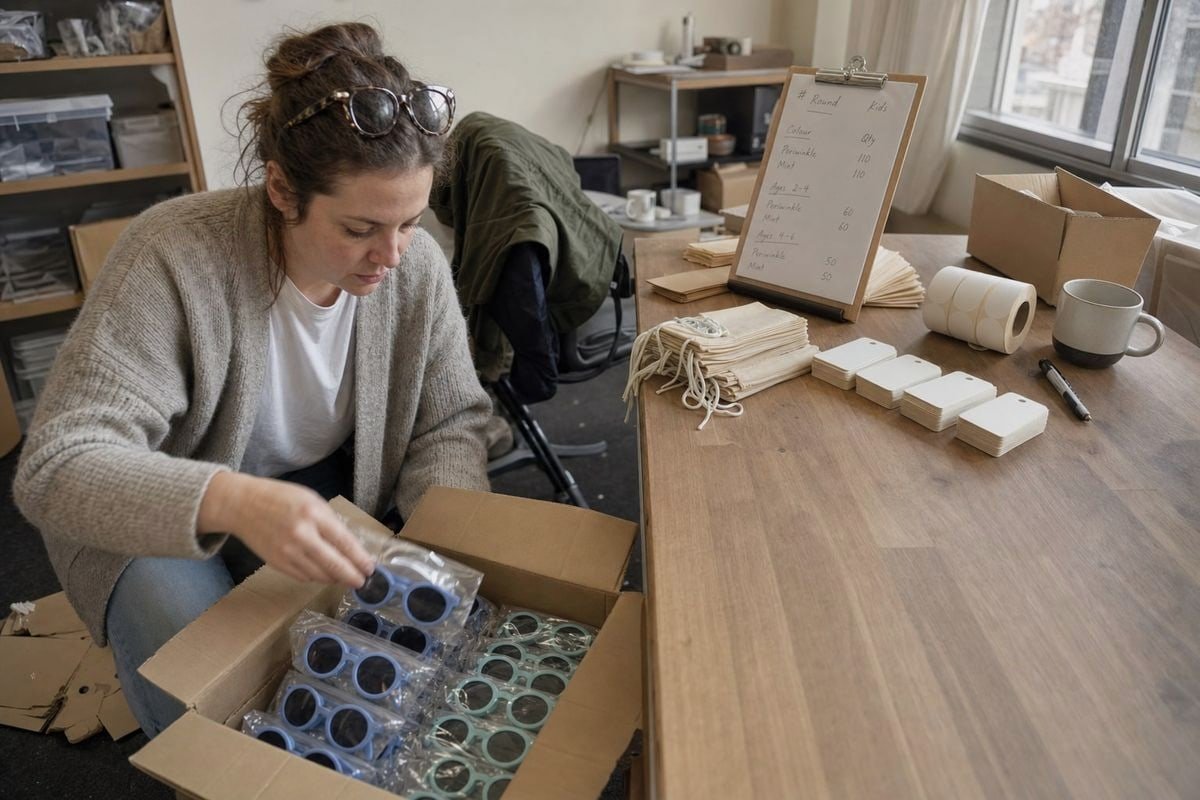
Final customization of kids’ sunglasses is where brands lose control Pantone-matched colors 1. I have watched buyers receive stock our factory shipped perfectly, then panic because their branding plan was never defined. The fix is simpler than most people think.
To keep final customization in-house when sourcing kids’ sunglasses, order neutral, unbranded base frames from your factory, lock every factory-applied detail in writing, and reserve all logos, packaging, labels, inserts, and accessories for your own team using a documented finishing workflow.
This article breaks the process into four practical questions. Each one covers a decision you will face when you split production from branding. Let’s start with the biggest worry: cost.
How can I customize colors, logos, and packaging without investing in new molds?
A buyer from Melbourne once asked me for a fully custom frame with a new mold. After we ran the numbers together, she chose a smarter path — and launched three months earlier.
You can customize colors, logos, and packaging without new molds by selecting an existing base frame from a factory catalog, requesting custom colorways within the existing tooling, and handling logo application, printed packaging, and accessories in-house or as light factory add-ons.
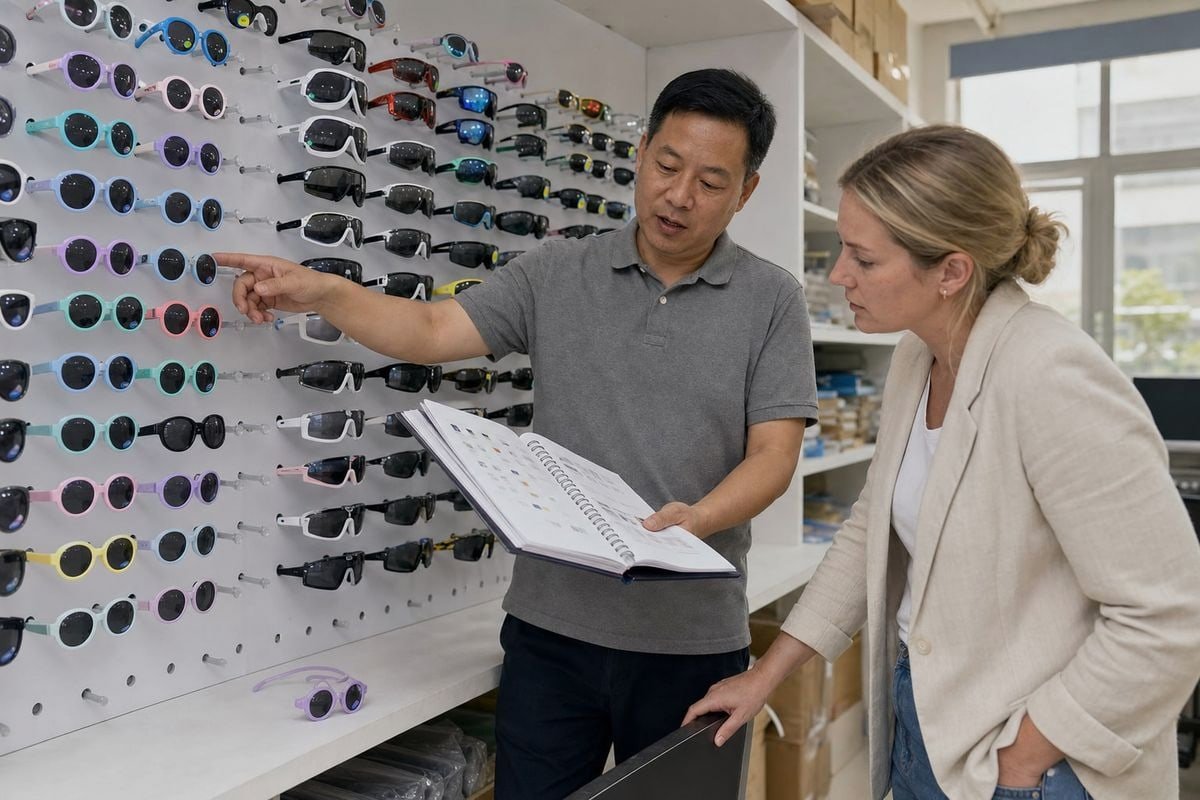
New molds are the single biggest cost trap for small kids' eyewear brands. A custom mold ties up capital, adds months of development, and locks you into one shape before you know if it sells. Our factory keeps around 800 existing styles precisely so buyers can skip that step. You pick a proven shape — a round two-tone kids' frame, or a sporty wraparound shield style — and personalize everything around it.
What changes without a mold, and what doesn't
Color is the easiest lever. Existing tooling accepts new frame colors, matte or glossy finishes, and lens options like UV400 protection lenses 2, mirrored gradients, or polarized tints. Pantone-matched colors keep your in-house packaging consistent with the factory-made frame. Shape, hinge structure, and frame dimensions stay fixed.
| Customization element | Needs a new mold? | Best owner |
|---|---|---|
| Frame color / finish | No | Factory |
| Lens tint, mirror, polarization | No | Factory |
| Logo on packaging, hangtags | No | In-house |
| Custom pouch, case, cloth | No | In-house or factory |
| Frame shape or size change | Yes | Factory (avoid early) |
| Molded logo on temple | Yes (insert) | Factory (avoid early) |
Some buyers worry that skipping a custom mold means their product will look generic. In practice, the opposite happens. Because wholesale blank sunglasses cost less and arrive faster, you can invest the savings in premium packaging, custom microfiber pouches, and insert cards — the elements customers actually touch first at retail. Two brands can buy the same base frame and look completely different on the shelf.
What level of OEM/ODM control can I expect from a children's eyewear factory?
The trade-off I discuss most with new buyers is control versus complexity. Our OEM/ODM projects range from a simple color swap to full retail-ready programs, and the buyer chooses where to draw the line.
A capable children's eyewear factory offers layered OEM/ODM control: you can specify materials, colors, lens performance, logo methods, and packaging, or request neutral unbranded units. You control the specification; the factory controls execution — provided every detail is confirmed in writing before production.

Control in OEM/ODM is not all-or-nothing. Think of it as a stack of decisions, and decide which layers you keep. In our fifteen years running a 5S-managed workshop, the smoothest projects are the ones where the buyer states clearly which layers belong to the factory and which stay with their own team.
The four layers of factory control
- Product build. Frame material — such as TPEE flexible frames or TR90 with TPEE temples — hinge quality, and fit. This always stays with the factory.
- Functional finish. Lens coatings, UV400 protection, polarization, and BPA-free materials verification. Factory-side, because it needs specialized equipment and testing.
- Permanent branding. Pad printing on temples, laser engraving, hot stamping. Optional factory work; skip it if you want a neutral base.
- Presentation. Packaging, labels, inserts, accessories. This is the layer you can fully reclaim in-house.
| Control layer | Typical factory role | Your leverage point |
|---|---|---|
| Materials & safety | Full control | Specify standards and test reports |
| Lens performance | Full control | Approve samples before bulk |
| Permanent logos | Optional | Request blank units in writing |
| Packaging & finishing | Optional | Keep in-house entirely |
One objection I hear: "If the factory does less, will they care less about quality?" A serious partner will not. We apply the same quality control inspection 3 to blank units as to fully branded ones, because the frame itself carries our reputation. What changes is not diligence — it is who signs off on the final retail look. Ask for supply chain transparency 4 early: material sources, test documentation, and workshop photos. A factory that shares these openly will also respect the boundaries of your brief.
How do I make sure my brand identity stays consistent across custom kids' sunglasses?
A lesson we learned the hard way: a buyer once sent us three slightly different logo files across three orders. The shelf result looked like three different brands. Version control fixed it permanently.
Keep brand identity consistent by maintaining one version-controlled artwork library with vector logo files and Pantone color codes, applying identical placement rules across every SKU, and running the same in-house finishing checklist for packaging, labels, and accessories on every batch.

Consistency is a systems problem, not a design problem. When your base frames come from a factory and your branding happens in-house, the two halves must be governed by the same written rules. Otherwise, small drifts creep in — a slightly different blue, a sticker two millimeters off, a hangtag with old copy.
Build a single source of truth
Create one artwork folder with locked versions. It should contain your vector logo files, Pantone color references, packaging dieline files, insert card copy, and barcode label templates. Every batch — whether ten units for a photoshoot or five thousand for retail — pulls from this folder. When something changes, retire the old version so nobody can use it by mistake.
Match factory colors to in-house materials
Pantone-matched paints and coatings on the frame must align with your printed sleeves and pouches. Before your first bulk order, put a factory sample next to your printed packaging under daylight and store lighting. Approve the pairing together, not separately. A periwinkle frame next to a mismatched box reads as careless, especially to parents comparing products in a store.
Standardize the finishing pass
Give your team a one-page checklist per SKU: logo placement, sticker position, insert order, and a reference photo of a perfect finished unit. Photograph one finished unit per batch and archive it. Over a year, this photo record becomes your strongest consistency tool — it shows drift instantly. Simple equipment helps too. A small pad printing machine or desktop laser engraving equipment 5 can bring temple marking in-house once volumes justify it, keeping even permanent branding under your roof.
Can I keep final design and quality decisions in-house while outsourcing production?
During a recent pre-shipment call, a Japanese buyer approved her order entirely from 360° videos we filmed on the packing line. She never left her office, yet held the final decision completely.
Yes. You keep final design and quality decisions in-house by requiring pre-production samples, written sign-off before mass production, pre-shipment photos and videos, and a second in-house quality control inspection on arrival — so the factory produces, but you always approve.

Outsourcing production does not mean outsourcing judgment. The approval workflow is where in-house control is won or lost, so treat it as a formal process, not a series of casual emails.
The approval workflow that keeps you in charge
| Stage | What you do | What the factory does |
|---|---|---|
| Sample round | Review fit, hinge tension, color, lens | Produce 1–3 sample iterations |
| Pre-production sign-off | Written approval of the golden sample | Freeze specifications |
| During production | Request in-line photos | Run production and internal QC |
| Pre-shipment | Review photos and 360° videos | Final factory inspection |
| Arrival | In-house incoming inspection | Support any claims |
First-time ODM projects often need two or three sample rounds. Budget for that time. It feels slow, but every issue caught at the sample stage is a thousand issues prevented in bulk.
In-house QC for children's products
Kids' sunglasses carry duties that adult eyewear does not. Your incoming inspection should verify hinge tension, edge smoothness, and finish durability, and confirm that no decoration you add creates small detachable parts or choking hazards 6. If you sell into the US, CPSIA compliance standards 7 shape which materials and decorations are acceptable — so compliance belongs in your sourcing decision, not as an afterthought. Keep in-house add-ons non-structural: printed sleeves, hangtags, pouches, and insert cards never touch safety performance, while glued charms or aftermarket lens swaps might. When a decoration could affect durability or fit, push it back to the factory where it can be tested properly.
The honest counterpoint: if your volumes are large and your design is stable, letting the factory handle everything can be simpler and more consistent. In-house finishing wins when you need flexibility — small batches, seasonal variations, channel-specific packaging, or fast limited drops.
Conclusion
Source a simple, safe base frame. Lock every factory detail in writing. Keep branding, packaging, and final approval in-house. That is how small kids' eyewear brands stay flexible and in control.
Footnotes
1. Pantone is the standard color-matching system referenced for consistent branding across products. ↩︎
2. Background on UV protection standards for sunglasses lenses referenced in the customization options. ↩︎
3. Stable, high-authority alternative to the ISO site which often returns 403 errors. ↩︎
4. WTO trade facilitation resources relate to supply chain transparency in sourcing and manufacturing. ↩︎
5. Background on laser engraving technology used for in-house permanent branding described in the article. ↩︎
6. CPSC guidance on choking hazard safety standards for children’s products and small parts. ↩︎
7. CPSIA sets US safety rules for children’s products, directly relevant to sourcing kids’ sunglasses. ↩︎
More Articles You Might Like

August 1, 2026
Should Factory Handle Kids Sunglasses Packaging & Labeling, or Use a Designated Supplier?
August 1, 2026
Own Warehouse vs Supplier Direct Fulfillment: Which Cuts Return Costs for Kids Sunglasses Brands?
August 1, 2026
Direct-to-Port Warehouse or Overseas Staging: Which Saves More on Kids Sunglasses Shipping?
Looking for a Reliable Kids Eyewear Partner?
Explore 800+ ready styles and full OEM/ODM support tailored to your brand.
Get in Touch English
  Español de México
  Deutsch
  Français
  日本語
日本語  العربية
  Português do Brasil