How to Confirm Kids’ Optical Frames Don’t Infringe Design Rights When Sourcing?
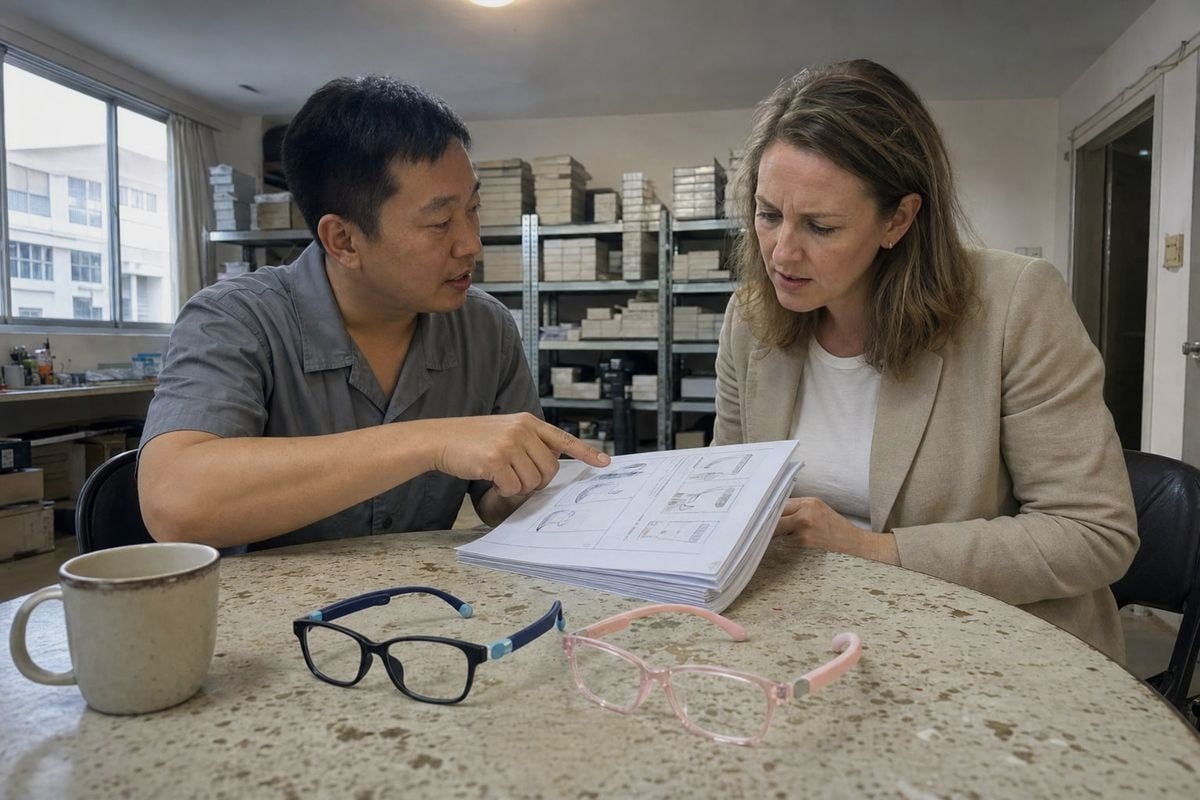
Sourcing kids’ optical frames without checking design rights is a hidden landmine Locarno Class 16-06 1. I’ve watched buyers lose entire shipments at customs — inventory seized, launch dates destroyed, and legal bills piling up. At our Taizhou factory, we help brands avoid exactly this trap.
To confirm kids’ optical frames don’t infringe design rights, identify your target markets, run a design patent search in each jurisdiction’s register, compare the frame’s overall visual impression against active registrations, verify the supplier’s ownership documents, and keep dated evidence of your clearance work before ordering.
That sounds like a lot of steps. It isn’t, once you break it down. Below, I’ll walk you through each stage the way we guide our own OEM clients through it.
How can I check if a supplier's frame designs are truly original before I place an order?
A buyer from Australia once asked me point-blank: "How do I know these 800 styles in your catalog aren't copies?" Fair question. We showed her our design files, mold records, and development timeline — and that's exactly what you should demand from any factory.
Check originality by searching the WIPO Global Design Database and national registers for similar frame silhouettes, running reverse image searches on the supplier's catalog photos, asking for design development records like sketches and CAD files, and comparing the frame against known branded styles side by side.
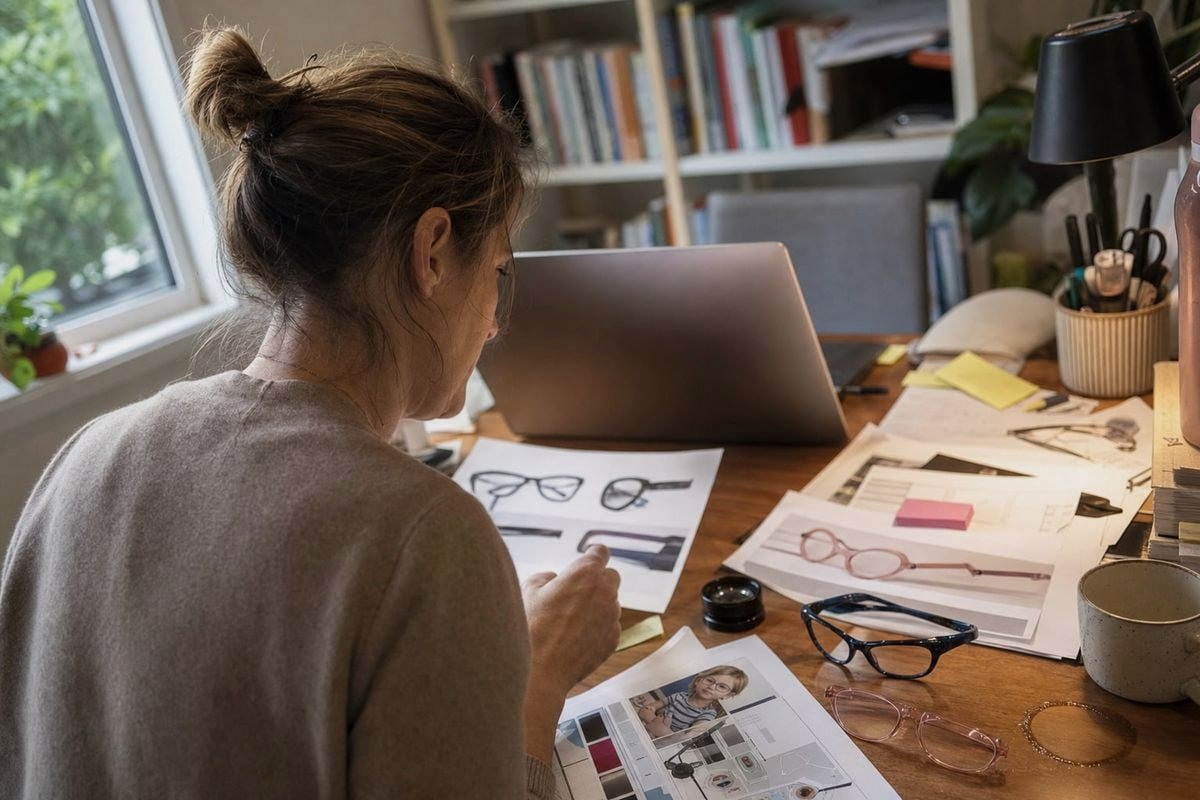
Originality checks work best when you attack the question from several angles at once. No single search is conclusive. But together, they form a solid infringement risk assessment that most lookalike products cannot survive.
Start with the design registers
Design rights are territorial. So begin with where you will actually sell. If you sell in Europe, search the Registered Community Design 2 database at the EUIPO. If you sell in the US, search USPTO design patents. The WIPO Global Design Database covers international registrations 3 and is free to use. For eyewear, filter by Locarno Class 16-06, which covers spectacles and frames. This narrows thousands of records down to a manageable set.
Compare your candidate frame against the registered drawings — not against marketing photos. Courts assess the design as registered. A frame can look different from a product photo but still match the registered views.
Then test the supplier's story
A genuine designer can show the design's history. Ask for early sketches, CAD files, first-sample photos with dates, and mold invoices. In our workshop, every one of our TR90 and TPEE styles 4 has a development file going back to the first hand sketch. A factory that "borrowed" a design cannot produce that trail.
| Check | Tool or method | What a red flag looks like |
|---|---|---|
| Register search | WIPO Global Design Database, EUIPO, USPTO | Near-identical silhouette in an active registration |
| Reverse image search | AI-powered visual search on catalog photos | Photos traced back to a protected brand's website |
| Development records | Sketches, CAD files, mold invoices | Supplier cannot show any design history |
| Side-by-side comparison | Physical sample vs. known branded frames | Only trivial differences like a changed temple tip |
| Marketplace scan | Search major e-commerce platforms | Same frame sold under a well-known brand name |
One more point buyers often miss. Reverse image lookups on supplier catalog photos are surprisingly effective. If a "factory original" photo turns out to be lifted from a designer brand's lookbook, walk away. That single finding tells you everything about the supplier's chain of title.
What questions should I ask my manufacturer to confirm they hold rights to their optical frame styles?
There's a trade-off we discuss with every new client: catalog styles are faster and cheaper than custom molds, but only if the factory genuinely owns those styles. That's why we keep ownership records for our existing designs — and why you should question any factory that can't.
Ask your manufacturer who designed the frame, who owns the design rights, whether the design is registered and still in force, whether rights were assigned from any contractor, and whether they can provide registration certificates, assignment documents, or a licence covering production and export.
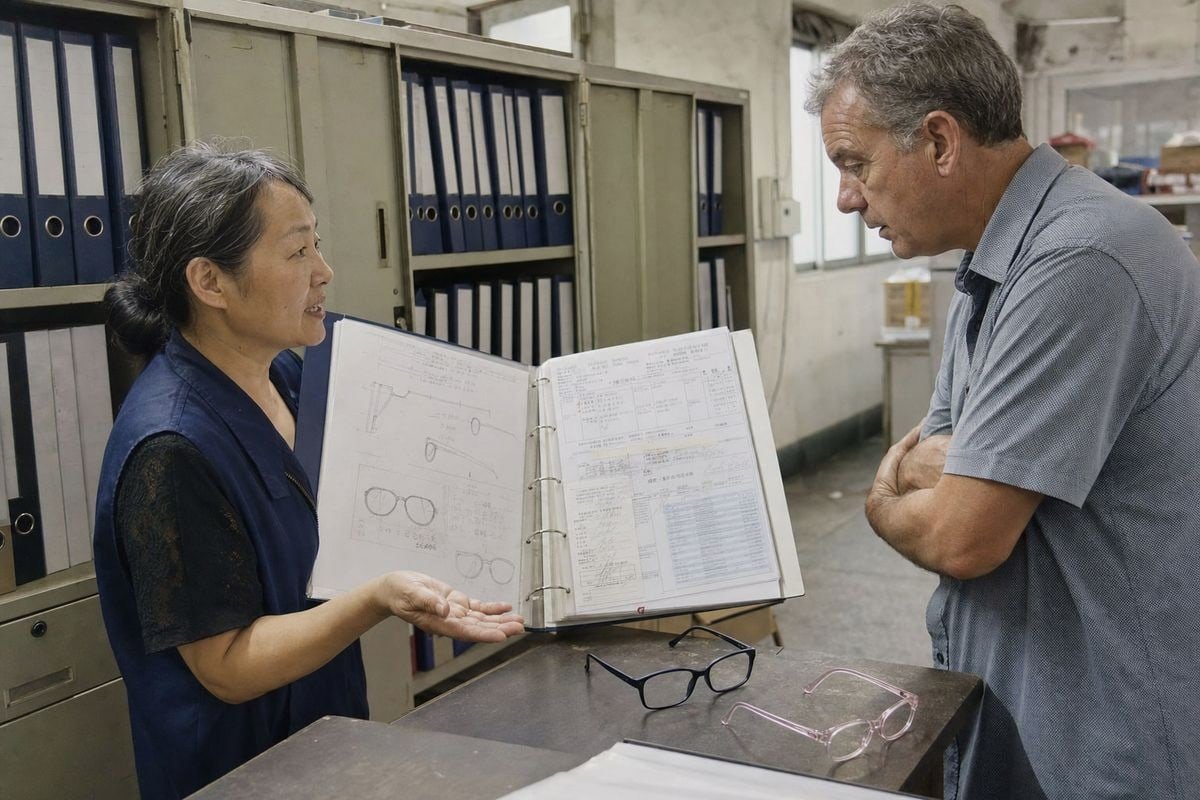
Good intellectual property due diligence starts with the right questions. Weak suppliers answer with vague reassurances. Strong suppliers answer with documents. The difference tells you almost everything about your risk level.
The core question set
Here is the list I recommend buyers send before any deposit is paid:
- Who created this design? An in-house designer, a contractor, or a third party? If a contractor designed it, ask whether rights were formally assigned to the factory. Retained rights are a common gap.
- Is the design registered, where, and under what number? A registration number lets you verify the record yourself. Also check the right is still in force — design registrations expire.
- If the design is licensed, can you show the licence? The licence must cover manufacturing, your product category, and export to your markets. A domestic-only licence does not protect your imports.
- Has this style ever received an infringement complaint or takedown notice? Marketplaces now run notice-and-takedown procedures 5 for design-right complaints. A style with a takedown history is a style with a target on its back.
- For licensed characters, who is the licensor's contact? Verify character licences with the brand owner's licensing department directly. Forged or expired certificates are common in the children's category.
- Will you sign a supplier indemnity clause in the purchase order? Watch how they react. Hesitation over indemnification usually means hesitation about ownership.
Read the answers, not just the documents
In our experience exporting to 20+ countries, the manner of the answer matters as much as the paperwork. A factory that has done real eyewear OEM manufacturing for years will answer these questions in a day. A trader reselling catalog frames from unknown molds will stall, deflect, or offer a generic "we guarantee originality" letter with no registration numbers behind it. Treat undocumented claims as high risk, even when the price is attractive.
How do I verify that custom features I request won't accidentally copy a patented design?
A lesson we learned early in our fifteen years of building children's frames: the danger zone isn't the catalog — it's the customization stage. A buyer once sent us a "reference photo" for temple modifications that turned out to be a patented flexible-hinge design. We caught it before tooling.
Verify custom features by searching both design patents and utility patents before tooling, checking functional elements like screwless hinges and flexible bridges under CPC code G02C, comparing your modified design's overall impression against active registrations, and documenting a freedom to operate analysis for each target market.
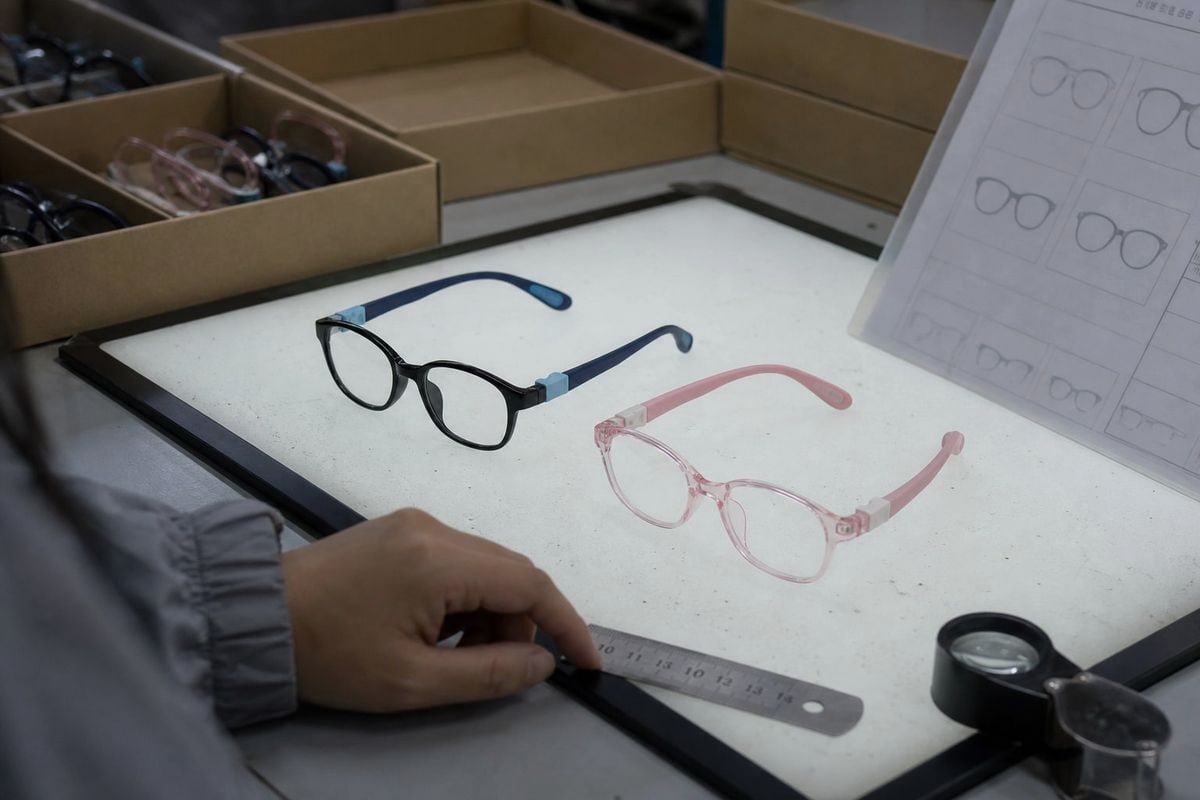
Custom work creates two separate risks, and buyers usually only think about one of them. The first is the design right — the frame's ornamental appearance. The second is the utility patent 6 — how a feature works. Children's eyewear is full of both.
Design risk versus functional risk
Take a frame like our flexible TR90 style with TPEE temples, silicone hinge connectors, and adjustable ear hooks. The rounded front shape and dotted temple texture are appearance questions, covered by design rights and possibly trade dress protection. But the hinge mechanism, the flexible bridge behavior, and the material system are function questions. Functional innovations — 360-degree rotating hinges, screwless assemblies, proprietary flexible polymers — are often protected by utility patents even when the frame shape itself is generic. Buyers who only run a design patent search walk straight into these functional patent traps.
| Risk type | What it covers | Where to search | Example in kids' frames |
|---|---|---|---|
| Registered design | Ornamental shape and surface decoration | WIPO Global Design Database, EUIPO RCD, USPTO design patents | Front silhouette, temple pattern, two-tone styling |
| Utility patent | How a feature works technically | USPTO, Google Patents under CPC G02C | Screwless hinge, rotating temple joint, flex-bridge system |
| Trade dress | Distinctive overall look tied to a brand | Trademark registers, market comparison | A signature frame shape consumers link to one brand |
| Unregistered design right | Recent original designs in some regions | Prior art search, market and archive review | New-season styles from EU or UK designers |
The safe workflow for custom requests
Do a prior art search before you commit to tooling, not after. First, define the feature precisely — "silicone hinge connector with downward-curving ear hook," not "flexible temple." Second, search design registers for the appearance and patent databases for the mechanism. Third, compare multiple views: front, side, and perspective, because courts judge frames as consumer goods seen in use. Fourth, if your custom frame lands close to an active registration, change enough elements to shift the overall impression — one altered detail rarely does it. We often propose alternative hinge geometries or bridge profiles to move a design safely away from a protected zone while keeping the comfort and safety performance the client wants.
What documentation should I request from my factory to protect my brand from IP disputes?
When we onboard a new brand client, we send a document pack before they ask for it — registration extracts, material certificates, and a signed authorization for the styles they've chosen. We do this because we've seen what happens to buyers who ordered on trust alone.
Request a Letter of Authorization for each style, copies of design registration certificates and assignment or licence documents, the original tech pack, a signed indemnification clause in your purchase order, traceability records with batch codes, and your own dated clearance file of searches and comparisons.
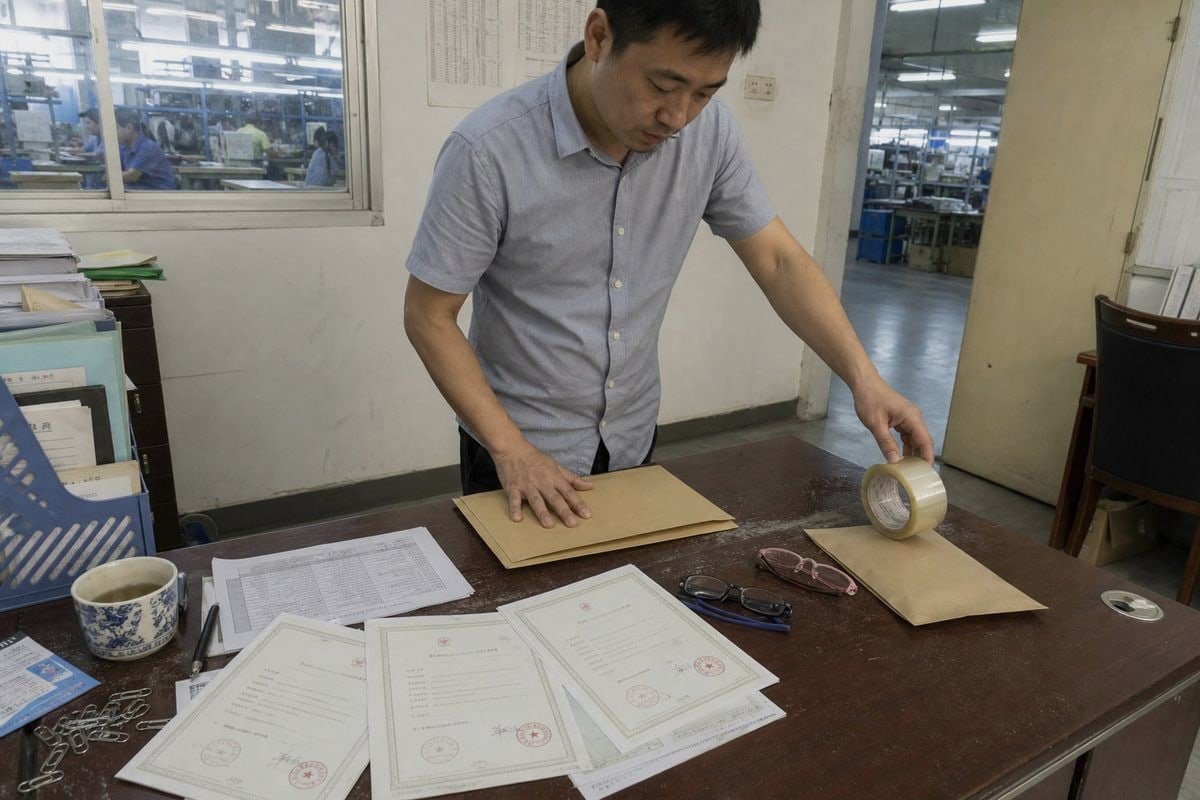
Documentation is your insurance policy. If a rights holder ever challenges your kids' optical frames, the difference between a manageable dispute and a disaster is what sits in your files on day one.
The document pack, item by item
| Document | Who provides it | Why it protects you |
|---|---|---|
| Letter of Authorization (LOA) | Factory | Proves the factory grants you the right to sell the specific frame style |
| Design registration certificates | Factory or rights holder | Confirms the design is registered, and lets you verify it is still in force |
| Assignment or licence documents | Factory | Shows the chain of title from designer to manufacturer to you |
| Original tech pack | Factory | Establishes the design's provenance and exact specifications |
| Indemnification clause in the PO | Both parties | Shifts financial responsibility for third-party claims to the supplier |
| Batch codes and traceability records | Factory | Meets GPSR-style traceability expectations and exposes "ghost shift" production |
| Your clearance file | You | Dated searches, screenshots, and comparison sheets prove good-faith diligence 7 |
Two honest caveats
First, supplier indemnity clauses are only as strong as the supplier's ability to pay. A small trading company's indemnity may be worthless against a major eyewear conglomerate's claim. That is one reason to work with an established factory rather than a middleman — a real production partner has assets, a reputation, and fifteen years of history to protect.
Second, your own clearance file matters more than buyers expect. Keep the search logs, dated screenshots of register extracts 8, supplier emails, and side-by-side comparison photos in one folder per style. This evidence does not guarantee non-infringement. But if a dispute arises, it demonstrates good-faith clearance, which shapes how regulators, marketplaces, and courts treat you. And if any frame still sits uncomfortably close to a known design after all this, get a written opinion from local IP counsel in your selling country before the inventory ships. That opinion costs far less than a seized container.
Also remember that IP clearance and safety compliance are separate tracks. A frame can pass every drop test and lens standard and still infringe a registered design. Run both checklists before purchase, not one or the other.
Conclusion
Skipping design clearance turns kids' optical frames into a legal gamble. Search the registers, question your factory, document everything — and partner with a manufacturer who welcomes the scrutiny.
Footnotes
1. International classification system used for the registration of industrial designs and spectacles. ↩︎
2. Official EUIPO page explaining the unified design protection system across all European Union member states. ↩︎
3. The Hague System for the international registration of industrial designs managed by WIPO. ↩︎
4. Authoritative .gov (NIH) review of spectacle frame materials, specifically covering TR90 and thermoplastic elastomers. ↩︎
5. Legal process for online platforms to remove content upon notification of IP infringement. ↩︎
6. Authoritative .edu legal resource providing a stable, accessible definition of utility patents without access restrictions. ↩︎
7. The standard of care and effort a person or business is expected to take in a given situation. ↩︎
8. Official documentation providing details of a registered design from a national or regional register. ↩︎
More Articles You Might Like
August 5, 2026
Bio-Based vs Regular Cellulose Acetate: What's the Difference for Kids' Frames?

August 5, 2026
How Recyclable Are Kids' Optical Frame Materials, and What Eco-Friendly Alternatives Exist?
August 5, 2026
Do Kids Optical Frames Whiten or Age in Storage, and How to Control Warehouse Conditions?
Looking for a Reliable Kids Eyewear Partner?
Explore 800+ ready styles and full OEM/ODM support tailored to your brand.
Get in Touch English
  Español de México
  Deutsch
  Français
  日本語
日本語  العربية
  Português do Brasil