How to Compare B2B Platforms, Trade Shows, and Sourcing Agents for Kids’ Optical Frames from China?

Choosing how to compare B2B platforms, trade shows, and sourcing agents for kids’ optical frames from China is a question buyers ask our Taizhou factory almost weekly acetate 1. Pick the wrong channel, and you waste months chasing suppliers who look great online but fail at sample stage. Worse, a child wears the result. The good news: each channel has a clear, learnable role.
Compare the three channels by function, not price. B2B platforms are best for fast supplier discovery and shortlisting. Trade shows are best for hands-on quality inspection and relationship building. Sourcing agents are best for on-the-ground execution, factory audits, and quality control coordination. Most successful buyers combine all three.
Below, I break down each channel one by one. I will show you what each does well, where each fails, and how to build a hybrid proce 2ss that actually protects your brand.
What should I look for when comparing B2B platforms for kids' optical frame suppliers?
A buyer from Australia once told me she had messaged forty suppliers on Alibaba before finding our listing. Only six turned out to be real factories. That ratio is normal, and it explains why platform screening skills matter so much.
Compare B2B platforms on supplier verification depth, listing transparency, and test-order support. Check whether listings show real MOQ, materials like TR90, and compliance claims. Alibaba offers breadth and trade assurance programs, Made-in-China leans factory-direct, and Global Sources is more curated with stricter vetting.

Platforms are discovery tools. They are not verification tools. In our fifteen years exporting children's eyewear, we have seen buyers treat a gold badge as proof of quality. It is not. A badge means a supplier paid for membership and passed a basic check. It does not tell you whether the factory can hold hinge-torque consistency across 5,000 kids' frames.
The three major platforms compared
| Platform | Best For | Vetting Level | Typical Weakness |
|---|---|---|---|
| Alibaba | Broadest supplier pool, OEM/ODM search, trade assurance programs | Basic to moderate | Trading companies mixed with factories |
| Made-in-China | Factory-direct sourcing, competitive pricing | Moderate | Fewer niche kids' eyewear specialists |
| Global Sources | Curated, mid-to-high-end suppliers | Stronger | Smaller pool, fewer small workshops |
What a strong listing actually shows
When you scan listings for children's optical frames, look for specifics, not adjectives. A serious eyewear manufacturer in China will state frame materials clearly — TR90 frames 3, TPEE temples, acetate, or titanium — and will publish real Minimum Order Quantity figures per color and per style. Vague phrases like "high quality" with no material data are a red flag.
Also check compliance language. Suppliers often advertise CE, UV400 4, or CPSC compliance claims. Never accept these at face value. Ask for certificate copies, test reports covering lead and phthalates testing, and the business license. On our side, we keep these documents ready before a buyer asks, because buyers who serve children's brands always ask eventually.
Finally, use platforms for what they are good at: build a shortlist of five to eight candidates, then move verification offline. Video factory tours, sample orders of 3–5 units, and third-party checks come next. The platform's job ends at the shortlist.
Are trade shows still worth attending when sourcing kids' eyewear manufacturers from China?
At the last optical fair our team exhibited at, a Japanese buyer spent twenty minutes just flexing our TPEE temples back and forth. He said no photo had ever told him what that flex felt like. That moment sums up why fairs still matter.
Yes, trade shows remain worth attending for kids' eyewear sourcing. Fairs like the Hong Kong Optical Fair, China International Optics Fair (CIOF), Wenzhou Optical Fair, and Shanghai SIOF let you physically test frame flexibility, hinge action, and finish quality, and meet dozens of vetted manufacturers in two or three days.
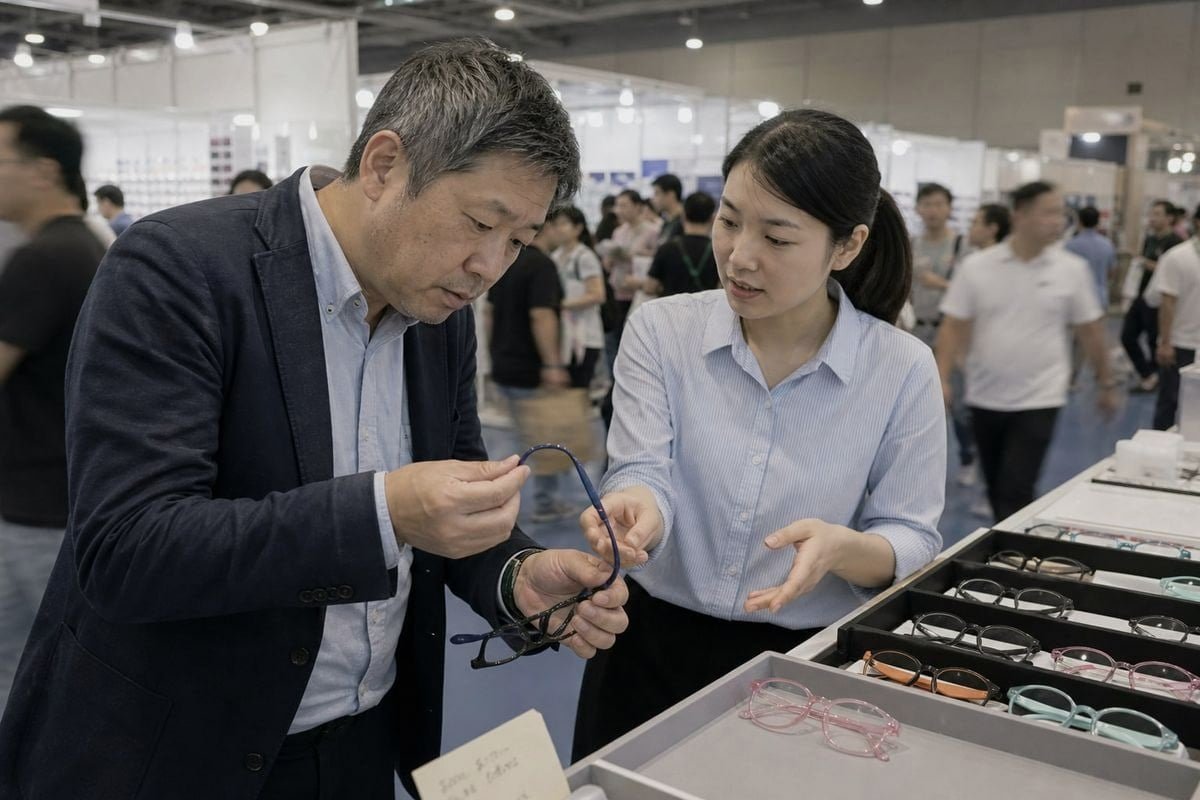
Some buyers argue trade shows are old-fashioned now that video calls exist. I understand the objection — travel is expensive, and fairs run only on fixed dates. But for children's frames specifically, the objection falls apart. You cannot judge nose-pad comfort, plating adhesion, slip resistance, or how a frame recovers after a twist through a screen. Kids sit on their glasses. They throw them in schoolbags. Tactile evaluation is not optional in this category.
Key optical fairs worth planning around
| Fair | Location | Why It Matters for Kids' Frames |
|---|---|---|
| Wenzhou Optical Fair (WOF) | Wenzhou | Close to a major eyewear production cluster; many true factories exhibit |
| CIOF | Beijing | Large international optics fair with broad manufacturer attendance |
| SIOF | Shanghai | Strong mix of OEM/ODM manufacturers and export-focused suppliers |
| Hong Kong Optical Fair | Hong Kong | International buyer base, good for meeting export-experienced factories |
How to work a fair efficiently
Prepare a fixed question list and ask every booth the same things: material grades, MOQ per color, mold costs for custom shapes, lead times, and which safety tests they run for children's products. Consistent questions make comparison honest.
One warning from our side of the booth: trade show samples are hand-finished showpieces. Mass production can differ. Always follow up a fair meeting with a paid sample order and, ideally, a factory visit or third-party quality control inspection before committing to a seasonal program. The fair reveals who is serious. Production proves who is capable.
How do I know if a sourcing agent is reliable for children's optical frame production?
We work alongside sourcing agents regularly, and the difference between good and bad ones is stark. The best agent we ever hosted spent a full day in our 5S-managed workshop, photographed our injection machines, and cross-checked our export records. The worst never visited at all — he just forwarded our catalog with a markup.
A reliable sourcing agent proves independence and process. They provide factory audit reports with photos, disclose their fee structure openly, arrange lead and phthalates testing through third-party labs, and let you communicate directly with the factory. Hidden commissions and blocked factory contact are the two biggest warning signs.
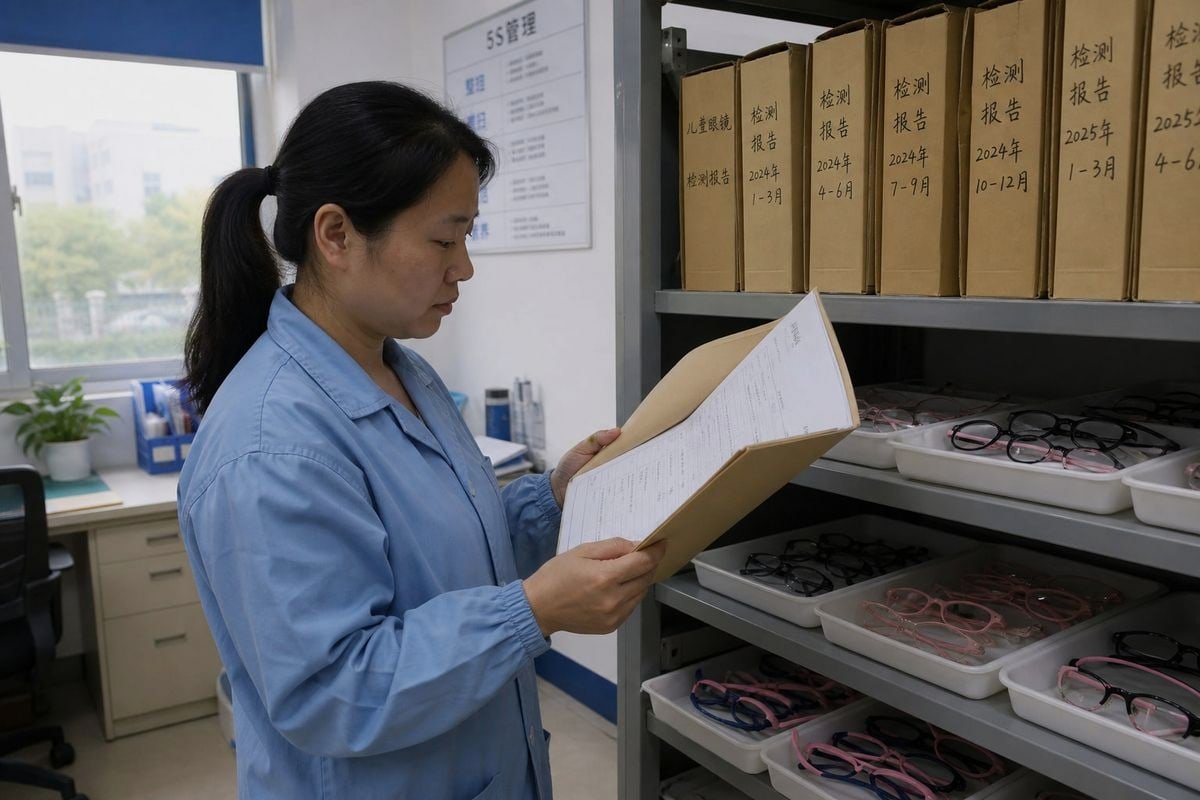
Agents solve real problems. They bridge language gaps, navigate domestic platforms like 1688.com, manage payments, and coordinate logistics in the Chinese time zone. For a first-time importer or a small kids' brand without sourcing staff, that support is genuinely valuable.
But agents also introduce two risks buyers should confront directly. First, cost: fees or commissions reduce your margin. Second, conflict of interest: some agents steer you toward factories that pay them, not toward the best fit for your product. The answer to both is transparency testing.
A vetting checklist for sourcing agents
- Ask how they are paid. A flat service fee or disclosed percentage is fine. Vague answers about "included in the price" are not.
- Request a sample factory audit report from a past project. It should include photos, machine lists, worker counts, and license copies.
- Confirm they will verify children's product compliance — including a Children's Product Certificate (CPC) 5 for the US market and CPSC compliance testing 6 — not just visual quality checks.
- Insist on direct factory introductions. A good agent facilitates the relationship; a controlling one hides it.
- Check their quality control process: incoming material checks, in-line inspection, and pre-shipment inspection with an AQL standard 7.
When an agent adds the most value
Agents earn their fee when oversight matters more than the lowest unit cost — private-label programs, first orders with a new factory, or buyers who cannot travel. In our experience, brands that pair a competent agent with a genuinely capable factory get fewer surprises than brands chasing the cheapest quote alone. The savings from avoiding one bad shipment usually cover the agent's fee several times over.
Which sourcing method gives me the most control over quality and communication with my factory?
A European distributor once asked me why his previous supplier's frames snapped at the bridge after two months. The answer was simple: he had never spoken to the actual factory. Three intermediaries stood between his spec sheet and the injection machine.
A direct factory relationship gives you the most control over quality and communication, especially after platform screening or trade show validation. Direct contact lets you approve materials, review pre-production samples, set inspection standards, and resolve issues in hours instead of weeks — with no intermediary filtering your requirements.
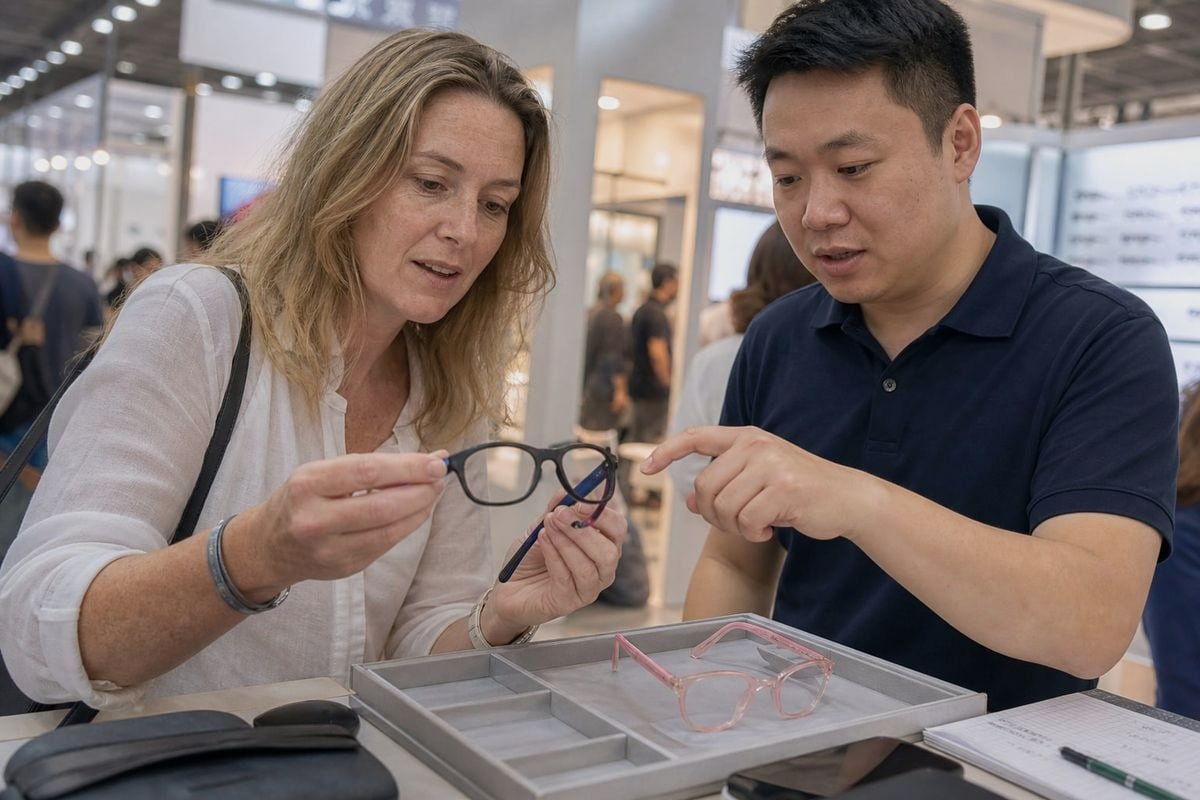
Control is not a single thing. It breaks into four parts: control over specifications, control over materials, control over inspection, and control over timing. Each channel handles these differently.
Control comparison across the three channels
| Control Dimension | B2B Platform Only | Trade Show + Follow-Up | Sourcing Agent | Direct Factory Relationship |
|---|---|---|---|---|
| Specification accuracy | Medium | High | Medium–High | High |
| Material verification | Low | Medium | High (with lab tests) | High |
| Inspection authority | Low | Medium | High | High |
| Communication speed | Medium | Medium | High | Highest |
| Learning about your product | Low | Medium | Low | High |
Why direct communication compounds over time
The first order with any supplier is the hardest. But with a direct relationship, every order teaches the factory your standards. At our facility, repeat buyers get color libraries, retained tooling settings, and packaging templates on file. Our engineers already know a specific brand's tolerance preferences for temple flex and hinge tension. An agent-mediated relationship rarely builds that memory, because the buyer's knowledge stays with the agent.
Direct control also matters for import regulations eyewear buyers must meet. If your market requires specific optical standards, migration limits, or labeling rules, you want the factory to hear that requirement from you, in writing, with no translation loss. This is why we always encourage even agent-supported buyers to join sampling calls directly.
The practical path is hybrid: discover on platforms, validate at a fair or by video audit, use an agent for the first quality control inspection cycle if you need one, then shift to a direct, documented relationship for repeat production. Control grows at each step. For a category as sensitive as children's optical frames, that progression is the safest route from shortlist to reliable supply.
Conclusion
No single channel wins everything. Platforms deliver speed, fairs deliver certainty, and agents deliver execution. For kids' optical frames, combine all three — then build a direct factory relationship that protects quality for years.
Footnotes
1. Provides information on cellulose acetate as a common material for eyewear frames. ↩︎
2. Official information on the CE marking for products sold in the European Economic Area. ↩︎
3. Explains the properties and benefits of TR90 material for eyewear. ↩︎
4. Replaced broken link with an authoritative source (All About Vision) explaining UV400 protection in sunglasses. ↩︎
5. Official CPSC guide on the requirements for a Children’s Product Certificate in the US. ↩︎
6. Official CPSC resource for businesses regarding product safety testing and certification. ↩︎
7. Explains the Acceptable Quality Limit (AQL) and its importance in quality control processes. ↩︎
More Articles You Might Like
August 5, 2026
Bio-Based vs Regular Cellulose Acetate: What's the Difference for Kids' Frames?

August 5, 2026
How Recyclable Are Kids' Optical Frame Materials, and What Eco-Friendly Alternatives Exist?
August 5, 2026
Do Kids Optical Frames Whiten or Age in Storage, and How to Control Warehouse Conditions?
Looking for a Reliable Kids Eyewear Partner?
Explore 800+ ready styles and full OEM/ODM support tailored to your brand.
Get in Touch English
  Español de México
  Deutsch
  Français
  日本語
日本語  العربية
  Português do Brasil