How to Calculate Volumetric Weight and Optimize Packing for Kids Optical Frames?
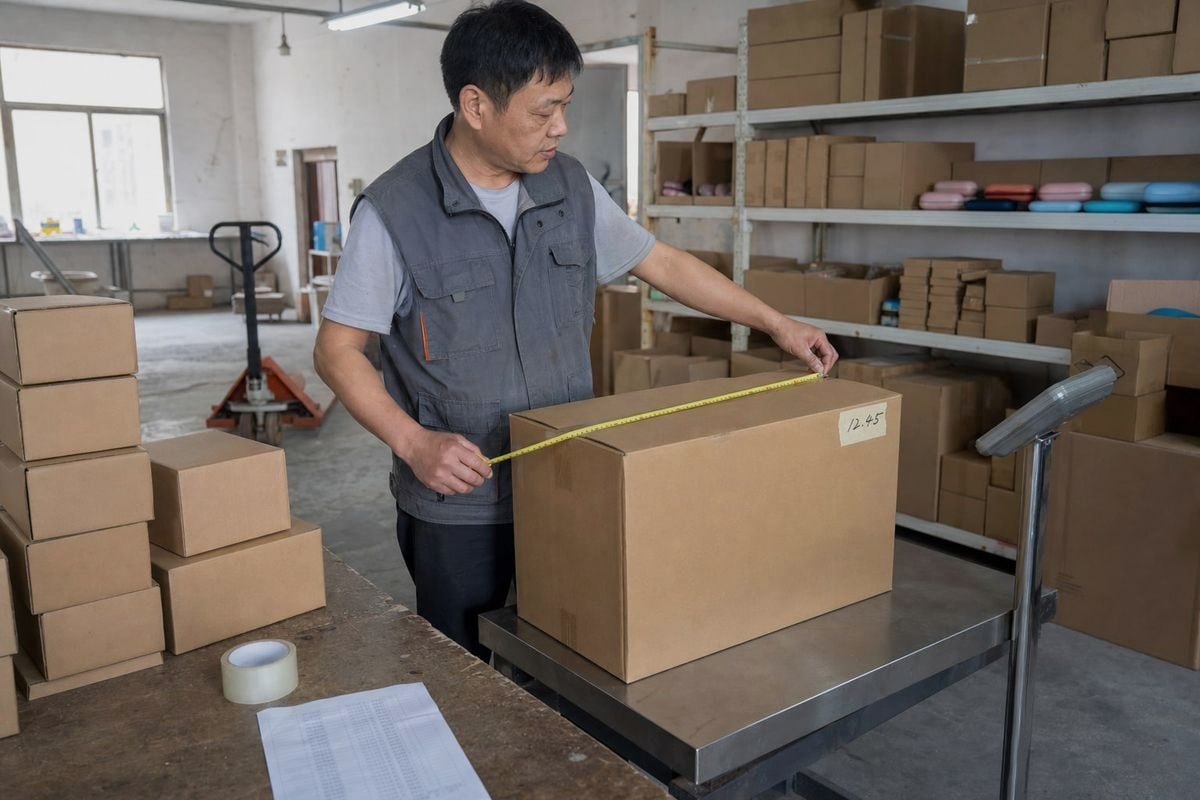
Volumetric weight for kids optical frames surprised one of our first export clients years ago. Their frames weighed almost nothing, yet the freight invoice looked like they shipped bricks.
To calculate volumetric weight for kids optical frames, multiply the carton’s length, width, and height in centimeters, then divide by the carrier’s DIM factor (usually 5000 or 6000). Carriers bill the higher of volumetric or actual weight, so compact, well-designed packaging directly cuts shipping costs.
The math is simple. The savings are real. Let me walk you through the formula, the packing tactics, and the supplier questions that protect your freight budget.
How do I calculate volumetric weight for kids optical frame shipments?
A buyer from Australia once asked me why her 40 kg shipment was billed at 68 kg. Our team pulled out a tape measure and showed her the answer in five minutes.
Measure the sealed outer carton in centimeters, multiply length × width × height, and divide by the DIM factor divisor: 5000 for most express couriers, 6000 for most air freight. Compare that result with the actual scale weight. The carrier charges whichever figure is higher.
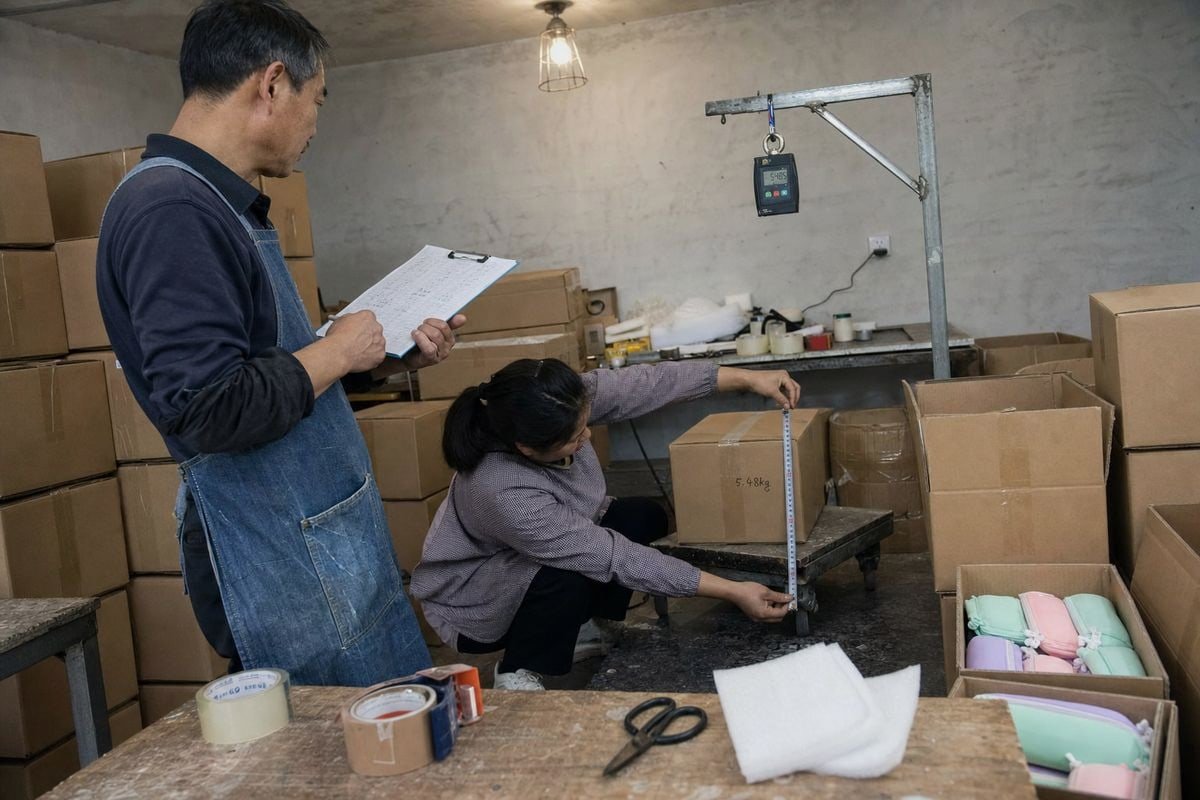
The dimensional weight formula 1 exists because carriers sell space, not just lifting power. A plane or truck fills up by volume long before it hits its weight limit. Kids optical frames are the classic problem product here. They are light, small, and wrapped in protective layers, so the parcel often contains more air than product.
The three weights you must know
Do not confuse these three numbers. Each one plays a different role in your landed cost calculation 2.
| Term | What it means | Who uses it |
|---|---|---|
| Actual weight | The scale weight of the sealed carton | Everyone, as the baseline |
| Volumetric weight | L × W × H ÷ DIM factor divisor | Carriers, to price space usage |
| Chargeable weight | The higher of the two above | Your invoice |
A worked example with a real eyewear carton
Suppose your sealed master carton measures 30 cm × 20 cm × 10 cm. That gives a volume of 6,000 cm³.
- At a divisor of 5000 (typical for DHL-style express): 6,000 ÷ 5000 = 1.2 kg volumetric weight.
- At a divisor of 6000 (typical for air freight 3): 6,000 ÷ 6000 = 1.0 kg volumetric weight.
Now weigh the carton. A dozen TR90 4 kids frames with cases might total only 0.9 kg. In both scenarios, the carrier bills the volumetric figure, not the scale figure. The smaller the divisor, the higher your carrier billing weight for the same box.
Two measurement rules matter. First, always measure the outermost dimensions after sealing, including any bulge from tape or straps. Carriers scan parcels with automated dimensioning equipment, and they round up. Second, many couriers round the chargeable weight up to the next half or full kilogram. A 1.2 kg volumetric result can become a 1.5 kg billed weight. When we quote freight estimates for clients at our Taizhou factory, we always build in that rounding so the invoice never shocks anyone.
What packaging choices can help me reduce volumetric weight and shipping costs?
There is a trade-off we weigh on every packing job: shrink the carton to save freight, or add protection to prevent breakage. For flexible TR90 and TPEE frames, the answer is usually smarter, not bigger.
Choose the smallest carton that safely fits the frames, replace bulky void fill materials with form-fit inserts, nest frames in an opposing-temple orientation, and standardize a few optimized box sizes. Every centimeter you remove from any dimension lowers the volumetric weight and your freight bill.

Dead air is your enemy. Guidance from packing engineers is consistent: keep internal clearance under about 1 cm per side. Anything more is space you pay to ship. Here is how we attack that space, layer by layer.
Layer-by-layer optimization
| Layer | Bulky approach | Optimized approach | Effect on volume |
|---|---|---|---|
| Frame protection | Loose bubble wrap | Microfiber pouch | Slimmer per unit |
| Case | Rigid clamshell, oversized | Slim semi-hard or folding case | Cuts height per unit |
| Inner box | Universal adult-size box | Age-segmented, form-fit carton | Removes headspace |
| Inserts | Plastic foam blocks | Compressed molded pulp 5 trays | High protection, low profile |
| Master carton | Oversized with fillers | 3-ply corrugated 6, snug fit | Lowest cubic total |
Tactics that deliver the biggest wins
Nesting orientation matters more than most buyers expect. When we bulk pack for wholesale orders, we interlock frames front-to-front with opposing temples. That simple rotation can reduce stack height meaningfully, sometimes by up to a fifth of the cubic volume, because temples no longer stack on top of each other.
Age-segmented carton sizing is another easy win. A toddler frame is much smaller than a pre-teen frame. If your supplier packs both in the same standard optical box, the toddler shipment carries pure air. We keep separate inner-box sizes for our smaller sizes precisely for this reason.
Also separate transit packaging from retail packaging where possible. A beautiful printed retail box does not need to double as the shipping protector. Ship retail boxes flat or nested, and let a dense master carton with molded pulp cradles do the protective work. Your packaging density goes up, your shipping box dimensions go down, and nothing arrives scratched.
One warning from experience: never optimize past the point of protection. A crushed hinge or scratched demo lens costs far more in returns and reputation than the freight you saved. Test any new packing configuration with a drop test before committing a full production run.
How does OKAY EYEWEAR design retail-ready packaging that stays lightweight and space-efficient?
During a packaging redesign for a European kids brand last year, our team cut their master carton volume by roughly a quarter without changing a single frame — just by rethinking the case and insert system.
OKAY EYEWEAR designs retail-ready packaging around slim cases, form-fit molded trays, age-segmented inner boxes, and standardized master cartons matched to carrier DIM factors. As a full OEM/ODM factory, we customize branding, colors, and accessories while keeping every layer as compact and protective as possible.

Our approach starts from a simple belief: packaging is part of the product for a kids eyewear brand, but it should never be part of the freight problem. With around 800 existing styles in our catalog, we have packed nearly every frame shape and size that fits a child's face, and that experience shapes how we design each packaging program.
Our packing workflow, step by step
- Match the case to the frame. A small TR90 toddler frame gets a smaller, slimmer case. We never force a compact frame into an adult-size case just because it is on the shelf.
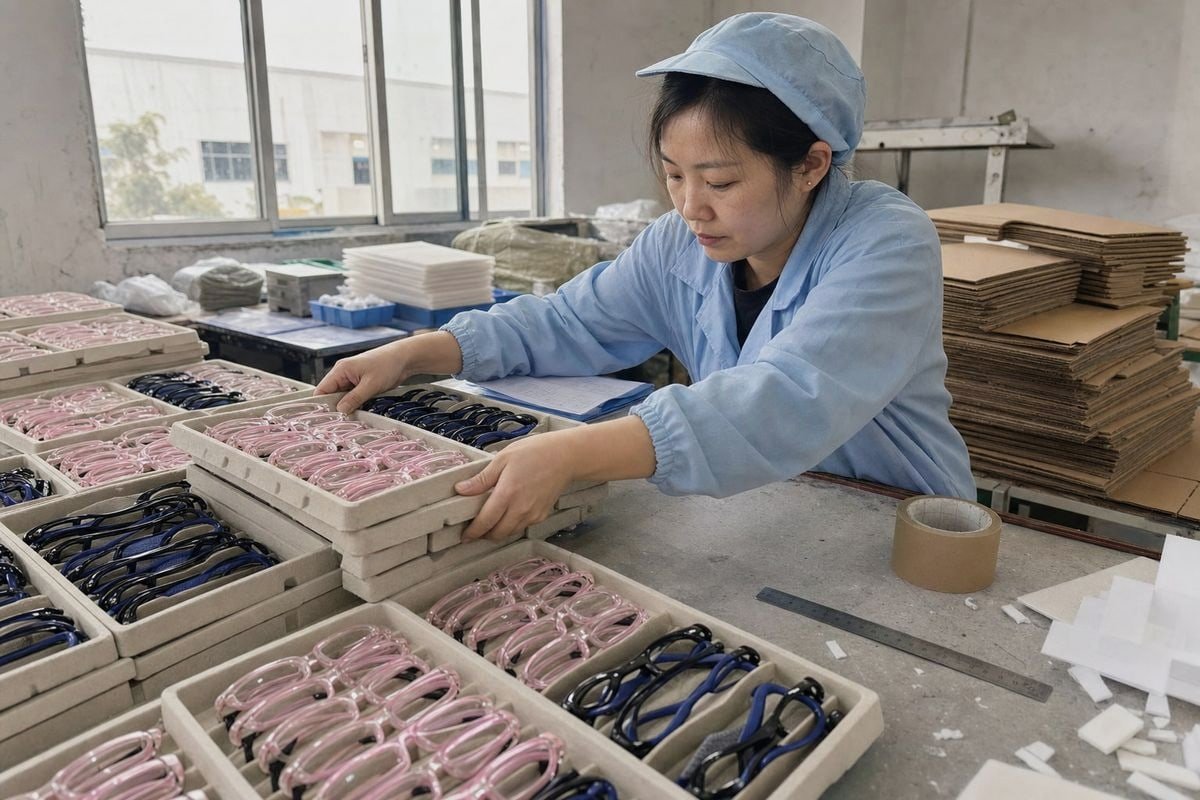
- Design the insert around the case. We favor compressed molded pulp and paperboard cradles over thick plastic foam. They absorb shock well, weigh less, and hold a much lower volumetric profile.
- Consolidate into standardized inner boxes. Retail units go into uniform inner boxes that tile perfectly inside the master carton, leaving no gaps and no need for extra void fill.
- Size the master carton to the divisor. Before we finalize dimensions, we run the dimensional weight formula for the client's usual carrier. Sometimes trimming 1 cm from carton height drops the chargeable weight by a full billing increment.
- Verify after sealing. Our QC team measures and weighs sealed cartons on the line, because bulges and taping add real millimeters. The dimensions on the packing list must match what the courier's scanner will see.
Because we are the factory — about 120 workers, 15 years in eyewear, a 5S-managed workshop in Taizhou — the packaging engineers and the production line sit under one roof. When a client wants custom logos, hangtags, cleaning cloths, or demo lenses included, we adjust the insert design at the same time so accessories never inflate the carton. That integration is what keeps a fully branded, retail-ready shipment as light and dense as a plain bulk one.
Flexible materials help too. TPEE temples and TR90 fronts tolerate snug packing better than brittle acetate 7, which lets us pack tighter with confidence. Protective eyewear packaging does not need to be bulky when the frames themselves are resilient.
What should I check with my supplier before shipping to avoid unexpected freight charges?
A hard lesson from our early exporting years: a client quoted their retail prices using our estimated carton size, then the final artwork added a thicker gift box. Their margin on that first order nearly vanished.
Before shipping, confirm the sealed outer carton dimensions and weight, the units per carton, the carrier's current DIM factor divisor and rounding rules, and whether packaging changes altered the original quote. Request the final packing list before booking freight, not after.
Freight cost optimization starts long before the goods leave the factory. Most unexpected charges trace back to a gap between what the buyer assumed and what the supplier actually packed. Close that gap with a written checklist.
Pre-shipment freight checklist
| Question to ask | Why it matters |
|---|---|
| What are the sealed outer carton dimensions? | Volumetric weight uses outermost measurements, including tape and bulge |
| What is the actual gross weight per carton? | You need both figures to predict the chargeable weight |
| How many units per inner box and per master carton? | Determines per-unit freight cost and reorder planning |
| Which DIM factor divisor applies to my route? | 5000 vs 6000 changes the billed weight materially |
| Does the carrier round up to the next kg or half kg? | Rounding can add a full billing increment per carton |
| Did any packaging change since the quote? | New gift boxes or inserts can silently grow the carton |
| Can you send photos of the sealed carton with a tape measure? | Verifies dimensions before the invoice arrives |
Fold freight into your landed cost early
We encourage buyers to run the landed cost calculation at the sampling stage, not at booking. Ask your supplier for the projected carton dimensions with the final packaging, then run both divisors. If volumetric weight exceeds actual weight by a wide margin, that is your signal to revisit the packing configuration before mass production.
For bulk eyewear shipping, also compare modes. Sea freight bills largely by cubic meter 8, so a dense, well-packed carton pays off there too, just through a different formula. Express courier suits small reorders; air freight suits mid-size launches; sea suits large seasonal programs. The best carton for one mode and divisor may not be best for another, so audit your packaging by route at least once a year.
Finally, insist on clear communication. A good supplier will flag dimension changes proactively. At our factory, we send the confirmed packing details — carton size, gross weight, units per carton — with every order confirmation, because surprises on a freight invoice damage trust faster than almost anything else.
Conclusion
Volumetric weight, not scale weight, drives shipping costs for kids optical frames. Measure sealed cartons, apply the right divisor, pack densely, and confirm details with your supplier early.
Footnotes
1. Defines the core industry concept the article’s calculations are based on. ↩︎
2. Defines the total cost concept the article recommends calculating early with suppliers. ↩︎
3. IATA governs air cargo standards including DIM factor conventions mentioned in the article. ↩︎
4. TR90 is a nylon-based polyamide material referenced throughout the packaging discussion. ↩︎
5. Explains the molded pulp packaging material used for protective inserts. ↩︎
6. Explains the corrugated fiberboard material used for master carton construction. ↩︎
7. Defines the brittle acetate material contrasted with flexible TPEE and TR90. ↩︎
8. Clarifies the volume unit used for sea freight billing mentioned in the article. ↩︎
More Articles You Might Like

August 5, 2026
Bio-Based vs Regular Cellulose Acetate: What's the Difference for Kids' Frames?

August 5, 2026
How Recyclable Are Kids' Optical Frame Materials, and What Eco-Friendly Alternatives Exist?

August 5, 2026
Do Kids Optical Frames Whiten or Age in Storage, and How to Control Warehouse Conditions?
Looking for a Reliable Kids Eyewear Partner?
Explore 800+ ready styles and full OEM/ODM support tailored to your brand.
Get in Touch English
  Español de México
  Deutsch
  Français
  日本語
日本語  العربية
  Português do Brasil