How to Calculate Landed Cost for Kids’ Optical Frames from Factory to Warehouse?

Landed cost for kids’ optical frames trips up many new buyers I meet. They budget from our factory quote, then freight, duties, and broker fees quietly eat their margin. It hurts. The fix is a [complete, per-unit calculation](https://okayeyewear.com/how-calculate-total-landed-cost-kids-sunglasses-beyond-unit-price/) before you order.
Landed cost for kids’ optical frames equals factory unit price plus international freight, customs duties and import taxes, cargo insurance, brokerage and port handling fees, and inland delivery to your warehouse — all divided by the number of frames in the shipment to get a true per-unit cost.
That is the short answer. Now let me walk you through each piece, with real numbers, so you can price your frames with confidence.
What Costs Should I Include Beyond the Factory Unit Price?
A buyer from Australia once told me our quote looked "too good." She was right to check. Our FOB price covered the frames — not the seven other costs waiting after the port.
Beyond the factory unit price, include international freight, marine cargo insurance, customs duties and taxes, import brokerage fees, port handling fees, inland haulage charges, compliance testing costs, and any one-time mold or sampling fees amortized across your order volume.

The factory quote is only the starting line. In our fifteen years of exporting kids' eyewear from Taizhou, I have seen the gap between factory price and true landed cost 1 range from 15% to over 40%. The variation depends on shipment size, destination, and how well the buyer planned.
The Full Cost Stack
Here is every category you should track for a shipment of children's optical frames:
| Cost Category | What It Covers | Typical Behavior |
|---|---|---|
| Product cost | Factory price per frame (EXW or FOB) | Variable per unit |
| International freight | Air or ocean transport to destination port | Semi-fixed per shipment |
| Cargo insurance | Marine cargo insurance on shipment value | Small % of invoice value |
| Duties and taxes | Customs duties and taxes, VAT/GST | % of declared value |
| Brokerage | Import brokerage fees, customs filing | Fixed per entry |
| Port charges | Port handling fees, terminal charges | Fixed per shipment |
| Inland transport | Inland haulage charges, port to warehouse | Fixed per delivery |
| Compliance | CPSIA or EN71 lab testing for children's products | Fixed per production run |
| Tooling | OEM mold fees for custom pediatric sizes | Amortize over lifecycle volume |
Two Costs Buyers Forget Most
First, compliance testing. Kids' frames are children's products. Markets like the US require lab testing for lead and phthalates 2 under CPSIA; the EU applies EN71 logic. That testing fee is fixed per production run, so spread it across all units in the run.
Second, quality control inspection costs. Many buyers hire a third-party inspector 3 before shipment. That fee belongs in landed cost too. At our factory, we run 5S-managed workshop QC internally, but I still encourage new buyers to budget for their own inspection on the first one or two orders. Trust is built, not assumed.
One more nuance: because we hold around 800 existing styles, most of our buyers avoid mold fees entirely. If you do commission a custom pediatric size, amortize the mold over the style's projected lifetime volume — not just the first order — or your first-batch unit cost will look artificially terrible.
How Do Duties and Import Taxes Affect My Landed Cost for Kids' Frames?
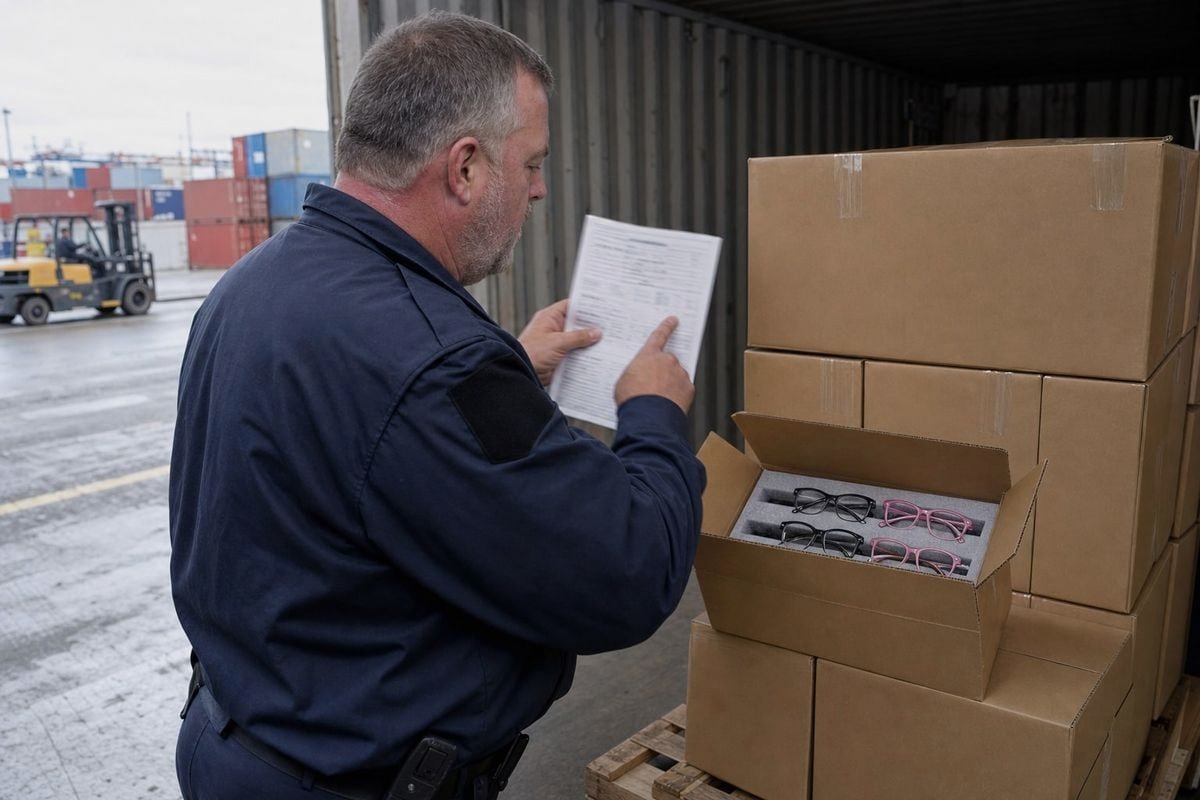
When we prepare export documents for a new market, the first thing I confirm with the buyer is the tariff classification. One wrong digit in the HTS code for eyewear can shift the duty bill noticeably.
Duties and import taxes typically add 2% to 8% for standard eyewear classifications, plus destination VAT or GST calculated on product value plus duty. Correct HS code selection — 9003.11 for plastic frames, 9003.19 for other materials — is the single biggest driver of the final rate.
Duties are not one number. They depend on three things: the classification, the country of origin, and the destination market's tax system. Let me break each down.
Classification Comes First
Frames of plastics generally fall under HS 9003.11. Frames of other materials, including metal, fall under 9003.19. Most of our TR90 and TPEE kids' frames classify as plastic frames 4, which matters because rates differ between the two codes in some markets. Never guess. Confirm the code with your customs broker before you order, because duty is assessed on your declared customs value, and errors trigger delays or penalties.
Base Duty Is Not the Whole Story
Sourcing from China can attract additional measures. US Section 301 tariffs 5, for example, stack on top of the base rate for many product categories. Trade policy also moves faster than product development. That is why I tell buyers to hold a tariff contingency buffer of 15% to 25% in their pricing model when geopolitics are unstable. Some buyers push back: "Isn't a buffer just inflating my cost estimate?" I understand the objection — but a buffer you never use becomes margin, while a tariff you never planned for becomes a loss. In Europe, keep an eye on emerging carbon-linked measures like CBAM too; plastic and metal production intensity may eventually touch eyewear supply chains.
Then Taxes Stack on Top
Most markets charge VAT or GST on top of the dutiable value. Critically, the tax base usually includes the duty itself:
| Step | Example Calculation |
|---|---|
| Customs value (goods + freight + insurance, CIF) | $5,000 |
| Duty at 5% | $250 |
| VAT/GST base | $5,250 |
| VAT at 10% | $525 |
| Total duty + tax | $775 |
If your VAT is recoverable as a registered business, treat it as cash flow, not cost. If it is not recoverable, it belongs fully in your landed cost. Currency exchange rates matter here too — duty is assessed in destination currency 6, so a swing between deposit and balance payment changes your real cost. Forward contracts can lock in the factory-gate cost months ahead.
Can Choosing the Right MOQ and Packaging Reduce My Shipping Costs?
Here is a trade-off I discuss with buyers almost weekly: bigger hard cases look premium on the shelf, but they can double your freight bill. Frames are light. Boxes are not.
Yes. Because eyewear freight is priced on volumetric weight, compact retail packaging and higher order quantities directly cut per-unit shipping cost. Fixed fees like brokerage and port handling stay constant, so spreading them over more frames lowers landed cost per unit significantly.

Kids' optical frames are one of the lightest products you can import. A TR90 frame with TPEE temples weighs almost nothing. So why do freight quotes sometimes shock buyers? Volumetric weight. Carriers charge on whichever is greater: actual weight 7 or dimensional weight. Bulky protective cases and oversized gift boxes inflate the dimensional weight far beyond what the frames themselves justify.
Packaging Choices That Change Your Freight Bill
We offer full OEM/ODM packaging support, and I always show buyers the freight impact of each option before they choose:
| Packaging Option | Shelf Appeal | Volumetric Impact | Best For |
|---|---|---|---|
| Polybag + soft pouch | Low | Minimal | Distributors repackaging locally |
| Slim folding case | Medium | Moderate | Value-focused retail lines |
| Rigid hard case + box | High | High | Premium retail, gift positioning |
| Bulk pack, cases shipped flat | Medium | Low | Brands assembling at destination |
Shipping hard cases nested or flat-packed, then assembling at your warehouse, often saves meaningful cubic volume. Small change, real money.
Why MOQ Math Favors Slightly Larger Orders
This is the "small product, big fee stack" problem. Brokerage, documentation, port handling fees, and inland haulage charges are largely fixed per shipment. On 300 frames, a $600 fixed-fee stack adds $2.00 per unit. On 1,500 frames, it adds $0.40. Same fees, five times less impact.
Now, some buyers object: "Higher MOQ means higher inventory risk." That is fair — and it is exactly why we built our catalog of roughly 800 existing styles. You can mix multiple styles and colors in one shipment to hit an efficient freight volume without betting everything on a single SKU. New brands test the market with lower risk, and the fixed fees still get spread across the full container of goods. Just allocate shared shipment costs consistently — by units, weight, or value — across every SKU in the mix.
How Do I Compare Landed Cost Across Different Suppliers Fairly?
A lesson I learned early in our export business: two quotes that look $0.30 apart on paper can be equal — or reversed — once you land the goods. Buyers who compare factory prices alone often choose the more expensive supplier without knowing it.
Compare suppliers by normalizing every quote to the same Incoterm, then building a full landed cost per unit for each: product price, freight from that supplier's port, duties by declared value, fixed fees, and defect-related costs. Only the final per-unit number is comparable.
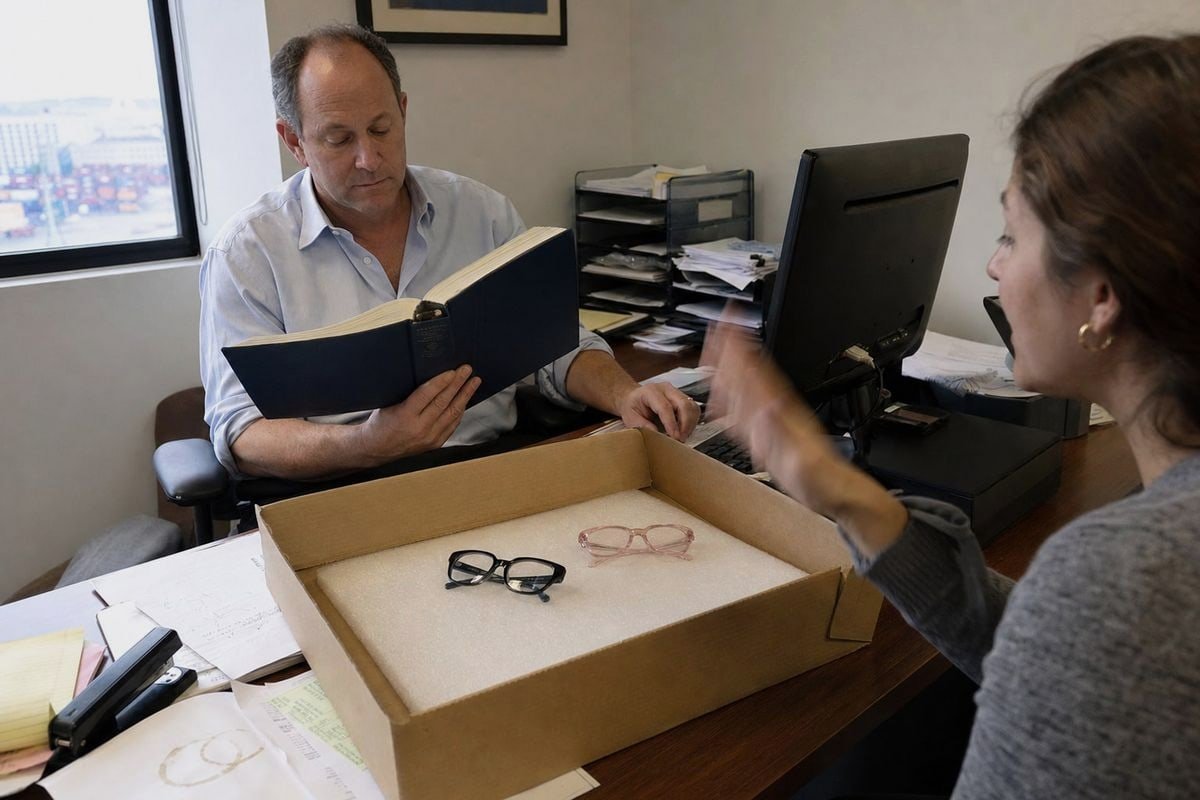
Fair comparison starts with a level playing field. Here is the workflow I recommend to procurement managers who evaluate us against other factories:
- Confirm the Incoterm on every quote. Incoterms FOB vs EXW is the classic trap. An EXW price excludes origin trucking, export documentation 8, and origin port charges. An FOB price includes them. An EXW quote that looks cheaper may cost more once you add origin-side fees.
- Get freight quotes for each supplier's actual port. Freight forwarding fees differ by origin port and route. Two Chinese suppliers in different provinces can produce different freight numbers for identical cartons.
- Verify the declared value and classification. Duty is a percentage of value, so a higher factory price also means proportionally higher customs duties and taxes.
- Add fixed per-shipment fees. Brokerage, terminal handling, and inland delivery are roughly the same regardless of supplier — but they hit smaller orders harder.
- Price in quality risk. A supplier with weak QC generates returns, replacements, and re-testing. In our workshop, hinge tension, temple flexibility, and lens fit are checked before packing, because a 2% defect rate on children's frames is not just a cost — it is a brand safety problem.
A Worked Comparison
Consider 1,000 kids' optical frames from two suppliers:
| Cost Item | Supplier A (EXW $2.20) | Supplier B (FOB $2.45) |
|---|---|---|
| Goods total | $2,200 | $2,450 |
| Origin charges to port | $350 | Included |
| Ocean freight + insurance | $700 | $680 |
| Duty (5% on CIF) | $163 | $158 |
| Brokerage + port handling | $450 | $450 |
| Inland haulage to warehouse | $280 | $280 |
| Compliance testing (amortized) | $300 | Included in price |
| Total landed cost | $4,443 | $4,018 |
| Per-unit landed cost | $4.44 | $4.02 |
The "cheaper" supplier landed 10% higher. This is why I never mind when buyers benchmark us on landed cost rather than unit price — a factory that quotes FOB transparently, includes compliance-ready testing, and ships right the first time usually wins the real comparison. Recalculate quarterly, too: freight rates and tariffs move faster than factory prices.
Conclusion
Factory price is not margin. Calculate the full landed cost for kids' optical frames — freight, duties, fees, testing — before you commit. If you want transparent FOB quotes and packaging built for efficient freight, our team is ready to help.
Footnotes
1. Authoritative Wikipedia entry providing a stable definition and breakdown of landed cost components. ↩︎
2. Official US government guidelines on safety testing requirements for children’s products under CPSIA. ↩︎
3. Overview of quality control processes and the role of third-party inspections in manufacturing. ↩︎
4. Official USITC Harmonized Tariff Schedule (HTS) portal for classifying plastic spectacle frames under Chapter 90. ↩︎
5. Official USTR landing page for Section 301 investigations, replacing the broken specific investigation subpage. ↩︎
6. Explanation of how currency fluctuations impact international trade and customs valuation. ↩︎
7. Industry standard explanation of how volumetric weight impacts shipping costs for lightweight, bulky goods. ↩︎
8. Standardized international trade terms defining cost and risk responsibilities between buyers and sellers. ↩︎
More Articles You Might Like

August 5, 2026
Bio-Based vs Regular Cellulose Acetate: What's the Difference for Kids' Frames?

August 5, 2026
How Recyclable Are Kids' Optical Frame Materials, and What Eco-Friendly Alternatives Exist?
August 5, 2026
Do Kids Optical Frames Whiten or Age in Storage, and How to Control Warehouse Conditions?
Looking for a Reliable Kids Eyewear Partner?
Explore 800+ ready styles and full OEM/ODM support tailored to your brand.
Get in Touch English
  Español de México
  Deutsch
  Français
  日本語
日本語  العربية
  Português do Brasil