How Do I Ask Suppliers for a Spare Parts List for Kids Optical Frames?

Requesting a spare parts list for kids optical frames sounds simple — until a vague email stalls your repairs, frustrates parents, and forces you to replace whole frames exploded parts diagram 1. At our Taizhou factory, we see this problem weekly.
To ask suppliers for a spare parts list for kids optical frames, send a model-specific request including the frame code, color, and needed components, then ask for part numbers, pricing, MOQs, and lead times in one message. Suppliers organize parts by exact product identifiers, so precise requests get faster quotes.
That is the short answer. Below, I will walk you through what parts to expect, how to confirm fit, which questions to ask, and how to secure long-term after-sales support.
What Spare Parts Should I Expect a Kids Optical Frame Supplier to Offer?
A buyer from Australia once asked us for "some extra bits" for a TR90 kids frame order. We had to send three follow-up emails just to learn she meant replacement temples. That taught me how much clarity matters.
A kids optical frame supplier should offer replacement temples, hinge screws, nose pads, temple tips, front frames, and hinge assemblies. Good suppliers list these eyewear components by part number, color, and compatible frame code, and can also supply complete eyewear repair kits for aftercare.
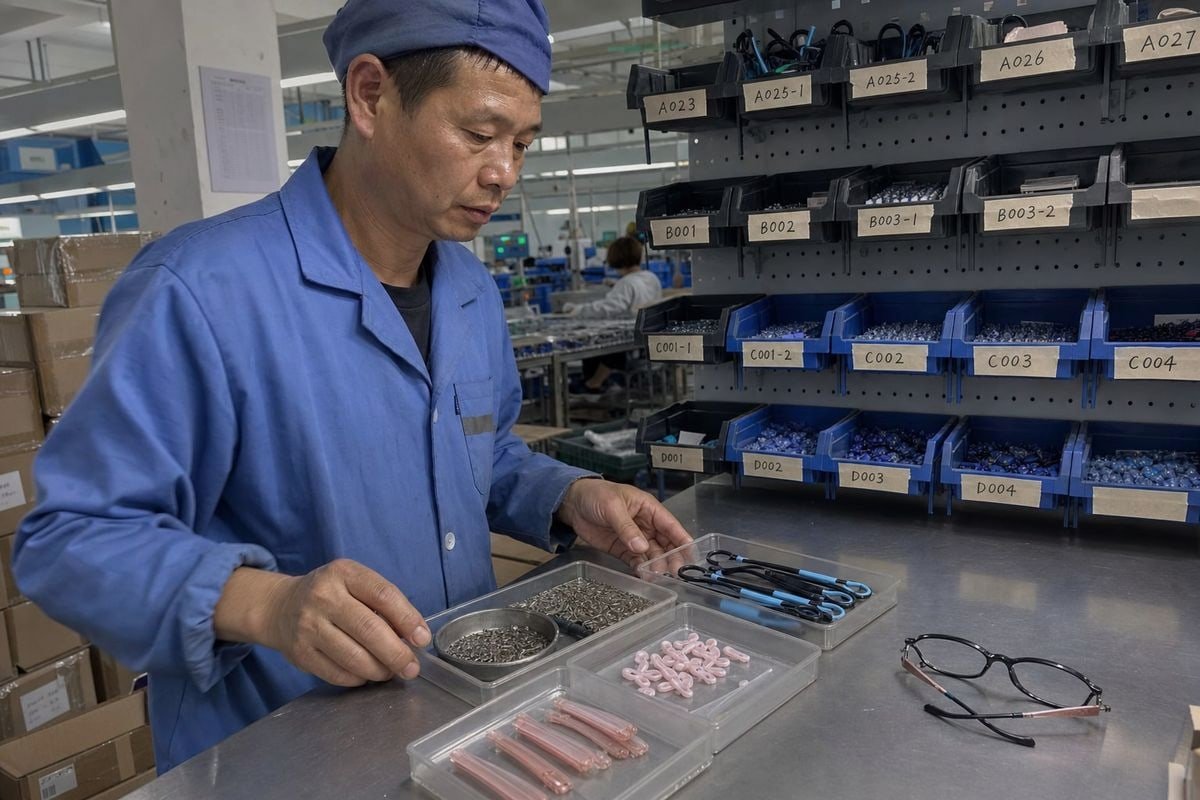
Children's frames take more abuse than adult frames. Kids sit on their glasses, twist the temples, and drop them at the playground. So the wear points are predictable. In our workshop, the parts we restock most often for buyers are temples, hinge screws, and nose pads — in that order.
The Core Wear Items
Here is what a complete spare parts offering usually covers for a children's optical frame line:
| Component | Why It Fails on Kids' Frames | Typically Sold As |
|---|---|---|
| Replacement temples | Twisting, sitting on frames, pulling off one-handed | Pairs, color-matched to frame code |
| Hinge screws | Loosening from constant folding and flexing | Packs of 10–100 |
| Nose pads | Wear, discoloration, loss of grip | Pairs or bulk bags |
| Temple tips | Chewing, cracking, slipping off | Pairs, by temple size |
| Front frames | Cracks at the bridge or lens rim | Individual units, by color |
| Hinge assemblies | Metal fatigue on spring hinges | Sets with matching screws |
Take a frame like our two-tone navy-and-black style with TPEE rubber temples and looped ear grips. The flexible temple is the hero feature for active kids, but it is also the part most likely to need replacement after a year of hard wear. The same applies to a translucent blush-pink acetate style — its silicone-like temple tips are comfort parts that wear faster than the front frame itself.
One caution: not every part is sold individually. Some suppliers only offer temples in full sets or minimum packs. Ask up front whether components come as singles, pairs, or bulk quantities, because that difference changes your optical inventory management math completely.
Materials matter too. For children's eyewear, durable materials 2 like TR90 and TPEE flex instead of snapping, which reduces spare part consumption in the first place. A supplier who understands child-specific sizing and flexible materials will usually have a more sensible parts program than one selling generic adult frames scaled down.
How Do I Know If a Supplier's Spare Parts Will Actually Fit My Frame Styles?
In our 5S-managed workshop 3, we keep hinge tooling records for every one of our ~800 existing styles precisely because two frames that look identical can use different screw threads. Fit is never something to assume.
Confirm fit by matching the exact frame code, color code, and production batch with the supplier, then requesting part numbers tied to that model. Ask for an exploded diagram or a physical sample part, because hinge screws and temples often vary between visually similar frames.
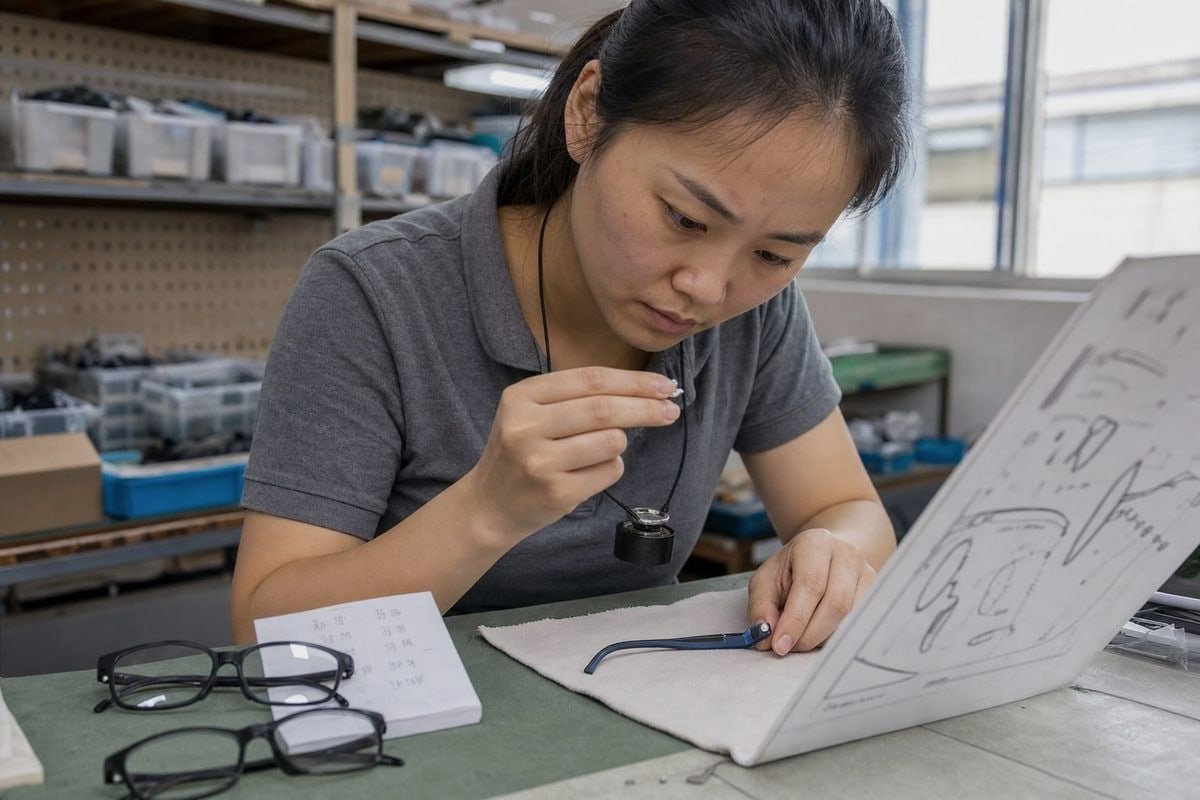
Compatibility is where most spare-parts problems begin. Frames from the same collection can share a front shape but use different hinge geometry. A temple molded for a 125mm child-specific sizing spec will not seat properly on a 130mm variant. So you need traceability, not guesswork.
A Four-Step Fit Verification Process
- Send the frame code and color code. Suppliers file parts under exact product identifiers, not descriptions. "The pink one" is not enough; "OK-2153 in translucent blush pink" is.
- Attach photos. Photograph the whole frame, the damaged area, and the inside of the temple where size markings are printed. This lets the supplier cross-check against their tooling records.
- Ask for an exploded parts diagram. A model-specific spare-parts sheet or diagram shows every component and its part number, so both sides talk about the same piece.
- Request a sample before bulk ordering. For anything beyond standard hinge screws, a physical sample confirms fit, finish, and color match before you commit to an MOQ.
Some buyers ask whether generic hardware can substitute for original parts. Sometimes yes — standard screws and silicone nose pads are often interchangeable across brands, and third-party component suppliers stock them. But I would push back on relying on generic parts for kids' frames. A hinge screw that is fractionally too long can protrude and scratch a child's skin. A temple with slightly different flex can change how the frame grips a small head. For children's eyewear, fit is a safety issue, not just a cosmetic one. Use original, brand-authorized parts wherever the component touches the child's face or affects retention.
Color matching is the other trap. Our navy-and-black TPEE temples with light blue hinge accents come from specific colorant batches. A replacement temple from a different batch may show a visible shade difference. Ask your supplier whether they color-match replacement parts to your original production run, or whether you should order spares at the same time as the main order — which is what we recommend.
What Questions Should I Ask Before Requesting a Spare Parts List?
There is a trade-off I discuss with almost every new buyer: asking only for the parts you need right now gets you a fast quote, but asking for the full list for a frame model sets you up for years of smoother aftercare. My advice is to do both in one message.
Before requesting a spare parts list, ask about part availability and pricing, MOQs per component, lead times, whether parts sell individually or in sets, color variant availability, support for discontinued models, and whether the supplier provides exploded diagrams or a digital parts catalog.
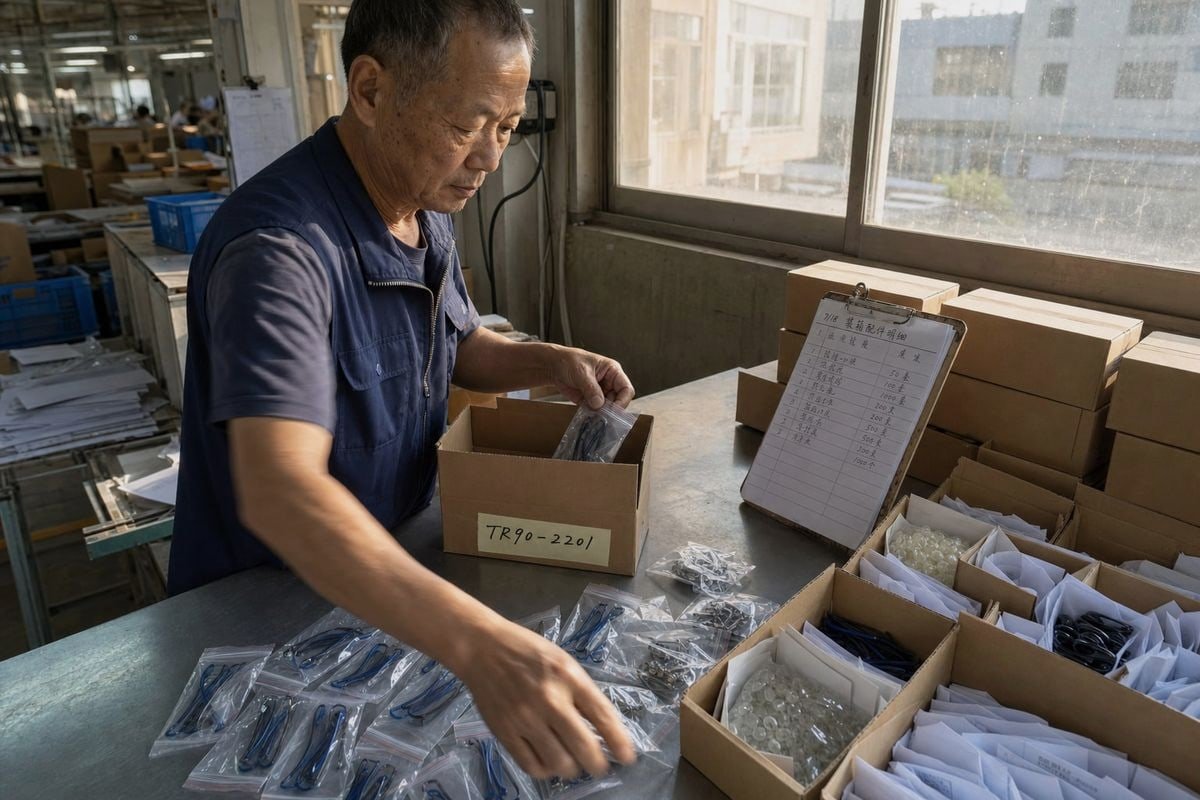
A spare parts list is only useful if it comes with the commercial terms that make it actionable. In our experience exporting to buyers in 20+ countries, the inquiries that get answered fastest are the ones that ask everything at once, in a structured way. Here is the question set I recommend, along with why each one matters:
| Question | Why It Matters |
|---|---|
| What is the MOQ per spare part? | Spare-part MOQs often differ from frame MOQs and affect your stocking budget |
| What is the lead time for reorders? | Determines whether you can promise repair turnaround to retailers and parents |
| Are parts sold individually or in sets? | Changes unit cost and how you plan eyewear repair kits |
| Are all color variants available as spares? | Color-matched replacement temples may be batch-dependent |
| Is there an exploded diagram or parts catalog? | Speeds up identification and removes back-and-forth |
| Do you support discontinued frame lines? | Protects you when a style receives a discontinuation notice |
| Can we do a last-time buy before discontinuation? | Secures repair stock for frames still under warranty in the field |
| Can spare parts terms go into our supply agreement? | Makes after-sales support contractual, not a favor |
Structuring the Actual Request
Keep the message short but complete. Introduce your company in one line, state the exact frame code and color, name the components you need — for example, replacement temples, hinge screws, and nose pads — and then ask for the full available parts list, unit pricing, MOQs, and lead time. If the supplier offers an online form, catalog, or cart-style ordering system, use it instead of freeform email. I understand the objection here: email feels more flexible. But structured forms capture the exact data the factory needs for quoting, so they usually get you an answer in one pass instead of three.
One more point buyers often miss: state whether the parts are for an immediate repair or for stocking aftercare inventory. We quote these differently. Immediate repairs may ship from residual stock; stocking orders may be scheduled into a production run alongside your next frame order, which lowers your cost and guarantees color match.
How Can I Make Sure My Supplier Provides Spare Parts Support After My Order Ships?
A lesson we learned early in our 15 years of eyewear production: the spare-parts conversation that happens before the order ships is worth ten conversations after. Once goods leave the factory, your leverage drops — so lock in support terms first.
Secure post-shipment support by writing spare parts terms into your supply agreement: guaranteed parts availability periods, reorder lead times, pricing validity, and advance discontinuation notice. Also order a small spare parts stock with your initial shipment to cover early repairs.
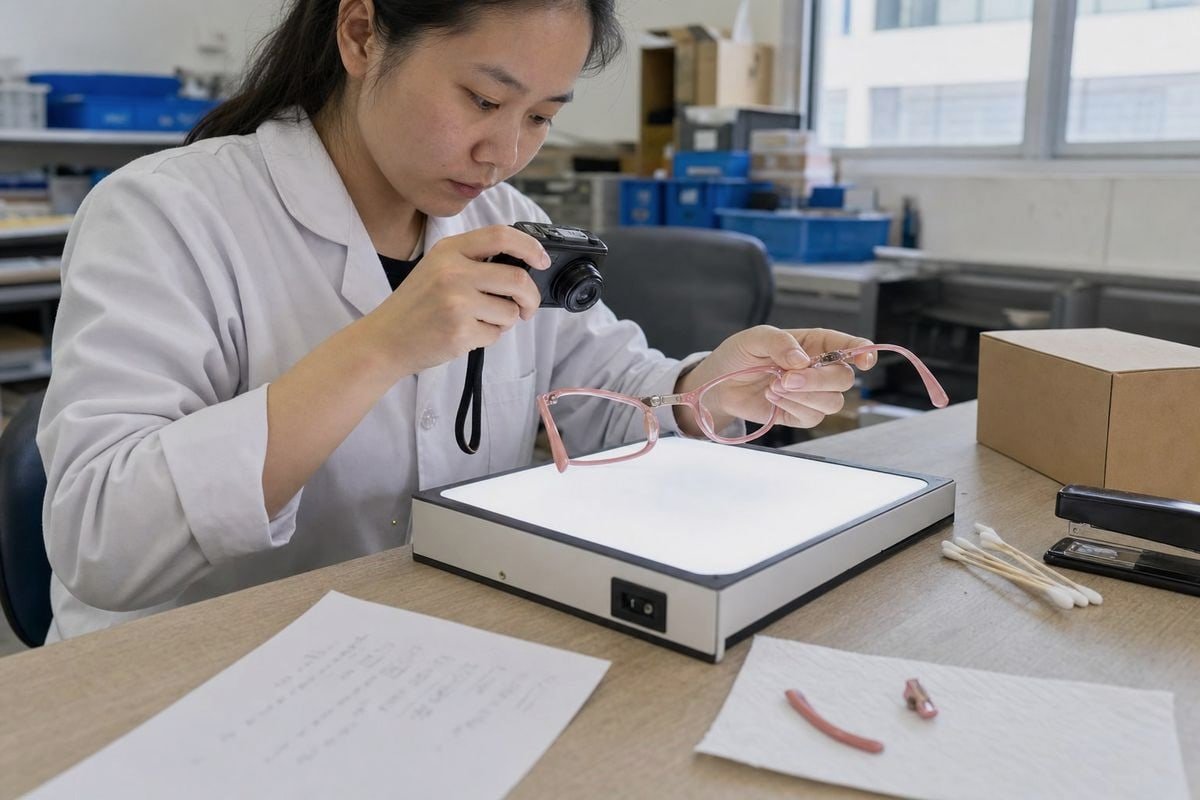
After-sales support for eyewear components 4 is not automatic. Some factories treat spare parts as an inconvenience; others, like ours, treat them as part of the customer experience. The difference shows up twelve months later, when a retailer calls you about a snapped temple on a frame you no longer have in stock.
Build Support Into the Commercial Relationship
Start with the supply agreement. Ask the supplier to commit, in writing, to keeping parts available for a defined period after your last frame order — two to three years is a reasonable ask for children's optical frames, since kids' frames stay in circulation through warranty periods and hand-me-downs. Include reorder lead times and a pricing mechanism so a small parts order does not arrive with a surprise invoice.
Next, protect yourself against discontinuation. Ask for a formal discontinuation notice — ideally six months — before any frame line or component is retired. When a notice arrives, evaluate a last-time buy of critical parts: hinge screws, nose pads, and the temples for your best-selling colors. If the original molds still exist, some factories can also run a final small batch of components even after the frame itself is discontinued. We have done this for buyers who needed repair stock for frames still under warranty in the field.
Third, stock smart from day one. We encourage buyers to add a spare parts allocation to their first order — commonly a small percentage of order volume in temples, screws, and nose pads, packed as labeled eyewear repair kits. This costs little, ships in the same container, guarantees batch color match, and means your first repair request never waits on an ocean shipment.
Finally, keep the relationship warm. Suppliers prioritize parts requests from active, communicative partners. Share your repair data with us — which parts fail, how often, on which styles. At our factory, that feedback loops straight into design revisions. A temple that keeps failing at the hinge gets reinforced in the next tooling update, which reduces your spare parts spend over time. That is what long-term partnership looks like in practice: fewer broken frames, not just faster replacements.
Conclusion
A vague parts request wastes weeks; a model-specific one gets answered in days. Send frame codes, ask for the full list with terms, and secure support contractually.
Ask for the spare parts list for kids optical frames before your first order ships — with part numbers, MOQs, lead times, and a written availability commitment. Do that, and a broken temple becomes a five-minute fix instead of a lost customer. If you want a supplier who treats spare parts as part of the product, not an afterthought, that is exactly how we work with our brand partners every day.
Footnotes
1. Defines and illustrates what an exploded-view drawing represents. ↩︎
2. Highlights suitable frame materials for durable children’s eyeglasses. ↩︎
3. Describes the 5S methodology for workplace organization and productivity. ↩︎
4. Provides a detailed anatomy of the different parts of eyeglasses. ↩︎
More Articles You Might Like
August 5, 2026
Bio-Based vs Regular Cellulose Acetate: What's the Difference for Kids' Frames?

August 5, 2026
How Recyclable Are Kids' Optical Frame Materials, and What Eco-Friendly Alternatives Exist?
August 5, 2026
Do Kids Optical Frames Whiten or Age in Storage, and How to Control Warehouse Conditions?
Looking for a Reliable Kids Eyewear Partner?
Explore 800+ ready styles and full OEM/ODM support tailored to your brand.
Get in Touch English
  Español de México
  Deutsch
  Français
  日本語
日本語  العربية
  Português do Brasil