What Does UV400 Mean on Kids’ Sunglasses, and Why Is It Important?
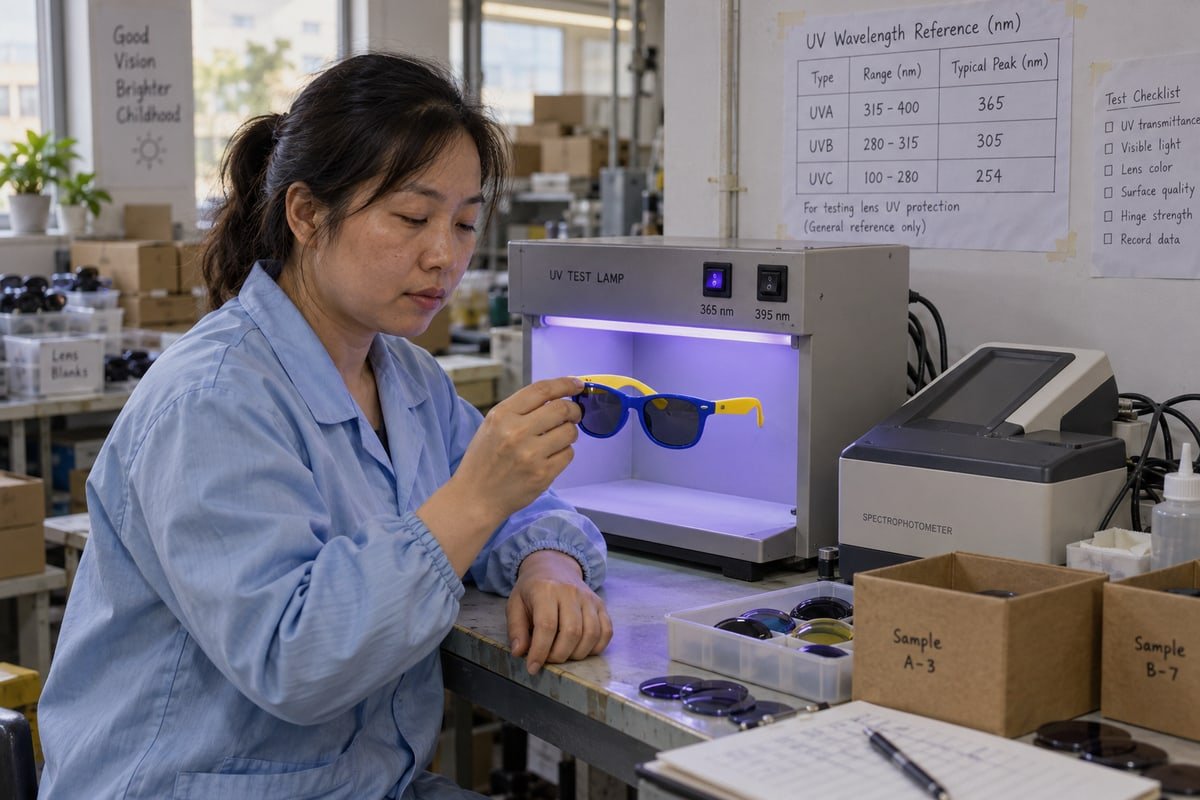
Buyers ask me about UV400 on kids’ sunglasses almost weekly. Many have been burned by suppliers whose “protective” lenses failed lab tests — a risk our factory works hard to eliminate.
UV400 on kids’ sunglasses means the lenses block ultraviolet light up to 400 nanometers, covering 100% of UVA and UVB radiation. It matters because children’s clearer eye lenses transmit more UV to the retina, and cumulative UV exposure raises lifetime risks of cataracts and retinal damage.
That short answer hides a lot of detail. Below, I will unpack how to verify the claim, which materials deliver it, and how to build a premium line around it.
How can I verify a supplier's UV400 sunglasses actually meet the claimed protection standard?
A procurement manager from Australia once sent our samples to a third-party lab before signing. I welcomed it. In fifteen years of eyewear production, verification has always separated serious partners from risky ones.
Verify UV400 claims by requesting spectrophotometer test reports showing 0% transmission below 400nm, checking compliance certificates against ANSI Z80.3 standards or EN ISO 12312-1, ordering third-party lab tests on random production samples, and auditing the factory's incoming lens inspection process before mass production.
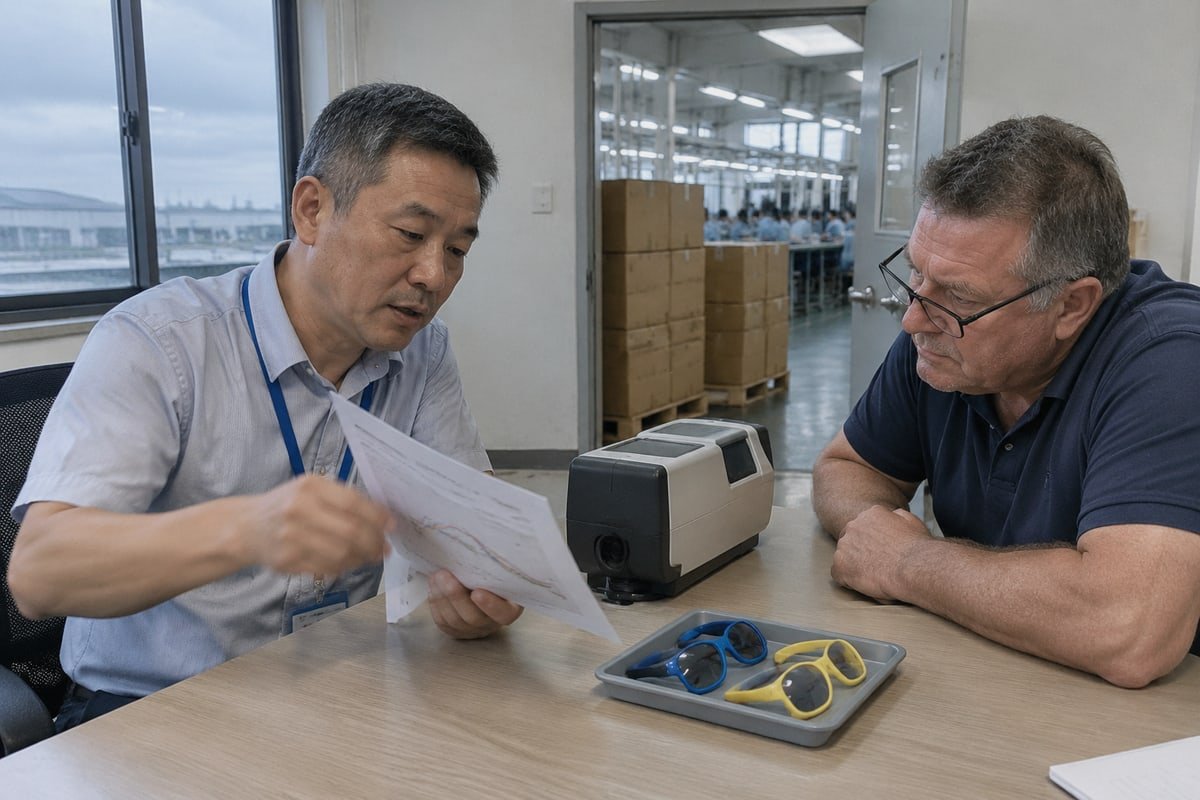
Trust is good. Documents are better. A dark tint tells you nothing about UV blocking. In fact, a dark lens without real UV filtering is worse than no lens at all. The tint causes the pupil to dilate, which lets more ultraviolet radiation reach the retina. So verification is not optional paperwork. It is child safety.
Step-by-step verification process
Here is the process I recommend to every new buyer who visits our Taizhou workshop:
- Ask for a spectral transmission curve. A spectrophotometer report should show near-zero transmission from 280nm up to 400nm. If the curve only reaches 380nm, the 380–400nm band is left unprotected — a known gap in weaker standards.
- Match the report to the actual lens batch. Reports from two years ago prove nothing about today's shipment. We keep batch-level records for this reason.
- Check the certification framework. Sunglasses sold in the US should reference ANSI Z80.3 standards. European markets require CE marking under EN ISO 12312-1. Our lavender cat-eye model, for example, carries the CE marking engraved on the inner temple arm.
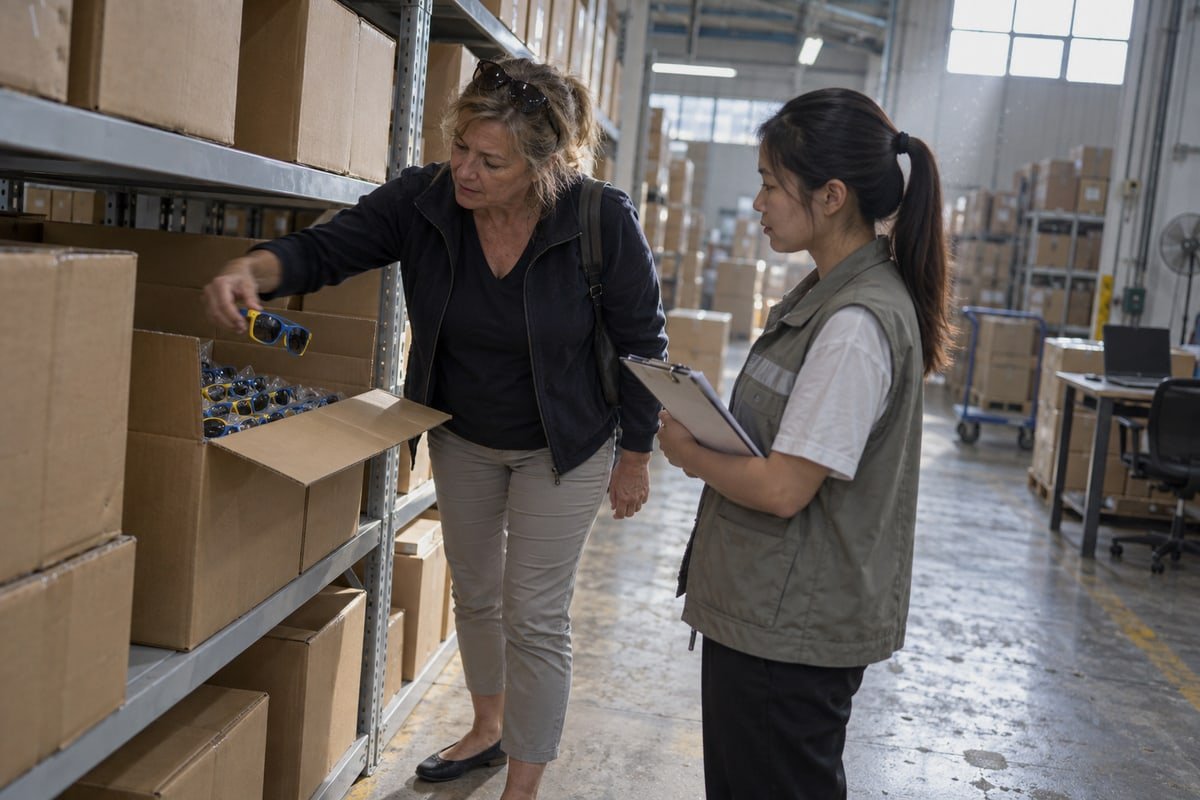
- Commission your own random test. Pull samples from the middle of a production run, not the golden samples. A reliable factory will not object.
- Audit incoming lens inspection. Protection UV is built into the lens material or coating before assembly. If the factory does not test incoming lenses, defects flow straight to your customers.
What the documents should show
| Verification item | Ce qu'il faut rechercher | Indicateur rouge |
|---|---|---|
| Spectral report | 0% transmission below 400nm | Cutoff at 380nm or lower |
| Norme citée | ANSI Z80.3 or EN ISO 12312-1 | "Meets industry standard" with no name |
| Sample source | Random production units | Only pre-selected golden samples |
| Report date | Matches current batch | Reports older than the order |
| Lens supplier trace | Named lens source with specs | Unknown or changing lens sources |
When we onboard a new brand client, we send this package proactively. It shortens the trust-building phase and protects both sides.
What lens materials help my brand deliver reliable UV400 protection without adding weight for kids?
Our engineers weigh a real trade-off on every project: protection versus wearability. A heavy lens slides down a small nose, and a child who removes their sunglasses gets zero protection.
Polycarbonate lenses are the best choice for lightweight kids' UV400 sunglasses because the material inherently blocks UV up to 400nm, weighs less than glass or CR-39, and offers superior impact resistance. Pairing them with flexible TR90 or TPEE frames keeps total weight minimal for children.
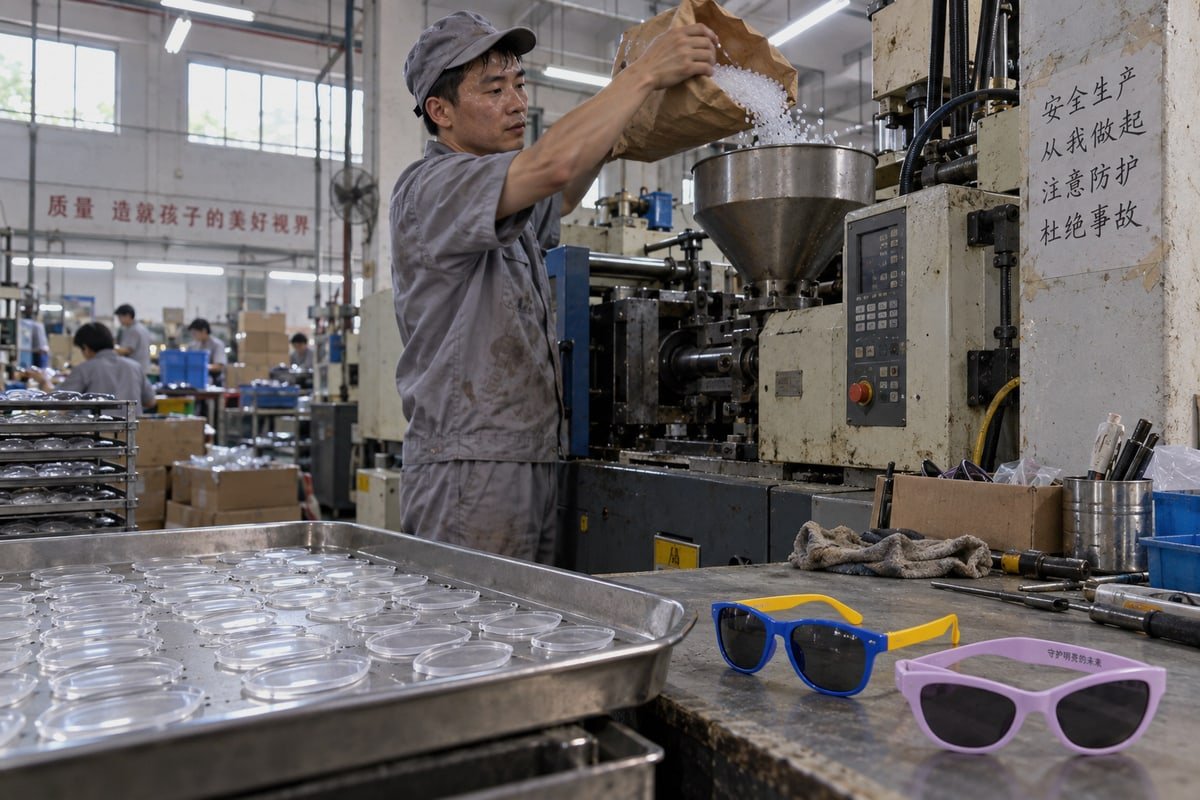
Material choice decides whether kids actually wear the product. Let me break down the options we work with daily on our production line.
Comparing lens materials for children's eyewear
| Matériel | UV400 capability | Poids | Conformité au test de chute de bille de la FDA | Meilleure utilisation pour les enfants |
|---|---|---|---|---|
| Polycarbonate | Inherent, no coating needed | Très léger | Excellent | Everyday and sports sunglasses |
| CR-39 resin | Requires UV coating or additive | Léger | Modéré | Budget lines with verified coating |
| Glass | Needs coating; heavy | Heavy | Poor for kids | Not recommended for children |
| TAC (for polarized) | Built into film layers | Très léger | Bon | Polarized kids' lines |
Polycarbonate wins for most children's applications. The UV protection sits in the material itself, not in a surface coating that can be skipped or thinned during cost-cutting. That structural honesty matters when a child's retinal health is on the line. Impact resistance is the second win. Active kids drop, sit on, and throw their sunglasses. Polycarbonate flexes instead of shattering into sharp fragments.
Frames complete the weight equation
The lens is only half the story. Across our roughly 800 existing styles, we pair light lenses with TR90 frames and TPEE temples. TR90 is a flexible nylon material 1 that bends without snapping. TPEE adds a soft, rubbery touch on the temples, so the glasses grip gently without pressure points. Our chunky blush-pink round frame looks bold but stays feather-light on a toddler's face. When a brand asks us to shave grams, we adjust wall thickness in the mold, never the lens protection. Comfort drives wear time, and wear time drives real-world UVA and UVB protection.
Does UV400 protection fade over time, and how can I ensure long-lasting quality for my customers?
A distributor in Japan once asked me why a competitor's sunglasses failed re-testing after one season. The answer taught us both something about how UV protection is engineered — and how it can be cheapened.
UV400 protection built into the lens material, as in quality polycarbonate, does not fade over the product's life. Coating-based UV protection on cheap lenses can degrade with scratches, heat, and wear. Ensure longevity by specifying material-embedded UV absorbers and scratch-resistant hard coatings.
The fear that protection "wears off" is common among buyers. The honest answer depends entirely on how the protection was applied in the first place.
Embedded protection versus surface coating
When UV absorbers are mixed into the lens polymer, the protection is distributed through the full lens body. A scratch removes a tiny bit of surface material, but the UV blocking underneath remains intact. When protection is only a thin surface coating, every scratch, heat cycle, and cleaning abrasion chips away at it. Kids are hard on their gear. They leave sunglasses on hot car dashboards. They wipe lenses on sandy shirts. Coating-only protection is the wrong engineering choice for this user.
There is a second, subtler issue: back-surface UV reflection. UV rays can bounce off the inner surface of the lens and into the eye from behind. For premium lines, we recommend either wraparound frames that limit stray light entering from the sides, or a back-side anti-reflective coating. Both close a gap that a simple "UV400 lens" spec leaves open.
What to specify in your purchase order
- UV absorbers embedded in the lens material, not coating-only protection.
- A scratch-resistant hard coat to keep visible light transmission stable and views clear.
- Optional back-side AR coating for premium SKUs.
- Frame geometry with adequate side coverage for outdoor-focused lines.
- Batch-level spectral testing before shipment, documented and archived.
One more point I stress with brand partners: cumulative UV exposure 2 is the reason durability matters. UV damage adds up over a lifetime, contributing to cataracts, pterygium, and macular degeneration 3 decades later. Sunglasses that quietly lose protection mid-season betray that mission. Frames matter too. Our 5S-managed workshop tests hinge cycles and temple flex, because a broken frame means an unprotected child, no matter how good the lens was.
Developing a polarized kids' collection for a European outdoor brand taught our team a key lesson: the two features answer different questions, and premium buyers want both answered well.
Yes, UV400 and polarization combine perfectly in one lens. UV400 is the health-critical safety standard blocking radiation, while polarization is a comfort feature cutting glare from water, snow, and sand. Together they create a genuine premium tier for outdoor-focused kids' sunglasses lines.
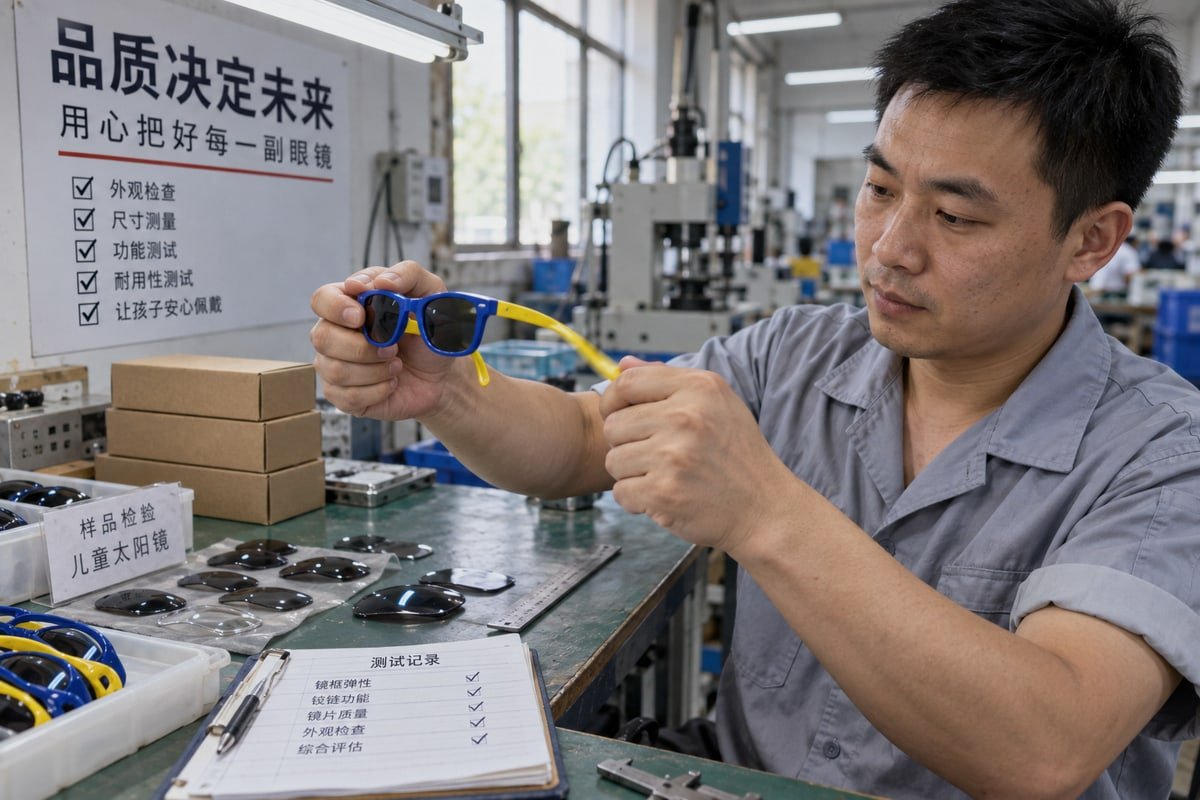
First, let me kill a dangerous myth. Polarization alone does not block UV. A polarized film filters horizontally reflected glare, nothing more. Some cheap "polarized" sunglasses on the market carry no meaningful UV protection at all. In a premium line, UV400 must be the non-negotiable base layer, and polarization the comfort layer on top.
How the two features divide the work
| Caractéristique | What it does | Catégorie | Kid-specific benefit |
|---|---|---|---|
| UV400 | Bloque les UVA et UVB jusqu'à 400 nm | Safety standard | Prevents photokeratitis and long-term retinal damage |
| Polarisation | Filters reflected glare | Comfort feature | Reduces squinting and visual fatigue near water, snow, sand |
| Tint category | Controls visible light transmission | Comfort/context | Category 2 lenses suit morning light and developing sleep cycles |
Polarized lens benefits are strongest exactly where UV risk peaks. Reflective surfaces like snow, sand, and water can nearly double a child's UV exposure. A beach or ski product is precisely where glare is worst and where photokeratitis — sunburn of the eye — is a real short-term risk. That overlap is your premium story.
Building the premium tier in practice
Structure the line in two levels. The core line uses UV400 verres en polycarbonate 4 in flexible TR90 frames. The premium line adds polarized TAC lenses, wraparound frames or wider temple coverage, and upgraded retail packaging. On tint selection, we often advise Category 2 lenses for everyday kids' models. They deliver full UV400 radiation protection while admitting enough natural light to support a child's developing sleep-wake cycle during morning wear. Darker Category 3 tints then slot into the beach and snow SKUs.
Because we hold molds for hundreds of existing styles, a brand can launch a polarized tier without new tooling investment. Custom colors, logo printing, and retail-ready packaging turn the same proven frames — a color-blocked blue-and-yellow square, a pastel cat-eye, a round pink acetate look — into a coherent branded collection. One tip we share with brand marketers: pair the product with simple education, like the shadow rule. If a child's shadow is shorter than they are, UV intensity is at its peak. It gives kids ownership of their own eye health, and it gives your brand a story parents remember.
Conclusion
UV400 is the health-critical core of kids' sunglasses. Verify it with data, build it into polycarbonate, protect it structurally, and layer polarization on top for premium lines.
Interested in sourcing the products mentioned in this article? See details and request a quote here:
Notes de bas de page
1. General reference for the properties of nylon, the base material for flexible TR90 eyewear frames. ↩︎
2. Authoritative fact sheet from the World Health Organization regarding the health risks of ultraviolet radiation exposure. ↩︎
3. Clinical information from the National Eye Institute on how UV exposure contributes to long-term retinal diseases. ↩︎
4. Technical overview of polycarbonate properties and its common applications in engineering and lens manufacturing. ↩︎
Plus d'articles que vous pourriez aimer



Vous recherchez un partenaire fiable en lunetterie pour enfants ?
Explorez plus de 800 styles prêts et un support OEM/ODM complet adapté à votre marque.
Contactez-nous English
  Español de México
  Deutsch
  Français
  日本語
日本語  العربية
  Português do Brasil