What Are the Structural Design Differences Between Infant and Big Kids’ Sunglasses?
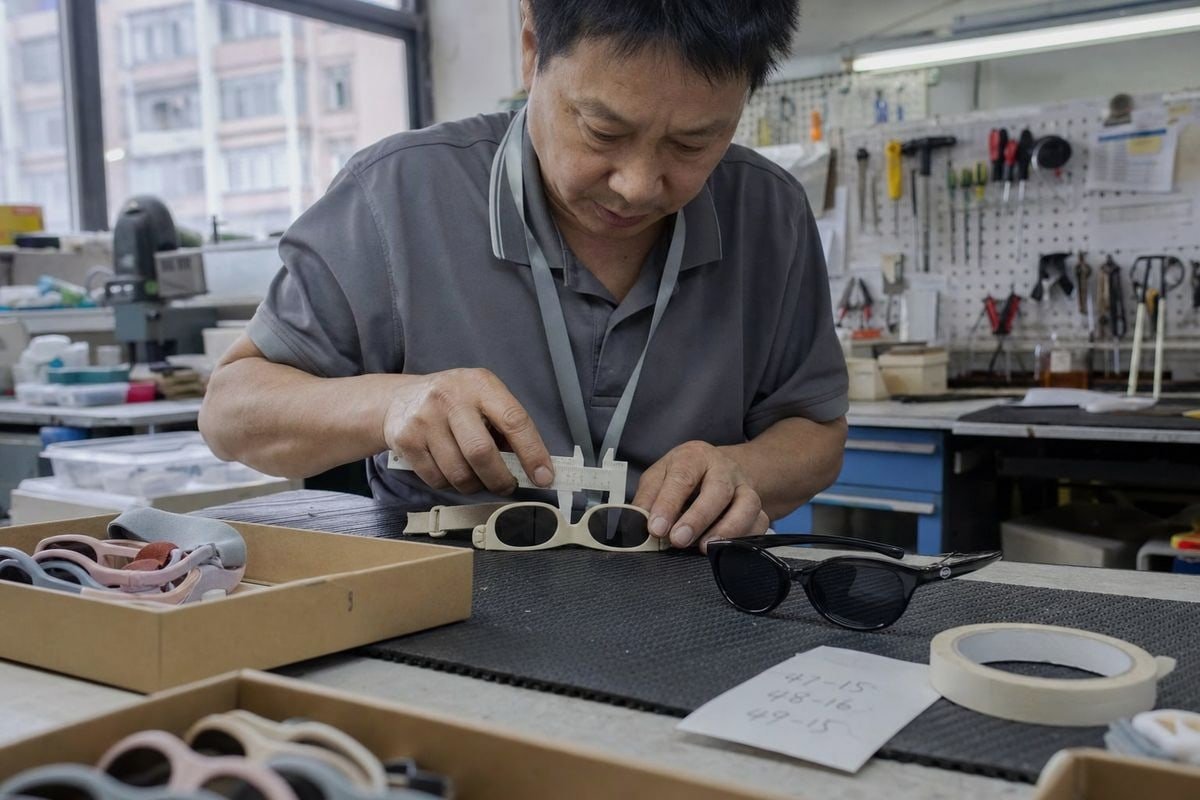
The structural design differences between infant and big kids’ sunglasses trip up many buyers who visit our Taizhou factory ISO 1. They assume one mold family covers all ages. It doesn’t. Get it wrong, and returns pile up, frames slide off tiny faces, and your brand takes the blame. On our production line, we solve this with age-specific geometry, materials, and retention systems.
Infant sunglasses use ultra-flexible TPEE or silicone frames, flat low bridges, hinge-free one-piece construction, and adjustable head straps for retention. Big kids’ sunglasses shift to structured TR90 frames, defined saddle bridges, spring hinges, and standard temple arms — durable everyday eyewear built for a more developed face.
These are not cosmetic differences. They come from how a child’s face grows. Let me walk you through each structural element, one by one, so you can spec the right product for each age group.
How do sizing and fit requirements differ between infant and big kids' sunglasses?
A buyer from Australia once asked us to simply shrink a popular big-kid frame by 20% for a baby line. Our engineers pushed back, and I want to explain why that scaling approach fails.
Infant sunglasses require narrow bridges, shorter temples, forward-weighted balance, and flat nose fits for undeveloped nasal bridges. Big kids' sunglasses use larger lens widths, longer temples, and defined bridge geometry because facial proportions — interpupillary distance and ear position — change dramatically between ages five and fifteen.
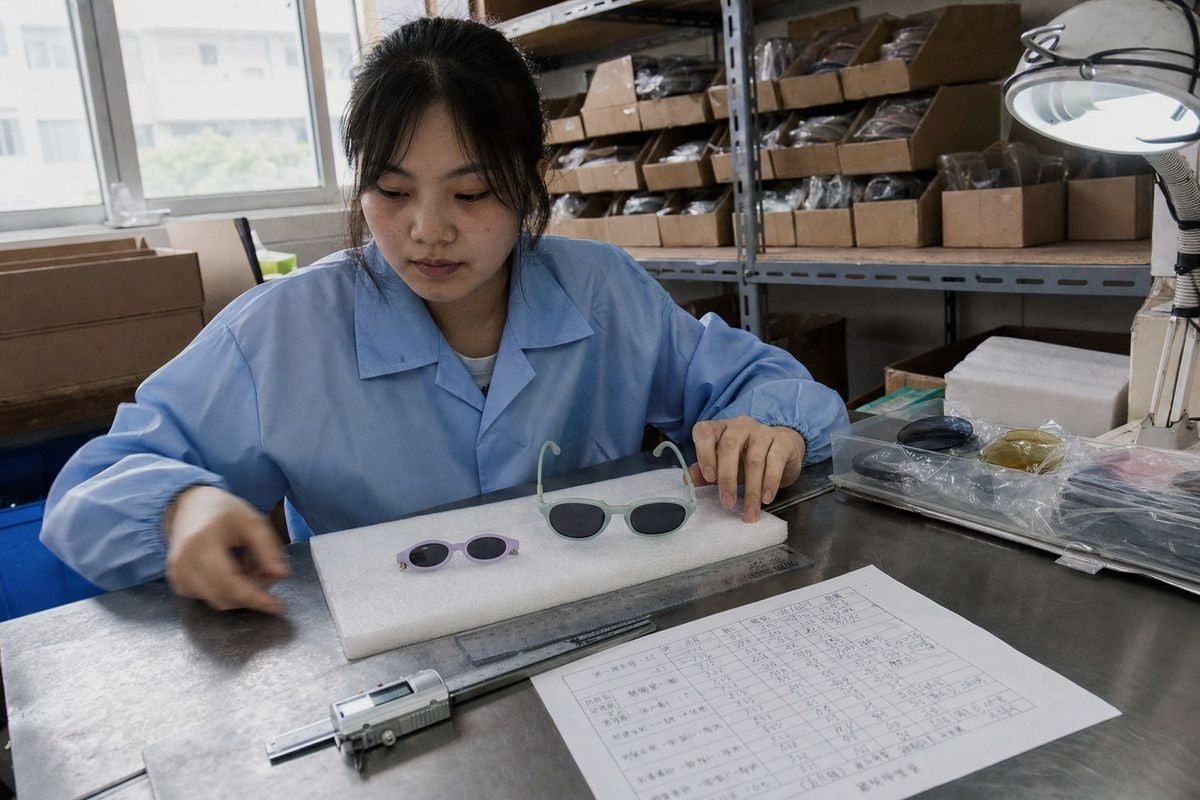
Children's sunglasses are not scaled-down adult sunglasses, and infant sunglasses are not scaled-down big-kid sunglasses. Each age band solves a different fit problem. A baby's skull is rounder. The nasal bridge is barely developed. The ears sit differently relative to the eyes. So a frame that fits by "hooking" onto the nose and ears — the way adult eyewear works — has almost nothing to hold onto.
Key facial development factors
Facial proportions change substantially through childhood. Interpupillary distance 2 widens. The nose gains height and definition. The head circumference grows fast in the first two years, then more slowly. That is why we build infant frames around retention and softness, and big-kid frames around anatomical support.
Here is how the core sizing parameters compare across the two categories:
| Fit Parameter | Infant (0–3 yrs) | Big Kids (6–12 yrs) |
|---|---|---|
| Nasal bridge support | Flat, wide, low-profile saddle | Defined saddle or keyhole bridge |
| Largeur du verre | 38–45 mm typical | 46–52 mm typical |
| Longueur des branches | Very short, often replaced by strap | Standard length with ear hook |
| Frame weight target | As light as possible, under ~20 g | Light but structured |
| Balance point | Forward-weighted to resist sliding back | Neutral, ear-supported |
Pourquoi l'âge seul ne suffit pas
In our experience exporting to 20+ countries, we always remind buyers that age is only a starting point. Head shape matters as much as age. A four-year-old with a low nasal bridge development curve may still need an infant-style flat bridge. That is why our catalog of roughly 800 existing styles includes overlapping transition sizes, so brands can cover edge cases without new mold investment.
What temple and strap designs work best for infants versus older children?
During a QC round last spring, we watched a toddler tester pull a strapless sample off her face in under ten seconds. That moment sums up why retention design is the single biggest differentiator between the two categories.
Infants need adjustable neoprene straps, elastic headbands, or wrap-around soft arms because standard temples cannot grip small heads. Older children rely on conventional temple arms with ear hooks and friction, adding spring hinges or sport straps only for high-activity use.

Retention is where infant eyewear behaves more like protective gear than fashion eyewear. A baby cannot be told to keep glasses on. The frame must stay put through crawling, head-shaking, and deliberate pulling. Standard temples fail here because there is no defined ear ridge to rest on and the head is nearly round.
Retention options by age stage
We typically recommend this progression to our brand clients:
- 0–2 years: Adjustable neoprene straps or full elastic headbands. The strap replaces the temple entirely or clips onto very short stubs. Nothing detaches easily, which removes choking risk.
- 2–4 years: Wrap-around flexible temples in TPEE, often with an optional removable strap. This is the transition zone.
- 5–8 years: Standard temples with curved, paddle-like tips that spread pressure across the soft temporal bones instead of clamping at one point.
- 8–12 years: Conventional temple architecture, often with spring hinges for flex during rough play, plus sport straps for cycling or beach use.
Pressure distribution matters more than grip strength
A common mistake is over-tightening infant retention to compensate for poor geometry. Our engineers design wider temple contact surfaces instead. Distributed pressure keeps the frame secure without leaving marks on soft skin. For big kids, the ear does most of the work, so the temple tip can be slimmer and lighter, which improves comfort during longer wear periods.
We also make sure straps are washable and made from Sans BPA 3 non-toxic materials, because infant accessories get chewed, drooled on, and dropped in sand constantly.
Why do lens shape and frame structure change as children grow?
One trade-off we weigh constantly on our line: how much structure can we add before we sacrifice the softness an infant frame demands? The answer changes at every age band, and lens shape follows the same logic.
Infant sunglasses favor close-fitting, wrap-around lenses with flatter base curves and hinge-free one-piece frames for maximum UV coverage and zero small parts. Big kids' sunglasses adopt structured TR90 frames, spring hinges, and sport or fashion lens shapes with polarized options.

For infants, the lens must do more work because behavior cannot be trusted. A baby will not angle their head away from glare. So we spec a wrap-around frame style with wide lenses that block UV light entering from the sides. Full UV400 4 protection is non-negotiable at every age — that never changes. What changes is the structure delivering it.
Material and hardware evolution
Infant frames from our workshop use TPEE flexible frames that can twist 180 degrees and spring back. There are no screws to loosen and no small detachable parts. Hinge-free, one-piece construction eliminates pinch points and choking hazards. The frame edges are rounded and the material is soft enough to be atraumatic if a child falls face-first.
Big kids' frames graduate to TR90 5 — still flexible and light, but more structured. We often pair TR90 fronts with TPEE temples to get rigidity where it helps and flex where it protects. Spring hinges appear at this stage because older kids yank glasses off one-handed, and the hinge must survive thousands of those cycles.
| Structural Element | Infant Design | Big Kids' Design |
|---|---|---|
| Matériau du cadre | TPEE, silicone, ultra-flexible | TR90, nylon, structured flex |
| Charnières | None — one-piece construction | Spring hinges or reinforced barrels |
| Forme de la lentille | Wraparound, wide, flatter base curve | Sport wrap or fashion shapes |
| Matériau des verres | Polycarbonate 6 shatterproof lenses | Polycarbonate, often with coatings |
| Lens features | UV400, chew-resistant | UV400, polarized lens technology, scratch resistance |
| Petites pièces | Zero detachable components | Screws and hinges acceptable |
Why the base curve matters for infants
A subtle point most buyers miss: infant lenses often use a flatter base curve to reduce peripheral distortion. Early binocular vision 7 and spatial tracking are still developing, and heavily curved lenses can distort the visual field. Big kids tolerate higher wrap curves, which is why sporty shield styles — like the mirrored single-lens designs we produce — work well from around age six upward.
Impact resistance standards apply across both categories. We fit polycarbonate shatterproof lenses on everything, because a lens that survives a chew test must also survive a playground.
How can I choose the right supplier to develop both infant and big kids' sunglasses?
A procurement manager from Japan once told me she had cycled through three suppliers before finding one that understood infant-specific engineering rather than just small frames. Her checklist shaped how I now advise new buyers.
Choose a factory with proven flexible-material expertise, age-specific existing molds, documented impact resistance standards testing, and full OEM/ODM support for straps, lenses, and packaging. Avoid traders and generic sunglasses factories that only rescale adult designs for children.
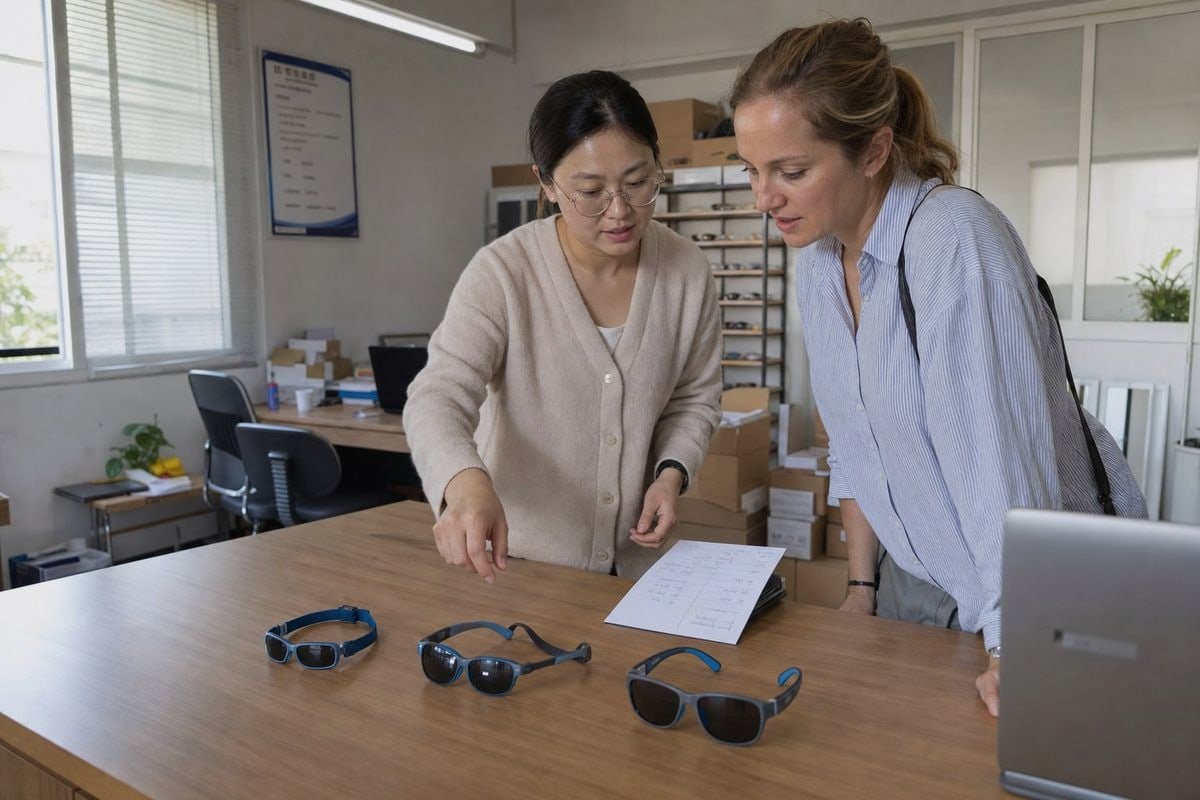
Developing both categories under one supplier saves cost and keeps quality consistent — but only if that supplier genuinely masters both architectures. After fifteen years running our eyewear factory in Taizhou with around 120 workers, I can tell you the gap between "makes kids' sunglasses" and "engineers infant eyewear" is wide.
Une liste de contrôle pratique pour l'évaluation des fournisseurs
| Evaluation Area | Ce qu'il faut vérifier | Pourquoi c'est important |
|---|---|---|
| Capacité matérielle | In-house TPEE and TR90 molding, BPA-free non-toxic materials documentation | Infant safety depends on the raw material, not the marketing |
| Existing mold library | Age-banded styles across 0–3 and 6–12 ranges | Launching from existing molds cuts risk and avoids heavy tooling cost |
| Retention hardware | Adjustable neoprene straps, strap clips, wrap temples in stock | Retention is the hardest part to develop from scratch |
| Lens supply chain | UV400 verification, polarized lens technology options, polycarbonate stock | Lens claims must be testable, not assumed |
| QC system | 5S workshop management, incoming and final inspection records | Consistency across reorders protects your brand |
| Customization depth | Custom colors, logos, lenses, packaging, accessories | Retail-ready presentation without a second vendor |
Test the supplier before the market tests you
I always suggest three steps. First, request samples from both categories and flex-test them yourself — an infant frame should twist freely; a big-kid frame should flex and recover. Second, ask how they handle the transition sizes between three and six years, because weak suppliers have nothing there. Third, start with a low-MOQ order from existing styles. With around 800 designs already tooled, a new brand can validate both infant and big-kid lines in one order, then invest in custom molds once sell-through data comes in. That staged approach is how most of our long-term partners started.
Conclusion
Infant sunglasses are protective gear for undeveloped anatomy; big kids' sunglasses are durable everyday eyewear. Spec each correctly — or partner with a factory that already has. We're ready when you are.
Notes de bas de page
1. Authoritative standards body relevant to impact resistance testing claims for children’s eyewear ↩︎
2. Defines the anatomical measurement referenced for children’s facial proportion changes ↩︎
3. FDA source on BPA safety relevant to non-toxic materials used in infant eyewear ↩︎
4. Background reference on sunglasses UV protection standards and terminology used throughout article ↩︎
5. Background on the thermoplastic material family that includes TR90 frame material ↩︎
6. Explains the shatterproof lens material specified for both infant and kids’ sunglasses ↩︎
7. Authoritative NIH/StatPearls clinical overview of binocular vision and eye coordination. ↩︎
Plus d'articles que vous pourriez aimer

Vous recherchez un partenaire fiable en lunetterie pour enfants ?
Explorez plus de 800 styles prêts et un support OEM/ODM complet adapté à votre marque.
Contactez-nous English
  Español de México
  Deutsch
  Français
  日本語
日本語  العربية
  Português do Brasil