Les normes de protection UV pour les lunettes de soleil pour enfants varient-elles selon les pays ?
Les normes de protection UV pour les lunettes de soleil pour enfants ont piégé l'un de nos premiers acheteurs australiens il y a des années. Leur expédition a passé les contrôles CE mais a échoué à l'examen local. Cette erreur leur a coûté une saison — et elle est totalement évitable.
Oui, les normes de protection UV pour les lunettes de soleil pour enfants varient selon les pays. Les États-Unis suivent la norme ANSI Z80.3, l'Europe utilise la norme ISO 12312-1 avec marquage CE, et l'Australie applique la norme AS/NZS 1067.1, l'une des plus strictes. Les différences résident dans les longueurs d'onde de coupure UV, les méthodes de test et l'étiquetage obligatoire.
Ces différences ne sont pas académiques. Elles décident si votre produit passe la douane, réussit les audits des détaillants et protège réellement les yeux des enfants. Laissez-moi vous expliquer ce qui compte sur chaque marché.
Quelles normes de protection UV s'appliquent aux lunettes de soleil pour enfants aux États-Unis, dans l'UE et en Australie ?
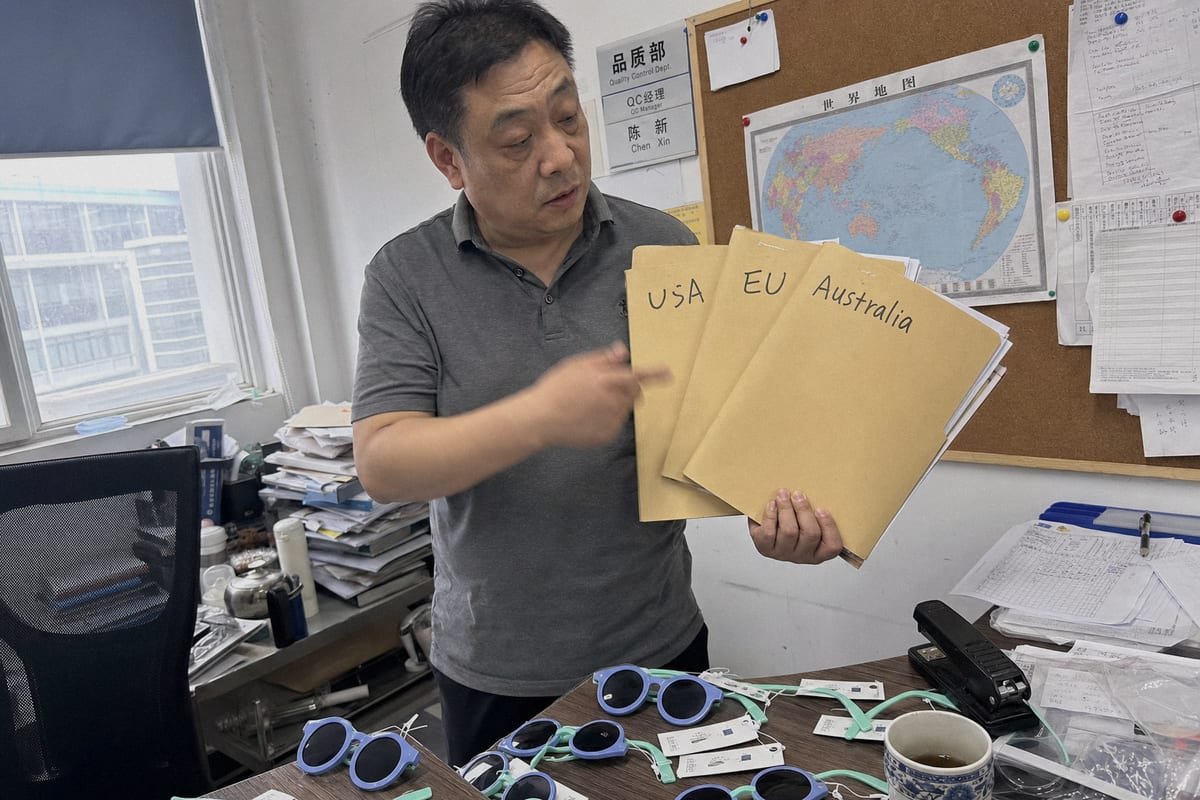
Dans notre usine de Taizhou, nous conservons trois dossiers de conformité séparés sur le mur de notre salle de contrôle qualité — un pour les États-Unis, un pour l'UE et un pour l'Australie. Les acheteurs des trois marchés commandent les mêmes montures TR90, mais la paperasse qui les accompagne n'est jamais identique.
Les États-Unis appliquent les règles d'impact de la bille tombante ANSI Z80.3 et de la FDA ; l'UE traite les lunettes de soleil comme des EPI selon la norme ISO 12312-1 avec marquage CE obligatoire ; l'Australie et la Nouvelle-Zélande appliquent la norme AS/NZS 1067.1, largement considérée comme la référence la plus stricte, avec des catégories de verres définies et des exigences d'étiquetage explicites.
Voici la comparaison rapide que nous partageons avec les nouveaux acheteurs B2B avant de chiffrer un projet :
| Marché | Norme | Statut légal | Marque clé | Focus UV |
|---|---|---|---|---|
| États-Unis | ANSI Z80.3 (2018) | Norme volontaire + règle d'impact de la FDA | Allégation de protection UV sur étiquette volante | Rayonnement UVA et UVB 1, UV400 courant |
| Union européenne | norme ISO 12312-1 2 (EN ISO 12312-1) | Obligatoire en vertu du règlement EPI | Certification marquage CE | Protection définie par rapport à 380 nm |
| Australie / NZ | AS/NZS 1067.1 3:2016 | Norme consommateur obligatoire | "Étiquette "Conforme AS/NZS 1067" | Limites de transmission strictes, catégories de verres 0–4 |
Pourquoi le même produit nécessite des dossiers différents
Le système américain semble léger sur le papier, mais il ne l'est pas. La norme ANSI Z80.3 est techniquement volontaire, pourtant la règle d'impact de la FDA ne l'est pas. Chaque verre expédié aux États-Unis — y compris les verres pour enfants — doit résister à un test de chute de bille ou à un équivalent statistique approuvé. Les acheteurs américains accordent donc autant d'importance aux normes de résistance aux chocs qu'à la filtration UV. 21 CFR 801.410 4 L'Europe adopte une approche juridique. Les lunettes de soleil sont classées comme.
, donc la certification marquage CE est obligatoire, soutenue par une déclaration de conformité et un dossier technique faisant référence à la norme ISO 12312-1. Pas de marquage CE, pas de vente légale. des équipements de protection individuelle 5, L'Australie et la Nouvelle-Zélande vont plus loin. La norme AS/NZS 1067.1 est une.
norme obligatoire pour les produits de consommation , appliquée par l'ACCC. Elle définit les catégories de verres 0 à 4, fixe des limites de transmission strictes, et les directives australiennes avertissent explicitement que les lunettes de soleil jouets ne respectent pas la norme et doivent être étiquetées comme telles. Lorsque nous développons des modèles pour enfants pour des marques australiennes, nous traitons cette norme comme le plafond — si un verre passe la norme AS/NZS 1067.1, il satisfait généralement les deux autres cadres avec une marge confortable., Les lunettes de soleil vendues dans l'UE nécessitent légalement le marquage CE car elles sont classées comme équipement de protection individuelle.
Comment puis-je m'assurer que les verres de mon fabricant respectent la norme UV requise sur mon marché ?
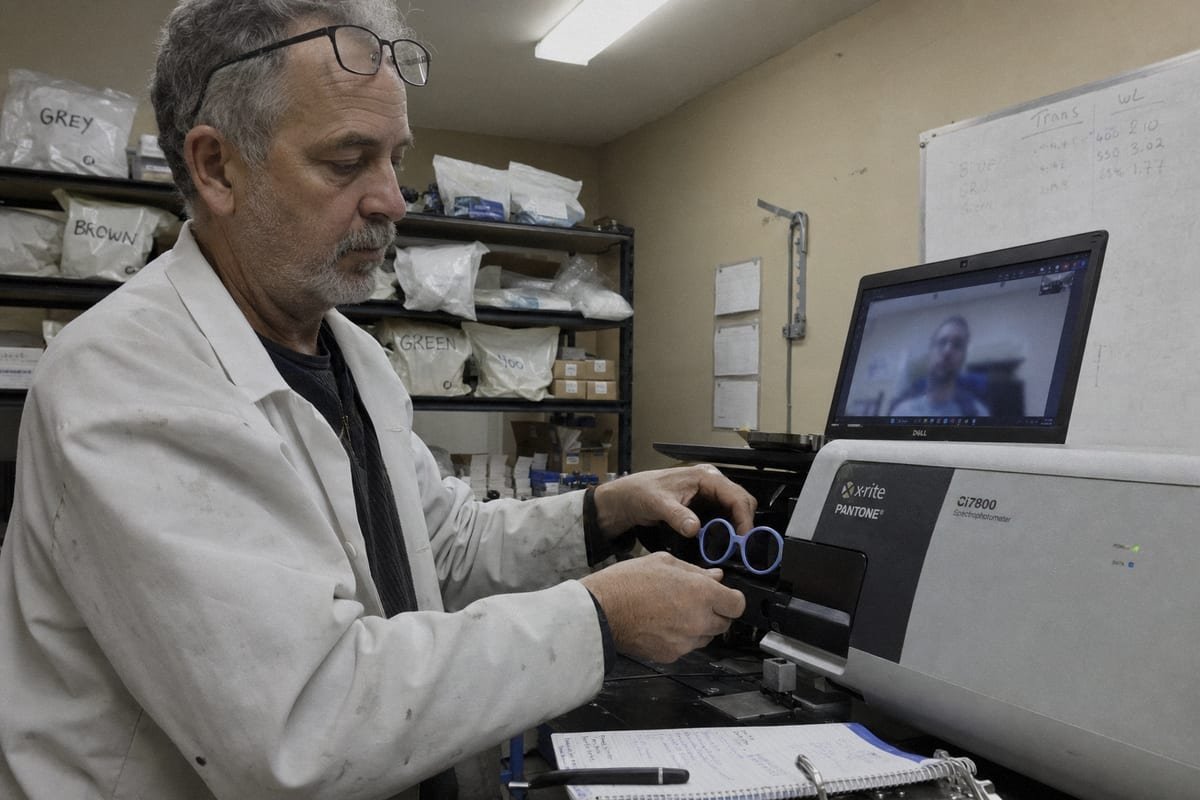
spectrophotomètre lors d'un appel vidéo, en direct. Ce niveau d'ouverture devrait être votre attente de base de la part de tout fournisseur. 6 Spécifiez votre norme de destination par écrit avant la production, demandez des rapports de test tiers de laboratoires accrédités selon cette norme exacte, vérifiez la transmission UV avec des données de spectrophotomètre, et auditez si votre fournisseur teste par lot ou seulement une fois par modèle. Ne vous fiez jamais à une allégation verbale "UV400".
Au cours de nos quinze années d'exportation de lunettes pour enfants vers plus de vingt pays, les acheteurs qui n'ont jamais de problèmes de conformité suivent tous un processus similaire. Voici la version que nous recommandons :.
Nommez la norme dans votre bon de commande.
- Écrivez "les verres doivent être conformes à la norme AS/NZS 1067.1:2016, catégorie de verre 3" — pas seulement "bonne protection UV". Des spécifications vagues produisent des verres vagues. Demandez des courbes de transmission spectrale.
- Un véritable rapport UV montre la transmission sur différentes longueurs d'onde, généralement de 280 à 400 nm. Si votre fournisseur ne peut pas produire une courbe, il ne mesure pas ; il devine. Commandez des tests tiers.
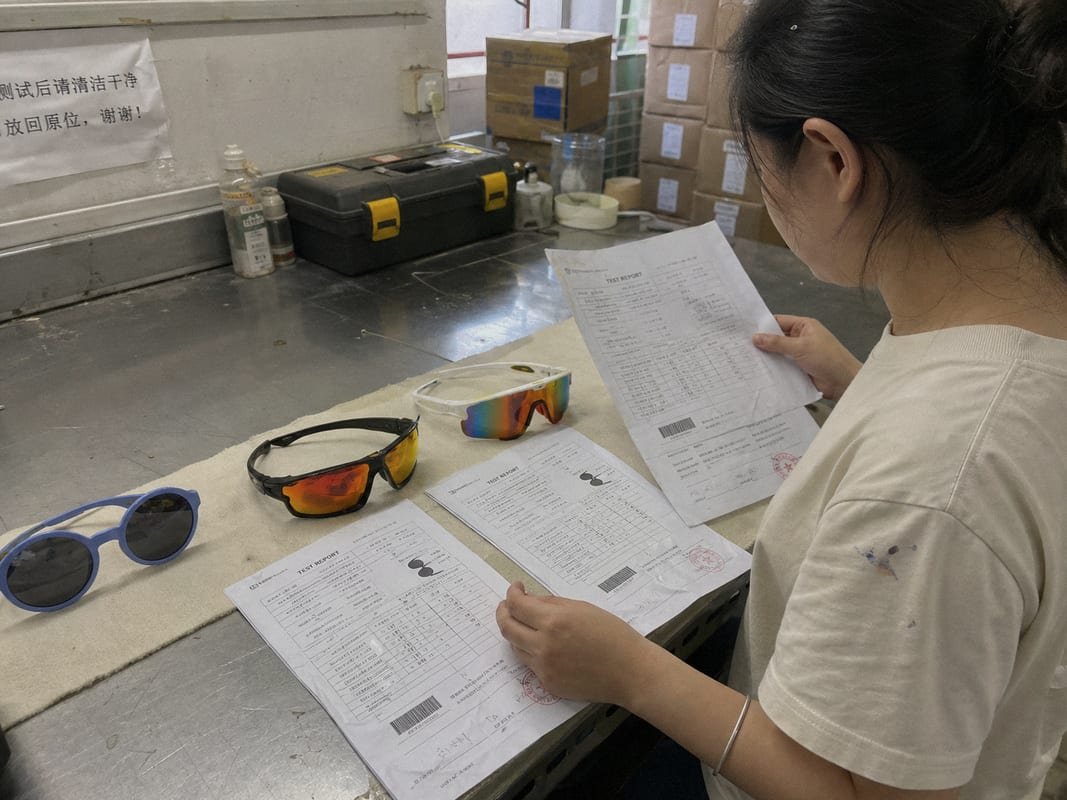
- Des laboratoires accrédités tels que SGS, Intertek, TÜV ou Bureau Veritas peuvent tester des échantillons de référence selon les normes ISO 12312-1, ANSI Z80.3 ou AS/NZS 1067.1. Budgétisez cela pour chaque nouveau fournisseur de verres ou chaque nouvelle couleur de verre. Vérifiez le contrôle qualité par lot, pas seulement par modèle.
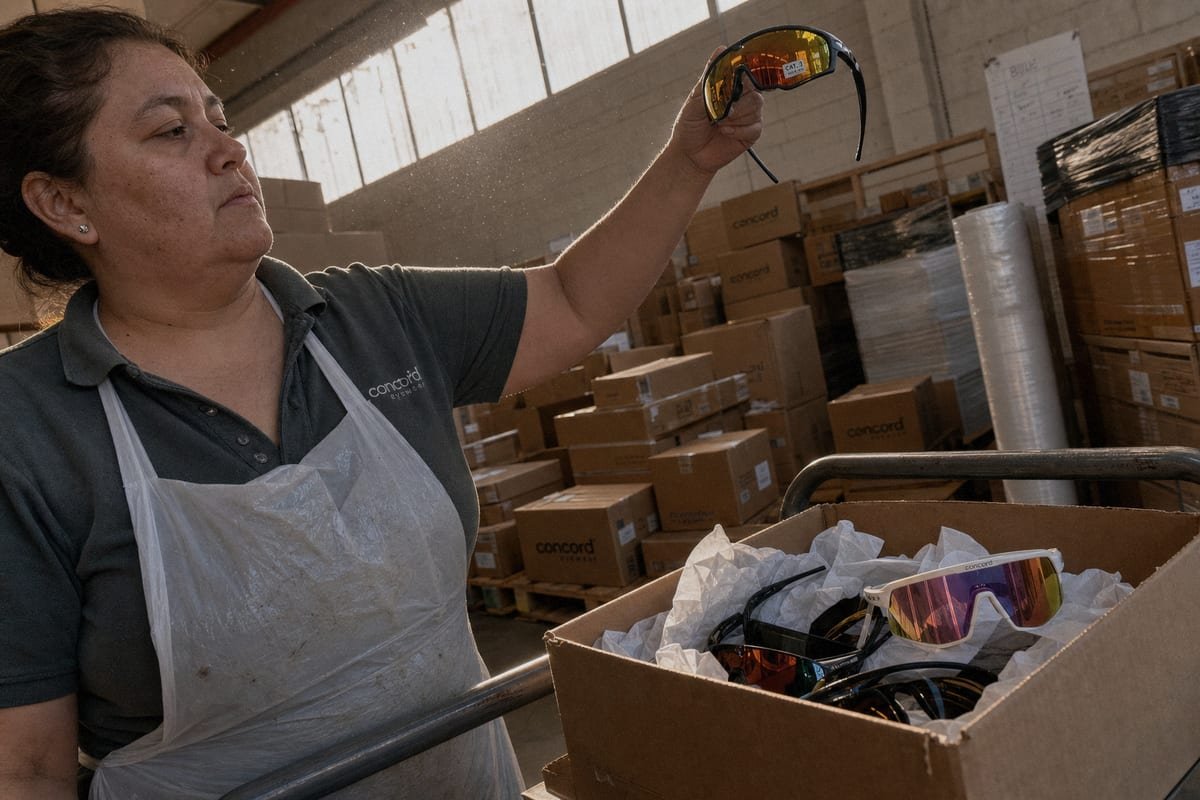
- Vérifier le CQ au niveau du lot, pas seulement au niveau du style. Les mélanges maîtres de teinte de lentilles varient d'un lot de production à l'autre. Nous vérifions la transmission UV sur les lots de lentilles entrants dans notre usine, car un certificat datant de deux ans ne dit rien de la résine de ce mois-ci.
- Associez la catégorie de lentille à son cas d'utilisation. Pour un usage général en extérieur, la catégorie 3 est la référence pratique pour les enfants. La catégorie 4 est trop foncée pour un usage quotidien, et les catégories 0-1 sont des teintes mode, pas une protection solaire.
Les signaux d'alarme que nous conseillons aux acheteurs de surveiller
Soyez prudent si un fournisseur propose le même "certificat" pour chaque produit, si le rapport de test n'a pas de photo d'échantillon ou de numéro de modèle, ou si le prix d'une lentille "UV400 polarisée" est suspectement inférieur au marché. Les additifs absorbant les UV coûtent cher. Un devis qui ignore ce coût ignore généralement aussi la protection.
Quelle est la différence entre UV400 et les autres indices de protection UV que je vois sur les verres ?
Il y a un compromis que nous discutons avec presque tous les clients européens : leur norme nationale autorise techniquement une coupure UV inférieure à celle de la classification UV400 que nous installons par défaut. Comprendre cet écart est la clé pour décoder les étiquettes des lentilles.
UV400 signifie que la lentille bloque toute lumière ultraviolette jusqu'à 400 nanomètres, couvrant tout le spectre UVA et UVB. Des étiquettes comme "100% de protection UV" ou "conforme à la norme CE" peuvent seulement garantir une protection jusqu'à 380 nm, laissant la bande UVA de 380 à 400 nm partiellement découverte.
La confusion existe car différentes normes fixent la limite de "ultraviolet" à différentes longueurs d'onde. Voici comment les étiquettes courantes se comparent réellement :
| Étiquette que vous voyez | Ce qu'elle garantit généralement | Couvre 380-400 nm ? | Fiabilité pour les enfants |
|---|---|---|---|
| la classification UV400 | Bloque les UV jusqu'à 400 nm | Oui | Meilleure référence disponible |
| 100% UVA/UVB | Blocage complet des UVA et UVB (devrait atteindre 400 nm) | Généralement oui | Bon, si soutenu par des données de test |
| Marquage CE uniquement | Conformité à la norme ISO 12312-1, référencée à 380 nm | Pas nécessairement | Adéquat, mais pas maximal |
| "Protection UV" (sans chiffre) | Affirmation marketing non vérifiée | Inconnu | À traiter avec prudence |
| Teinte foncée, aucune affirmation | Rien du tout | Non | Potentiellement dangereux |
Pourquoi les 20 derniers nanomètres comptent pour les enfants
La bande de 380 à 400 nm se situe en haut de la gamme UVA. Certains chercheurs soutiennent qu'elle mérite une attention particulière car elle pénètre profondément dans l'œil. Cela est plus important pour les enfants que pour les adultes. Le cristallin d'un enfant est plus clair que celui d'un adulte, 7 de sorte qu'une quantité significativement plus importante de rayons UV atteint la rétine pendant l'enfance. Les dommages oculaires dus au soleil sont cumulatifs — cataractes, ptérygions et changements rétiniens remontent à une exposition à vie qui commence dès les premières années. C'est pourquoi nous installons des lentilles UV400 en standard sur toute notre gamme pour enfants, même pour les commandes marquées CE où 380 nm suffiraient légalement.
Le piège de la dilatation
Un autre point mérite d'être souligné. Les lentilles foncées sans filtres UV vérifiés sont pires que pas de lunettes de soleil du tout. La teinte fait dilater les pupilles d'un enfant, ce qui laisse entrer plus de rayons UVA et UVB non filtrés dans l'œil. C'est précisément pourquoi les lunettes de soleil jouets et fantaisie échouent aux attentes des régulateurs. Certaines marques nous interrogent également sur une approche de type 'Indice de Protection Oculaire" qui évalue l'ensemble du produit — lentille plus couverture du cadre — ce qui reflète une vérité plus large : la couverture enveloppante et l'ajustement sont importants aux côtés de la lentille elle-même.
Quels certificats ou rapports de test dois-je demander avant d'importer des lunettes de soleil pour enfants ?
La paperasse a sauvé l'un de nos distributeurs de longue date d'un rappel coûteux. Un agent des douanes a remis en question les affirmations UV de leur expédition ; comme le dossier complet était prêt — rapports de test, déclaration de conformité, registres de lots — le conteneur a été dédouané en quelques jours au lieu de plusieurs mois.
Demandez un rapport tiers sur la transmission UV et la catégorie de lentilles par rapport à la norme de votre marché, un rapport de test de résistance aux chocs, des résultats de sécurité chimique pour les matériaux de monture, une déclaration de conformité signée pour l'UE et les enregistrements de contrôle qualité du fournisseur liés à votre lot de production spécifique.
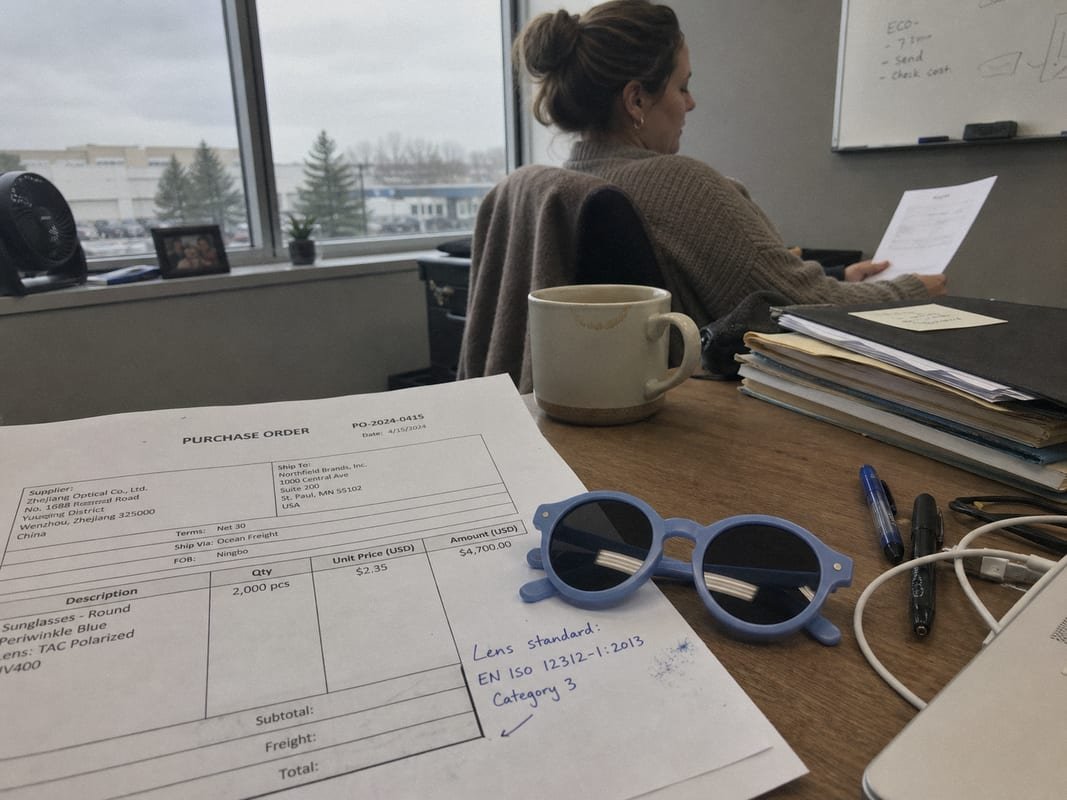
Différentes destinations nécessitent différents dossiers. Voici le cadre de liste de contrôle que nous préparons pour les acheteurs, adapté par marché :
| Document | États-Unis | UE / Royaume-Uni | Australie / NZ | Objectif |
|---|---|---|---|---|
| Rapport de transmission UV (laboratoire accrédité) | ANSI Z80.3 | norme ISO 12312-1 | AS/NZS 1067.1 | Prouve le blocage UV et la catégorie de lentille |
| Rapport de test d'impact / chute de bille | FDA 21 CFR 801.410 | Test de robustesse selon la norme ISO 12312-1 | Clauses de robustesse | Prouve la résistance aux éclats |
| Déclaration de conformité | — | Obligatoire avec marquage CE | — | Déclaration légale du responsable |
| Rapport de sécurité chimique (BPA, phtalates, plomb, cadmium) | CPSIA pertinent pour les enfants | REACH | Recommandé | Sécurité des matériaux du cadre pour les enfants qui mâchent les cadres |
| CPC (Certificat de produit pour enfants) | Souvent requis pour les produits pour enfants | — | — | Conformité des produits pour enfants aux États-Unis |
| Enregistrements de CQ par lot | Recommandé | Recommandé | Recommandé | Lie les rapports à vos biens réels |
La sécurité chimique fait partie du tableau
Les données UV seules ne suffisent pas pour les produits pour enfants. Les tout-petits mâchent les embouts de branches. C'est une des raisons pour lesquelles nous fabriquons nos montures en TPEE et TR90 — des matériaux flexibles et légers que nous pouvons étayer avec une documentation de sécurité chimique pour les phtalates, le BPA et les métaux lourds. Si votre fournisseur hésite sur les déclarations de matériaux, cette hésitation vous dit quelque chose.
Vérifiez, ne vous contentez pas de collecter
Une pile de PDF ne prouve rien si les documents sont recyclés ou falsifiés. L'essor du commerce électronique transfrontalier a produit un marché gris plein de contrefaçons de revendications CE et UV400. Alors vérifiez : appelez le laboratoire ou utilisez son portail de vérification de rapports en ligne, confirmez que le numéro de modèle et les photos du rapport correspondent à votre produit, et vérifiez que la date de test est récente. Pour votre première commande auprès d'une usine, envisagez une inspection avant expédition avec des tests UV aléatoires. Nous accueillons ces inspections dans notre atelier, car un fournisseur confiant dans ses verres n'a aucune raison d'éviter la surveillance.
Conclusion
Les normes pour les lunettes de soleil pour enfants varient selon les pays — en termes de seuils, de tests et d'étiquetage. Ignorez les différences et vous risquez des expéditions saisies et des yeux jeunes non protégés. Spécifiez votre norme, exigez des données de test UV400 vérifiées, et associez-vous à une usine qui documente tout.
Notes de bas de page
La fiche d'information de l'OMS sur le rayonnement ultraviolet explique les risques pour la santé liés à l'exposition aux UV non filtrés. ↩︎
L'ISO est l'organisme de normalisation qui publie la norme sur les lunettes de soleil référencée pour la conformité UE. ↩︎
Le régulateur australien de la sécurité des produits applique cette norme obligatoire sur les lunettes de soleil pour les consommateurs. ↩︎
Règlement officiel de la FDA cité exigeant des tests de résistance aux chocs par chute de bille pour les verres vendus aux États-Unis. ↩︎
Concept de fond expliquant pourquoi les lunettes de soleil entrent dans la classification réglementaire des EPI de l'UE. ↩︎
Explique l'instrument utilisé pour vérifier les données de transmission UV mentionnées dans le processus de conformité. ↩︎
Le National Eye Institute du NIH fournit des informations faisant autorité sur l'anatomie des yeux des enfants et l'exposition aux UV. ↩︎
Plus d'articles que vous pourriez aimer


Vous recherchez un partenaire fiable en lunetterie pour enfants ?
Explorez plus de 800 styles prêts et un support OEM/ODM complet adapté à votre marque.
Contactez-nous English
  Español de México
  Deutsch
  Français
  日本語
日本語  العربية
  Português do Brasil