TR90 vs TPEE/Silicone Kids Frames: Which Suits Which Age Group?

Every season, buyers ask our Taizhou team the same thing: [TR90](https://okayeyewear.com/tr90-tpee-kids-optical-frame-ensure-safety-impact/) vs TPEE/silicone kids frames—which for which age? Choose wrong, and returns follow. Choose right, and parents reorder.
In the TR90 vs TPEE/silicone kids frames choice, TPEE and silicone suit babies and toddlers from 0 to 3 because they are soft, chew-safe, and hinge-free. TR90 suits preschoolers, school-age kids, and pre-teens from 3 to 12+ because it adds lightweight structure, impact resistance, and shape memory.
That is the short answer. The longer answer depends on behavior, fit, and what your brand sells. Below, I break it down age by age, and I show where a hybrid frame makes sense.
How do I choose between TR90 and TPEE/Silicone frames for my age-specific product line?
The trade-off we weigh on every new kids' collection is simple: softness against structure. Softer frames forgive chewing. Stiffer frames hold lenses and shape through a school day.
Choose by developmental stage, not by size or trend. Use TPEE or silicone for 0–3 where mouthing and pulling dominate. Use TR90 from preschool onward where kids need frame flexibility plus shape retention. Treat 3–5 as a transition zone and decide by the child's behavior.

Here is the side-by-side view I share with brand buyers before we talk about styles.
| Facteur | TPEE | Silicone | TR90 |
|---|---|---|---|
| Sensation sur la peau | Soft, warm | Very soft, grippy | Smooth, firm but flexible |
| Frame flexibility | Bends 180° and twists | Bends freely | Flexes, then returns to shape |
| Rétention de forme | Bas | Bas | High (memory polymer) |
| Lens security | Bon, mais points de contrainte des charnières | Bon, mais points de contrainte des charnières | Strong, holds heavy lenses |
| Poids | Léger | Léger | Very light, often under 20 g |
| Charnières | Often screwless or one-piece | Usually one-piece | Spring or standard hinges |
| Meilleur âge | 0–3, some 3–5 | 0–3, comfort parts at any age | 3–5 (calm kids), 6–12+ |
What each material actually is
TPEE stands for thermoplastic polyester elastomer. It is a rubber-like plastic. It stretches, bends, and comes back without cracking. Silicone is even softer. We use it most for one-piece baby frames 1 and for temple tips and nose contact areas. TR90 is a nylon-based memory polymer. It is the material behind most lightweight eyewear for active kids. It flexes under stress and then snaps back to its original shape.
Why age matters more than trend labels
Research splits on the cutoff. Some guides draw the line at age 3. Others say TPEE for 0–5 and TR90 for 6+. Buyers often ask me which number is correct. My answer is that neither number is wrong. The real question is behavior. A 4-year-old who still chews temples belongs in TPEE. A calm 3-year-old who wears sunglasses at the beach can do well in a light TR90 frame. So I recommend a developmental range, not one birthday.
A quick decision path for your line
- Map your target ages. Baby brands lean TPEE and silicone. School-age brands lean TR90.
- Check the use case. Daycare and stroller use want soft. Playground and sports want structure.
- Decide on lenses. Sunglasses only, or optical too? Optical pushes toward TR90.
- Test before tooling. With around 800 existing styles in our range, you can sample both materials first and skip early mold costs.
That last step matters. Most new brands do not know their real age mix until they sell. Sampling from stock lets them learn without heavy risk.
What makes TPEE/Silicone frames safer for babies and toddlers under 3?
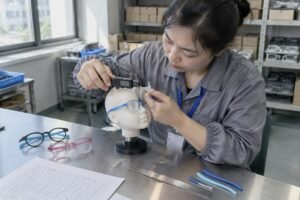
On our QC bench, every baby frame gets bent, twisted, and pulled by hand before it ships. A TPEE temple folds flat and springs back. That is the point.
TPEE and silicone frames are safer for children under 3 because they are soft, BPA-free, and hypoallergenic, bend 180 degrees without snapping, and use one-piece or screwless designs with no small metal parts. Paired with adjustable head straps, they stay on without pressure points.

Babies do not wear glasses the way older kids do. They grab them. They chew them. They throw them out of the stroller. So the safety question is really about what happens during misuse, not during normal wear.
Chewing, dropping, and twisting
A rigid frame can crack under a toddler's bite. A cracked edge is sharp. TPEE does not crack that way. It deforms and recovers. That is why many sources call TPEE frames "unbreakable." Silicone goes even further. It has no hard edges at all. Both are BPA-free materials, and both offer propriétés hypoallergéniques 2 for sensitive skin. On our line, we also avoid tiny screws on baby styles. Screwless hinges, or no hinges at all, remove the choking hazard that a loose screw creates.
Where silicone fits in
Buyers sometimes assume silicone is the main structural material for all kids' frames. It is not. Full silicone frames work well for the youngest wearers, especially with an integrated elastic strap for babies who are not yet walking. But silicone is too soft to hold optical lenses reliably. So in most of our range, silicone shows up as a comfort part: temple tips, nose pads, or the strap itself.
Fit and retention under 3
| Caractéristique de rétention | Why it helps under 3 |
|---|---|
| Forme ajustée ou enveloppante | Keeps frames on during play, no ear pressure |
| Wide, soft bridge | Suits flat infant noses, no red marks |
| Wraparound temples | Hugs the head instead of hooking the ear |
| One-piece front | No hinge to pinch fingers |
Enfants sensibles sensoriellement
One more point that pediatric optometry professionals 3 raise with us: children with sensory processing sensitivities often reject frames that feel cold or hard. Medical-grade silicone has a matte, soft-touch surface. It is never cold to the touch. For neurodivergent kids, that texture can be the difference between wearing the glasses and pulling them off.
When should my brand switch to TR90 frames for older kids and pre-teens?
A European importer once asked us for a 10-year-old's frame in pure TPEE. We advised against it. Lenses would not stay seated, and kids would call it a toy.
Switch to TR90 once a child stops chewing frames and starts active, all-day wear, usually from ages 5 to 6 and firmly by 6 to 12. TR90 holds lenses securely, resists impact, weighs under 20 grams in many kids' styles, and looks grown-up enough for pre-teens.

The switch is not about the child getting bigger. It is about the child's day getting harder on the frame. School bags, playgrounds, sports, and eight hours of wear all stress a frame differently than a stroller does.
Age-by-age breakdown
| Âge | Comportement typique | Matériau recommandé |
|---|---|---|
| 3–5 | Less chewing, more running, still drops frames | TPEE for chewers; light TR90 or hybrid for calm, active kids |
| 6–8 | School wear, playground impacts, first optical prescriptions | TR90 |
| 9–12 | Sports, screen time, style awareness | TR90 |
| Pre-teen and teen | Wants adult-looking frames | TR90 first; acetate or titanium as style options |
Four signs it is time to switch
- The child no longer mouths or chews the temples.
- The child wears glasses for a full school day, not just outdoors.
- The prescription is getting stronger or the lenses heavier.
- The child cares how the frame looks.
Why TR90 wins for this age group
La structure moléculaire du TR90 répartit l'énergie d'impact sur toute la monture. Elle n'envoie pas de choc violent directement sur l'arête du nez ou les branches. Lorsqu'une balle frappe le visage d'un enfant, cela compte. Le matériau conserve également sa flexibilité par temps froid. résistance aux chocs 4 is the headline. But the details matter more to buyers. First, weight. TR90 is much lighter than traditional plastic. A light frame stops sliding down the flatter nasal bridge of an elementary-aged child. It also reduces pressure during a long school day. Second, structure. High-index or heavy prescriptions need a rim that does not stretch. TR90 holds lenses in place where TPEE would let them shift. Third, climate. TR90 keeps its shape memory in heat. In hot markets, a TPEE frame can soften and lose grip on the head. TR90 stays stable. Fourth, style. Blue-light glasses are now common for pre-teens. TR90 allows thinner, more fashionable profiles, and that raises compliance among kids who refuse chunky frames.
Some buyers worry that "durable" means "stiff." I understand the worry, because stiff frames break. But TR90 is different. It flexes when a child sits on it, and it returns to shape. In the TR90 vs TPEE/silicone kids frames comparison, TR90 is the material that offers both frame flexibility and shape retention at the same time.
Can I combine TR90 and TPEE materials in one frame for maximum flexibility across age groups?
Our biggest lesson from 15 years of kids' eyewear is that one material rarely wins alone. That is why façades en TR90 avec branches en TPEE became our most requested hybrid.
Yes. A hybrid frame with a TR90 front and TPEE or silicone temples gives structure where lenses sit and softness where skin touches. It fits the 3–5 transition and active 6–10 kids best. Under 3, keep full TPEE or silicone; over 10, full TR90 usually wins.

The logic of a hybrid is simple. A frame has two jobs. The front must hold lenses and keep its shape. The temples must touch skin and survive bending. Those jobs want different materials. So we split them.
Common hybrid combinations
| Front | Temples / contact parts | Sweet spot |
|---|---|---|
| TR90 | Branches en TPEE | Active 4–10, sunglasses and optical |
| TR90 | TR90 temples with silicone tips | School-age optical, longer wear |
| TR90 | TPEE temples plus adjustable head strap | Sports, cycling, water play |
| TPEE | Silicone strap, no hinge | Under 3 only |
A two-tone frame, say a matte black TR90 front with soft sky-blue TPEE temples, also gives your brand a visual story. Parents can see the soft part. That helps at retail.
Where hybrids do not help
I will be honest about the limits. Under 3, a hard TR90 front still gets chewed. So hybrids do not replace full-soft baby frames. And eco-conscious buyers raise a fair objection: TPEE is a mono-material that recycles more easily, while TR90 often needs metal temple cores removed first. A hybrid mixes both, which complicates recycling. We address this by using coreless TPEE temples where possible and by keeping parts easy to separate. But if sustainability is your brand's main claim, full TPEE is the cleaner story.
A buying checklist for hybrid development
- Confirm bridge width and temple length for your target age.
- Choose hinge style: spring hinge, standard, or screwless.
- Decide on lenses: UV400, polarized, optical, or blue-light.
- Pick colors and logo placement on both materials.
- Plan packaging and any strap or case accessories.
Full OEM/ODM support covers all five steps. Custom colors, printed logos, lens options, and retail-ready packaging are standard for us, and our 5S-managed workshop runs QC at each stage. A hybrid frame only works if the two materials are bonded and finished consistently, and that is a production discipline, not a design sketch.
Conclusion
Age drives the TR90 vs TPEE/silicone kids frames decision. Wrong material means returns. Match softness to toddlers, structure to school kids, hybrids in between, and your line sells.
Vous souhaitez vous procurer les produits mentionnés dans cet article ? Voir les détails et demander un devis ici :
Notes de bas de page
1. General reference for eyewear construction and specialized frame designs for infants and toddlers. ↩︎
2. Technical specifications for TPEE materials, detailing their hypoallergenic and flexible properties for consumer safety. ↩︎
3. Authoritative medical organization providing clinical guidelines on pediatric eye health and safe eyewear materials. ↩︎
4. Official site of the manufacturer of TR90, providing technical data on polymer impact resistance and durability. ↩︎
Plus d'articles que vous pourriez aimer

27 octobre 2026
Comment les détaillants doivent-ils stocker les montures optiques TR90 pour enfants par âge et par tendances de genre ?

26 octobre 2026
Qu'est-ce que les parents privilégient dans les montures optiques TR90 pour enfants ?
25 octobre 2026
Comment choisir des montures optiques TR90 pour enfants par forme de visage et pont de nez ?
Vous recherchez un partenaire fiable en lunetterie pour enfants ?
Explorez plus de 800 styles prêts et un support OEM/ODM complet adapté à votre marque.
Contactez-nous English
 Español de México
 Deutsch
 Français
 日本語
 العربية
 Português do Brasil