Should TPEE Kids Sunglasses Follow Sunglasses or Toy Safety Standards?
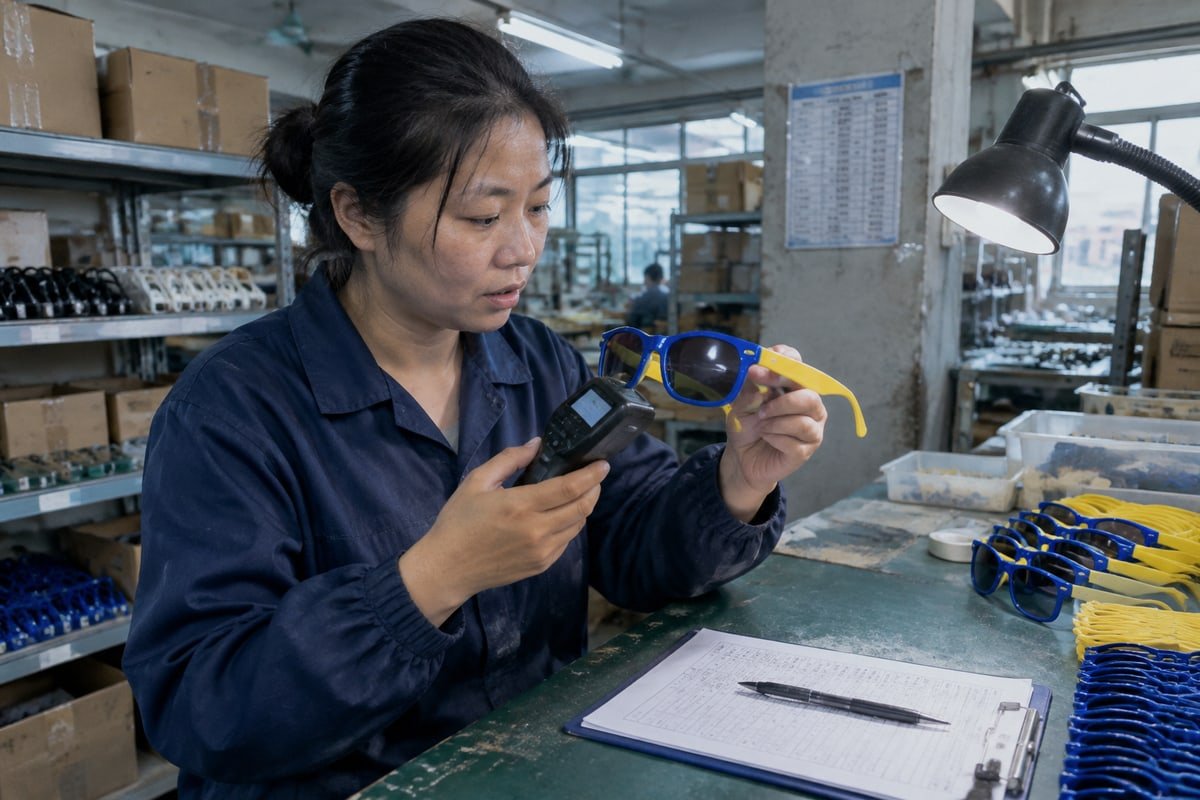
Every month, buyers ask our Taizhou factory the same question about TPEE kids sunglasses: sunglasses standard or toy standard? Choose wrong, and customs holds your shipment. Here is the answer.
TPEE kids sunglasses should follow sunglasses standards first—ANSI Z80.3, ISO 12312-1, or AS/NZS 1067.1 for UV and impact performance—plus children’s product chemical rules like CPSIA. Toy standards such as EN 71 or ASTM F963 apply only if the product is sold or marketed as a toy.
That short answer hides a lot of detail. The sections below explain how to classify your product, why the two rulebooks differ, which test reports to demand, and how to pick a supplier who will not get this wrong.
How Do I Know Which Safety Standards Apply to My TPEE Kids Sunglasses?
Last year an Australian baby-brand buyer sent us a spec sheet that mixed toy clauses with lens clauses. Sorting it out took a week. The fix was one simple question.
Start with the product's intended use. If it is worn to block sun, it is eyewear and follows ISO 12312-1, ANSI Z80.3, or AS/NZS 1067.1. Because it is made for children, layer CPSIA regulations or REACH on top. Toy standards apply only when you market it as a toy.
Most buyers assume there are two boxes: sunglasses or toy. In practice there are three, and they overlap. Once you see the three boxes clearly, the confusion goes away.
Three regulatory categories, not two
| Catégorie | Ce que cela signifie | Governing rules | Applies to TPEE kids sunglasses? |
|---|---|---|---|
| Eyewear | Worn on the face to filter sunlight | ANSI Z80.3 (US), ISO 12312-1 (EU), AS/NZS 1067.1 (AU/NZ); the FDA treats sunglasses as a Class I FDA medical device and requires drop-ball testing under 21 CFR 801.410 | Always |
| Children's product | Any product designed or intended for children | CPSIA regulations 1 for lead and phthalates in the US; REACH restrictions in Europe | Always |
| Toy | Designed or marketed primarily for play | EN 71 compliance in Europe; ASTM F963 2 in the US | Only if you market it as a toy |
The first two rows are mandatory for every pair we ship. The third row depends entirely on your marketing.
The one question I ask every buyer
I ask: "What will the packaging say?" The wording decides the category. If the box says "blocks 100% UVA and UVB," the product is eyewear. If the box says "chewable," "teething-safe," or "play sunglasses," the product has crossed into toy territory. Those words trigger toy bite-endurance and small-parts testing that a normal sunglasses certificate does not cover.
This matters because the two routes are not interchangeable. A toy certificate will not prove UV400 protection. A sunglasses certificate will not prove bite endurance. Our lavender cat-eye style carries a small CE marking engraved on the inner temple. In Europe that mark references the sunglasses route, not the toy directive. We keep those two paths separate on purpose, and I recommend you do the same in your product copy.
Why Do Sunglasses and Toy Safety Standards Differ for Children's Eyewear?
On our inspection line, a dark lens that blocks glare but fails UV testing looks identical to a good one. That gap explains why the two rulebooks diverge.
They differ because they protect against different hazards. Sunglasses standards regulate UV transmission, lens category, optical distortion, and impact resistance testing. Toy standards like EN 71 and ASTM F963 regulate choking, sharp edges, and chemical migration. Toy rules never verify that a lens actually protects a child's eyes.

The difference is not a paperwork detail. It comes down to what can hurt a child, and the two rulebooks were written by people worried about different injuries.
The pupil dilation trap
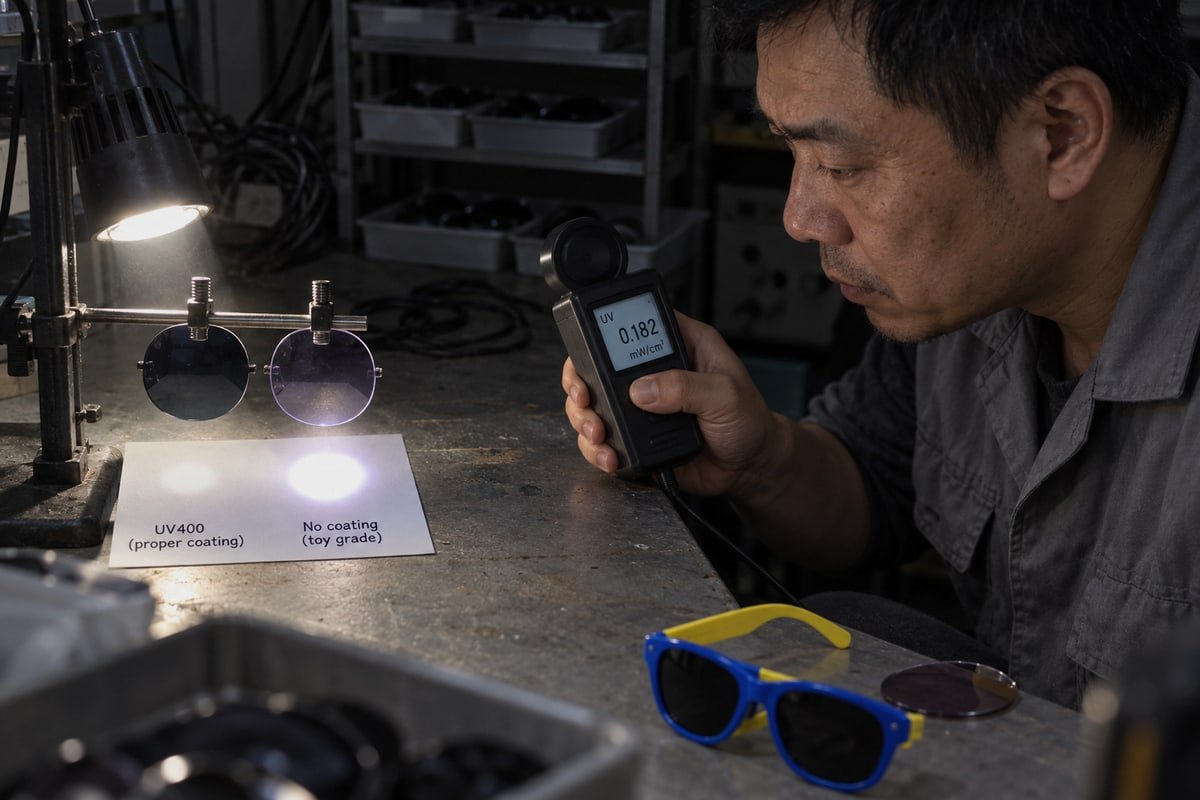
A dark lens makes the eye think it is in shade. The pupil opens wider. If that lens has no UV filter, more unfiltered radiation reaches the retina than if the child wore nothing at all. Toy-grade "sunglasses" often fall into this trap, because no toy standard contains a UV transmission test 4. This is the single strongest reason to treat children's eyewear as eyewear.
What each rulebook actually checks
| Danger | Sunglasses standard (ISO 12312-1 / ANSI Z80.3) | Toy standard (EN 71 / ASTM F963) |
|---|---|---|
| UV transmission (UV400) | Tested and marked | Not tested |
| Lens category CAT 0–4 | Required marking | Non requis |
| Optical distortion and prism | Tested | Not tested |
| Conformité au test de chute de bille de la FDA | Drop-ball or equivalent | Only sharp edges after breakage |
| Small parts and choking | Not a core requirement | Tested |
| Chemical migration | Covered via CPSIA or REACH | Tested, with migration limits |
Read the left column as "will this protect the eye?" Read the right column as "will this hurt the child during play?" Both questions matter. Only one of them is about vision.
The buyer objection: soft, BPA-free, unbreakable—isn't that enough?
I hear this a lot, and I understand why. TPEE frames are flexible, bite-resistant, and free of BPA. They feel like a toy-safe product. But every one of those claims describes the frame. None of them describes the lens. A frame can twist in a toddler's hands and still hold a lens that leaks UV. The marketing language of "unbreakable" is a frame property. It is not a standard, and it does not substitute for a lens test report.
What Compliance Tests Should I Require From My Manufacturer Before Importing?
Every test report costs money and time. We weigh that against a rejected container every time we quote a new market. The tests below are the ones worth paying for.
Require third-party reports for UV400 protection and lens category under ISO 12312-1 or ANSI Z80.3, drop-ball impact resistance under 21 CFR 801.410 for the US, CPSIA lead and phthalate testing, and REACH for Europe. Add EN 71 or ASTM F963 only if your marketing makes toy claims.
In our workflow, we ask three questions before we quote: target market, age range, and packaging claims. Those answers build the test list. Here is the sequence I recommend to any importer.
A six-step test sequence
- Confirm the lens spec first. Ask for the lens material and the UV cut-off. We supply UV400 and polarized options, and most buyers choose shatterproof polycarbonate lenses for children because they resist impact well.
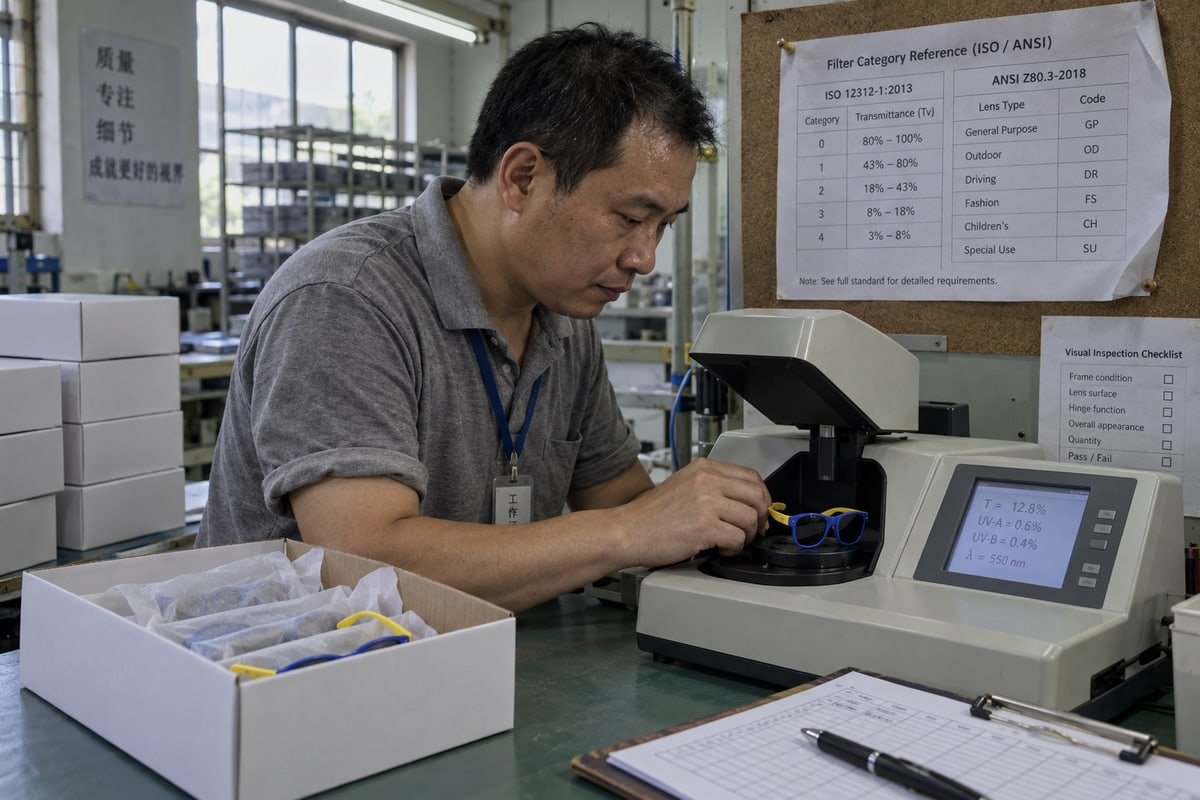
- Request the optical report. The report should cite ISO 12312-1, ANSI Z80.3, or AS/NZS 1067.1 and show the lens category (CAT 0–4) and UV transmission results.
- Request the impact report. For the US, this means drop-ball impact resistance testing under 21 CFR 801.410. Novelty products often skip this step. Do not let yours.
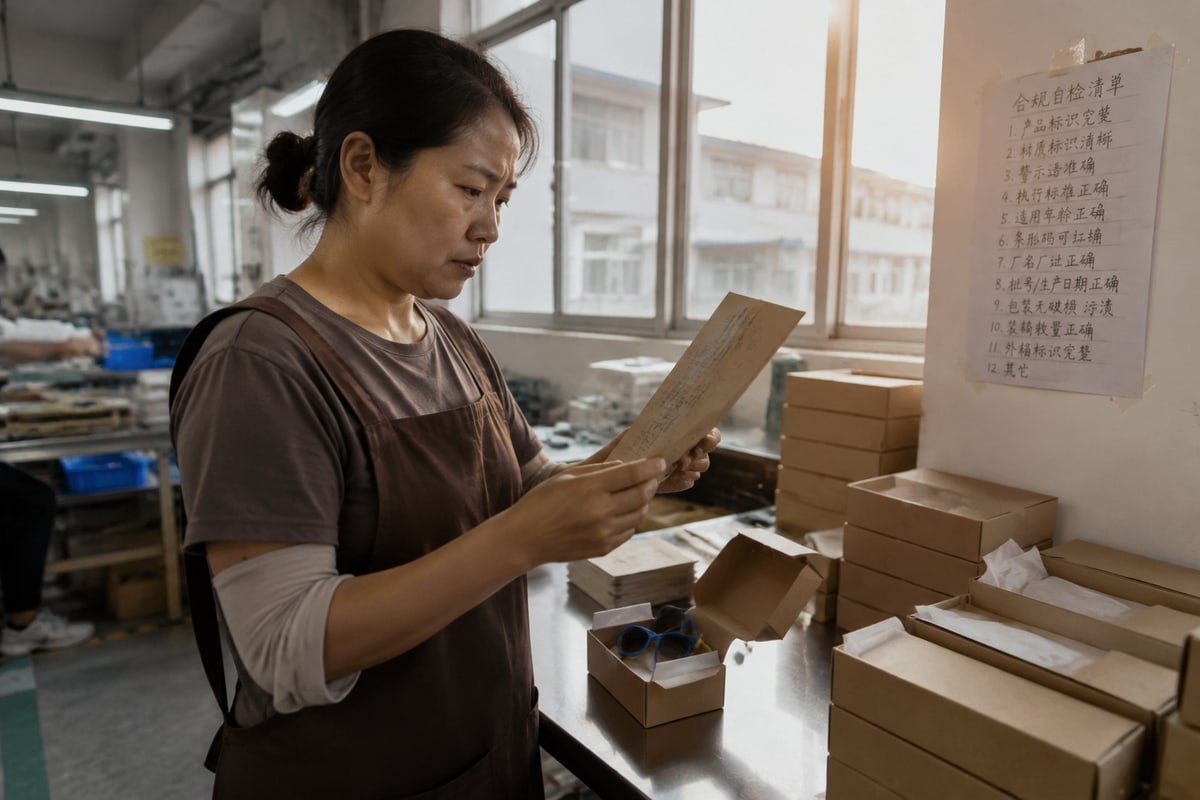
- Request the chemical report. CPSIA regulations cover lead and phthalates for the US. REACH covers restricted substances for Europe. Ask for BPA-free frames and phthalate-free materials to be stated on the report, not only on the sales sheet.
- Check for toy triggers. If your copy says "chewable" or "teething," add EN 71 compliance or ASTM F963, including bite endurance and small-parts testing.
- Verify the lab and the date. Reports should come from a recognized third-party lab and match the exact colorway and lens you are buying.
Requirements by region
| Région | Optical standard | Impact requirement | Chemical framework | Toy add-on if marketed as toy |
|---|---|---|---|---|
| États-Unis | ANSI Z80.3 | 21 CFR 801.410 drop-ball | exigences CPSIA | ASTM F963 |
| Union européenne | norme ISO 12312-1 | Within ISO 12312-1 | REACH | EN 71 |
| Australie / Nouvelle-Zélande | AS/NZS 1067.1 | Within AS/NZS 1067.1 | State and federal product safety rules | AS/NZS ISO 8124 |
Some leading brands now pursue a hybrid approach and certify to ISO 12312-1 plus EN 71 or ASTM F963. That is a valid strategy. It lets you market the product as protective eyewear and as play-safe. Just understand that it doubles the test scope, and the sunglasses report remains the non-negotiable half.
How Can I Choose a Supplier Who Understands Both Standards for My Brand?
Fifteen years of making children's eyewear taught us one thing: a supplier who says "TPEE is unbreakable, so no test needed" has confused a material with a standard.
Choose a supplier that separates lens compliance from frame material claims, holds current third-party reports for your target market, knows when toy claims trigger EN 71 or ASTM F963 testing, and offers OEM/ODM support with retail-ready packaging. A real factory with existing styles lowers your launch risk.
The supplier conversation reveals more than the catalog does. I suggest you listen for how the supplier talks about materials versus tests. The good ones keep those two topics apart.
Five questions for your first call
- Which standard does your lens report cite, and can I see the lens category on it?
- Do you hold separate chemical reports for the frame and the lens?
- If my packaging says "teething-safe," what extra tests will you run?
- Can I test the market from your existing styles before I pay for a mold?
- Who owns quality control on the line, and how is the workshop managed?
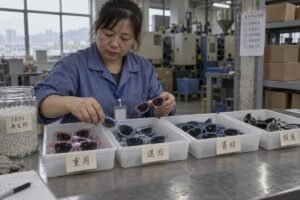
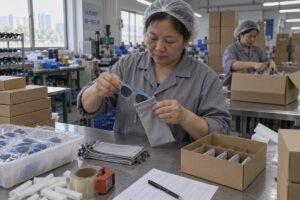
The last question sounds soft, but it matters. Our workshop runs 5S management with around 120 workers, and that discipline is what keeps colorways and lens specs consistent from sample to bulk.
What TPEE solves and what it does not
| TPEE frame property | What it delivers | What it does not replace |
|---|---|---|
| Flexibility and bend resistance | Fewer snapped temples on active kids | UV400 lens verification |
| No sharp fragments on failure | Lower cut risk | Drop-ball impact resistance testing on the lens |
| Soft-touch feel | Comfort, including for sensory-sensitive children who reject rigid frames | CPSIA or REACH chemical reports |
| BPA-free formulation | Cleaner material story | Phthalate and lead testing on the finished product |
TPEE is a genuinely good frame material. Our round blush-pink kids style and our blue-and-yellow square style both rely on it for comfort on small faces. Buyers now also ask about bio-based TPEE and environmentally friendly materials, and that interest is growing. Even so, TPEE is a material choice. It improves the frame. It does not certify the product.
Why a real factory matters for TPEE kids sunglasses
A brand launching TPEE kids sunglasses faces two risks: mold investment and compliance mistakes. Our roughly 800 existing styles address the first risk. You can pick a shape, apply your colors and logo, choose UV400 or polarized lenses, and receive branded packaging without paying for tooling. Our test-ready sampling addresses the second risk. We prepare samples for third-party labs based on your target market, and we tell you upfront when a marketing claim will trigger toy testing. That combination is what lets brands in 20+ countries move from idea to shelf with fewer surprises.
Conclusion
Mislabeling kids' eyewear as a toy leaves eyes unprotected and shipments at risk. Treat TPEE kids sunglasses as eyewear, add children's chemical rules, and test before you import.
Interested in sourcing the products mentioned in this article? See details and request a quote here:
Notes de bas de page
1. Official CPSC statute page for the Consumer Product Safety Improvement Act (CPSIA). ↩︎
2. CPSC overview of the mandatory toy safety standard for products sold in the United States. ↩︎
3. Official ECHA explanation of REACH regulations concerning chemical safety and restricted substances in products. ↩︎
4. Official ISO page for the international standard governing sunglasses and related eyewear requirements. ↩︎
Plus d'articles que vous pourriez aimer

Vous recherchez un partenaire fiable en lunetterie pour enfants ?
Explorez plus de 800 styles prêts et un support OEM/ODM complet adapté à votre marque.
Contactez-nous English
  Español de México
  Deutsch
  Français
  日本語
日本語  العربية
  Português do Brasil