Should Suppliers Pre-Install Anti-Theft Tags on Kids’ Optical Frames or Add Them at the Warehouse?
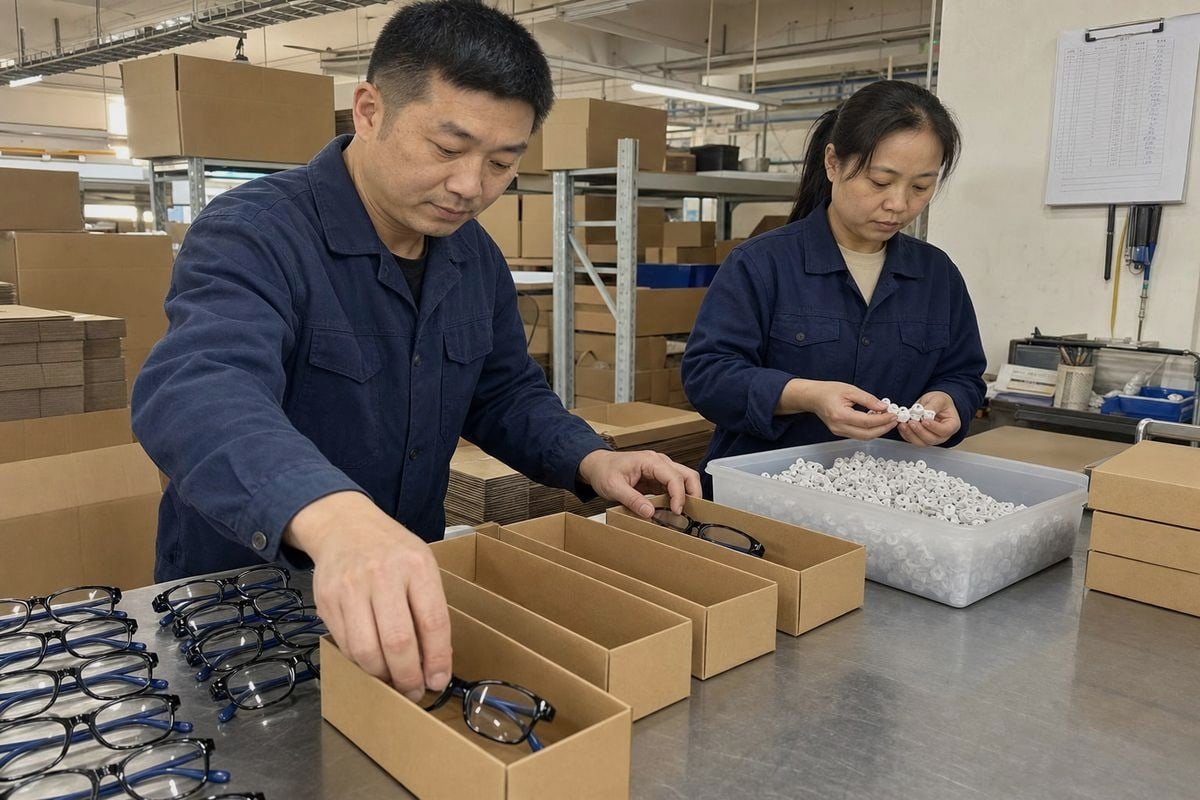
Anti-theft tags on kids’ optical frames create a real dilemma. On our production line, buyers keep asking where tagging belongs. Get it wrong, and shrinkage or breakage eats your margin.
Warehouse tagging is the safer default for most retailers of kids’ optical frames because it preserves EAS compatibility, easier returns, and fitting access. Supplier pre-installation wins only when the retailer and factory share one standardized system, stable SKUs, and tightly aligned floor-ready packaging workflows.
That is the short answer. But the full picture involves labor cost 1, damage risk, returns, and your store’s detection gates. Let me walk you through each factor.
A distributor in Australia once asked us to source-tag 8,000 frames. Halfway through the discussion, we discovered half his stores used AM gates 2 and half used RF. That changed everything.
Compare four costs: warehouse labor, transit damage risk, EAS system compatibility, and returns handling. Pre-installed tags cut labor and ensure consistent placement, while warehouse tagging protects flexibility. If your stores run mixed detection systems or high return rates, warehouse tagging protects margins better.

The real question is not security. It is workflow. Both methods deter theft. The difference is where problems appear in your supply chain logistics, and how much each problem costs you.
Start with a side-by-side view
| Facteur | Supplier Pre-Installation | Warehouse Tagging |
|---|---|---|
| Labor cost | Low for retailer; done at point of manufacture | Higher; needs trained warehouse staff |
| Tag placement consistency | Very high, standardized | Varies by operator |
| EAS compatibility risk | High if systems differ by region | Low; matched at destination |
| Transit damage risk | Slightly higher with hard tags | Lower; frames ship clean |
| Returns and re-routing | Harder; tagged units limit channel options | Easier; tag added only when needed |
| Inbound protection | Protected through the whole chain | Unprotected until tagged |
Source tagging shines when volume is high and everything is standardized. One retail chain, one detection frequency, one packaging format. In that case, moving tagging upstream reduces missed units and delivers floor-ready shipments straight to stores.
Warehouse tagging shines when your business is messy in normal, healthy ways. Multiple regions. Seasonal assortments. Some product going to tagged retail 3, some to e-commerce where tags are pointless. In our experience exporting to 20+ countries, most growing kids' brands sit in this second category.
Run the numbers honestly
Labor cost optimization sounds attractive on paper. But one shipment of incompatible tags can erase a year of labor savings. Inventory shrinkage hurts, yet mis-tagging hurts too. Weigh both before deciding.
There is a trade-off we weigh constantly in our 5S workshop 4: earlier protection versus material stress. Flexible kids' frames behave differently from rigid adult acetate, and clips press on them differently too.
Properly placed eyewear tags will not damage TR90 or TPEE frames during normal transit. However, hard tags clamped on flexible temples for weeks can leave pressure marks, and they block the heat-molding zones needed for children's bridge and temple adjustments at fitting.

After fifteen years of making flexible children's eyewear 5, we have learned where these materials forgive and where they do not. TR90 and TPEE are memory materials. They flex and bounce back. That is exactly why active kids love them. But sustained clamping pressure is different from a quick bend.
Where the risk actually sits
A hard tag applied at our factory in Taizhou may sit on a temple arm for six to ten weeks before a child ever tries the frame on. During that time, three things can happen:
- The clamp point compresses the soft TPEE temple coating, leaving a visible dent on lighter colorways.
- Vibration in transit lets the tag rub against neighboring frames, scuffing glossy finishes.
- The tag covers the "hot zones" opticians heat to adjust the bridge and temples for a proper kids' fit.
That third point matters most for children's optical frames. Kids' faces vary enormously. Almost every frame gets adjusted before dispensing. A tag blocking the temple's adjustment zone slows the optician down or forces early removal, which defeats the purpose.
What reduces the risk
| Risk | Mitigation |
|---|---|
| Pressure marks on soft temples | Use lightweight optical-specific tags; avoid clamping on TPEE tips |
| Transit scuffing | Individual poly bags or slim-line security-optimized packaging |
| Blocked heat-molding zones | Tag the lens or demo lens area, not the temple hot zone |
| Long dwell time under clamp | Tag at the warehouse, closer to the sales floor |
Some vendors now discuss embedding invisible resonators inside the frame material during injection molding. It is an interesting direction. But for standard hard tags vs soft labels on flexible kids' frames, later application is gentler on the material.
Can my supplier customize tag placement so it doesn't interfere with branding or packaging presentation?
A Japanese buyer once rejected a pre-production sample because the tag hid the temple logo we had pad-printed for her brand. We repositioned it in one day. That lesson stuck with us.
Yes, a capable OEM/ODM factory can standardize tag placement to avoid logos, size markings, and packaging windows. Placement is agreed at the pre-production sample stage, documented in the QC checklist, and applied identically across the whole order for a consistent retail presentation.
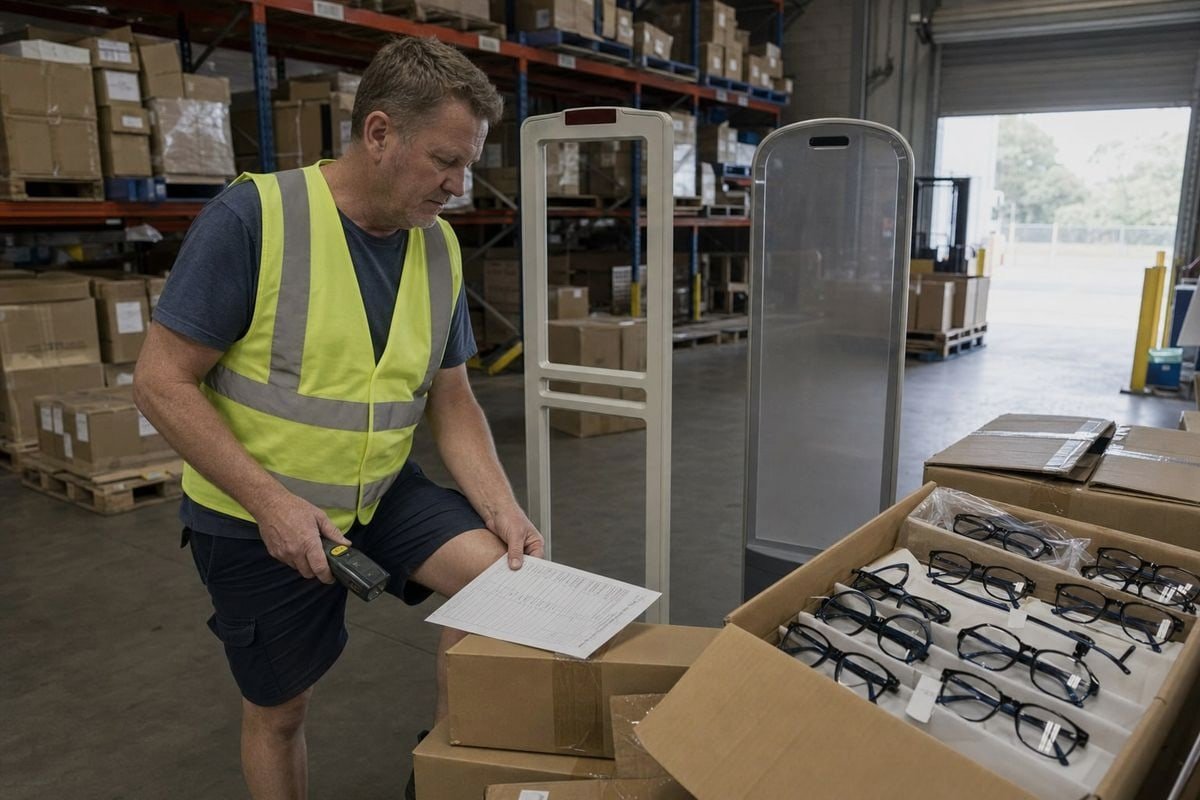
When we run OEM programs with custom logos, colors, and retail-ready packaging, tag placement becomes part of the design conversation, not an afterthought. It should be treated exactly like logo position or hang-tag placement.
What good placement customization looks like
First, the tag must never obscure the brand logo 6 on the temple. Your logo is why you invested in custom tooling and printing. Second, it must not cover the sizing information molded inside the temple arm. Opticians and parents rely on those numbers. Third, it must not fight your packaging. A bulky external clip can force you into oversized secondary boxes, raising shipping volume and cost.
Here is the process we follow with brand buyers:
- Buyer confirms the EAS tag model or ships us a reference sample.
- Our engineers test three placement positions on the actual frame style.
- We photograph each option inside the final retail packaging.
- Buyer approves one position at the pre-production sample stage.
- The approved position goes into the work instruction and QC checklist.
- Inline inspection verifies placement on every carton before pack-out.
This matters more for children's eyewear than adult frames. Kids' packaging often uses playful window boxes and character graphics. A tag placed carelessly can block the exact visual that sells the product on the shelf. With roughly 800 existing styles in our catalog, we have seen almost every frame shape, and placement rules differ between a rounded TR90 frame and a soft-hinge sport style. Ask your factory to show placement photos before you approve bulk production. A professional supplier will expect that request.
What should I ask my factory about tagging options before placing a bulk optical frame order?
Early in my career at our factory, I assumed buyers would tell us their tagging requirements upfront. Most never did. Now we ask them first, because silence at ordering time becomes chaos at receiving time.
Ask five things: which EAS technologies the factory supports, whether tags are applied before or after individual packing, how placement is documented in QC, whether mixed tagged and untagged units are possible per order, and what the cost and lead-time impact will be.

A good factory conversation about Electronic Article Surveillance 7 takes twenty minutes and saves weeks of rework. Retail loss prevention works as a layered strategy, and your supplier is the first layer. Here is the checklist I recommend to procurement managers.
The essential questions
| Question | Why it matters |
|---|---|
| Which technologies do you support: RF 8.2 MHz, acousto-magnetic technology at 58 kHz, or RFID? | Tags must match your store gates; RFID asset tracking adds inventory visibility beyond theft deterrence |
| Do you apply tags before or after poly-bagging and boxing? | Affects scuff risk and whether shipments arrive floor-ready |
| Can you split one order into tagged and untagged units? | Protects e-commerce and export channels from useless tags |
| How is tag placement recorded in your QC documentation? | Prevents drift between sample approval and mass production |
| What is the per-unit cost and lead-time impact? | Tagging labor and tag sourcing add days and cents you must budget |
| Who supplies the tags: factory, retailer, or third party? | Buyer-supplied tags avoid frequency mismatches |
One more question most buyers forget
Ask how the factory handles returns of tagged goods. If a shipment is refused or re-routed, someone must remove or replace the tags. A factory with real OEM discipline will have an answer. A trader usually will not. We have supported both source tagging and untagged floor-ready programs for optical companies, and the successful ones all started with this checklist, not with price. Some global distributors also deliberately keep tagging at their own warehouse as a frequency buffer, applying AM or RF per destination country. That is a legitimate strategy, and your factory should respect it rather than push pre-installation by default.
Conclusion
Shrinkage is real, but mis-tagging costs more. Choose warehouse tagging for flexibility, pre-installation for standardized high-volume programs, and always confirm placement, compatibility, and QC with your factory first.
Notes de bas de page
1. Authoritative Wikipedia entry defining direct labor costs in manufacturing and supply chain contexts. ↩︎
2. Technical overview of acousto-magnetic (AM) technology used in retail anti-theft detection systems. ↩︎
3. Overview of the retail sector and its operational requirements for inventory. ↩︎
4. Government resource explaining the 5S methodology for workplace efficiency and organization. ↩︎
5. High-authority medical association guide from AAPOS on selecting and fitting glasses for children. ↩︎
6. Definition and importance of logos in brand identity and product design. ↩︎
7. Authoritative definition of EAS technology used in retail security systems. ↩︎
Plus d'articles que vous pourriez aimer

août 5, 2026
Bio-Based vs Regular Cellulose Acetate: What's the Difference for Kids' Frames?

août 5, 2026
How Recyclable Are Kids' Optical Frame Materials, and What Eco-Friendly Alternatives Exist?

août 5, 2026
Do Kids Optical Frames Whiten or Age in Storage, and How to Control Warehouse Conditions?
Vous recherchez un partenaire fiable en lunetterie pour enfants ?
Explorez plus de 800 styles prêts et un support OEM/ODM complet adapté à votre marque.
Contactez-nous English
  Español de México
  Deutsch
  Français
  日本語
日本語  العربية
  Português do Brasil