Les matériaux des lunettes de soleil pour enfants sont-ils conformes aux exigences environnementales ?
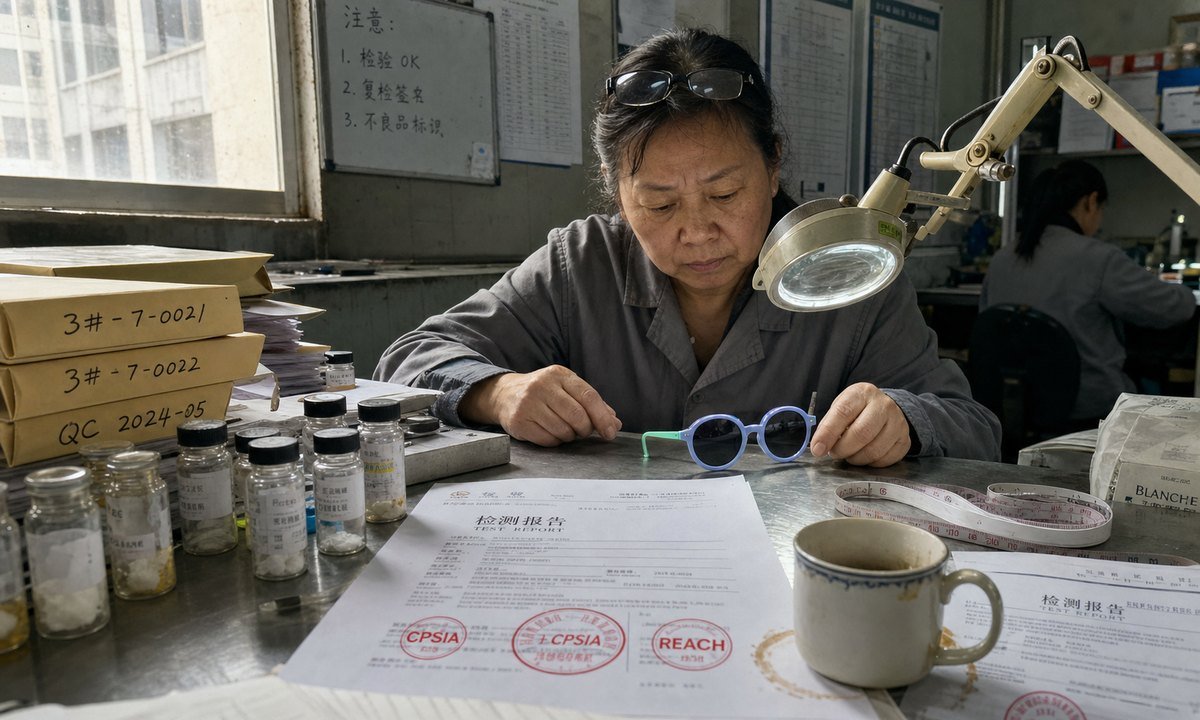
Les matériaux des lunettes de soleil pour enfants inquiètent de nombreux acheteurs que je rencontre Matériaux plastiques sans BPA 1. Un mauvais rapport de test peut faire couler toute une expédition. Après 15 ans à diriger notre usine de lunetterie à Taizhou, je connais cette douleur — et comment l'éviter.
Oui, les matériaux des lunettes de soleil pour enfants peuvent être conformes aux exigences environnementales, mais seulement lorsque la monture, les verres, les revêtements et l'emballage passent tous les tests chimiques selon le CPSIA et le REACH, et lorsque les allégations écologiques comme le contenu recyclé ou les intrants biosourcés sont étayées par des certifications tierces, et non pas seulement par du langage marketing.
La conformité n'est pas une seule case à cocher. Elle couvre la chimie, la durabilité et la sécurité en même temps Déclaration de conformité REACH 2. Laissez-moi vous guider à travers chaque couche, comme je l'explique à nos acheteurs B2B.
Quelles normes environnementales dois-je vérifier lors de l'approvisionnement en matériaux pour lunettes de soleil pour enfants ?
Une responsable des achats d'Australie m'a un jour envoyé une liste de contrôle de conformité de deux pages avant sa première commande Certification FSC 3. Je suis heureux qu'elle l'ait fait. Les acheteurs qui posent des questions tôt évitent les surprises coûteuses plus tard, et notre équipe prépare les documents pour exactement ces demandes.
Vérifier la conformité CPSIA pour le plomb et les phtalates aux États-Unis, la réglementation REACH pour les substances restreintes en Europe, la FDA 21 CFR 801.410 pour les verres résistants aux chocs et l'AS/NZS 1067.1:2016 pour les performances UV en Australie. Les allégations environnementales doivent en outre faire référence à la certification GRS ou ISCC.
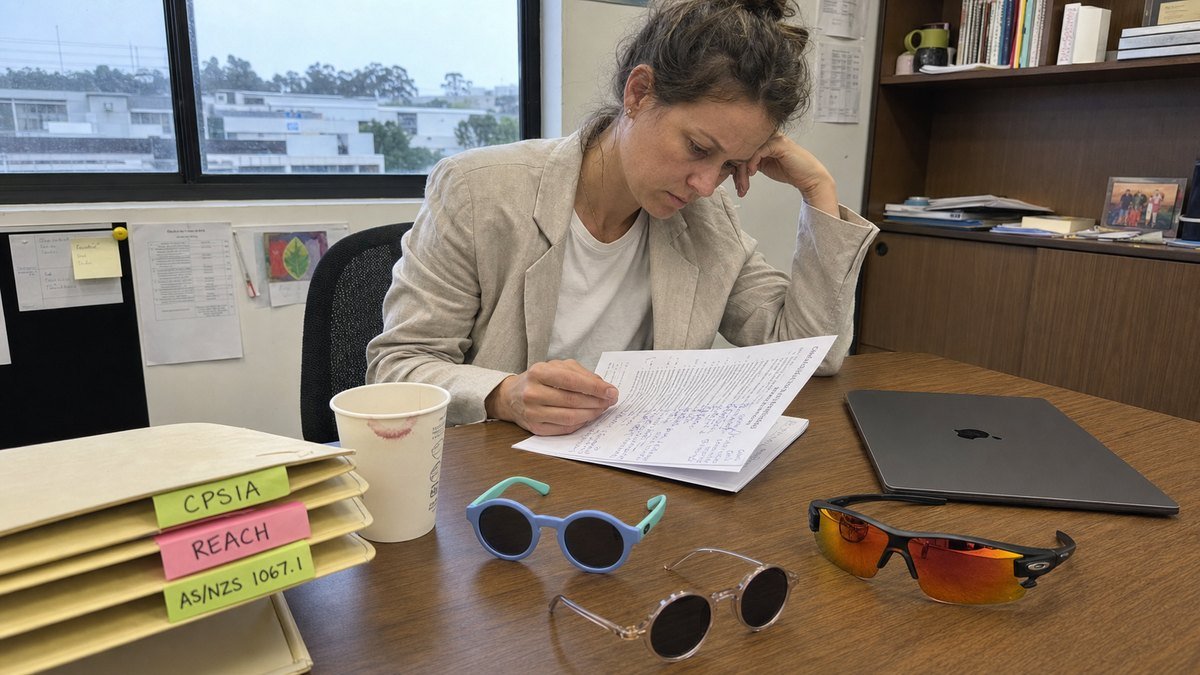
La première chose que je dis aux nouveaux acheteurs, c'est ceci : la conformité environnementale et la conformité à la sécurité des enfants sont deux pistes distinctes. Une monture fabriquée à partir de plastique océanique recyclé 4 peu encore échouer à un test de phtalates. Une monture parfaitement non toxique peut encore porter une fausse allégation "lunettes biodégradables 5". Vous devez vérifier les deux pistes.
Les réglementations de base par marché
Différents marchés de destination déclenchent des règles obligatoires différentes. Voici la carte que je partage avec les clients dans plus de 20 pays.
| Marché | Norme / Réglementation | Ce qu'elle couvre |
|---|---|---|
| États-Unis | exigences CPSIA | Plomb, phtalates, tests par des tiers pour les produits pour enfants |
| États-Unis | FDA 21 CFR 801.410 | Résistance aux chocs des verres de lunettes de soleil |
| UE | Règlement REACH | Substances restreintes : cadmium, colorants azoïques, plastifiants |
| UE | EN ISO 12312-1 | Protection UV et performance optique des lunettes de soleil |
| Australie/Nouvelle-Zélande | AS/NZS 1067.1:2016 | Norme obligatoire pour les lunettes de soleil, y compris la protection UV pour enfants |
Normes environnementales en plus des règles de sécurité
Une fois la couche obligatoire couverte, les acheteurs qui construisent une marque positionnée écologiquement ajoutent des normes volontaires. Le Norme Mondiale de Recyclage 6 (GRS) vérifie le contenu recyclé, tel que le rPET provenant de plastiques d'origine océanique. L'ISCC vérifie les matières premières biosourcées. Aucune n'est légalement requise, mais les détaillants les exigent de plus en plus avant d'accepter les allégations de durabilité sur les emballages.
En pratique, nous conseillons aux acheteurs de constituer une simple pile de documents : d'abord les rapports de tests de sécurité obligatoires, puis le dépistage chimique des matériaux non toxiques, puis les certificats de durabilité volontaires. Lorsqu'un agent des douanes ou un auditeur de vente au détail pose des questions, cette pile y répond dans l'ordre. Sauter la première couche pour courir après l'étiquette verte est l'erreur d'approvisionnement la plus courante que je vois.
Les TPEE et TR90 sont-ils des matériaux sûrs et écologiques pour les lunettes d'enfants ?
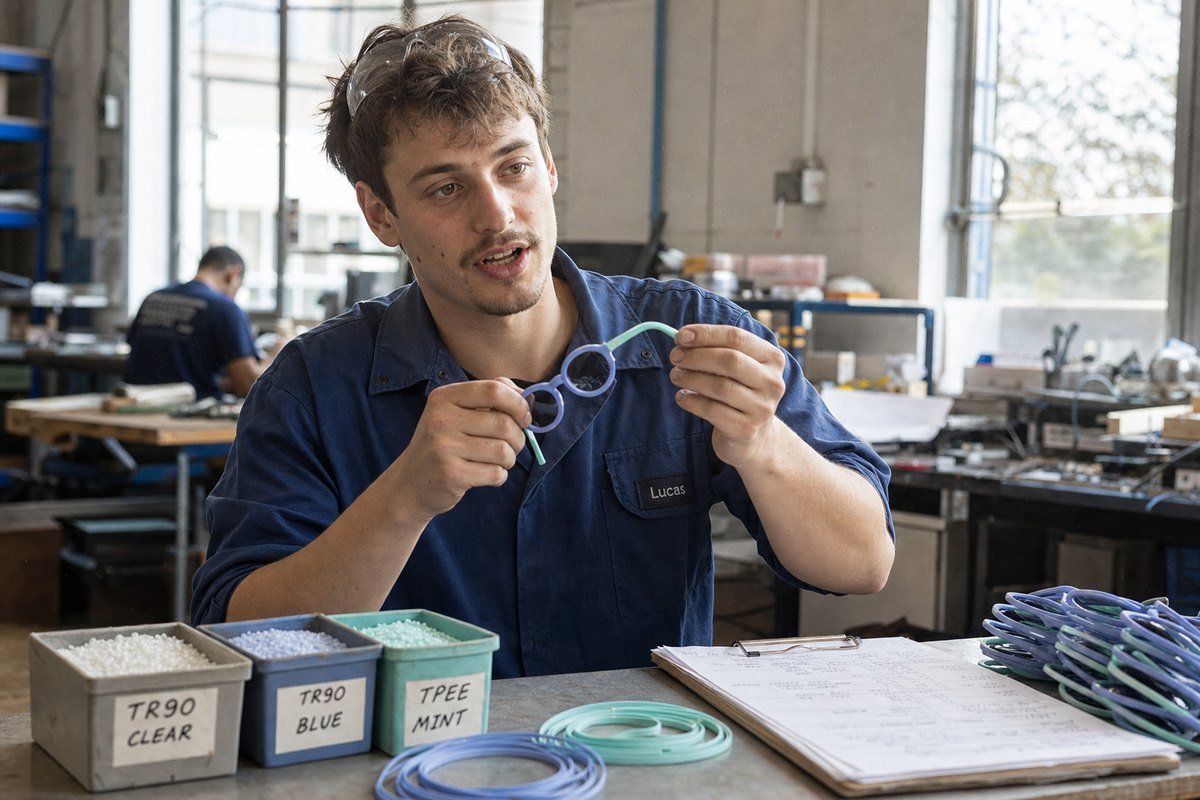
La flexibilité a été le compromis qui nous a poussés vers ces deux matériaux il y a des années. Les montures rigides se cassaient sur les enfants actifs, créant des bords tranchants et des déchets. Nos ingénieurs ont opté pour des faces en TR90 avec des montures et des branches flexibles en TPEE, et nous avons affiné cette combinaison depuis.
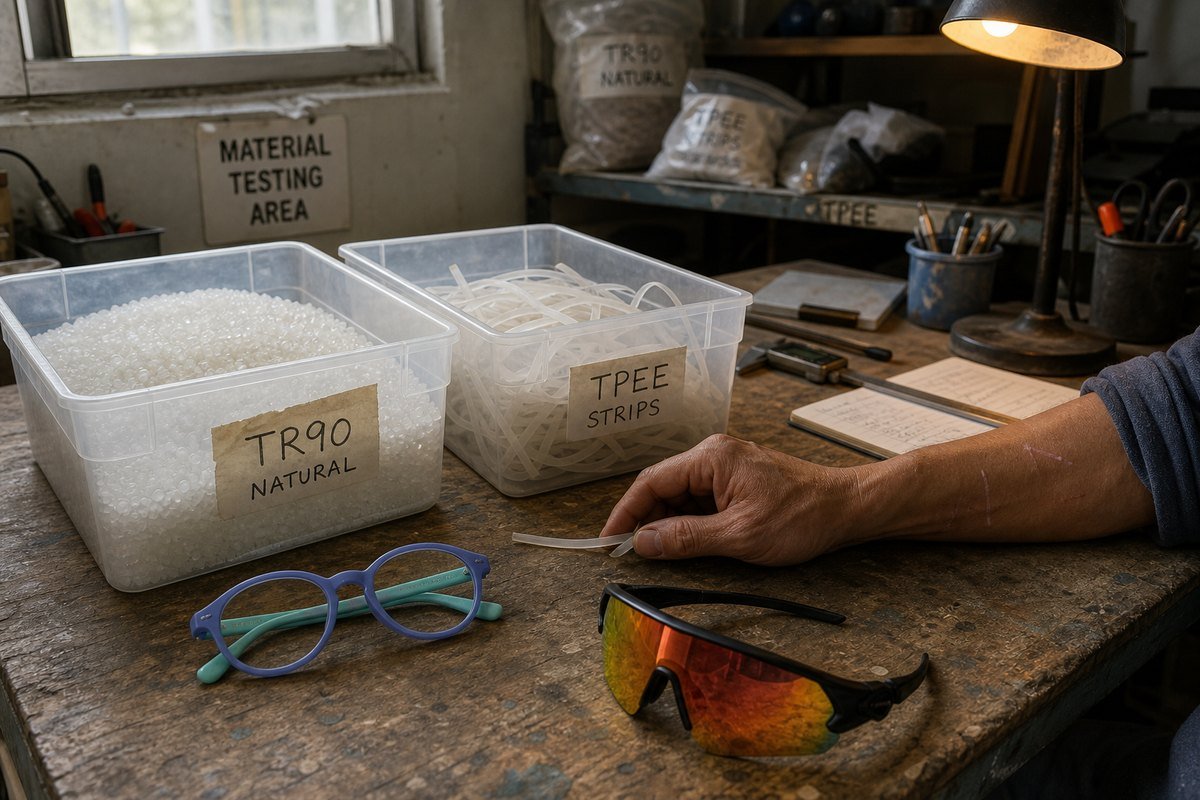
Oui, le TPEE et le TR90 font partie des options courantes les plus sûres pour les lunettes d'enfants. Les deux sont des matières plastiques sans BPA, légères et très flexibles, elles résistent donc à la casse. Le TPEE est recyclable et nécessite moins d'énergie de production, tandis que le TR90 offre une durabilité éprouvée — bien que chaque lot nécessite toujours des tests chimiques.
Soyons directs sur la raison pour laquelle ces matériaux sont importants pour les jeunes porteurs. Les enfants tirent, tordent, mâchent et s'assoient sur leurs lunettes de soleil. Une monture cassante se brise en fragments tranchants. Une monture flexible se plie et reprend sa forme. C'est un avantage pour la sécurité et un avantage environnemental, car une monture qui survit une saison ne finit pas à la décharge après une semaine.
Comparaison des deux matériaux
| Le rétrécissement des montures en acétate est le problème caché des matériaux traditionnels. L'acétate perd lentement ses plastifiants, se contractant avec le temps. Ironiquement, un léger rétrécissement peut resserrer un verre — mais il rend également la monture cassante, et les fils de lunette cassants se fissurent au niveau de la gorge. Il faut également tenir compte de la contraction thermique différentielle : lorsqu'un enfant passe de la chaleur extérieure à la climatisation, la monture et le verre se contractent à des vitesses différentes. Les polymères flexibles absorbent cette inadéquation ; les matériaux rigides transfèrent le stress au siège du verre. | TPEE | TR90 |
|---|---|---|
| Flexibilité | Mémoire extrêmement élevée, semblable à du caoutchouc | Élevée, se plie sans se casser |
| Poids | Très léger | Très léger |
| Sans BPA | Oui | Oui |
| Recyclabilité | Thermoplastique recyclable | Recyclable, mais moins souvent traité |
| Meilleure utilisation | Branches, montures pour bébés, montures entièrement souples | Faces, montures optiques |
| Sensation sur la peau | Doux, légèrement caoutchouté | Lisse, mat |
Les montures douces pour tout-petits, bleu pervenche, de notre gamme en sont un bon exemple. La finition mate, légèrement caoutchouteuse, provient du polymère flexible lui-même, et non d'un revêtement plastifiant. Cela est important, car les composants sans phtalates sont exactement ce que les tests CPSIA recherchent. Nous formulons sans plastifiants ajoutés, puis vérifions par des analyses en laboratoire.
Là où la prudence est toujours de mise
Je ne vous dirai pas que le TPEE est automatiquement écologique. Certains fournisseurs revendiquent la recyclabilité ou une production à faible consommation d'énergie sans données à l'appui. Traitez ces affirmations avec prudence. Demandez les fiches de données de matériaux 7 et les rapports de tests au niveau du lot. N'oubliez pas non plus la phase de "mise à la bouche" des tout-petits : toute monture qu'un enfant de deux ans porte finira dans sa bouche, donc les matériaux non toxiques et les formulations respectant le contact alimentaire méritent d'être discutés avec votre fournisseur avant la production de masse.
Comparés à des alternatives comme les montures en bio-acétate, le TPEE et le TR90 échangent une partie de la narration "matériau naturel" contre une durabilité supérieure. Pour les produits pour enfants, je crois que la durabilité l'emporte. Une durée de vie plus longue du produit est un véritable gain environnemental, pas un gain marketing.
Comment puis-je vérifier la conformité des matériaux d'un fabricant avant de passer une commande ?
Un acheteur japonais m'a donné une leçon au début de ma carrière : il a refusé notre premier jeu d'échantillons jusqu'à ce que nous puissions retracer le numéro de lot de résine jusqu'au fournisseur de matières premières. Cela semblait strict à l'époque. Aujourd'hui, notre atelier géré selon la méthode 5S considère cette traçabilité comme une pratique standard.
Vérifier la conformité en demandant des rapports récents de laboratoires tiers de SGS ou Intertek, en les faisant correspondre au modèle et au lot de matériaux exacts, en auditant l'usine directement ou virtuellement, en vérifiant la traçabilité des matières premières et en testant indépendamment les échantillons avant expédition avant de libérer le paiement final.
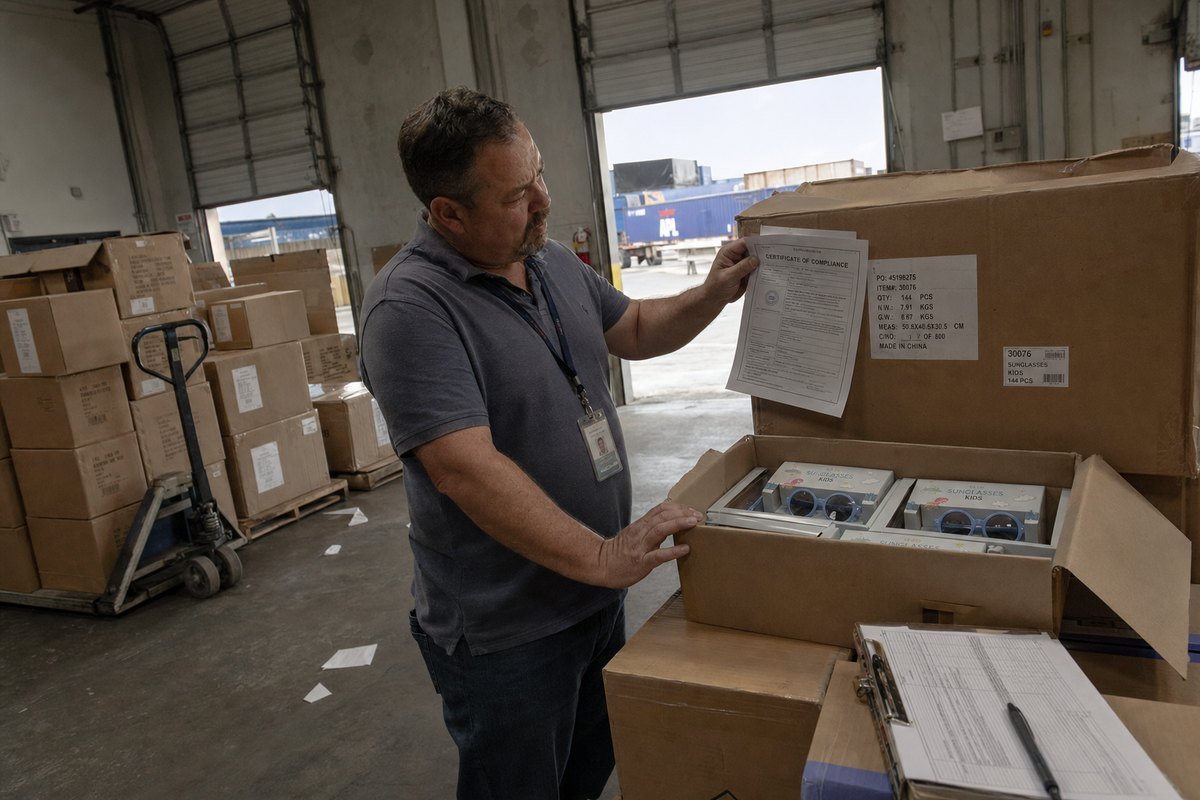
Les documents peuvent être falsifiés. La vérification consiste à relier les documents à la réalité physique. Voici le processus que je recommande à chaque fondateur ou chef de produit, qu'ils achètent chez nous ou ailleurs.
Un processus de vérification en cinq étapes
- Demandez les rapports de tests actuels. Demandez les rapports de réglementation CPSIA et REACH émis au cours des 12 à 24 derniers mois. Les anciens rapports peuvent ne pas refléter les formulations de résine actuelles.
- Faites correspondre les rapports à votre produit réel. Un rapport pour une monture adulte noire ne couvre pas une monture enfant pastel. Les colorants modifient la chimie. Vérifiez les numéros de modèle et les descriptions des matériaux ligne par ligne.
- Auditez l'usine, pas la société de négoce. Nous accueillons les visites d'acheteurs et les audits vidéo dans notre usine de Taizhou car le certificat d'un commerçant ne vous dit rien sur le véritable atelier de production. Demandez à voir le stockage des matières premières et le contrôle qualité à réception.
- Tracez les matières premières. Une usine sérieuse peut indiquer les noms des fournisseurs de résine, les numéros de lot et les fiches de données de matériaux. Si elle ne le peut pas, les affirmations de fabrication durable sont invérifiables.
- Testez vous-même les échantillons avant expédition. Prélevez des unités aléatoires dans la série de production, pas des échantillons de référence, et envoyez-les à un laboratoire indépendant. C'est votre protection la plus solide.
Drapeaux rouges qui me feraient renoncer
Réponses vagues sur la composition des matériaux. Rapports avec des photos de produits non concordantes. Refus d'autoriser l'échantillonnage par lot. Prix bien inférieurs au marché, ce qui signifie généralement des déchets recyclés d'origine inconnue mélangés à de la résine "vierge". D'après notre expérience d'exportation vers l'Europe et l'Australie, les acheteurs qui suivent les cinq étapes ci-dessus ne rencontrent presque jamais de rejet en douane.
Quelles certifications devrais-je demander pour confirmer que les lunettes de soleil de mes enfants respectent la réglementation environnementale ?
Les demandes de documentation ont considérablement changé au cours des dernières saisons. Il y a cinq ans, les acheteurs nous demandaient principalement des données de test UV400. Désormais, les marques européennes pour enfants posent des questions sur la vérification du contenu recyclé et l'emballage sans plastique dès le premier e-mail de demande.
Demander des certificats de test tiers CPSIA, une déclaration de conformité REACH, une documentation d'impact par chute de balle FDA, des rapports de lentilles UV400 ou EN ISO 12312-1, ainsi qu'une certification GRS pour toute revendication de contenu recyclé et une certification FSC pour les emballages en papier. Chaque certificat doit nommer votre produit spécifique.
Pensez aux certifications en deux groupes : celles que vous devez avoir pour vendre légalement, et celles qui prouvent votre histoire environnementale. Les deux doivent figurer dans votre contrat fournisseur avant que vous ne passiez une commande.
La liste de contrôle des certifications
| Certificat / Rapport | Taper | Ce qu'il prouve |
|---|---|---|
| Certificat de test CPSIA | Obligatoire (US) | Limites de plomb et de phtalates respectées pour les produits pour enfants |
| Déclaration REACH | Obligatoire (UE) | Substances restreintes contrôlées dans les plastiques et les charnières métalliques |
| Enregistrement du test de chute FDA | Obligatoire (US) | Les verres sont résistants aux chocs |
| Rapport UV400 / EN ISO 12312-1 | Obligatoire (varie) | Véritable performance de protection UV |
| Certificat GRS | Volontaire | Contenu recyclé vérifié, par exemple, rPET de plastique océanique recyclé |
| Certificat ISCC | Volontaire | Revendications de matières premières biosourcées ou circulaires |
| Certificat FSC pour emballage | Volontaire | Boîtes en papier et inserts d'origine responsable |
Au-delà de la monture elle-même
Un angle mort courant est que les certificats ne couvrent souvent que le substrat de la monture. Les verres, les revêtements miroir, les vis de charnière, les grips de branche en caoutchouc, les étuis et les chiffons de nettoyage ont chacun leur propre chimie. Lorsque nous construisons un emballage OEM prêt pour la vente au détail pour un client — couleurs personnalisées, logos, verres et emballage combinés — nous adaptons les tests pour couvrir l'ensemble de l'assemblage, ainsi que les encres à base de soja et les emballages sans plastique lorsque la marque le demande.
Surveillez également la frontière de ce sujet. Les passeports numériques de produits, les programmes de remise à neuf pour les montures d'enfants trop petites, et la production à faible gaspillage par impression 3D sont tous émergents. Aucun ne remplace la pile de certificats ci-dessus, mais les détaillants pourraient bientôt vous interroger à leur sujet. Le scepticisme est également sain : une affirmation de 'lunettes biodégradables" sans norme nommée et condition d'élimination est généralement du greenwashing, et les composants sans phtalates doivent être prouvés par des données de laboratoire, et non affirmés sur une étiquette volante.
Conclusion
Les allégations écologiques non vérifiées peuvent vous coûter un rappel, un retrait du marché et la perte de la confiance de votre marque. La solution est simple : exigez des matériaux testés, documentés et durables d'un partenaire d'usine transparent.
Les matériaux des lunettes de soleil pour enfants peuvent absolument être conformes aux exigences environnementales — lorsque les marques traitent la conformité comme un système, pas comme un slogan. Vérifiez les normes obligatoires pour chaque marché. Choisissez des matériaux éprouvés, flexibles et sans BPA comme le TPEE et le TR90. Vérifiez votre fabricant avec de vrais audits et des tests par lots. Ensuite, appuyez chaque allégation environnementale avec la documentation GRS, FSC ou ISCC. Dans notre usine, cette approche multicouche est la façon dont nous aidons les marques dans plus de 20 pays à lancer des lunettes pour enfants qui sont sûres, durables et véritablement vendables. Si vous souhaitez un partenaire qui dispose déjà d'environ 800 modèles testés et d'un support OEM/ODM complet prêt à l'emploi, cette conversation est exactement ce pour quoi nous sommes là.
Notes de bas de page
Informations faisant autorité sur les effets sur la santé et le statut réglementaire du bisphénol A dans les plastiques de consommation. ↩︎
Ressource officielle de l'UE pour comprendre les réglementations en matière de sécurité chimique applicables aux biens de consommation. ↩︎
Détaille le processus de certification pour garantir que les produits à base de bois proviennent de forêts gérées de manière responsable. ↩︎
Explique l'impact environnemental des déchets plastiques et le contexte des efforts de recyclage des plastiques destinés à l'océan. ↩︎
Fournit un contexte scientifique sur les normes et les définitions des matériaux biodégradables dans les produits de consommation. ↩︎
Site officiel de la norme qui vérifie le contenu recyclé et les pratiques sociales/environnementales dans la fabrication. ↩︎
Définit la documentation technique utilisée pour communiquer la sécurité chimique et les procédures de manipulation des matériaux. ↩︎
Plus d'articles que vous pourriez aimer
28 septembre 2026
Les lunettes de soleil pour enfants en TR90 et TPEE peuvent-elles utiliser des matériaux recyclés ou biosourcés ?
28 septembre 2026
Les lunettes de soleil pour enfants en TR90 et TPEE sont-elles recyclables ? Conseils de mise au rebut expliqués ?
28 septembre 2026
Comment éviter la déformation et les rayures lors de l'expédition de lunettes de soleil pour enfants en TR90 et TPEE ?
Vous recherchez un partenaire fiable en lunetterie pour enfants ?
Explorez plus de 800 styles prêts et un support OEM/ODM complet adapté à votre marque.
Contactez-nous English
  Español de México
  Deutsch
  Français
  日本語
日本語  العربية
  Português do Brasil