How Are TR90 & TPEE Kids Optical Frame Sizes Tiered by Age Group?

Kids’ glasses that slip or pinch come back, and each return hurts. On our Taizhou line, we tier TR90 and TPEE kids optical frame sizes by age to stop that.
TR90 and TPEE kids optical frame sizes are tiered by age bands: infants 35–38 mm lens width, toddlers 40–43 mm, preschool 43–45 mm, school age 45–47 mm, and teens 47–52 mm. Bridge and temple lengths grow with each tier; TPEE suits younger children, TR90 suits older kids.
Age bands are a shortcut. They help parents shop and help brands plan a range. But the real fit comes from three numbers: lens width, bridge width, and temple length. Below, I walk through each tier, explain what to ask a supplier, and show why these two materials need their own sizing logic.
How do I choose the right TR90 optical frame size for my child's age group?
During a final inspection last season, our QC team held a 7–10 year batch because temple length measurements drifted slightly. Even small drift changes fit for a whole age tier.
Choose a TR90 optical frame size by matching the child's age tier, then checking three numbers: lens width, bridge width, and temple length. For 4–7 years use roughly 43–45 mm lenses, 7–10 years 45–47 mm, and 10–16 years 47–52 mm, then confirm with a face measurement.
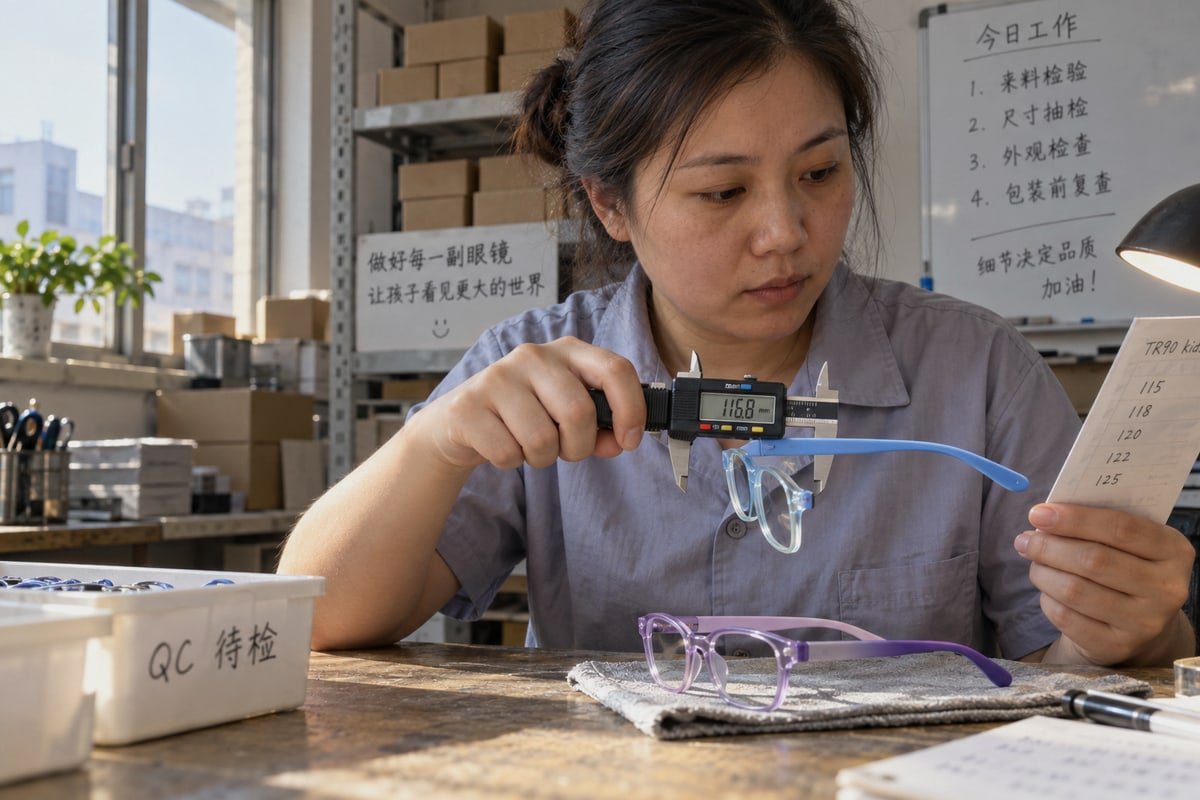
Reading a pediatric eyewear sizing chart
Every optical frame carries a code de taille 1 inside the temple. It looks like 45-16-130. The first number is lens width. The second is bridge width. The third is temple length. All three are in millimetres. When we build a pediatric eyewear sizing chart for a buyer, we map those numbers to age tiers. This is the progression we work from across our TR90 and TPEE kids optical frame sizes.
| Age tier | Largeur du verre | Largeur du pont | Longueur des branches | Material we usually suggest |
|---|---|---|---|---|
| 0–1 ans | 35–37 mm | 13–14 mm | 105–115 mm | TPEE |
| 1–2,5 ans | 37–38 mm | 14–15 mm | 110–120 mm | TPEE |
| 2,5–4 ans | 40–42 mm | 14–16 mm | 115–125 mm | TPEE |
| 4–7 ans | 43–45 mm | 15–17 mm | 120–130 mm | Avant en TR90 avec branches en TPEE |
| 7–10 ans | 45–47 mm | 16–17 mm | 125–135 mm | TR90 |
| 10–16 ans | 47–52 mm | 16–18 mm | 130–140 mm | TR90 |
Where TR90 enters the picture
Le TR90 est un flexible memory plastic. It bends under pressure and springs back. In our range, it starts to make sense from the 4–7 year tier. Children in this band run, jump, and drop things. They also start school, so parents want a frame that looks like real glasses. TR90 gives that structure without adding weight. By 7–10 years, TR90 is our default. It holds impact resistant lenses 2 well, and it carries stronger prescriptions without flexing the lens out of alignment. From 10–16 years, TR90 sizes begin to overlap small adult frames at 47 mm and above.
A simple three-step check
- Start with the age tier from the chart above.
- Compare lens width to the child's face. The frame front should not extend past the temples of the head.
- Confirm the temple reaches the ear and curves behind it without pressing.
One buyer objection I hear often: "Just give me the age chart, parents will not measure." I understand that. But an age label alone caused returns for two of our importers before we added the mm code to their packaging. Now we print both. We also keep around 800 existing styles across these tiers, so a brand can fill every age band without paying for new molds.
What age-based sizing standards should I look for when sourcing TPEE kids' frames?
A baby-product buyer from Australia once asked us why two suppliers labeled the same 43 mm frame as 2–3 years and 3–6 years. That question shaped how we present TPEE sizing.
No single official standard governs TPEE kids' frame sizing. Look for supplier charts that tier by age band and list lens width, bridge, and temple length: about 38–42 mm width for 2–4 years, 43–48 mm for 5–8 years, 49–52 mm for 9–12 years, and 13–16 mm bridges for young children.
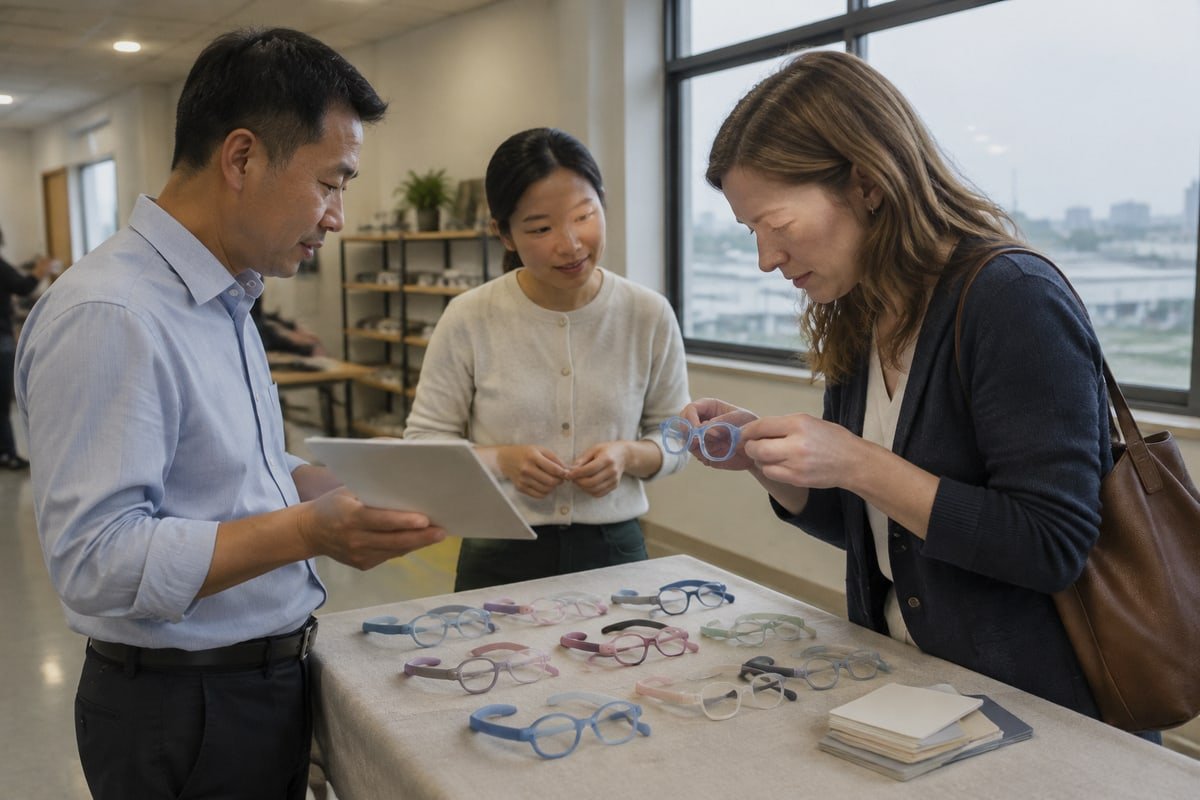
Six things to ask before you sign off on a TPEE range
Because there is no governing body for kids' frame sizes, the burden sits with the buyer. Here is the checklist we hand to new brand partners.
- Ask for the full size code, not just the age band. Many listings use the broad Baby (0–3), Toddler (3–6), and Junior (7–12+) split. That is fine for a catalog. It is not enough for a spec sheet.
- Check bridge width for toddlers first. Small-face guidance for children around 1–7 years points to 13–16 mm bridges. Toddlers have flat, underdeveloped nasal bridges. A bridge that is too wide slides straight down.
- Check temple length against the age band. The same guidance places 1–7 year temples at roughly 120–125 mm. Anything longer sticks out behind the ear and catches on hats and car seats.
- Confirm the material is safe for mouthing. Frames in the 0–3 tier get chewed. We specify BPA-free eyewear materials and hypoallergenic TPEE for this tier, and we ask buyers to state this on packaging.
- Look for retention features. Looped ear hooks, curved rubberized tips, and strap slots keep a frame on a small head.
- Check the hinge. A screwless hinge design removes a choking hazard and a loose-screw failure point.
How real listings compare
The table below shows why I push buyers to compare numbers, not names.
| Source type | Age label | Largeur du verre | Pont | Branche |
|---|---|---|---|---|
| Retail listing example | 2–3 ans | 43 mm | 14 mm | 125 mm |
| Supplier progression | 2,5–4 ans | 40–42 mm | 14–16 mm | 115–125 mm |
| TPEE product tiering | 2-4 ans | 38–42 mm | not stated | not stated |
| TPEE product tiering | 5–8 ans | 43–48 mm | not stated | not stated |
| TPEE product tiering | 9–12 ans | 49–52 mm | not stated | not stated |
Three sources. Three slightly different bands for a toddler. None of them are wrong. They just reflect different average faces. Some sellers argue a simple age-to-size chart is all a parent needs. Others say you should start from an existing frame's measurements. In our experience, the second view is right for optical frames, because a prescription lens has to sit in front of the pupil. That is why our TPEE spec sheets carry the age band, the size code, and a suggested distance pupillaire 3 range together. A brand can then offer a "global fit" note within each age tier for wider or narrower faces.
How can I make sure the frame fits comfortably as my child grows?
We weigh one trade-off every season: a frame built with growing room fits longer, but a frame too big today slides down the nose and needs constant pushing up.
Ensure comfort as a child grows by choosing frames with flexible temples, a properly sized bridge, and retention features like looped ear hooks or adjustable elastic headbands. Re-check fit every six months, watch for red marks or slipping, and move up a tier when temples stop reaching behind the ears.
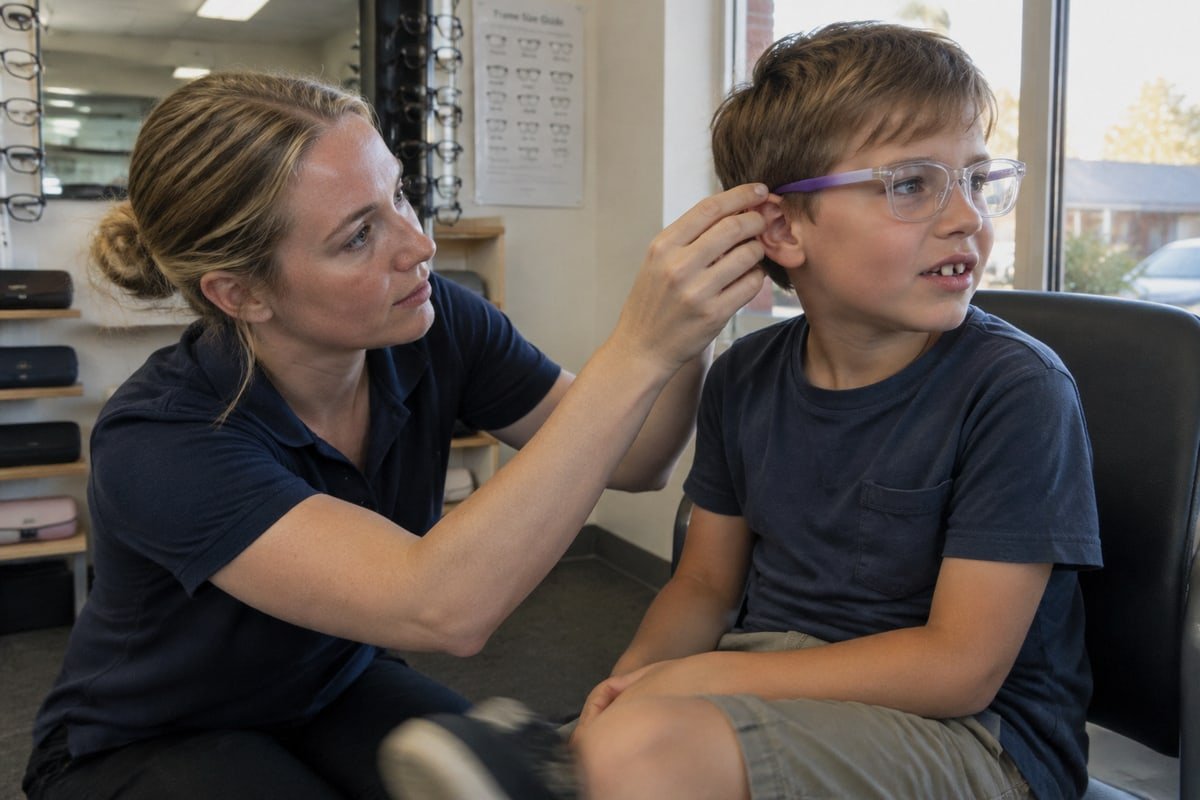
Children do not grow in a straight line. A four-year-old can hold the same head width for a year and then jump a full tier over a summer. So I do not tell parents or brands to size up early. I tell them to size right now and build growth into the frame's design instead.
Signs the frame is being outgrown
| Ce que vous voyez | Cause probable | Que faire |
|---|---|---|
| Marques rouges derrière les oreilles | Temple length too short for the head | Move up one temple size, keep the same front if it still fits |
| La monture glisse sur le nez | Bridge too wide or front too heavy | Choose a narrower bridge or a lighter TPEE front |
| Child looks over the top of the lenses | Lens height too small for the current tier | Move to the next lens width band |
| Frame sits crooked after play | Temples have lost their memory | Replace; a good flexible memory plastic should spring back for the life of the frame |
| Temples splay outward at rest | Head width has passed the frame's design width | Move up a tier |
Build in growth without oversizing
The pieces that grow fastest are temple length and head width. So the temples are where we put the flexibility. Our Avant en TR90 avec branches en TPEE design keeps the lens area rigid for the prescription and lets the arms stretch. Small perforated dots along the temple, like the ones on our purple gradient style, add bend without adding thickness. Curved looped ear hooks hold the frame in place through a growth spurt. For the youngest tier, adjustable elastic headbands take the load off the ears completely.
One more point that brands often miss. Pupillary distance for children changes as the face widens. The lens center should stay over the pupil. When a child moves from a 43 mm to a 47 mm lens width, the optician re-measures the pupillary distance and re-centers the lens. That is a good moment to re-check the whole tier, not just the width.
Why do TR90 and TPEE frames need different size tiers than regular kids' eyewear?
Early in our 15 years of eyewear work, we tried sizing a TPEE toddler frame from an acetate pattern. It fit on paper and sagged on real faces. Lesson learned.
TR90 and TPEE frames need their own size tiers because the materials behave differently. TPEE is soft and stretchy, so it needs bulkier rims and integrated saddle bridges for flat toddler noses. TR90 is stiffer and thinner, so it holds precise dimensions and heavier prescriptions for older children.

TR90 vs TPEE en un coup d'œil
| Caractéristique | TPEE | TR90 |
|---|---|---|
| Type de matériau | Élastomère de polyester thermoplastique | Grilamid nylon, a flexible memory plastic |
| Sensation | Rubber-like, very soft, high recovery after bending | Firm but flexible, springs back to shape |
| Best age tier | 0–5 years, and rough handling at any age | 6–12+ years, active school-age kids and teens |
| Rim thickness | Thicker, needs structure to hold a lens | Thinner, more precise rim dimensions in larger sizes |
| Type de pont | Integrated saddle bridge for flat noses | Keyhole or nose pads for an emerging nasal crest |
| Charnière | Often screwless hinge design, no metal | Spring hinge or reinforced temple |
| Safety focus | Mouthing safety, hypoallergenic, "unbreakable" | Tensile memory for sports and impact |
| Aspect | Playful, chunky, colorful | Closer to adult glasses |
The nasal crest decides the handoff
A regular kids' acetate frame is sized like a small adult frame. It assumes a nose with a bridge. Babies and toddlers do not have one yet. Their nasal crest is flat. So a TPEE frame in the 0–3 tier uses an integrated saddle bridge that rests on the cheeks and the flat nose area together. That is why our TPEE tiers use narrower bridge numbers, 13–16 mm, and why the bridge is molded into the front rather than added on. Around age 5 to 7, the nasal bridge starts to rise. That is when TR90 sizing takes over, with a shaped bridge that follows the new profile.
Why the same mm code does not mean the same fit
Material density changes what a size code feels like. Grilamid TR90 properties allow a thin rim that holds a 47 mm lens at a very low weight. A TPEE rim at 47 mm needs more wall thickness, which adds bulk and a little weight. So a 47 mm TPEE frame and a 47 mm TR90 frame do not sit the same on a nine-year-old. This is why we keep two separate size ladders in our workshop instead of one shared chart.
Some TR90-focused sellers call it the best all-purpose kids' material. Some TPEE-focused sellers say only TPEE is safe enough for children. Both are overstating it. Neither material is age-restricted. TPEE wins on softness and bendability. TR90 wins on structure and a "real glasses" look. Our answer to the tension is the hybrid: a TR90 front for lens precision 4 and TPEE temples for soft contact points. It lets a brand cover the 4–7 and 7–10 tiers with one construction and two size ladders, and it still supports full OEM customization of color, logo, lens, and packaging.
Conclusion
Wrong sizes cause returns and lost trust. Age tiers give a starting point; measurements finish the job. Our TR90 and TPEE range is built around both, ready for your brand.
Vous souhaitez vous procurer les produits mentionnés dans cet article ? Voir les détails et demander un devis ici :
Notes de bas de page
1. ISO standard for ophthalmic optics and frame requirements. ↩︎
2. Technical specifications from the official manufacturer of TR90 material. ↩︎
3. Clinical guidance on vision development and measurement for school-aged children. ↩︎
4. General overview of corrective lens specifications and eyewear terminology. ↩︎
Plus d'articles que vous pourriez aimer

28 octobre 2026
Quelles normes les montures optiques TR90 pour enfants doivent-elles respecter : GB/T 14214 ou ISO 12870 ?

27 octobre 2026
Comment les détaillants doivent-ils stocker les montures optiques TR90 pour enfants par âge et par tendances de genre ?

26 octobre 2026
Qu'est-ce que les parents privilégient dans les montures optiques TR90 pour enfants ?
Vous recherchez un partenaire fiable en lunetterie pour enfants ?
Explorez plus de 800 styles prêts et un support OEM/ODM complet adapté à votre marque.
Contactez-nous English
 Español de México
 Deutsch
 Français
 日本語
 العربية
 Português do Brasil