How to Plan a Sampling Timeline for Kids’ Sunglasses Before an Eyewear Trade Show?

Every season, I watch brands miss trade shows because their sampling timeline for kids’ sunglasses started too late. Samples arrive after setup day. Buyers see empty display trays. Deals die quietly.
Plan your sampling timeline for kids’ sunglasses backward from the show date. Start 12–16 weeks out for custom samples, 8–12 weeks for modified stock styles. Reserve time for design approval, safety checks, two prototype rounds, packaging, and shipping, plus a 20% buffer for holidays and logistics delays.
Below, I will walk you through the exact timing, the sampling stages, the customization traps, and what to do when things go wrong at the last minute.
How far in advance should I request samples before an eyewear trade show?
Last spring, a buyer emailed our Taizhou factory asking for custom samples "in three weeks" before SILMO. We made it work, but barely — and it cost her express freight and sleepless nights.
Request custom kids' sunglasses samples at least 12–16 weeks before the trade show. Modified stock styles need 8–12 weeks. New molds for injection-molded TR90 or TPEE frames need 4–6 extra weeks, so seasonal spring/summer launches should begin planning up to six months ahead.
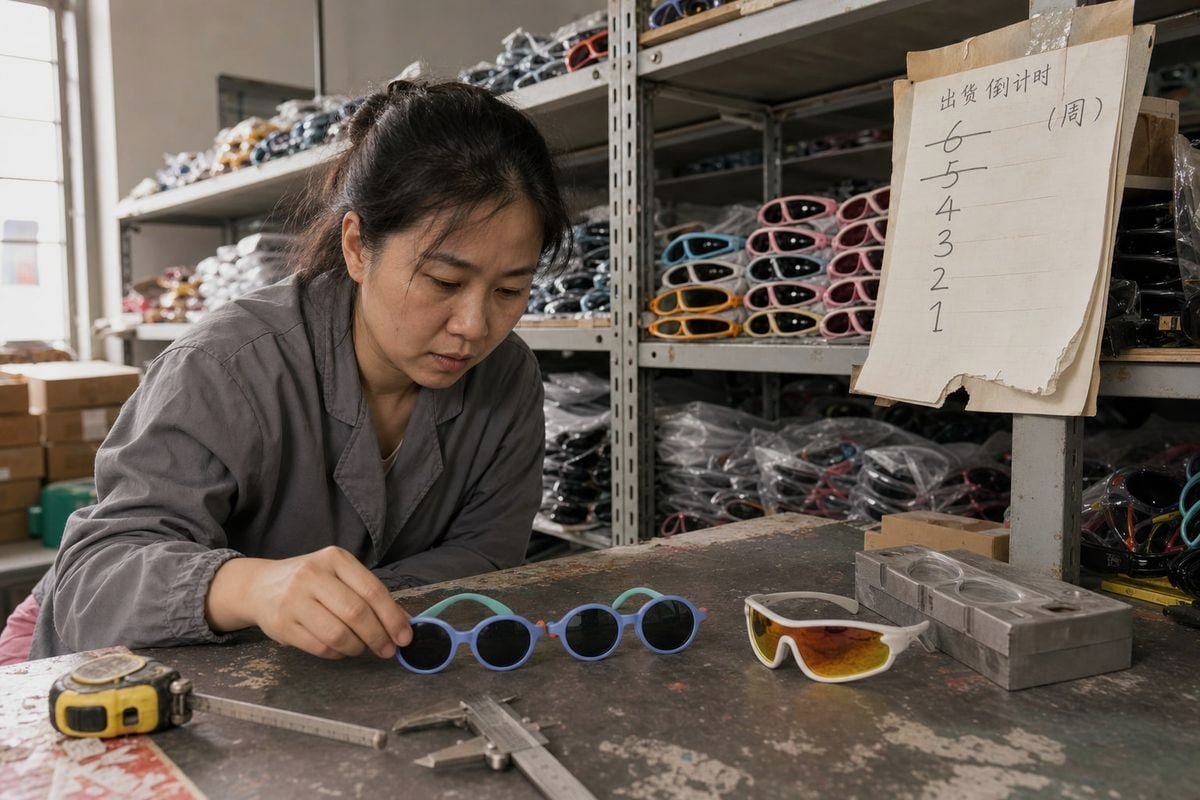
The right answer depends on one question: how custom is your sample? In our experience exporting to buyers in 20+ countries, the product development cycle for children's eyewear falls into three tiers, and each tier has a very different manufacturing lead time.
Three lead-time tiers you must know
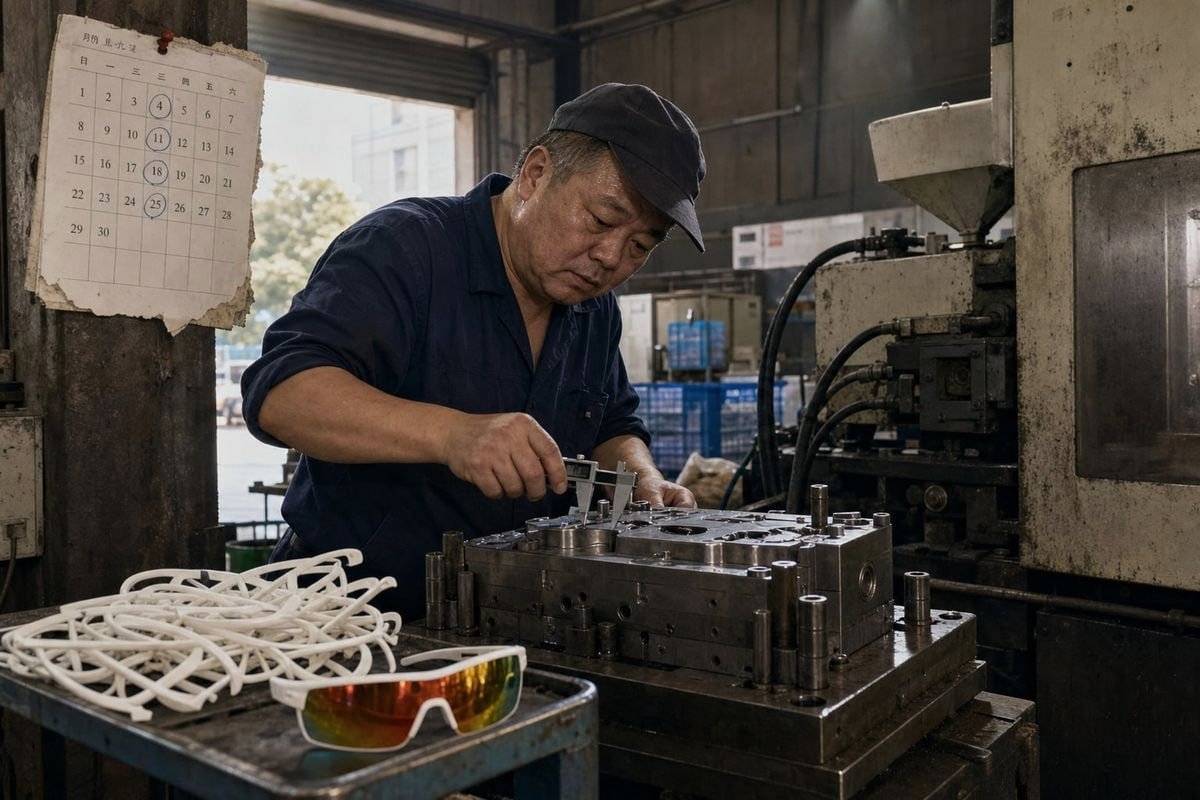
If you pick from an existing catalog — we hold around 800 ready styles — sampling can move fast, because no new tooling is needed. If you want custom colors or logos on an existing frame, you add material sourcing timeline and printing steps. If you want a brand-new shape, you add mold-making, and that alone takes 4–6 weeks for injection-molded TR90 or TPEE frames before the first physical prototype even exists.
| Sample type | Typical lead time | Best starting point before the show |
|---|---|---|
| Existing catalog style, no changes | 1–2 weeks + shipping | 8 weeks out |
| Custom color, logo, or packaging on stock frame | 3–6 weeks | 10–12 weeks out |
| Fully custom design with new mold | 10–16 weeks | 16–24 weeks out |
Do not forget the calendar itself. Chinese New Year, Golden Week 1, and peak shipping seasons regularly add one to three weeks to supply chain logistics. That is why I always tell buyers to build in a 20% time buffer on top of the quoted lead time. Some teams argue a compressed timeline is fine for simple giveaways. For generic promo items, maybe. But kids' sunglasses need fit checks, hinge testing, and child-safety review before they touch a booth table. Compressing the schedule pushes those checks to the last week, exactly when you have zero room to fix anything. If you are preparing for a major event like SILMO Paris, preparation should start the moment you confirm your booth.
What sampling stages should I plan for when working with a kids' sunglasses factory?
One trade-off I weigh with every client is speed versus certainty. Skipping a stage saves days now but risks a flawed sample standing in front of a hundred retail buyers later.
Plan five stages: design confirmation with 3D renders, pre-production samples, fit and safety testing across age groups, a final revision round, and quality control inspection before shipping. Limit prototype revisions to two rounds so delays never push delivery past your booth setup date.
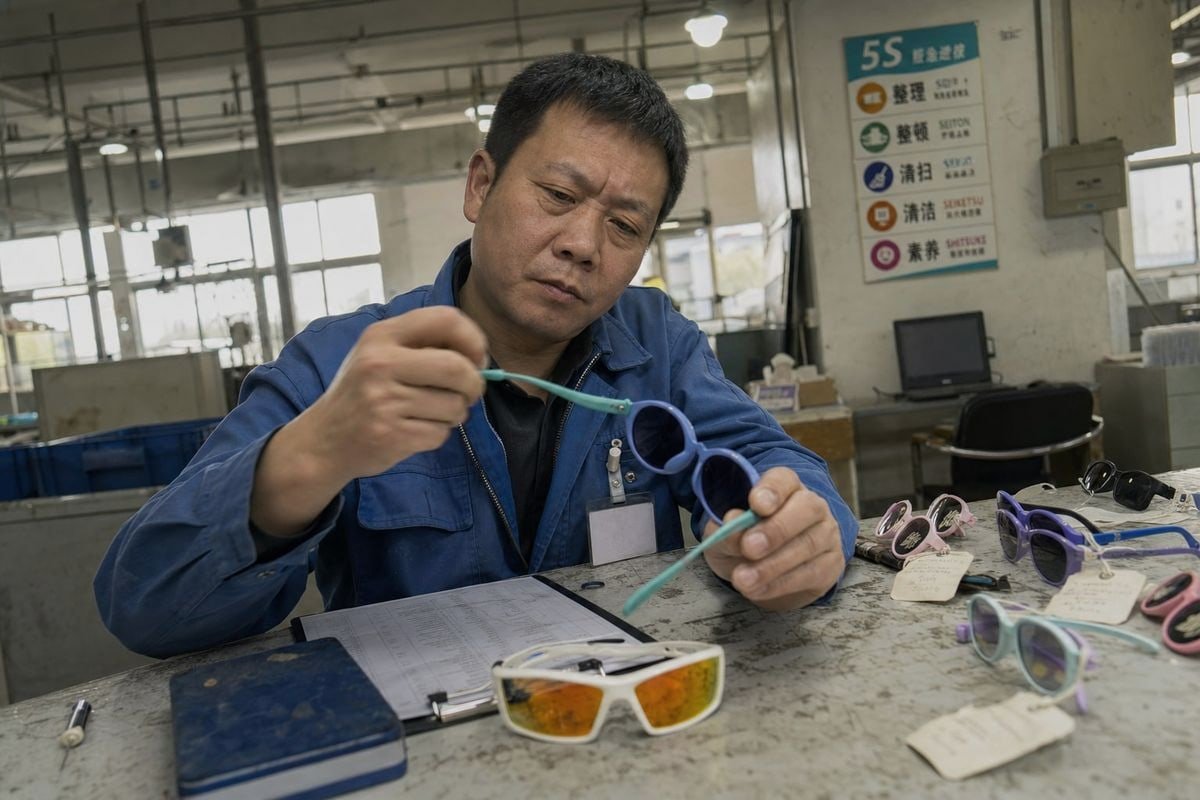
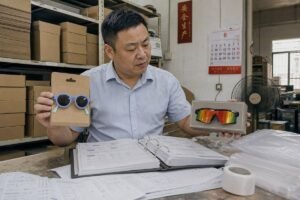
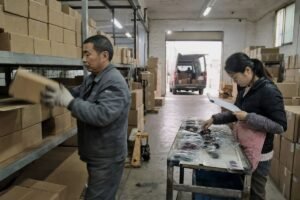
Our workshop runs on a 5S system 2, and our sampling process follows the same discipline: every stage has an owner, a checklist, and a deadline. Here is how the full sequence works when a kids' brand develops samples with us.
The five-stage sampling workflow
First comes design confirmation. We push buyers to approve high-fidelity 3D digital renders before we cut anything. Reach 3ing roughly 90% design sign-off on screen prevents the most expensive kind of delay: a physical prototype that misses the brief entirely. Second, we produce pre-production samples — the first physical units in the actual TPEE or TR90 material 4, with real hinges and real lenses. Third comes fit and safety testing. Children are not one size. Infant, toddler, and pre-teen faces need separate ergonomic checks, so if your line covers multiple age tiers, plan parallel development tracks. Fourth is the prototype iteration phase. I strongly recommend capping this at two revision rounds. Each extra round adds two to three weeks, and rounds compound. Fifth is the final quality control inspection: logo placement, color consistency, hinge function, lens clarity, packaging appearance, and count accuracy.
| Étape | Ce qui se passe | Typical duration |
|---|---|---|
| 1. Design confirmation | 3D renders, colorways, spec sheet approval | 1–2 weeks |
| 2. Pre-production samples | First physical units in final materials | 2–4 weeks |
| 3. Fit and safety testing | Age-tier fit checks, flexibility and durability tests | 1–2 weeks |
| 4. Revision round(s) | Max two rounds of adjustments | 2–3 weeks each |
| 5. Final QC and approval | Inspection, packaging check, sign-off | 1 week |
One more tactic I recommend: fast-track a single hero sample about a month before the full set arrives. Your marketing team can use it for professional photography, wholesale line sheets, and social teasers while production finishes the rest.
How can I avoid delays when customizing colors, logos, or packaging on my samples?
A procurement manager from Australia once sent us her logo file two weeks after approving the frame design. That single gap pushed her whole sampling timeline back — the frames sat waiting for artwork.
Submit final artwork, Pantone color codes, and packaging dielines at the same time you approve the frame design. Batch all customization decisions together, use factory-standard packaging formats where possible, and confirm CPSIA or REACH testing needs early so certification never blocks shipping.
Customization is where most sampling timelines quietly fall apart. In our OEM/ODM projects, the frame itself is rarely the bottleneck. The delays hide in the details buyers treat as afterthoughts: a logo file in the wrong format, a color reference that says "sky blue" instead of a Pantone number 5, or a packaging concept still in draft form when frames are ready to pack.
Batch your decisions, don't drip them
Every separate approval creates a separate waiting period. If you approve the frame in week one, the color in week three, and the logo in week five, the factory restarts work three times. Instead, deliver a complete spec package at once: vector logo files, exact Pantone codes for frames and temples, lens specifications such as UV400 6 or polarized, and packaging dielines. When we receive everything together, our team can run frame production, pad printing tests, and packaging proofs in parallel instead of in sequence.
Plan compliance before packaging
Children's products carry extra obligations. If your target market requires CPSIA compliance standards 7 in the US or REACH in Europe, allocate a mandatory buffer — around 14 days — for testing and documentation before samples ship internationally. We also advise buyers to decide early whether samples need size labels or age-range labeling, because retail buyers at shows want to understand fit at a glance.
Keep packaging simple for samples
Retail-ready packaging matters for the final order. For samples, a clean printed proof or a semi-finished box often communicates the concept well enough. Fighting for perfect foil stamping on ten sample boxes is a common way to lose a week you cannot afford.
What should I do if my samples arrive late or need last-minute changes before the show?
The hardest lesson I have learned in fifteen years of eyewear production: no timeline survives contact with reality perfectly. Smart exhibitors plan the recovery path before they need it.
Split your shipment so a partial sample set travels early by express courier. Keep a backup set of catalog styles as stand-ins, use hero samples plus 3D renders and photography for missing pieces, and pre-agree a fast-revision protocol with your factory for minor last-minute fixes.
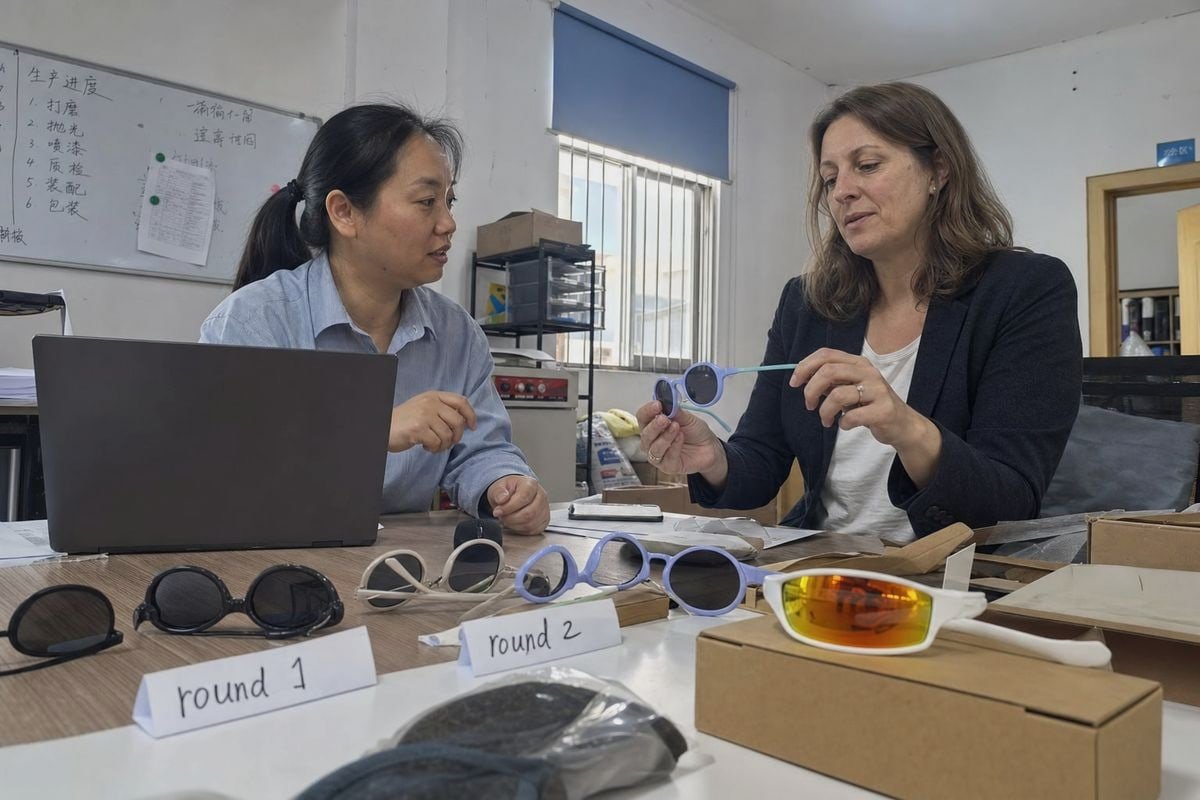
When a shipment slips, panic wastes the hours you have left. A contingency plan turns a crisis into an inconvenience. Here is the playbook we walk buyers through when the calendar gets tight.
Your late-sample recovery options
| Scenario | Best response | Time needed |
|---|---|---|
| Full shipment delayed 1–2 weeks | Air-freight a partial set of key styles directly to the show venue or hotel | 3–5 days |
| One style has a defect | Present the hero sample plus high-fidelity renders; take orders on spec | Immediate |
| Colors arrived wrong | Show correct Pantone swatches alongside frames; note correction on line sheets | Immediate |
| Nothing arrives in time | Display backup catalog samples in similar silhouettes with digital mockups | Pre-planned |
Split shipping is your best insurance
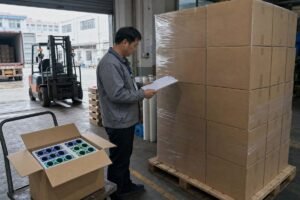
I always recommend shipping in two waves. Send one complete set of your most important styles by express courier two to three weeks early, addressed to your office. Send the full booth inventory by the standard route. If the main shipment stalls in customs, you still have a presentable core collection.
Handle last-minute changes with discipline
Sometimes the samples arrive fine, but a buyer meeting or internal review triggers a change request days before the show. Be honest about what is possible. A temple color swap on a stock frame might be feasible in 48 hours if the factory holds material. A lens change or mold adjustment is not. Agree with your supplier in advance on which quick fixes are realistic, and carry the change request to the show as a documented "coming soon" variation instead. Retail buyers respect a clear roadmap far more than a rushed, flawed sample.
Conclusion
Late samples kill trade show ROI before the doors open. Work backward from the show date, start 12–16 weeks out, cap revisions, batch approvals, and always ship a backup set early.
Notes de bas de page
1. Explains the Chinese holiday period that adds shipping delays mentioned in the article. ↩︎
2. Background on the lean manufacturing method the factory uses to organize sampling stages. ↩︎
3. Official EU chemical regulation source referenced for European compliance testing. ↩︎
4. Technical background on the flexible plastics used for children’s eyewear frame prototypes. ↩︎
5. Official color standard reference used for precise frame and packaging color matching. ↩︎
6. FDA guidance on UV protection standards relevant to lens specification decisions. ↩︎
7. Official US consumer product safety law governing children’s product testing requirements. ↩︎
Plus d'articles que vous pourriez aimer
1 août 2026
L'usine doit-elle gérer l'emballage et l'étiquetage des lunettes pour enfants, ou utiliser un fournisseur désigné ?
1 août 2026
Entrepôt propre vs. exécution directe par le fournisseur : lequel réduit les coûts de retour pour les marques de lunettes pour enfants ?
1 août 2026
Entrepôt direct au port ou staging outre-mer : lequel permet d'économiser le plus sur l'expédition des lunettes pour enfants ?
Vous recherchez un partenaire fiable en lunetterie pour enfants ?
Explorez plus de 800 styles prêts et un support OEM/ODM complet adapté à votre marque.
Contactez-nous English
  Español de México
  Deutsch
  Français
  日本語
日本語  العربية
  Português do Brasil