How Many Open-Close Cycles Can Kids’ Optical Frame Hinges Withstand Before Failing?
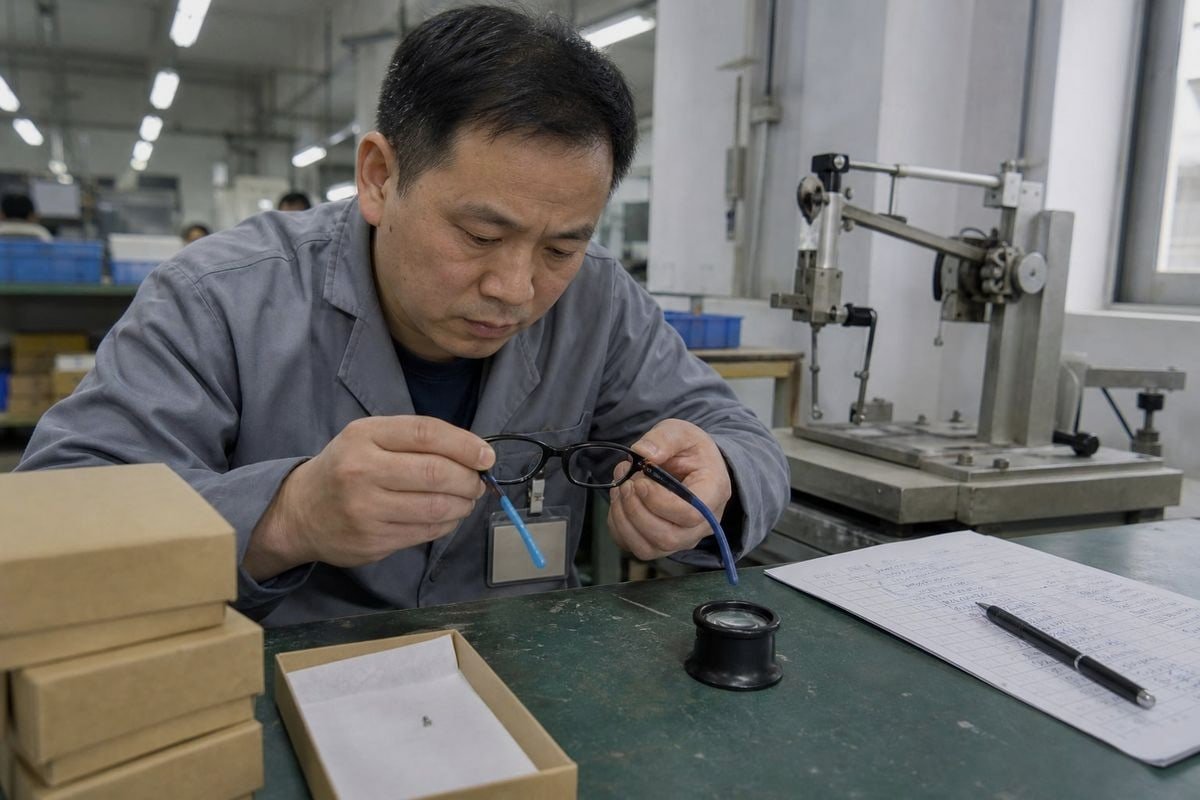
Kids’ optical frame hinges fail far earlier than most buyers expect temple deformation measurements 1. I learned this the hard way when a returned shipment landed on our QC bench in Taizhou years ago. Loose temples, backed-out screws, wobbling hinges — all within four months of retail. That failure reshaped how our factory tests every children’s frame we produce today.
Kids’ optical frame hinges typically withstand 5,000 open-close cycles before standard barrel hinges start loosening, while quality spring hinges last 10,000–15,000 cycles, and premium flexible TR90 or TPEE screwless designs can exceed 25,000–50,000 cycles before failing.
Those numbers hide a lot of nuance. Hinge type, material, screw quality, and how a child actually handles the glasses all change the outcome. Let me break it down section by section.
How many open-close cycles should I expect from TR90 vs. metal spring hinges on kids' frames?
When buyers visit our workshop, this is usually their first question. Our engineers keep cycle-test logs for both hinge families, and the gap between them surprises almost everyone who compares the raw data.
TR90 and TPEE flexible hinge designs on kids' frames commonly reach 25,000–50,000+ open-close cycles because material memory replaces mechanical friction. Metal spring hinges typically deliver 10,000–15,000 cycles of consistent tension, while basic metal barrel hinges loosen measurably around 5,000 cycles.
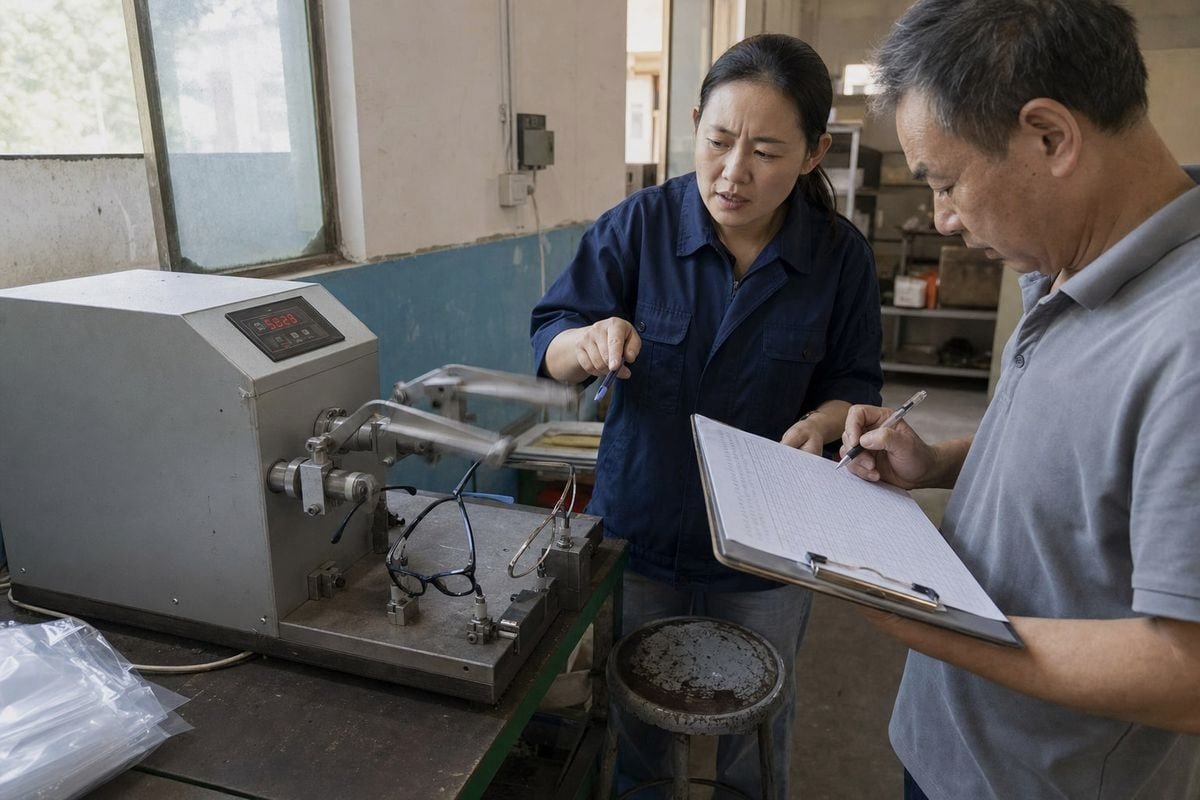
There is no single universal failure point for pediatric eyewear construction. Cycle life depends on hinge architecture, material quality, and real-world abuse. But performance tiers are well documented, and I use them constantly when advising brand buyers on frame specs.
The performance tiers at a glance
| Hinge type | Typical cycle life | Real-world equivalent | Common first failure |
|---|---|---|---|
| Standard barrel hinge | ~5,000 cycles | 3–6 months of heavy kid use | Temple splay, screw loosening |
| Quality metal spring hinge | 10,000–15,000 cycles | Roughly 3 years of daily use | Loss of spring tension |
| Premium spring hinge (lab claims) | 50,000–100,000+ cycles | Lab conditions only | Metal fatigue in the coil |
| Monolithic flexible hinge (TR90/TPEE/PEI-style) | 25,000–50,000+ cycles | 6+ years at moderate usage | Material fatigue at the flex zone |
Why the huge spread? A standard barrel hinge relies on a screw rotating inside barrel walls. Every cycle creates micro-abrasion between the screw and the barrels. After roughly 5,000 cycles, that abrasion produces measurable temple-width increase — what opticians call temple splay. One compliance source frames it bluntly: if friction disappears or a screw backs out after 5,000 cycles, the design needs revision.
Spring hinge durability comes from a different mechanism. The internal coil absorbs outward stress instead of transferring it to the screw joint. High-quality children's spring hinges are engineered to hold consistent tension for 10,000 to 15,000 cycles — about three years of heavy daily wear.
Flexible TR90 and TPEE designs sidestep the friction problem entirely. The polymer's memory metal resilience analog — its molecular elasticity 2 — does the flexing. That is why our TR90 frames with TPEE temples are the styles we recommend most for toddlers and active kids. Fewer mechanical failure points means fewer warranty claims for your brand.
Translate cycles into parent language
If a child opens and closes glasses 10 times a day, that is about 3,650 cycles per year. So 5,000 cycles means the frame starts loosening within 18 months at best — or as little as 3 months under demanding use. A 25,000-cycle hinge, by contrast, projects to 6+ years of service life at moderate usage.
What hinge durability tests do I need to see before approving a kids' optical frame supplier?
A procurement manager from Australia once asked me to name the one document that separates a real factory from a trader. My answer: the fatigue testing report with raw cycle data, not a summary certificate.
Before approving a supplier, request ISO 12870 compliance results, a flex-cycle test report showing at least 5,000 cycles without screw back-out or tension loss, temple deformation measurements against a 5mm tolerance, and screw retention data after vibration exposure.
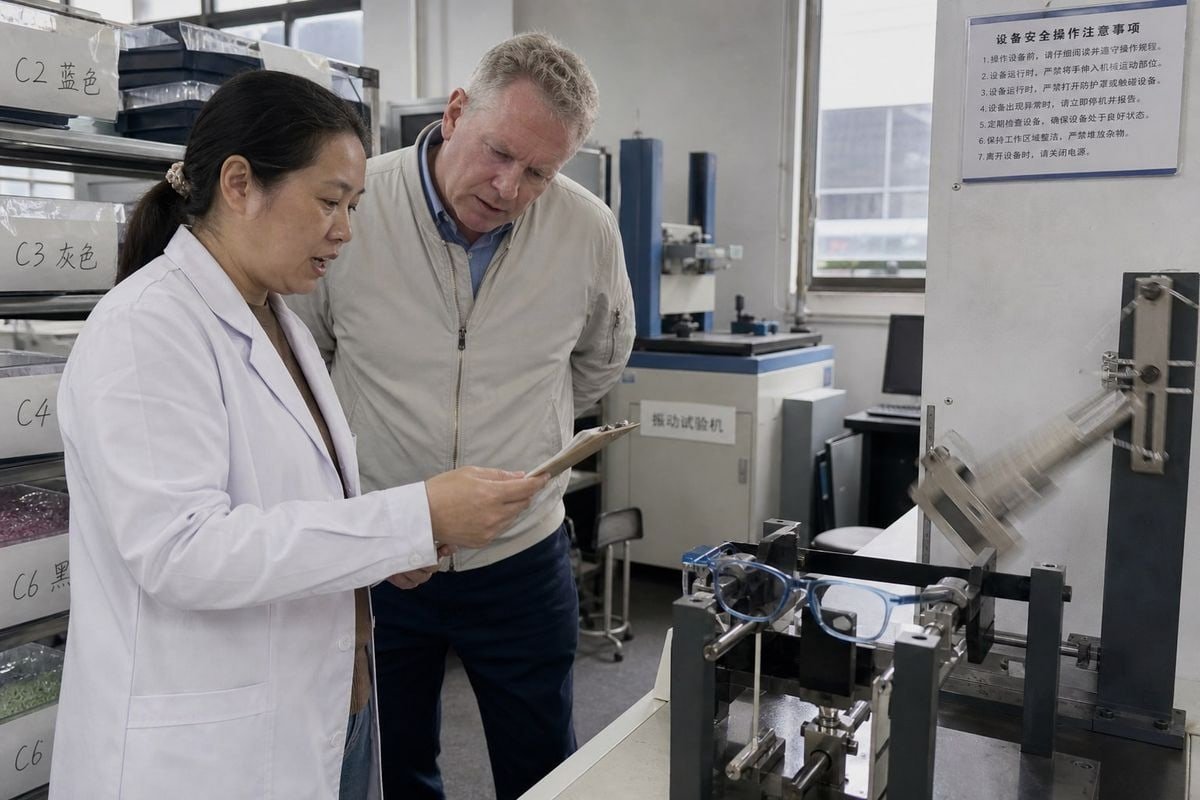
The ISO 12870 standards are the baseline, and I want to be honest about what "baseline" means. The standard requires hinges to survive at least 500 open-close cycles without permanent deformation 3 exceeding 5mm. That is a floor for general eyewear, not a target for children's frames. A kid can burn through 500 cycles in seven weeks. Any supplier who waves an ISO certificate as proof of kid-proof durability is telling you very little.
At our factory, we treat ISO 12870 as the entry ticket and then over-test. Premium manufacturers commonly run children's frames to 20,000 or even 30,000 cycles to confirm the internal spring mechanism 4 resists metal fatigue. Our cycle-test rigs open and close each sample at a fixed angle and speed until the hinge loses elasticity or changes state — which is exactly what standard fatigue testing equipment is designed to measure.
The test checklist I recommend to buyers
- ISO 12870 baseline report. Confirms 500 cycles minimum and the 5mm deformation tolerance. Non-negotiable, but insufficient alone.
- Extended flex-cycle test. Ask for 5,000 cycles minimum on standard hinges, 15,000+ on spring hinges. The report should record temple flex range and tension at intervals, not just pass/fail.
- Screw retention test. Screw loosening from cycle vibration is the most frequent mechanical failure in children's hinges. Ask how screws are secured — thread-locker, self-locking threads, or riveted designs.
- Torsion and impact resistance checks. Symmetrical open-close testing misses one-handed removal stress. A serious supplier tests twisting, too.
- Batch-level QC records. One golden sample proves nothing. Ask how often production batches are pulled for re-testing.
Our 5S-managed workshop keeps these records batch by batch, and I encourage buyers to write minimum cycle counts and deformation tolerances directly into their frame specs. A spec sheet beats a brand promise every time.
Why do flexible TR90 and TPEE hinges outlast rigid frames when my child customers open and close them all day?
Fifteen years of working with flexible polymers taught our team one core lesson: the best way to survive friction is to eliminate it. That principle explains almost everything about why flexible frames dominate our kids' catalog.
Flexible TR90 and TPEE hinges outlast rigid frames because elastic material memory absorbs each open-close motion instead of grinding a screw against barrel walls. With no friction interface, there is nothing to abrade, loosen, or back out — the dominant failure modes in rigid hinges.
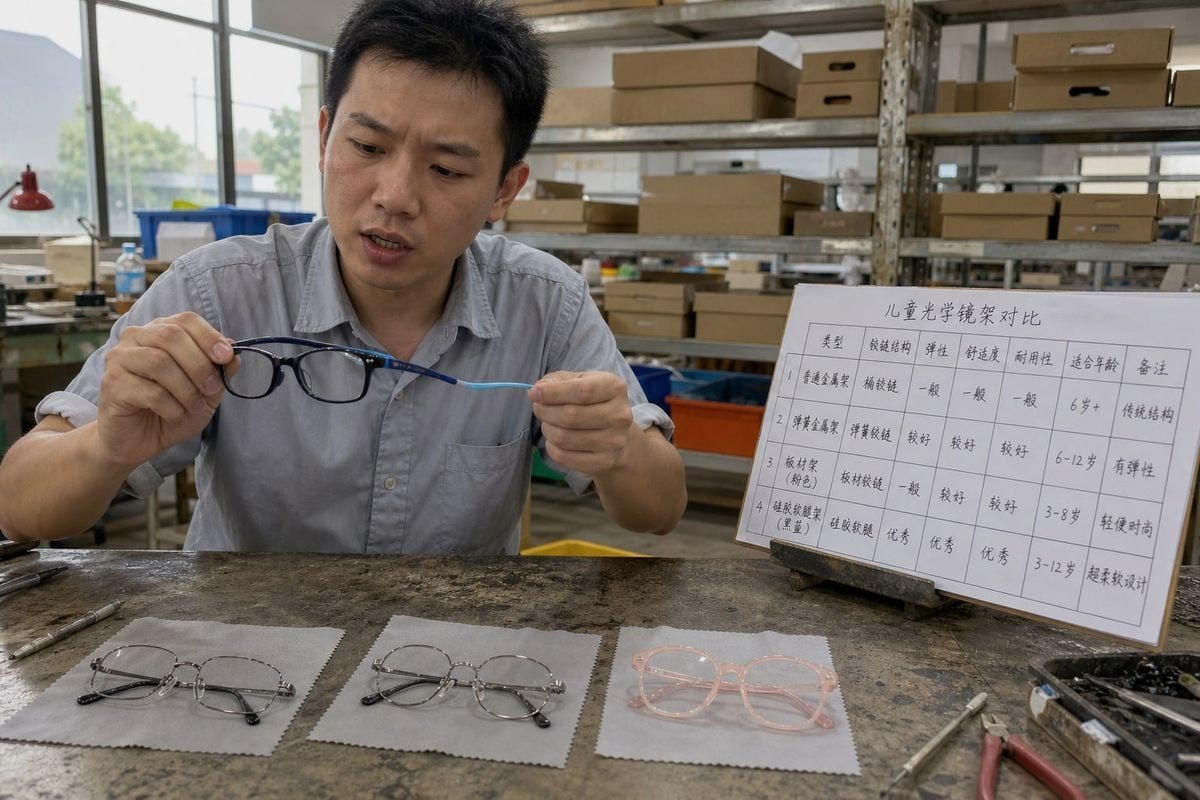
A rigid metal barrel hinge is a machine with moving parts. Every machine with moving parts wears. A flexible polymer hinge is closer to a living joint — it bends, stores energy, and returns to shape. Emerging monolithic screwless hinges made from high-performance polymers 5 like PEI can exceed 50,000 cycles precisely because flexible material memory replaces mechanical friction entirely. TR90 and TPEE work on the same principle at a price point that makes sense for children's frames.
Where rigid hinges lose the battle
| Failure mode | Rigid barrel/spring hinge | Flexible TR90/TPEE design |
|---|---|---|
| Screw loosening from vibration | High risk — most common failure | No screw at the flex zone |
| Micro-abrasion wear | Constant, cumulative | None at the friction interface |
| Chemical degradation of lubricants | Sunscreen and acidic kids' sweat degrade internal lubricants, causing gritty failure | No internal lubricant to degrade |
| Torsional stress from one-handed removal | Concentrates at the hinge joint, cutting effective lifespan by 30–40% | Distributed along the flexible temple |
| Micro-cycling from device use | Localized wear on hinge stop-points | Elastic recovery, no stop-point wear |
Two of those rows deserve emphasis. First, children apply asymmetrical stress constantly. They yank glasses off with one hand while running. That torsional force is exactly what standard symmetrical cycle testing fails to capture — and it can reduce a rigid hinge's effective lifespan by 30–40% below its lab rating. Flexible temples bend with the yank instead of fighting it.
Second, the micro-cycling effect matters more than most buyers realize. Kids adjusting glasses repeatedly during tablet or homework time create small, partial hinge movements. These micro-cycles cause localized wear on hinge stop-points and damage frame alignment faster than a full 90-degree open-close motion. A flexible hinge simply recovers.
The honest counterpoint: frame material fatigue still exists in polymers. TR90 and TPEE eventually tire at the flex zone. But that failure arrives after tens of thousands of cycles, not thousands — and it degrades gracefully rather than dropping a screw on the playground. That safety profile is exactly why we build most of our children's styles, like our TR90 frames with soft TPEE temples and silicone ear tips, around this construction.
How can I verify hinge cycle-life claims from an OEM manufacturer before placing a bulk order?
One of the trickiest supplier conversations I've had involved a competitor's "100,000-cycle" claim that a European buyer brought to our meeting. We opened the underlying test report together, and the story fell apart within minutes.
Verify cycle-life claims by requesting the raw fatigue test report with equipment details and cycle intervals, commissioning independent third-party testing on production samples, checking claims against realistic tiers, and confirming the test included torsion, screw retention, and post-cycle tension measurements.
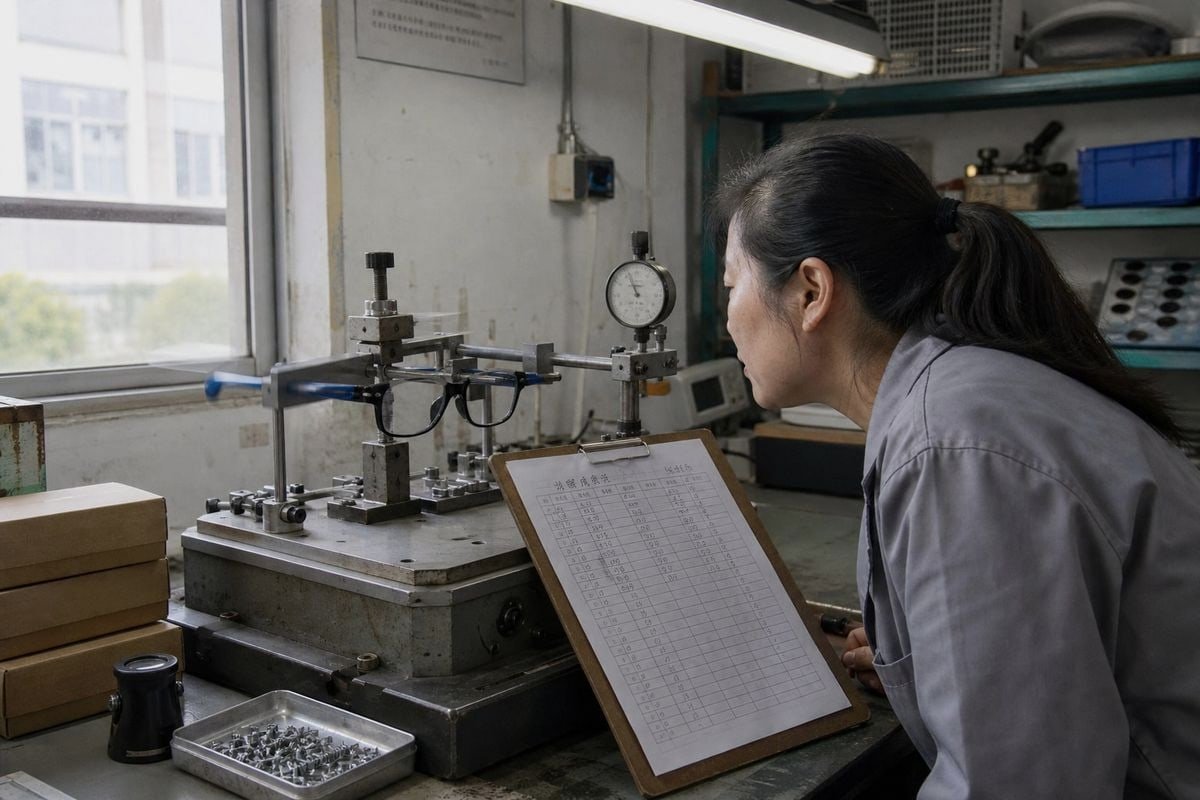
Marketing claims of 50,000 or even 100,000+ operating cycles usually come from controlled lab conditions: a machine opening the temple to a fixed angle, at a fixed speed, with zero twisting and zero dropping. Those numbers are real, but they measure a scenario no child has ever created. Your job as a buyer is to translate lab claims into playground reality — and to catch suppliers who cannot back their numbers at all.
A five-step verification process
- Demand the raw report, not the claim. A legitimate report names the test machine, the open angle, the cycle speed, and the sample size. If the supplier only offers a one-line certificate, treat the number as unverified.
- Check what was measured, not just how long. Good reports record temple width, hinge tension, and screw torque at intervals — for example, every 2,500 cycles. Loss of tension and wobble appear long before outright breakage, and a pass/fail report hides them.
- Sanity-check against known tiers. A basic barrel hinge claiming 50,000 cycles should trigger skepticism. Material drives longevity: 316L stainless steel and beta-titanium alloys resist repetitive hinge stress best among metals, and monolithic polymer flex designs top the polymer side. If the bill of materials doesn't support the claim, the claim is inflated.
- Test production samples independently. Golden samples are hand-finished. Pull units from a trial production run and send them to a third-party lab for flex-cycle and impact resistance testing. We actively encourage our buyers to do this — it protects both sides.
- Weigh repairability alongside cycle rating. A high cycle count means little if the hinge cannot be tightened or serviced. Some proprietary or riveted designs are impossible to maintain in the field. Ask about replacement screws, spare temples, and service parts before you commit.
At our factory, buyers can order small trial quantities from our roughly 800 existing styles before any bulk commitment. That lets a new brand validate hinge performance in their own market — with their own kids — before scaling. In my experience exporting to buyers in 20+ countries, the brands that verify first and order second are the ones still working with us five years later.
Conclusion
Kids' hinges range from 5,000 cycles for basic barrels to 25,000–50,000+ for flexible TR90/TPEE designs. Verify test reports, demand over-testing beyond ISO 12870, and choose serviceable hinges — not just big numbers.
Notes de bas de page
1. Reliable source for spectacle frame construction and components. ↩︎
2. Scientific overview of thermoplastic elastomers and their elastic recovery properties. ↩︎
3. Authoritative engineering definition of permanent material changes. ↩︎
4. Technical explanation of material fatigue and its impact on mechanical durability. ↩︎
5. Authoritative overview of advanced polymer materials. ↩︎
Plus d'articles que vous pourriez aimer
août 5, 2026
Bio-Based vs Regular Cellulose Acetate: What's the Difference for Kids' Frames?
août 5, 2026
How Recyclable Are Kids' Optical Frame Materials, and What Eco-Friendly Alternatives Exist?
août 5, 2026
Do Kids Optical Frames Whiten or Age in Storage, and How to Control Warehouse Conditions?
Vous recherchez un partenaire fiable en lunetterie pour enfants ?
Explorez plus de 800 styles prêts et un support OEM/ODM complet adapté à votre marque.
Contactez-nous English
  Español de México
  Deutsch
  Français
  日本語
日本語  العربية
  Português do Brasil