How Long Do TR90 Kids’ Optical Frames Last Before Replacement?
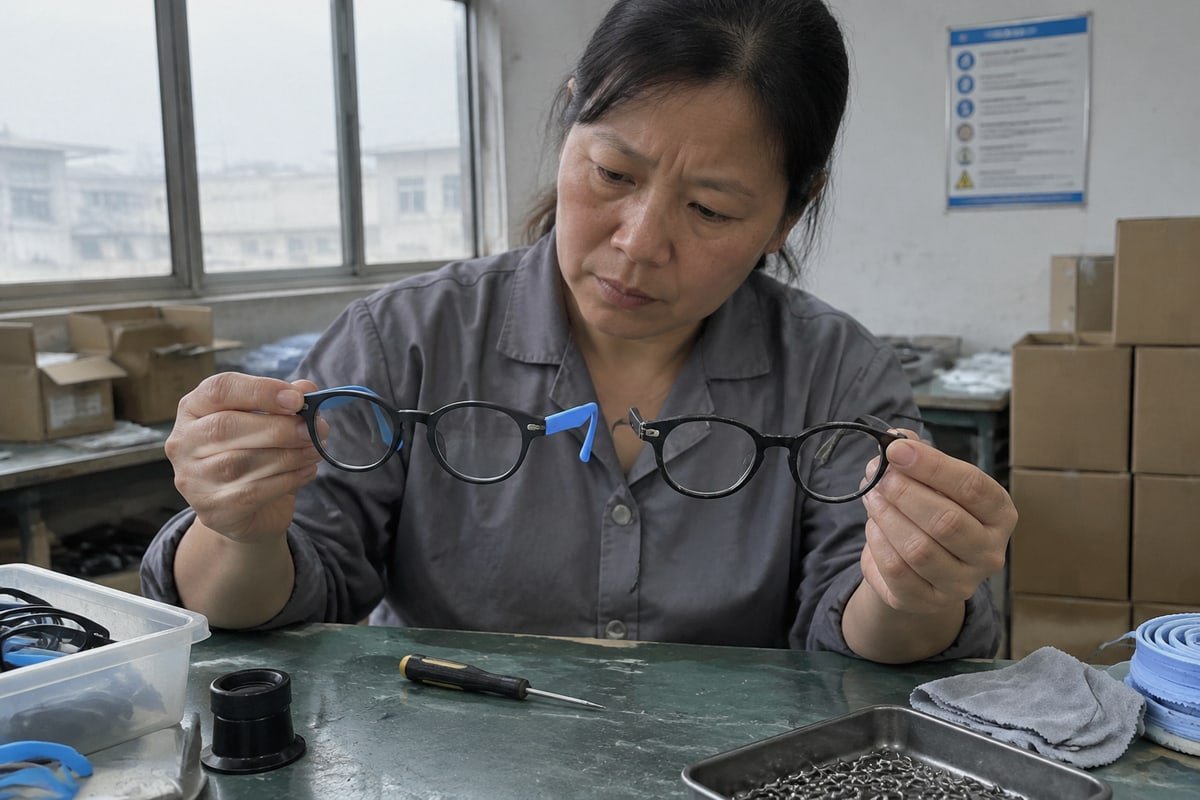
Buyers ask our Taizhou factory team one question about TR90 kids’ optical frames 1 every week. A frame that looks tough still ends up in the bin in six months. Why?
TR90 kids’ optical frames usually last one to three years before replacement. The frame material itself often survives longer. Most replacements happen because the child outgrows the fit, the prescription changes, hinges loosen, or lenses get scratched, not because the TR90 body breaks.
That gap between material life and real replacement timing is the whole story. Below, I break it down into signs of wear, the factors that shorten lifespan, how TR90 stacks up against acetate and metal, and what you can do as a brand to make the frames you source last as long as they should.
Comment puis-je savoir si les montures TR90 de mon enfant sont usées ou toujours sûres à utiliser ?
A distributor once sent a box of returned frames back to our QC bench in Taizhou. The TR90 fronts were all intact. The hinges told a different story.
Vérifiez cinq points : le serrage des charnières, l'alignement des branches, l'ajustement sur le nez, les rayures sur les verres et les fissures ou le blanchissement de surface. Une monture en TR90 reste sûre si elle se plie et reprend sa forme initiale de manière uniforme. Remplacez-la lorsque les branches s'affaissent, que les vis ne tiennent plus ou que la monture est de travers sur le visage de l'enfant.
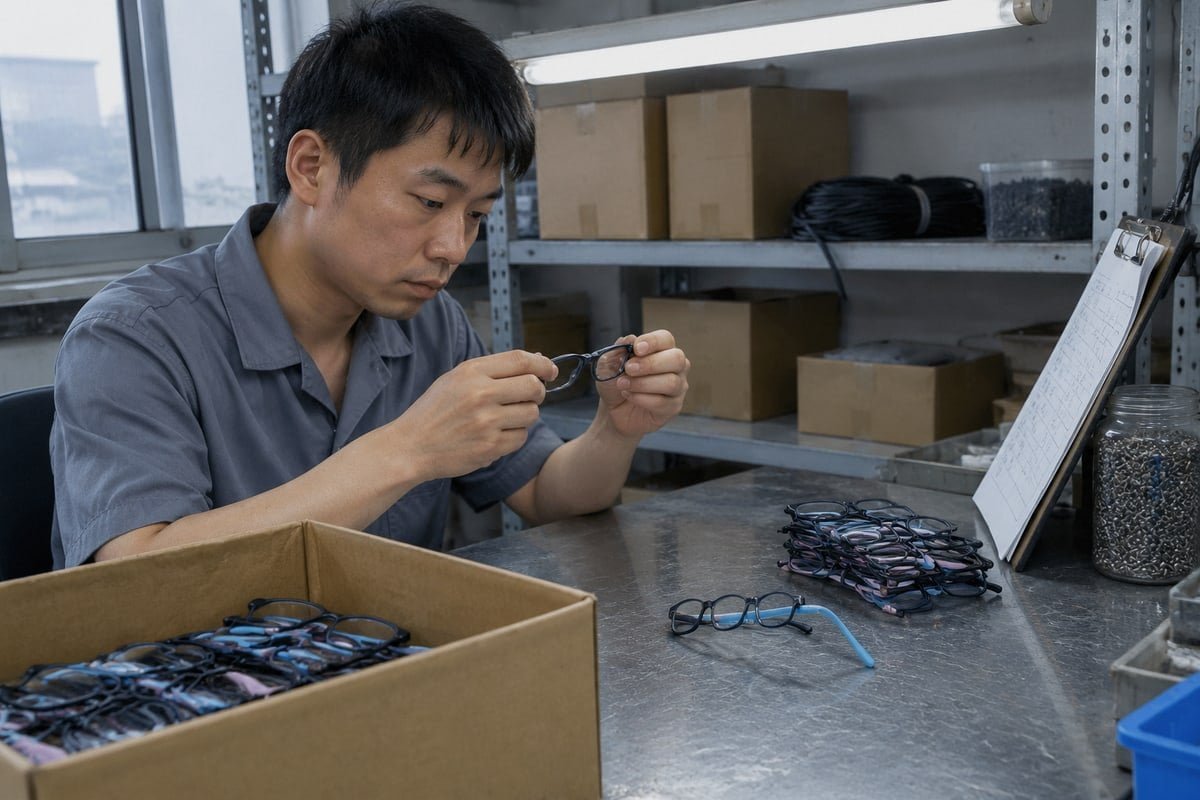
That returned box taught me something simple. Parents and retailers look at the wrong part first. They check whether the frame is broken. But TR90 is a thermoplastic memory resin. It bends and comes back. So the front rarely shows dramatic damage. The wear hides in the small parts and in the fit.
Material life is not the same as wear-life
I separate these two ideas in every buyer conversation. Material life is how long the Matériau Grilamid TR90 2 stays structurally sound. Wear-life is how long the glasses stay useful and safe on a specific child. A frame can pass material life with years to spare and still fail wear-life in twelve months. Loose hinges, misaligned temples, and scratched lenses all end wear-life early.
A practical inspection checklist
Here is the checklist I give to our OEM customers for their own retail staff or customer support teams.
| Ce qu'il faut vérifier | Ce que vous voyez | Ce que cela signifie | Action |
|---|---|---|---|
| Hinge tightness | Temples swing freely or wobble | Screw thread or barrel is worn | Tighten or replace screw; replace if it will not hold |
| Alignement des branches | La monture est de travers sur le visage | Temple has been bent past memory range | Professional adjustment; replace if it returns crooked |
| Ajustement du nez | Red marks or slipping | Bridge width no longer matches the child's facial growth | Move up a size |
| Surface du verre | Scratches in the line of sight | Coating wear | Replace lenses, keep frame if fit is good |
| Frame surface | Whitening at bends, fine cracks | Stress fatigue or heat damage | Remplacer la monture |
| Embouts de branche | Hard, dry, or split | Aged material | Replace tips or frame |
The hygienic lifespan question
One point from recent industry discussion deserves attention. Cumulative micro-abrasions on the frame surface 3 can hold biofilm and bacteria. This suggests a hygienic lifespan that may end before the mechanical lifespan does. In our experience, this is most visible on temple tips and nose pad areas, where skin contact is constant. Regular cleaning with mild soap and water extends this considerably. But if a frame surface feels rough or sticky even after washing, I treat that as a replacement signal, not just a cosmetic one.
Safety comes before appearance
A scuffed front is fine. A crooked front that puts uneven pressure on one ear is not. Uneven fit shifts the optical center of the lens 4, which affects how the child sees. That is a safety and vision issue, not a style issue. When I train new QC staff, I tell them to check fit symmetry before surface finish for exactly this reason.
What factors most affect how long TR90 optical frames actually last on active children?
Every time we spec a temple thickness, we weigh two things. Thinner means lighter and more comfortable. Thicker means more tensile strength against a child sitting on the glasses.
Fit and growth matter most. A child's facial growth, prescription update frequency, hinge quality, heat exposure, lens weight, and daily handling habits decide the real lifespan. Heavy-use kids may need replacement in 6–12 months, typical school use lasts 1–2 years, and careful use can reach 2–4 years.

That thickness trade-off is a good example of how lifespan gets decided in small choices. No single factor controls it. So I rank them by how often each one actually triggers a replacement in the feedback we receive from importers and optical customers across 20+ countries.
The five replacement triggers, ranked
- Outgrown fit. This is the number one reason. Bridge width and temple length stop matching the child's face. Even our most flexible temple arms cannot fix a frame that is now too narrow.
- Prescription changes. Many children need new lenses more often than a new frame. But if the old eyewire has stretched, the new lenses may not seat securely, and the whole unit gets replaced.
- Hardware wear. Hinges and screws loosen with thousands of open-and-close cycles. This happens well before TR90 fatigues.
- Lens damage. Scratches and coating wear end the glasses' usefulness even when the frame is perfect.
- Loss or serious abuse. Sports, drops, and bending far past the normal range. TR90 survives most of this, but not all of it.
Two factors people underestimate
Heat is the first. Leaving glasses on a car dashboard exposes the polymer to repeated thermal cycling. Over time this can compromise the molecular bonds. The practical result is sudden brittleness, often after 12 to 18 months of that kind of exposure. I have seen frames that felt fine one week and cracked at the hinge the next. The frame did not fail suddenly. It was weakened slowly.
Lens weight is the second. High-diopter lenses put constant peripheral tension on the eyewire. This can cause material creep, which is a slow permanent stretch. Eventually the lenses lose their secure fit. For strong prescriptions, I recommend a slightly thicker eyewire profile and a full-rim design rather than the thinnest fashion option.
Lifespan by usage profile
| Usage profile | Fenêtre de remplacement typique | Principal moteur | What helps most |
|---|---|---|---|
| Heavy use, sports, frequent loss | 6–12 mois | Abuse and loss | Spring hinges, strap, spare pair |
| Typical school use | 1–2 ans | Growth and lens updates | Correct sizing, 6–12 month servicing |
| Careful use, good fit, regular care | 2–4+ years | Prescription cycle | Hinge checks, heat avoidance, cleaning routine |
One product listing I reviewed states a 1-year normal-use expectation for a kids' TR90 frame. That is conservative compared to promotional claims elsewhere. I think it is honest for the heavy-use group. For a well-fitted frame with quality hinges, our customers generally report longer.
How does TR90's flexibility compare to acetate or metal frames when it comes to durability?
A product manager from Australia asked us why we don't just use acetate like the adult brands do. I handed her a sample and asked her to twist it.
TR90 bends and returns to shape, so it survives drops, twists, and sitting accidents better than acetate or standard metal. Acetate looks richer but snaps under stress. Metal holds shape but bends permanently and can corrode. For active children, TR90 offers the best balance of impact resistance and comfort.
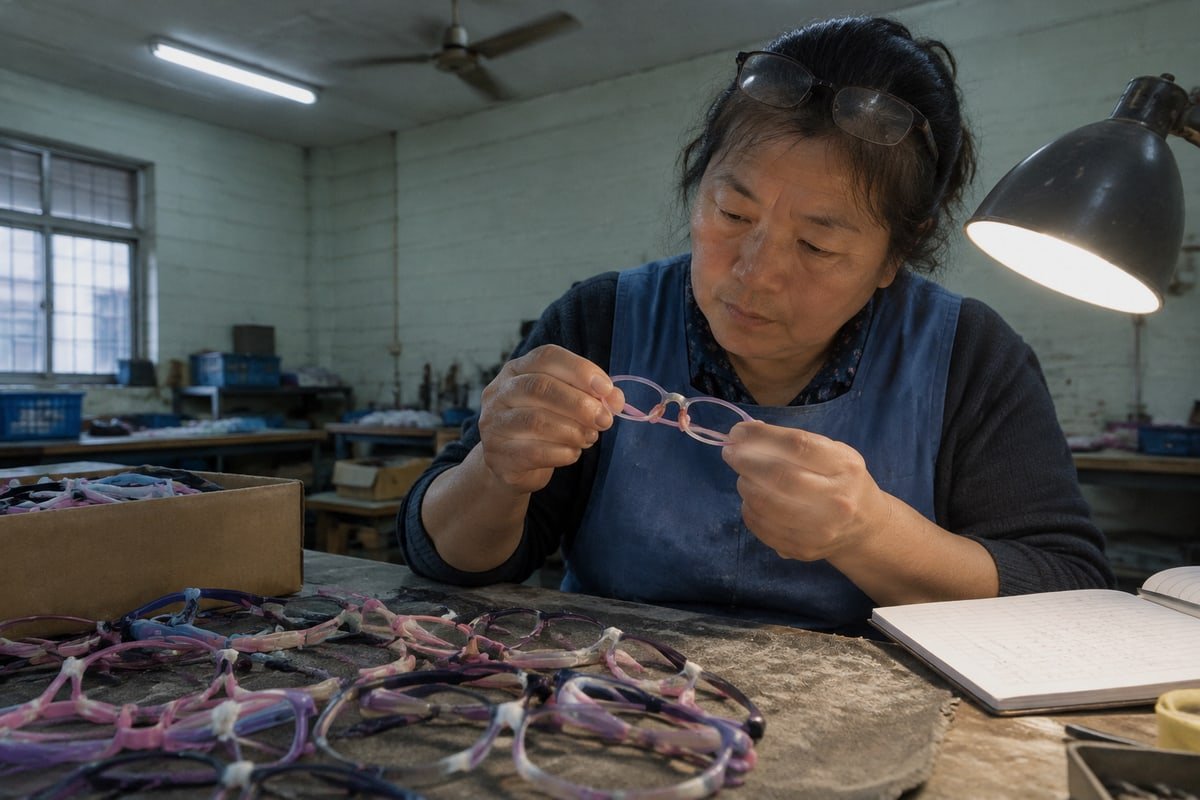
She twisted the sample, watched it spring back, and stopped asking about acetate. But the full picture is more nuanced than that demo. Here is how I compare the four common frame materials when a buyer is choosing for a children's range.
| Matériel | Comportement de flexion | Conformité au test de chute de bille de la FDA | Poids | Skin and sweat resistance | Typical kids' lifespan issue |
|---|---|---|---|---|---|
| TR90 (Grilamid) | Bends and returns | Élevé | Très léger | High, hypoallergenic properties | Hinges and fit outlast the front |
| Acétate | Rigid, limited flex | Modéré | Moyen | Can yellow and degrade from skin oils | Snaps at bridge or temple under stress |
| Standard metal | Se plie et reste plié | Modéré | Light to medium | Can oxidize, nickel sensitivity risk | Repeated re-adjustment, corrosion |
| Excellent — retour mémoire | Bends and stays bent, some spring | Élevé | Très léger | Encore un angle : la qualité de la finition. Les détaillants japonais remarquent immédiatement les lignes de moulage, la couleur inégale et les bords rugueux. Sur notre ligne, nous maintenons des tolérances de couleur et de moulage plus strictes. | Cost; still bends permanently |
Where acetate vs TR90 durability really diverges
Acetate is a beautiful material. Adults love the depth of color. But it is a plant-based cellulose material 5 that reacts to skin oils and perspiration over years. It can yellow, lose surface finish, and become brittle. TR90 resists those oils. It keeps its finish, and it does not irritate skin. For a child who wears glasses eight hours a day and sweats through recess, that resistance matters as much as the flex.
The flex difference is the bigger point. Acetate has almost no memory. Twist it past a small angle and it cracks. TR90 is a memory resin. It absorbs the twist and recovers. This is why a child sitting on TR90 glasses usually gets a quick re-adjustment, while sitting on acetate glasses usually means a new frame.
Where metal and titanium still fit
Metal has real strengths. It holds a precise adjustment and works well for thin, minimal looks. Titanium is light and hypoallergenic. But both bend permanently. A child who bends a metal temple needs an optician to bend it back, and each bend fatigues the metal a little more. Nose pads on metal frames also loosen and collect grime. For older children with careful habits, metal can be a fine choice. For the under-ten group, I steer buyers toward TR90.
Pourquoi nous associons des façades en TR90 à des branches en TPEE
Our own approach combines a TR90 front with TPEE temples on many styles. The front gives the eyewire tensile strength to hold lenses securely. The TPEE temples add another level of softness and flex where the frame contacts the head. Two of our current samples show this well: a round matte black front with sky-blue temples and a keyhole bridge, and a translucent pink gradient rounded-square. Both look like fashion frames. Both are built to be sat on.
What can I do as a brand to ensure the TR90 frames I source hold up to their expected lifespan?
Fifteen years in eyewear taught us one hard lesson. Frame lifespan is decided long before the child wears the glasses. It is set at the raw material and hinge stage.
Specify genuine TR90 resin, ask for flex-cycle and impact test evidence, choose spring or reinforced hinges, and confirm sizing charts match your target age groups. Then support customers with frame maintenance tips, a 6–12 month servicing reminder, and replaceable parts. This covers material life and wear-life together.
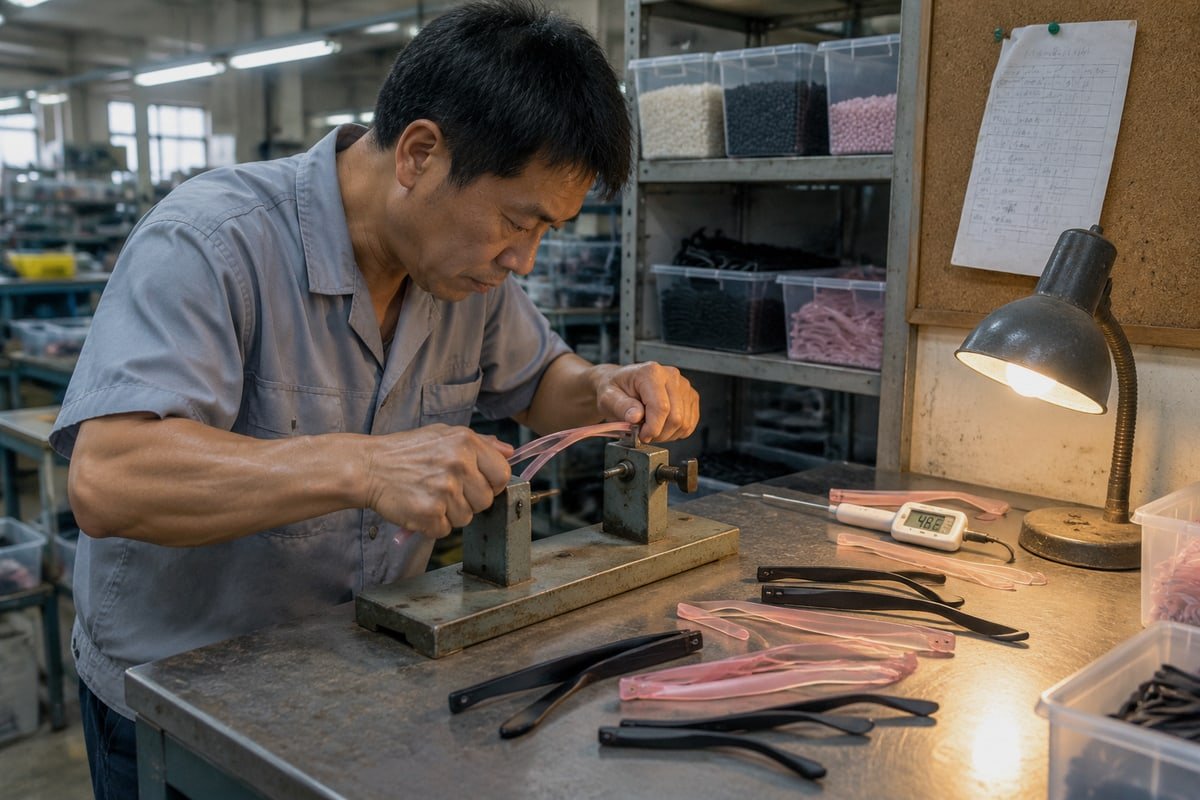
That lesson shaped how our 5S-managed workshop handles every new order. Here is the process I recommend to any founder or procurement manager building a children's optical range. It works whether you pick from our roughly 800 existing styles or develop a custom mold.
A six-step sourcing process
- Confirmer la résine. Ask for the material grade and supplier. Recycled or blended nylon does not behave like true Grilamid TR90 material. The flex feels similar for a week and then fails.
- Ask for test evidence, and read it critically. One supplier guide cites ISO 12870:2016 fatigue-resistance testing 6 with 500+ cycles of 90° temple flexing. Another flexible-frame vendor claims 50,000+ flex cycles in lab testing. These numbers are useful. But they are supplier-reported and not directly comparable across brands. I tell buyers to treat them as indicators that a frame will outlast basic plastic, not as a guaranteed lifespan.
- Specify the hinge. TR90 plus spring hinges is the combination most often recommended for active kids. The spring absorbs the over-extension that would otherwise wear the barrel and screw. If cost rules out spring hinges, ask for reinforced barrels and thread-locked screws.
- Match sizing to age bands. Growth is the top replacement trigger, so a good size ladder is a durability feature. We size by bridge width and temple length, not just lens width.
- Consider modular designs. Newer modular TR90 designs allow replacement of individual temples or bridges. This can extend a frame's functional life past the typical two-year growth spurt. It also reduces warranty cost for your brand.
- Plan the aftercare content. Lifespan continues after the sale. Give your retailers and parents clear care guidance.
What to request from your factory
| Élément à demander | Why it matters for lifespan | Ce à quoi ressemble un bon produit |
|---|---|---|
| Material data sheet | Confirms genuine TR90 | Named resin grade, not just "TR90" on the invoice |
| Flex and impact test report | Shows fatigue resistance | Referenced standard, cycle count, test conditions stated |
| Hinge specification | Hinges fail before TR90 | Spring hinge or reinforced barrel, screw type listed |
| Sizing chart by age | Prevents early outgrowth returns | Bridge, temple, and lens width per size |
| Spare parts availability | Enables repair over replacement | Temples, screws, tips available for reorder |
| Packaging and care insert | Extends wear-life at home | Cleaning and heat-avoidance guidance included |
Frame maintenance tips worth printing on your insert
I keep these short because parents skim. Clean with mild soap and lukewarm water. Never leave glasses in a hot car or on a radiator. Use two hands to take them off. Store them in the case, not a school bag pocket. Book a professional servicing check every 6–12 months, and a fit check at least every 1–2 years. None of this is complicated. But each tip removes one of the small causes that end a frame's life early.
Handling the unbreakable objection
Some sellers advertise lifetime or unbreakable performance. I understand the temptation. It sells. But your retailers will face the parent whose child lost the glasses at month four, or whose prescription changed at month eight. I advise our OEM partners to market TR90 honestly: bends instead of snapping, lighter on the nose, kind to sensitive skin, and built to survive normal childhood. That claim holds up. Unbreakable does not.
Conclusion
TR90 kids' optical frames usually outlast the child's need for them. Plan replacement around growth and lenses, not breakage, and source frames whose hinges and fit match that reality.
Vous souhaitez vous procurer les produits mentionnés dans cet article ? Voir les détails et demander un devis ici :
Notes de bas de page
1. Official US government resource for international trade and industry standards. ↩︎
2. Official manufacturer site for the high-performance polyamide resin used in TR90 optical frames. ↩︎
3. CDC resource on hygiene and the nature of microbial growth on various surfaces. ↩︎
4. Authoritative medical explanation of how lens alignment and the optical center affect vision. ↩︎
5. Technical background on the composition and properties of cellulose acetate used in eyewear. ↩︎
6. Official ISO standard for ophthalmic optics specifying requirements and test methods for spectacle frames. ↩︎
Plus d'articles que vous pourriez aimer

8 novembre 2026
Pourquoi les montures optiques TR90 pour enfants jaunissent-elles et deviennent-elles cassantes, et qu'est-ce qui accélère cela ?

6 novembre 2026
Quelles informations sur l'étiquette les parents vérifient-ils en premier sur les montures optiques TR90 pour enfants ?

5 novembre 2026
Comment associer les SKU de taille et de couleur pour les montures optiques TR90 pour enfants par tranche d'âge ?
Vous recherchez un partenaire fiable en lunetterie pour enfants ?
Explorez plus de 800 styles prêts et un support OEM/ODM complet adapté à votre marque.
Contactez-nous English
 Español de México
 Deutsch
 Français
 日本語
 العربية
 Português do Brasil