How to Negotiate Deposit and Payment Terms for Kids’ Sunglasses Suppliers?

Negotiating deposit and payment terms for kids’ sunglasses suppliers worries many buyers who contact our Taizhou factory. Pay too early, and you risk your cash before quality is proven.
Most kids’ sunglasses suppliers start at a 30% deposit with the 70% balance due before shipment. Negotiate by tying the balance to a passed pre-shipment inspection, offering staged milestones, and requesting lower deposits or net terms only after two to three successful orders build trust.
Payment terms are really a risk-sharing tool, not just a finance detail. Below, I will walk you through what is standard, what is negotiable, and what signals a supplier you can trust.
What deposit percentage is standard when ordering kids' sunglasses from a factory?
Last month, a first-time buyer from Australia asked me why our quotation listed a 30% deposit. She assumed it was negotiable to zero. Our finance team and I explained the real math behind it.
The standard deposit for kids' sunglasses factory orders is 30%, with the remaining 70% paid before shipment. Highly customized runs or unverified first-time buyers may face 50% deposits, while trusted repeat buyers with large volumes can often negotiate down to 20% or even 10%.
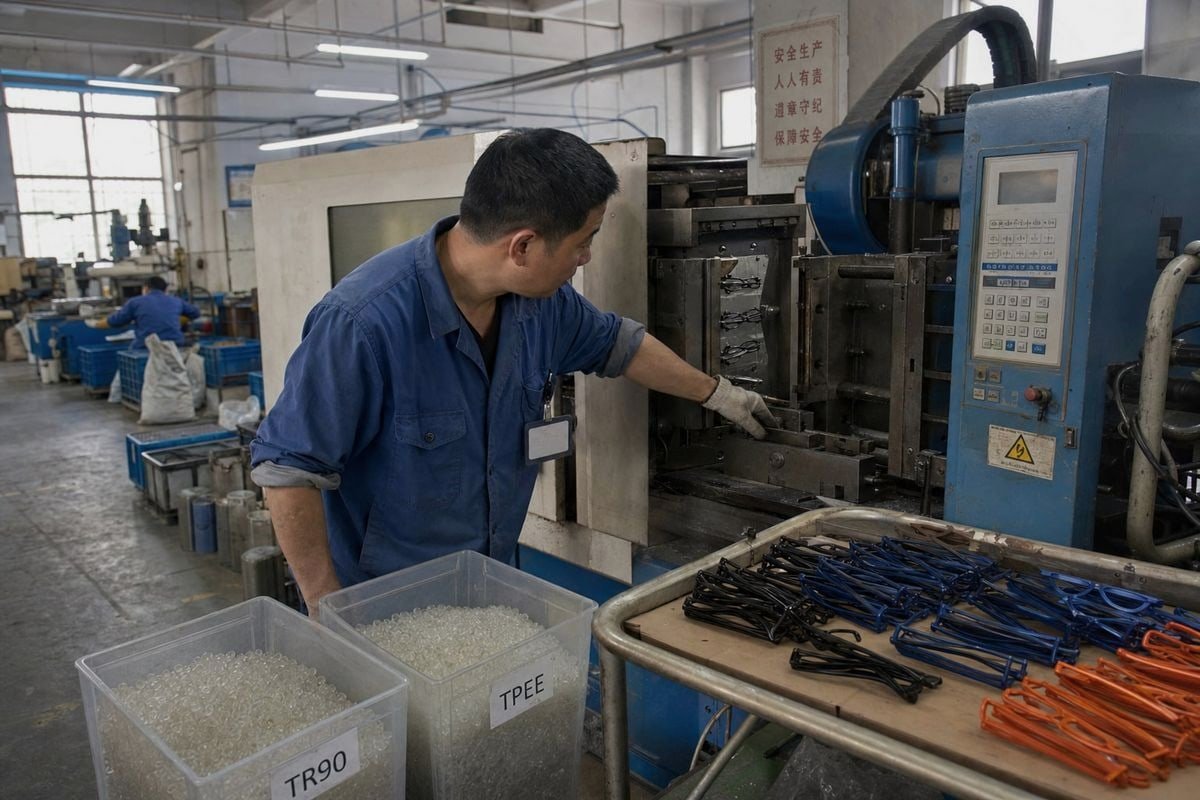
The 30/70 structure exists for a practical reason. When we confirm an order for TR90 frames with TPEE temples, we immediately buy raw materials, book injection-molding time, and schedule workers. If a buyer disappears mid-production, that deposit is the only thing covering our sunk costs. Custom colors, printed logos, and branded packaging make the goods harder to resell, so customization pushes deposits up, not down.
What moves the deposit number
Several factors shape what a factory will accept:
| Facteur | Pushes Deposit Higher | Pushes Deposit Lower |
|---|---|---|
| Type de commande | Fully custom molds, unique colorways | Stock styles from an existing catalog |
| Relationship | First order, no references | Two to three completed orders |
| Taille de la commande | Small trial runs below MOQ | Large or repeating volumes |
| Buyer profile | Personal account, vague company info | Verified business, clear paper trail |
| Product risk | Complex lenses, special packaging | Standard UV400 lenses, simple packing |
Here is one practical tip from our side of the table. Because we keep around 800 existing styles in our catalog, buyers who choose stock designs carry far less risk for us. That means we can be more flexible on deposits than we would be for a brand-new custom mold. If you want lower deposits on your first order, choosing existing styles is the fastest lever you have. Also, always confirm what "before shipment" means in writing. It should mean after your inspection passes, not before you have seen a single photo of finished goods.
How can I structure payment terms to protect my brand on a first order?
A trade-off comes up in almost every first-order negotiation we handle: buyers want to pay after seeing quality, while our production line needs funding before it starts. Milestone payments solve both sides.
Protect your first order by keeping the standard 30% deposit but releasing the 70% balance only after a passed pre-shipment inspection. Define objective triggers in writing — inspection reports, photos, and packing lists — and consider a small holdback for defect claims on children's products.
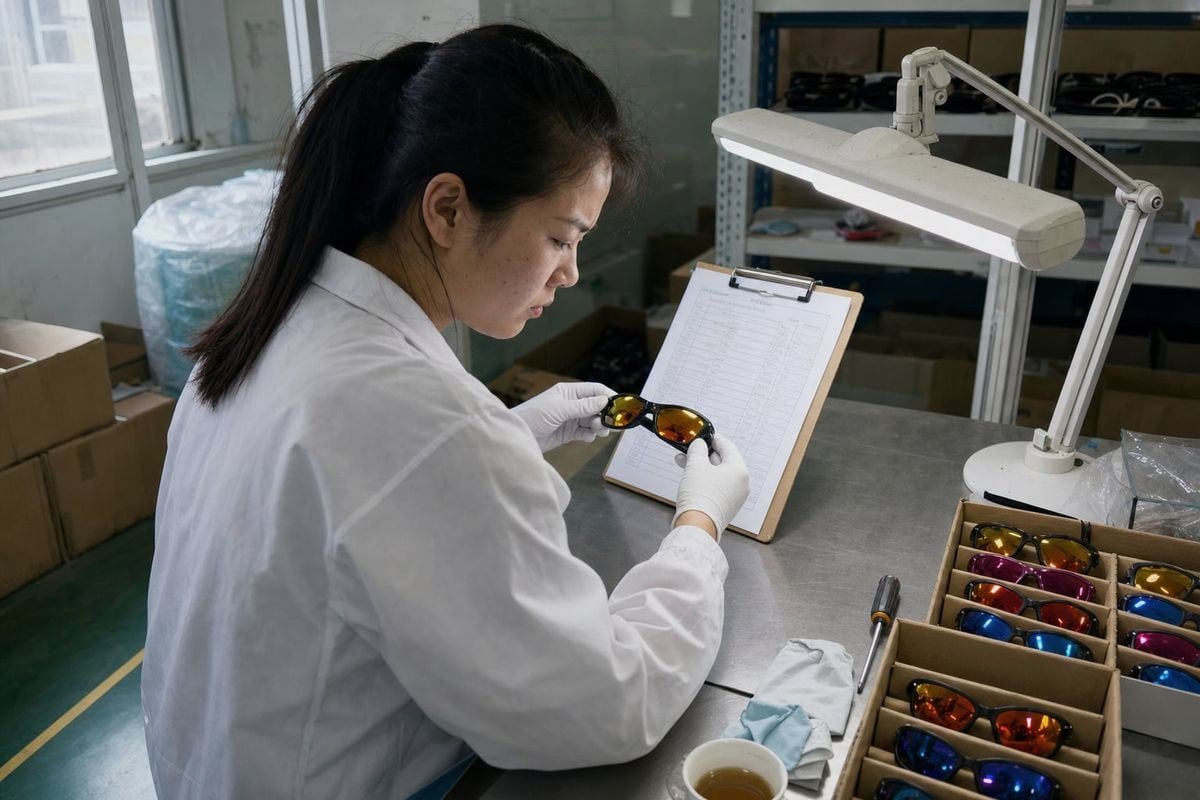
The single most important change you can make is shifting the balance trigger from "before shipment" to "after inspection pass." Most professional factories accept this. At our workshop, we actually prefer it, because a documented third-party inspection 1 protects us from disputed claims later. Kids' eyewear deserves this extra gate. Children's products face stricter safety expectations, and defects like sharp edges, weak hinges, or failed UV coatings are much more expensive to discover after delivery.
A safe milestone structure for a first order
- Sign a contract naming the exact payment triggers, inspection standard, and bank account.
- Pay the 30% deposit against the signed proforma invoice.
- Request production photos or a video call at production completion.
- Book a third-party pre-shipment inspection with written pass criteria.
- Release the 70% balance only after the inspection report passes.
- Optionally, hold back 5–10% for 30–60 days to cover defect claims.
Extra protection layers worth negotiating
Ask for approval criteria in writing before production starts: lens category, frame flexibility, drop-test expectations, and packaging condition. For children's sunglasses, also confirm which safety standards your market requires and agree on who pays for compliance testing 2. We often build testing timelines directly into the payment schedule so neither side is surprised. Finally, pay for samples separately before any bulk deposit. A small sample fee tells you far more about a factory's real quality than any brochure will.
What payment methods do reliable kids' eyewear manufacturers typically accept?
Over fifteen years of exporting children's eyewear to more than twenty countries, our sales team has processed nearly every payment method buyers propose. Each one allocates risk differently.
Reliable kids' eyewear manufacturers typically accept T/T bank transfers as the standard, plus letters of credit for larger orders, and platform escrow services like Alibaba Trade Assurance. Trustworthy factories always receive payment into a verified company bank account matching their business license.

T/T (telegraphic transfer 3) remains the backbone of eyewear sourcing. It is fast, low-cost, and works cleanly with the 30/70 structure. However, T/T offers no built-in buyer protection, which is exactly why milestone triggers and inspections matter so much when you use it.
Comparing the main payment methods
| Méthode | Idéal pour | Buyer Protection | Coût typique |
|---|---|---|---|
| T/T bank transfer | Standard 30/70 orders | Low — relies on contract and inspection | Low bank fees |
| Lettre de crédit 4 | Large or first-time cross-border deals | High — bank releases funds against documents | Higher fees, more paperwork |
| Escrow de la plateforme (par exemple, Trade Assurance) | Smaller first orders via marketplaces | Medium-high — platform mediates disputes | Platform commission |
| PayPal / cards | Sample payments only | Medium — chargeback options | High percentage fees |
A letter of credit 5 makes sense when order values are high and neither side has history with the other. The bank releases funds only against agreed documents, such as the connaissement 6 and inspection certificate. For smaller trial orders, platform escrow gives similar comfort at lower complexity.
One non-negotiable rule applies to every method. The receiving account name must match the company name on the business license 7 and the contract. When a supplier asks you to wire funds to a personal account or a differently named company, stop the transaction. In our experience, legitimate factories never route payments this way, and this single check filters out most fraud attempts before any money moves.
How do I know if a supplier's payment terms signal trustworthy quality and delivery?
Early in my career here, I learned that how a factory talks about payment reveals more than its showroom does. Precise terms usually mean precise production.
Trustworthy suppliers propose standard, clearly documented terms — around 30/70 with defined triggers — welcome pre-shipment inspections, and match bank details to their license. Red flags include full upfront payment demands, vague balance timing, mismatched account names, and refusal to put milestones in writing.

Payment terms are a window into how a supplier manages risk. A factory that documents every trigger, defines inspection rights, and issues a proper contract usually applies the same discipline to molding tolerances and lens coatings. A supplier who waves away paperwork with "don't worry, we ship on time" is telling you how they handle quality problems too.
Trust signals versus warning signs
| Signal | What It Suggests |
|---|---|
| Opens at 30/70 with written milestones | Standard, professional risk management |
| Accepts inspection-linked balance release | Confidence in their own quality control |
| Bank account matches license and contract | Legitimate registered business |
| Demands 100% upfront from a new buyer | Cash-flow trouble or outright fraud risk |
| Vague "balance before shipping" wording | Room to pressure you before you verify quality |
| Refuses written payment milestones | Avoids accountability for delivery and quality |
There is also a fairness point worth stating. Conservative terms from a factory are not automatically hostile. When we quote a higher deposit for a heavily customized order, it reflects real material and scheduling risk, not distrust of the buyer. The better question is whether the supplier explains their terms and offers structured alternatives. Suppliers who negotiate with options — 30/70, 25/75, or balance against shipping documents — are showing you a partner mindset. Suppliers who issue ultimatums are showing you the opposite. After two or three smooth orders, a good factory will typically loosen terms on its own, because your track record has lowered its perceived risk. That earned progression toward 20% deposits or net-30 windows is itself one of the strongest trust signals in this industry.
Conclusion
Weak payment terms expose your cash before quality is proven. Start at 30/70, tie the balance to inspection, verify bank details, and earn better terms through consistent, well-documented orders.
Notes de bas de page
1. WTO agreement governs pre-shipment inspection practices referenced for balance release. ↩︎
2. ISO governs the testing and standards frameworks referenced for compliance verification. ↩︎
3. Explains the international wire transfer mechanics behind the T/T payment method. ↩︎
4. Defines the formal trade-finance instrument recommended for large first-time orders. ↩︎
5. Explains how bank-mediated payment instruments protect both parties in trade deals. ↩︎
6. Clarifies the shipping document banks require before releasing letter-of-credit funds. ↩︎
7. Official guidance on verifying a registered business license before wiring payments. ↩︎
Plus d'articles que vous pourriez aimer


Vous recherchez un partenaire fiable en lunetterie pour enfants ?
Explorez plus de 800 styles prêts et un support OEM/ODM complet adapté à votre marque.
Contactez-nous English
  Español de México
  Deutsch
  Français
  日本語
日本語  العربية
  Português do Brasil