How to Ensure Kids Optical Frames Giveaways Are Choking-Hazard Free?
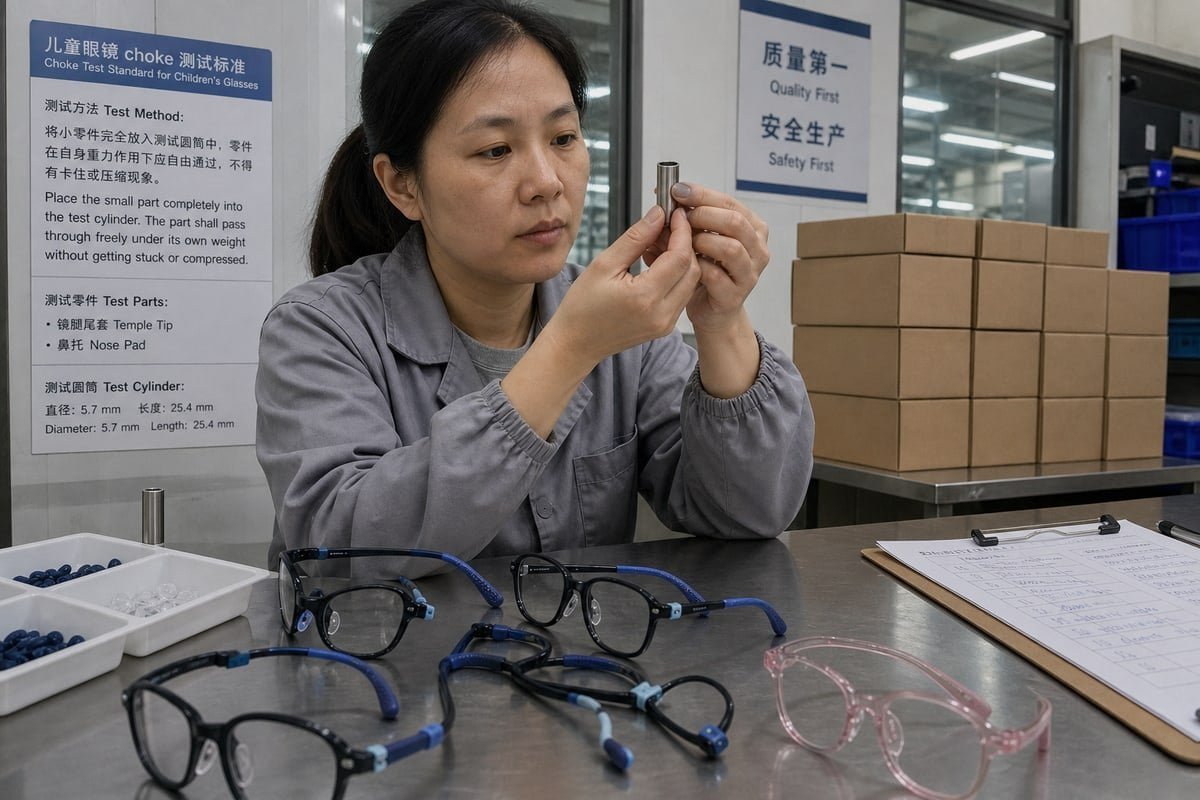
Free glasses feel harmless — until a temple tip ends up in a toddler’s mouth. Kids optical frames giveaways carry real choking risks, something our Taizhou production line confronts daily.
To ensure kids optical frames giveaways are choking-hazard free, eliminate detachable small parts, test every component against the CPSC small-parts cylinder (16 CFR 1501), use one-piece or screwless designs, choose polycarbonate lenses, and demand third-party lab testing documentation from your manufacturer before distribution.
That answer sounds simple. In practice, most giveaway failures happen because buyers treat promotional frames as swag, not as regulated children’s products. This article walks through the standards, the design details, the supplier questions, and the factory capabilities that keep small hands and small mouths safe.
What safety standards should I check before choosing kids optical frames for a giveaway campaign?
Last year, a European baby brand sent us a competitor's giveaway frame. The nose pad popped off with light finger pressure. That sample changed how they wrote their spec sheet.
Before choosing kids optical frames for a giveaway, check CPSC small-parts rules under 16 CFR Part 1501, ASTM F963 physical and mechanical requirements, CPSIA lead and phthalate limits, and correct age-grading with choking-hazard warning labels on all packaging.
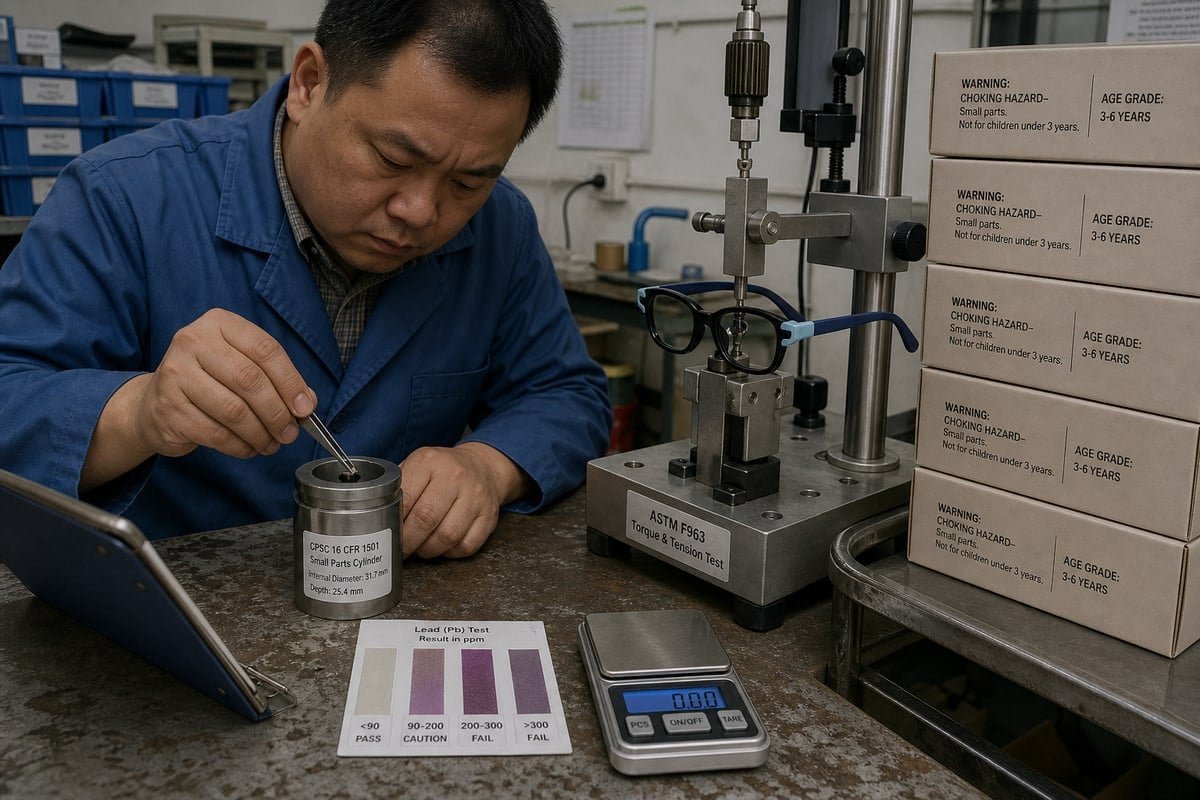
The regulatory picture looks complicated at first. It becomes manageable once you sort the rules by what each one actually controls. Here is the baseline we walk our B2B buyers through before any giveaway order goes into production.
| Standard or rule | Ce qu'elle couvre | Why it matters for giveaways |
|---|---|---|
| 16 CFR Part 1501 (CPSC) | The small parts test and cylinder dimensions defined in 16 CFR § 1501.4 | Any part that fits the cylinder is a banned hazardous substance in products for children under 3 |
| ASTM F963 standards | Physical and mechanical toy safety, including use-and-abuse testing | The benchmark for torque, tension, and drop tests on hinges and temple parts |
| conformité CPSIA | Lead limits, phthalate limits, tracking labels | Covers frame materials and surface coatings, not just shape |
| Age-grading and warning labels | Choking-hazard warnings on packaging | Required when small parts exist and the product is not restricted to under-3 use |
The small parts test in plain language
A part is a choking hazard if it fits, without compression, inside the CPSC small-parts cylinder 1. That includes parts that detach during use. So the real question is never just "is the frame small?" It is "can any screw, nose pad, or decorative bit come loose and fit the cylinder?"
Age grading changes everything
CPSC safety standards treat products for children under 3 far more strictly. If your giveaway targets toddlers, small detachable parts are simply banned. For older kids, warning labels may satisfy the rule — but only if the labels are correct.
International markets add more rules
U.S. compliance alone is not enough for global campaigns. One Chinese draft standard for children's frames, for example, proposes smooth surfaces, secure fasteners, and an unglazed frame weight limit of 19 g. We flag these differences early for buyers shipping to multiple regions.
How do I know if a manufacturer's materials and design actually reduce choking risks in children's eyewear?
Every design review at our Taizhou workshop weighs the same trade-off: decorative charm sells, but every added piece is a potential detachment point. We usually cut the charm.
A manufacturer genuinely reduces choking risk by using one-piece or monoblock designs, screwless hinge construction, permanently bonded components, flexible BPA-free materials like TR90 and TPEE, polycarbonate lenses in deep-groove frames, and by passing torque, tension, and drop testing on production samples.
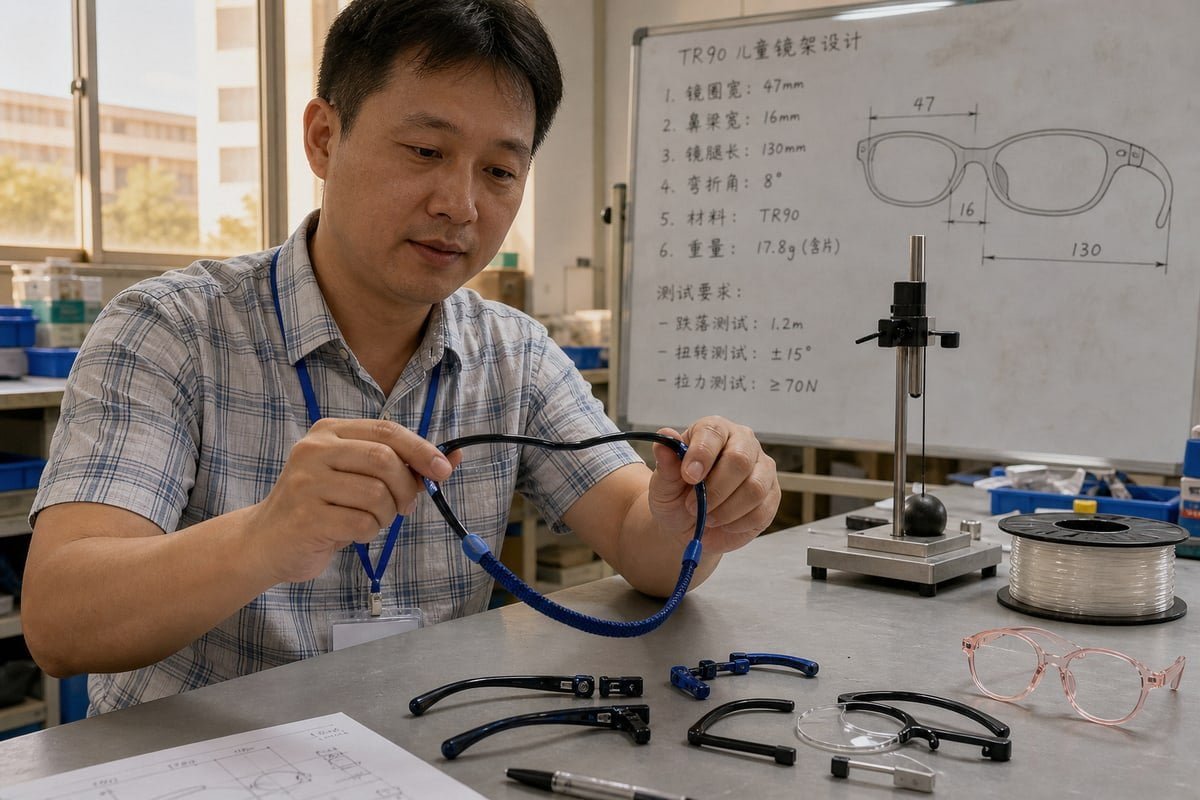
Materials and construction are where marketing claims and real safety diverge. A frame can look child-friendly and still hide detachment risks at every joint. When we develop kids optical frames for giveaway programs, we audit each component against a simple question: can a determined three-year-old pull this off?
| Composant | Risky version | Safer version |
|---|---|---|
| Charnière | Metal screw hinge that loosens over time | Screwless hinge design, ultrasonic welding, or a molded living hinge |
| Plaquettes de nez | Push-fit pads that pop off | A bridge molded into the frame body |
| Embouts de branche | Slide-on plastic tips | Co-molded TPEE or flexible silicone ear hooks |
| Decoration | Glued charms and inserts | In-mold patterns and embossed motifs |
| Lentilles | Glass, or shallow bevel fitting | Polycarbonate in deep-groove retention |
Materials that bend instead of break
We build most children's frames in TR90 and TPEE precisely because they flex under abuse instead of snapping into fragments. Both are Matériaux sans BPA 2, and any surface color must use non-toxic coatings that survive prolonged mouthing — which is why saliva-simulated leaching tests exist for kids' products. Glass lenses are a separate hard rule: WHO eye care guidance states children should never be fitted with glass, and polycarbonate is ideal because of its high impact resistance.
Design features that remove detachment points
Our safest giveaway styles integrate everything. One black frame we produce uses navy TPEE temples with a flexible silicone strap and textured dotted pattern — the strap is co-molded, not clipped on. Monoblock injection molding 3 with living hinges goes even further by eliminating mechanical pins entirely. Deep-groove lens fitting matters too, because a popped-out demo lens is itself a small-part hazard.
What questions should I ask my supplier to confirm compliance testing and quality control for small parts?
During a pre-shipment inspection last spring, our QC team pulled ten frames at random and hung weights from each temple. One buyer watched the whole test on a video call.
Ask suppliers for third-party lab test reports covering small parts, torque, tension, and drop testing, CPSIA lead and phthalate certificates, material safety data for coatings, details of incoming component checks, pre-production sample approval, and batch-level traceability for every giveaway order.

Suppliers rarely volunteer weaknesses. You have to ask directly. After fifteen years of running these conversations from the factory side, here are the questions that separate serious partners from assemblers of mixed components.
- Which tests par des tiers have these exact frames passed, and can I see the reports?
- Do you run use-and-abuse testing — torque, tension, and drop tests — on hinges, temples, and any attached parts?
- What tensile strength testing do you apply to straps and co-molded joints before shipment?
- How do you perform sharp edge assessment on molded parts, checking for burrs and protrusions?
- Are colorants and coatings verified as lead-free and phthalate-compliant under CPSIA?
- Do you inspect incoming components before assembly, or only finished goods?
- Can you provide batch-level traceability — some buyers now request batch-specific QR codes on temples linking to certifications and testing data?
- Will you produce and approve pre-production samples before mass production?
| Document to request | Ce qu'il prouve | Red flag if missing |
|---|---|---|
| Small-parts cylinder test report | No component or fragment fits 16 CFR 1501 dimensions | Supplier relies on visual judgment alone |
| Mechanical test report (torque, tension, drop) | Fasteners and hinges stay attached under abuse | "Our frames are strong" with no data |
| CPSIA certificates | Materials and coatings meet lead and phthalate limits | Only a general material name, no lab result |
| QC inspection procedure | Consistent checks across the full batch | Testing done once, years ago, on a different style |
In our own Réalités du transit par mode 4, these checks happen at three stages: incoming materials, in-process assembly, and pre-shipment sampling. Any supplier should be able to describe their equivalent process without hesitation. Vague answers usually mean the process does not exist.
Why does working with an experienced eyewear factory matter when sourcing safe giveaway frames for kids?
Fifteen years of eyewear production taught me one hard lesson: safety failures rarely come from bad intentions. They come from factories treating children's frames like adult ones.
An experienced eyewear factory matters because child-safe frames require specialized tooling, flexible-material expertise, strict 5S quality control, established testing routines, and existing compliant styles — capabilities that generic promotional suppliers lack, and that directly determine whether giveaway frames pass children's product safety requirements.
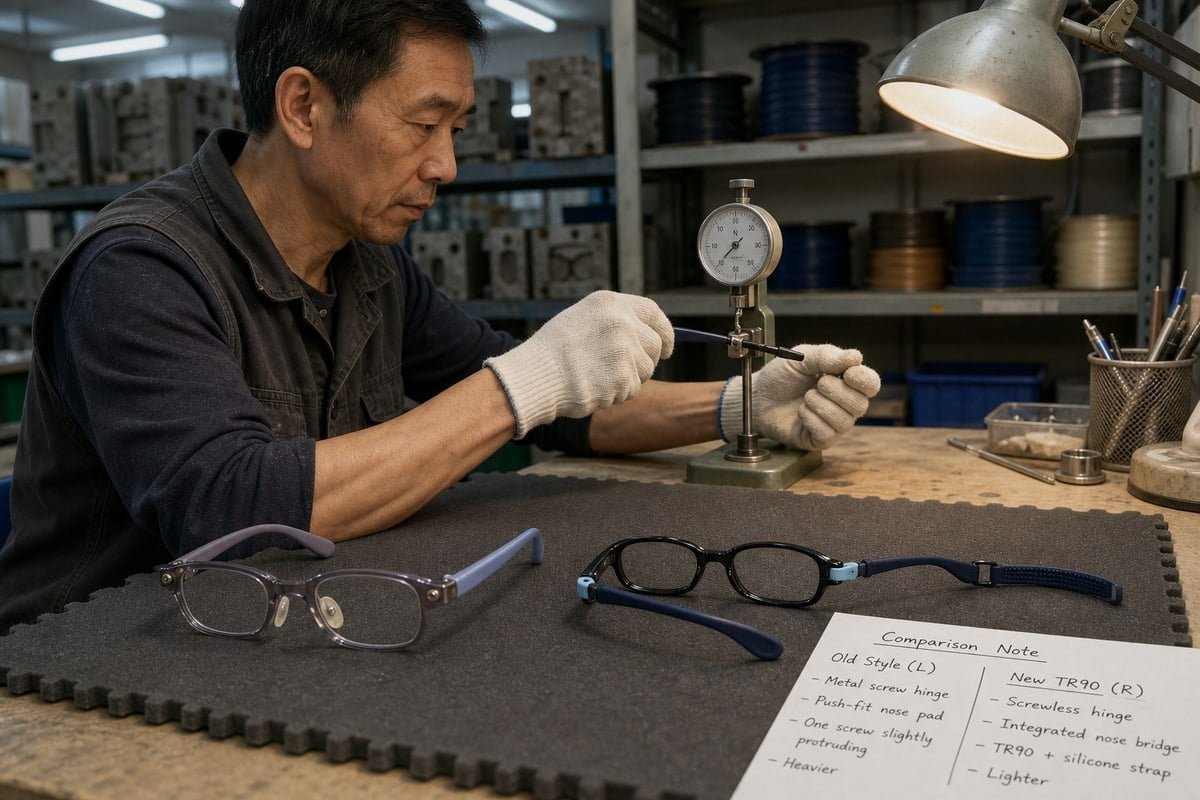
Promotional product safety fails most often at the sourcing stage, not the design stage. Giveaway frames are typically ordered at lower cost, assembled from mixed components, and pushed through on tight event deadlines. A generic promotional supplier will quote fast and cheap. But they usually lack children's eyewear tooling, so they retrofit adult constructions — screw hinges, push-fit nose pads, glued decorations — into smaller sizes. Every one of those shortcuts creates a detachment point.
An experienced children's eyewear factory changes the starting position. At our facility, around 120 workers run production lines built specifically for flexible TR90 and TPEE kids' frames, so screwless and co-molded constructions are standard, not custom engineering. Our library of roughly 800 existing styles means a brand, clinic, or event organizer can pick a proven, already-tested design instead of funding new molds and hoping the first samples pass. Full OEM/ODM support then handles custom colors, logos, lenses, and retail-ready packaging without touching the safety-critical structure.
Before you approve any kids giveaway frame, run this quick decision check:
- Does it have detachable small parts? If yes, reject it.
- Could any part fail the small-parts cylinder test? If yes, reject it.
- Does it use glass lenses? If yes, reject it.
- Is children's eyewear testing documentation missing? If yes, reject it.
If a frame clears all four gates, you have a giveaway you can distribute with confidence — and a supplier worth keeping.
Conclusion
Treat kids optical frames giveaways like regulated children's products. Verify standards, demand screwless designs, question suppliers, and partner with an experienced factory — because one loose part outweighs any marketing win.
Notes de bas de page
1. Official federal regulation defining the choking-hazard test referenced throughout the article. ↩︎
2. FDA reference on BPA safety supports the claim about non-toxic frame materials. ↩︎
3. Background on the manufacturing process used to eliminate mechanical hinge pins. ↩︎
4. Explains the lean manufacturing methodology behind the factory’s quality control process. ↩︎
Plus d'articles que vous pourriez aimer
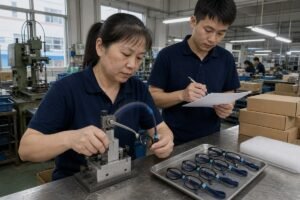
21 août 2026
Audits de fournisseurs de montures optiques pour enfants : inspection interne ou par un tiers ?

21 août 2026
Audits sur site vs audits tiers : Quelle est la différence en termes de couverture pour les fournisseurs de montures optiques pour enfants ?
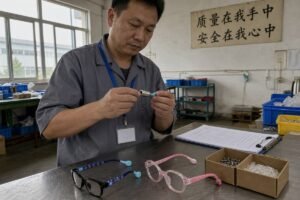
21 août 2026
Comment s'assurer que les articles promotionnels avec des montures optiques pour enfants ne présentent aucun risque d'étouffement ?
Vous recherchez un partenaire fiable en lunetterie pour enfants ?
Explorez plus de 800 styles prêts et un support OEM/ODM complet adapté à votre marque.
Contactez-nous English
  Español de México
  Deutsch
  Français
  日本語
日本語  العربية
  Português do Brasil