How Do I Determine Size Ratios When Ordering Kids Optical Frames?
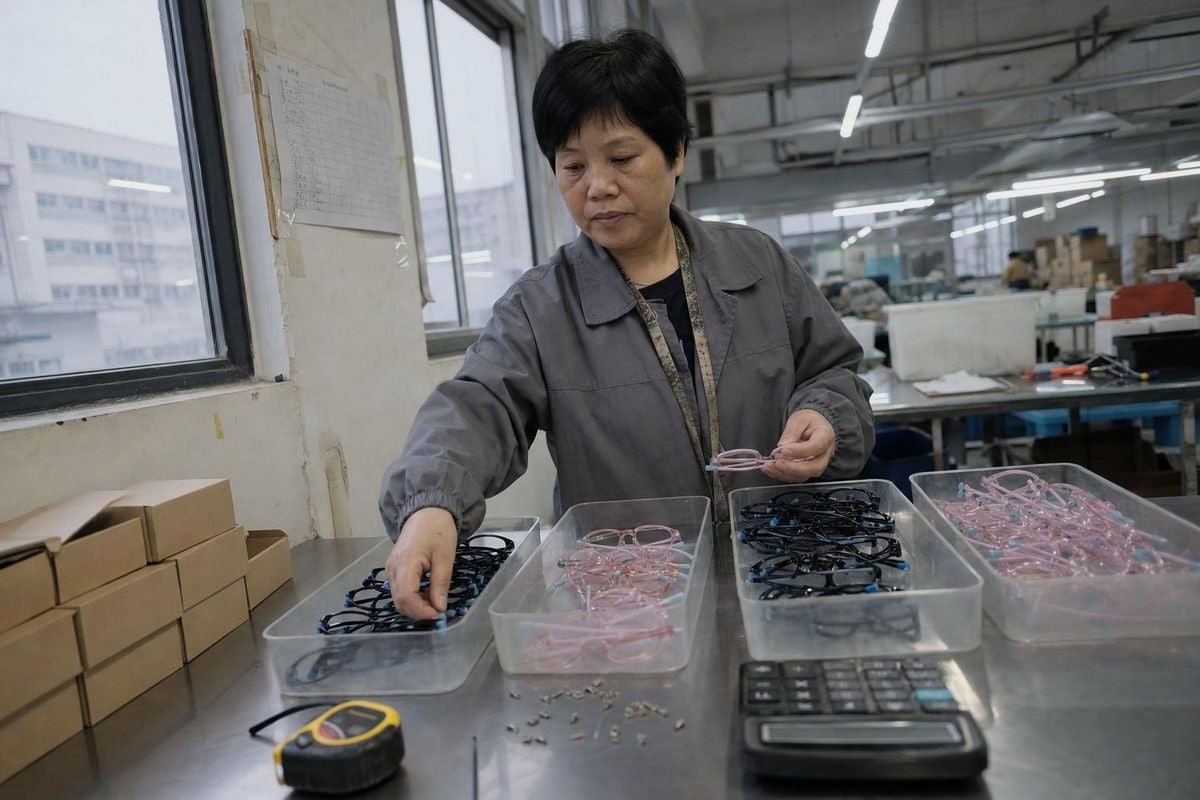
Getting size ratios right when ordering kids optical frames is where I see new brands stumble first. Order wrong, and half your inventory sits unsold while bestselling sizes run out. On our production line in Taizhou, we help buyers avoid exactly that trap.
To determine size ratios when ordering kids optical frames, map lens width, bridge width, and temple length to your target age groups, then weight quantities toward the 4–9 age range (typically 50–60% of the order), with smaller allocations for toddler and pre-teen sizes.
Below, I will walk through how to match frame dimensions to age groups, what market data suggests, how to structure a first bulk order, and how to avoid dead stock.
How Do I Know Which Frame Size Fits My Target Age Groups?
During a factory audit last spring, a European buyer asked me why we stock the same style in four sizes. The answer shaped this whole section: children's faces change fast, and frame dimensions must follow.
Match frame sizes to age groups using the three boxing system measurements: lens width (35–40mm for ages 0–3, 41–45mm for 4–6, 46–48mm for 7–9, 49–52mm for 10–13), bridge width, and temple length, then verify against typical facial measurements for each bracket.
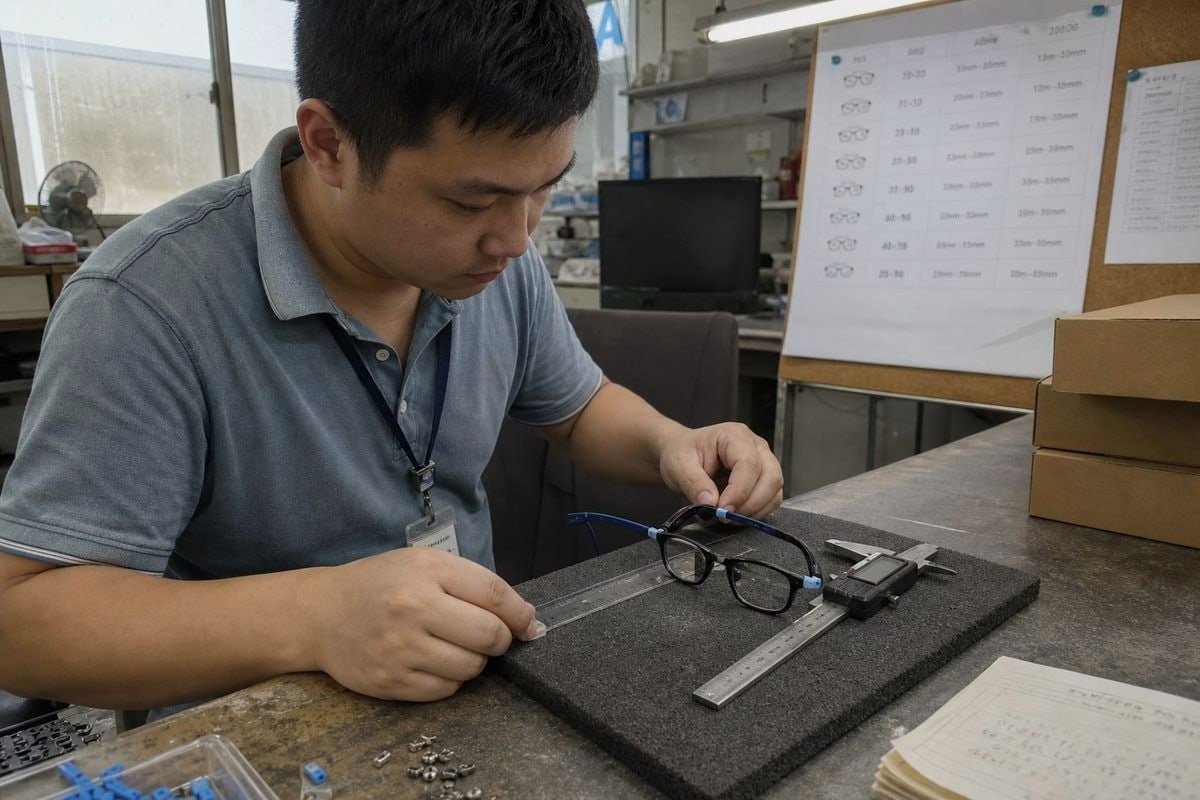
Every optical frame carries three numbers, usually printed inside the temple arm. A marking like 46-16-125 means a 46mm lens width, a 16mm bridge width, and a 125mm temple length. This is the boxing system 1, and it is the universal language between factories like ours and your suppliers, opticians, and end customers.
What Each Measurement Controls
Each number does a different job. Lens width determines visual balance and how much lens coverage the child gets. Bridge width decides whether the frame slides down or pinches, which matters enormously because children have flatter, less developed nasal bridges 2 than adults. Temple length controls stability behind the ears during play.
Here is the optical sizing chart we share with buyers planning their first assortment:
| Groupe d'âge | Largeur du verre | Largeur du pont | Longueur de la branche |
|---|---|---|---|
| 0–3 years | 35–40 mm | 14–16 mm | 110–115 mm |
| 4–6 years | 41–45 mm | 15–17 mm | 120–125 mm |
| 7–9 years | 46–48 mm | 16–18 mm | 125–130 mm |
| 10–13 years | 49–52 mm | 17–19 mm | 130–135 mm |
One nuance we always flag: age charts are a starting point, not a fit guarantee. Actual facial measurements vary within any age group, and distance pupillaire 3 matters as much as frame width for optical alignment. That is why our TR90 4 frames with TPEE temples build in flexibility — a slightly imperfect size still fits securely. For your ordering decision, though, these brackets are the practical foundation. Pick the age groups your brand targets, then order the sizes that map to them, with overlap at the boundaries because a large-faced six-year-old often needs the 7–9 size.
Can I Get a Size Ratio Recommendation Based on Market Data?
Fifteen years of export data across 20+ countries has taught our team one consistent pattern: demand is never flat across sizes. It clusters, and the cluster point is predictable.
Yes. Market data consistently shows demand concentrating in the 4–9 age range, since most first prescriptions happen at school age. A proven baseline ratio is roughly 15% toddler sizes, 35% small (4–6), 35% medium (7–9), and 15% large (10–13).

The reason demand clusters at school age is simple. Vision screening 5 usually starts when children begin school, so ages 4–9 generate the majority of first prescriptions 6. Toddler frames are a real but smaller market, mostly driven by specific conditions caught early. Pre-teen sizes face competition from small adult frames, which trims their share.
A Baseline Ratio You Can Adapt
Here is the baseline distribution we recommend to buyers who have no sales history yet:
| Size Bracket | Lens Width Range | Suggested Order Share |
|---|---|---|
| X-Small (0–3 yrs) | 35–40 mm | 10–15% |
| Small (4–6 yrs) | 41–45 mm | 30–35% |
| Medium (7–9 yrs) | 46–48 mm | 30–35% |
| Large (10–13 yrs) | 49–52 mm | 15–20% |
Adjust for Your Channel and Market
Now, some buyers push back on this. A baby-product brand once told me the toddler share looked too low for them. They were right — for their channel. If your brand sells through baby and toddler retailers, invert the weighting toward X-small and small. If you supply optical chains, keep the school-age center of gravity. Japanese buyers often request slightly narrower bridge width across all sizes; some European markets skew half a size larger. Market data gives you the skeleton. Your channel knowledge gives it flesh. We help buyers refine ratios after their first reorder, when real sell-through data replaces assumptions.
What Size Range Should I Include in My First Bulk Order?
Choosing between depth and breadth is the trade-off I discuss most with first-time buyers. More sizes means better coverage but higher inventory risk. Our 800 existing styles exist precisely to lower that risk.
For a first bulk order, cover two to three adjacent size brackets rather than all four. Most brands should order Small (41–45mm) and Medium (46–48mm) as the core, add one adjacent size only if their channel demands it, and limit colorways per size.
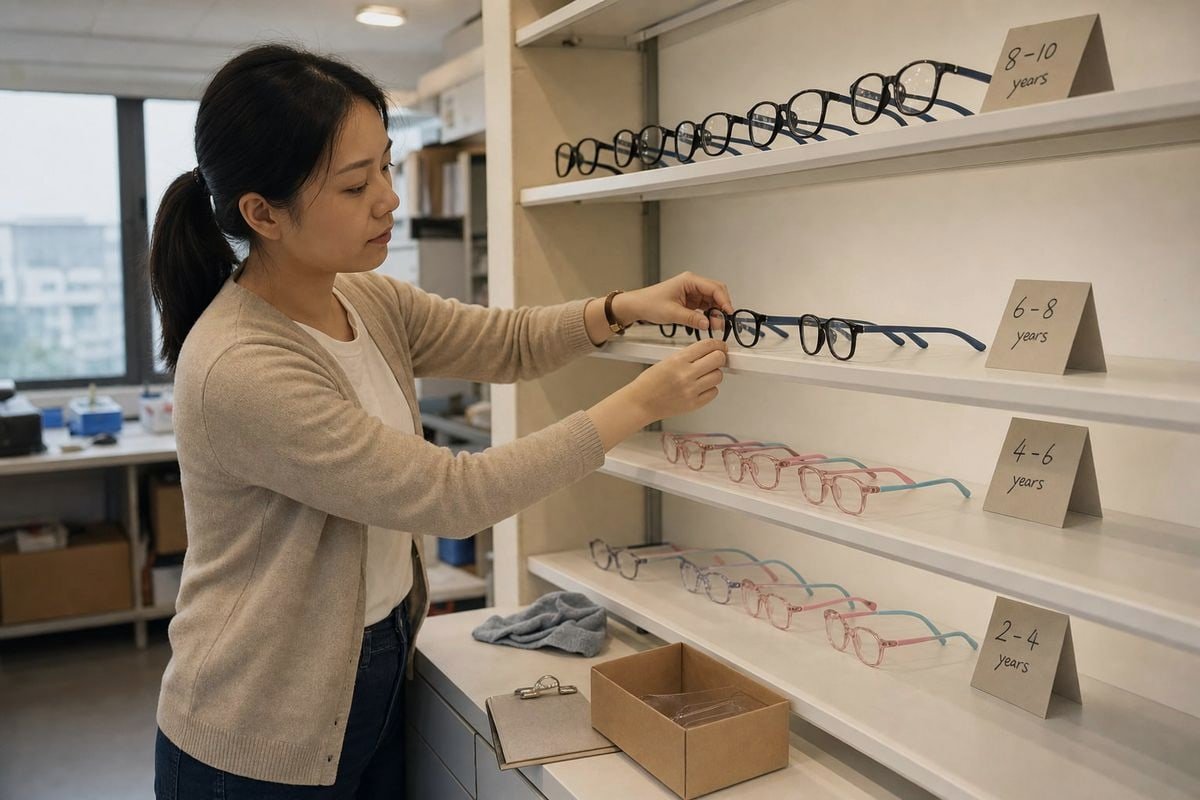
A first order is a market test, not a full catalog launch. The goal is learning what sells with the least capital tied up. That is why I steer new buyers away from ordering every size in every color. Instead, use a simple decision process.
A Four-Step First-Order Process
- Define your core age target. Pick the two adjacent brackets that match your brand's main customer. For most optical and kids' brands, that means Small and Medium.
- Choose styles that flex across sizes. Flexible TR90 frames with TPEE temples tolerate more facial variation than rigid acetate, so one size fits a wider band of children. Features like adjustable nose pads or silicone ear hooks extend the usable range further.
- Limitez les coloris. Two or three colors per size is enough to test preferences. Our glossy black sporty style and translucent pink acetate style, for example, cover the two dominant color demand poles without needing six variants.
- Reserve budget for the reorder. Keep roughly 20–30% of your eyewear budget unspent. Your first sell-through data will tell you where to deepen — and because we hold existing molds, reorders move fast without new tooling investment.
One more practical note: prioritize frames with adequate lens height. Children grow vertically fast, and a taller B-measurement keeps the pupil centered in the lens longer, which extends each frame's useful life on the shelf and on the face.
How Do I Avoid Overstocking Sizes That Don't Sell Well?
A distributor in Australia once showed me a warehouse shelf of unsold pre-teen frames from a previous supplier. That conversation changed how we advise buyers on ratio discipline.
Avoid overstocking by starting with conservative quantities in fringe sizes, tracking sell-through by size from day one, reordering fast movers in small frequent batches, and choosing flexible frame designs that each fit a wider band of facial measurements.

Overstock almost always comes from one of three mistakes: buying by gut feeling instead of channel data, ordering equal quantities across all sizes, or choosing rigid frames that only fit a narrow face range. Each mistake has a specific fix.
Common Overstock Causes and Fixes
| Overstock Cause | Why It Happens | The Fix |
|---|---|---|
| Flat ratios across sizes | Feels "safe" and simple | Weight toward 4–9 years; keep fringe sizes at 10–15% |
| Rigid, narrow-fit frames | Each SKU fits fewer children | Choose flexible TR90/TPEE frames with adjustable features |
| Guessing bridge width | Sliding frames get returned | Match bridge specs to your market; consider adjustable nose pads |
| No size-level tracking | Reorders repeat old errors | Track sell-through per size, not per style |
| Ignoring temple fit | Frames bow or slip during play | Specify correct temple length; use cable temples for toddlers |
Design Choices That Shrink Size Risk
Frame design directly affects how forgiving each size is. Soft silicone hinge connectors and downward-curving ear hooks, like those on our sporty black-and-navy style, keep a frame stable even when the temple length is a few millimeters off ideal. Cable temples do the same job for the youngest wearers. Flexible materials also have natural give, which is why we sometimes advise a bridge width one millimeter narrower than the measured target for TPEE-heavy designs — the material stretches slightly during active wear.
Finally, treat your reorder cycle as your safety net. Small, frequent reorders from existing molds beat one giant speculative order every time. Since we already carry the tooling, buyers can rebalance ratios within weeks instead of gambling a full season's budget upfront.
Conclusion
Size ratios make or break a kids eyewear launch. Use age charts to plan brackets, weight orders toward ages 4–9, start narrow, then let sell-through data guide every reorder.
Notes de bas de page
1. Authoritative Wikipedia entry explaining the standard boxing system for eyeglass frame measurements. ↩︎
2. Background anatomical concept explaining why bridge width fitting differs for children. ↩︎
3. Background concept on the optical measurement critical for proper frame alignment. ↩︎
4. Official manufacturer page for Grilamid TR90, the industry-standard material for flexible kids’ frames. ↩︎
5. CDC resource on childhood vision screening supporting the school-age prescription claim. ↩︎
6. Comprehensive clinical guide from NIH/NCBI on the principles of prescribing glasses for children. ↩︎
Plus d'articles que vous pourriez aimer



Vous recherchez un partenaire fiable en lunetterie pour enfants ?
Explorez plus de 800 styles prêts et un support OEM/ODM complet adapté à votre marque.
Contactez-nous English
  Español de México
  Deutsch
  Français
  日本語
日本語  العربية
  Português do Brasil