How to Allocate a Factory’s MOQ for Kids’ Sunglasses Among Combined Customer Orders?
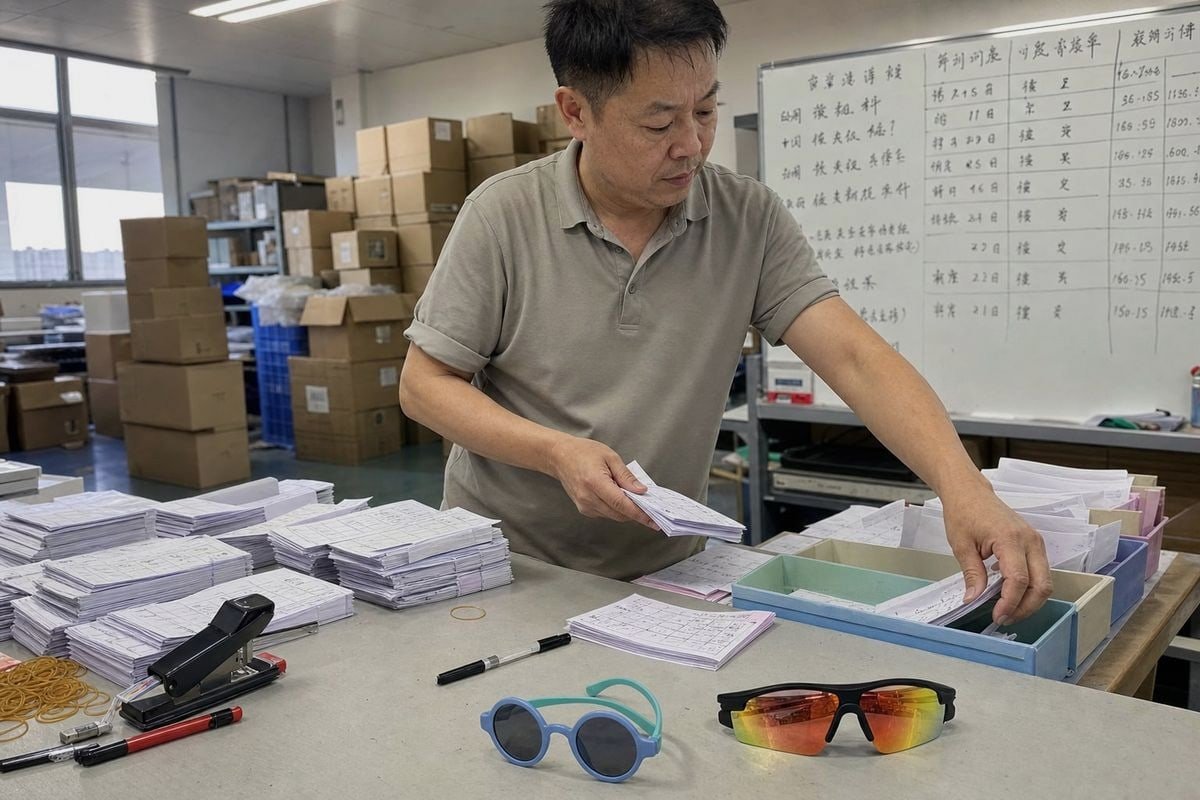
Allocating a factory’s MOQ for kids’ sunglasses across combined customer orders confuses many buyers polarized upgrades 1. On our production line in Taizhou, I see the same struggle every season. Small orders stall. Deals die. There is a fix.
To allocate a factory’s MOQ for kids’ sunglasses among combined orders, group orders by shared frame model first, then satisfy the model MOQ, then distribute units by color MOQ, and finally split remaining quantities among customers based on demand, pre-orders, or pre-agreed ratios.
That is the short answer. But the real value lies in how you apply it. Let me walk you through each step, using examples from real production runs we handle every month.
How can I combine multiple styles or colors to meet my supplier's MOQ without overordering?
Last spring, a buyer from Australia asked me to run three colorways of one round TPEE frame 2, but each color fell short of our threshold. We solved it together, and the method is repeatable.
Combine styles and colors by anchoring every order to one shared base frame, then mixing approved stock colors within a single production run. Most factories accept mixed-color orders on the same mold, so you meet the model MOQ without overordering any single SKU.
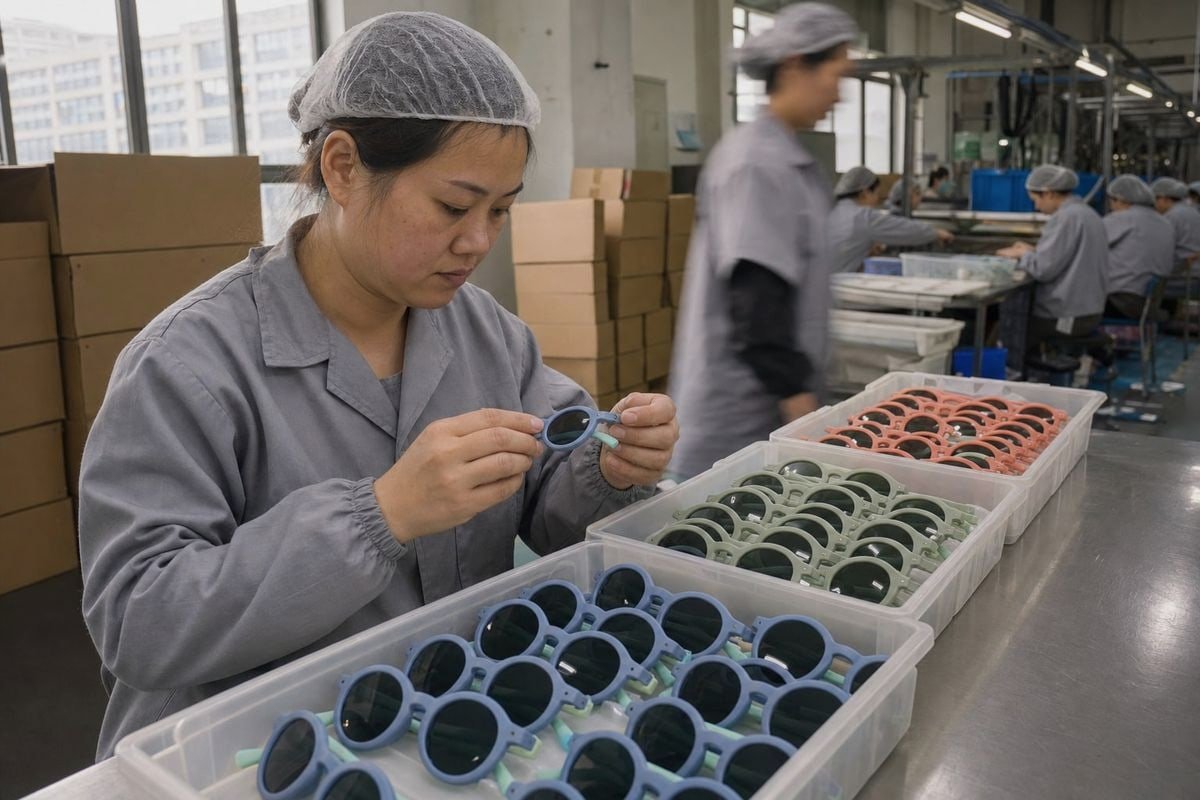
The first thing I tell buyers is this: MOQ in eyewear is not one number. It behaves like a layered rule set. In our factory, and in most kids' eyewear factories, there are usually three layers. There is a total order MOQ. There is a model MOQ tied to the mold. And there is a color MOQ tied to the raw material batch. If you only look at the total, you will miscalculate.
The three MOQ layers explained
| MOQ Layer | What Drives It | Typical Flexibility |
|---|---|---|
| Total order MOQ | Shipping, admin, and setup economics | Moderate — negotiable with reorder commitments |
| Model MOQ | Mold changeover and injection setup | Low — the mold run has real fixed costs |
| Color MOQ | Raw material dyeing and pellet batches | High — mixing colors on one mold is common |
Color is your friend here. When all orders share the same frame — say, our matte powder-blue round frame with mint-teal temples — we can run four or five colors in one production run. The mold never changes. Only the material feed changes. That keeps unit cost optimization intact for everyone in the pool.
Styles are harder. Each new style means a new mold setup. So my rule for buyers is simple: combine colors freely, combine styles carefully. If two styles share the same lens spec, hinge, and packaging line, combining is usually workable. If they differ in mold, lens curve, or decoration steps, the setup savings disappear.
One more tip from experience: do not chase every colorway your customers request. Good SKU management 3 means capping the color count at what the color MOQ can actually support. Three strong colors that sell through beat six colors that sit in a warehouse.
What MOQ options can I expect when working with a factory that offers 800+ existing styles?
A procurement manager from Japan once told me she assumed every factory demanded 1,200 units per model. Then she browsed our catalog of roughly 800 existing styles and realized stock tooling changes the math completely.
Factories with large existing-style catalogs typically offer much lower MOQs — often a few hundred units per model with mixed colors — because molds already exist. Custom molds push MOQs toward 1,200+ units, while stock frames with custom colors or logos sit in between.
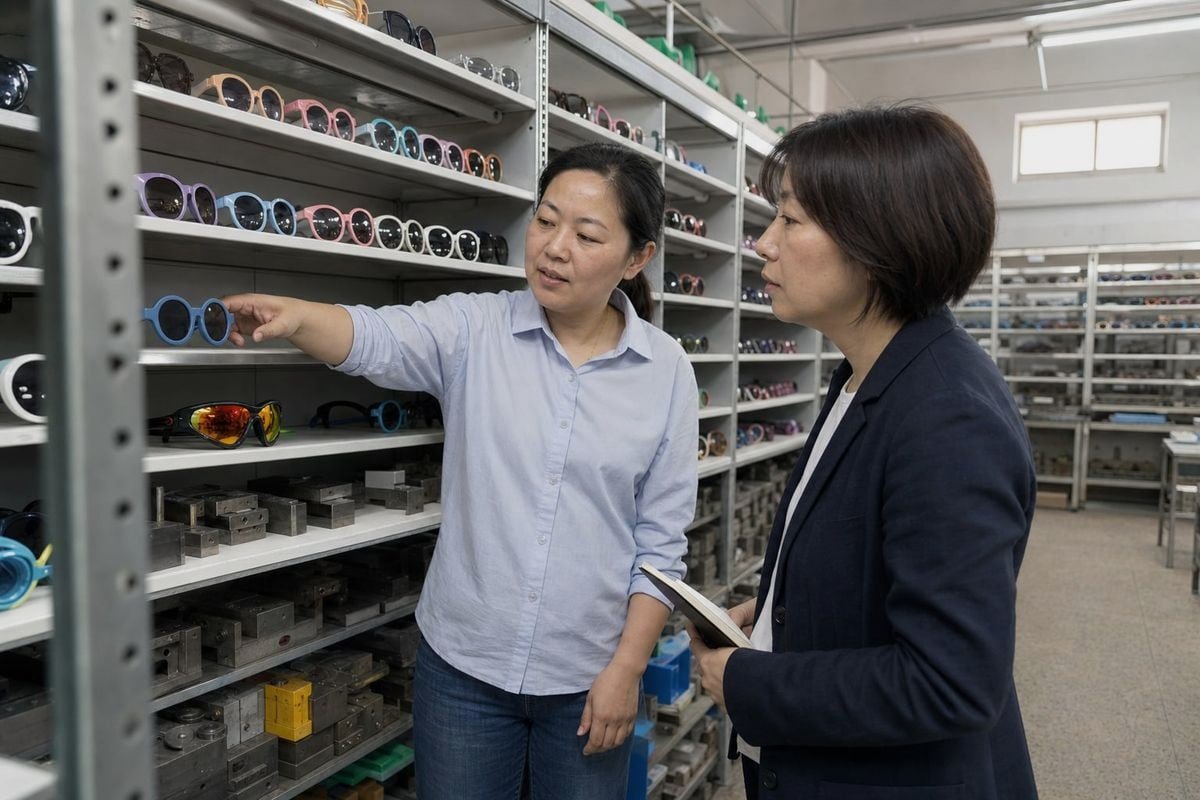
The size of a factory's existing catalog directly shapes your MOQ options. Here is why. The biggest fixed cost in eyewear is the mold. When we developed our wraparound sport shield frame — the glossy black one with the orange-to-gold mirrored lens — the mold investment was significant. A brand ordering that style from scratch would have to justify that cost with volume. But once the mold exists and sits in our tooling library 4, any buyer can use it. The setup cost drops. So the MOQ drops with it.
Typical MOQ tiers you can expect
| Order Type | Typical MOQ Range | What You Can Customize |
|---|---|---|
| Ready stock frames | Very low, sometimes per-carton | Nothing — buy as-is |
| Existing style, stock colors | Low hundreds per model | Logo printing, packaging |
| Existing style, custom colors | Mid hundreds per color | Colors, lenses, logo, packaging |
| Fully custom mold (ODM) | 1,000–1,200+ per model | Everything, including frame shape |
This tiered structure is why I always advise new kids' brands to start with existing styles. You get private label manufacturing — your logo, your packaging, your brand story — without heavy mold investment. You test the market with lower risk. Then, once sell-through data proves demand, you graduate to a custom mold.
There is another benefit buyers often miss: production lead times. Existing styles skip mold trials and sample iterations, so a run that would take months with custom tooling can ship in weeks. For seasonal products like kids' sunglasses, where the selling window is short, that speed matters as much as the MOQ number itself. Our UV400 protection standards apply across the whole catalog, so a low MOQ never means a compliance shortcut.
Distributors and sourcing agents ask me this more than any other question. Three clients, one production run, one MOQ — and everyone wants the split to feel fair. In our experience exporting to 20+ countries, fairness comes from a clear method, not from equal thirds.
Split a shared MOQ by allocating units to the hardest constraint first — usually the model MOQ — then distribute by color blocks matched to each client's demand data. Use pre-orders or historical sell-through, not even splits, and document each client's share and payment terms upfront.
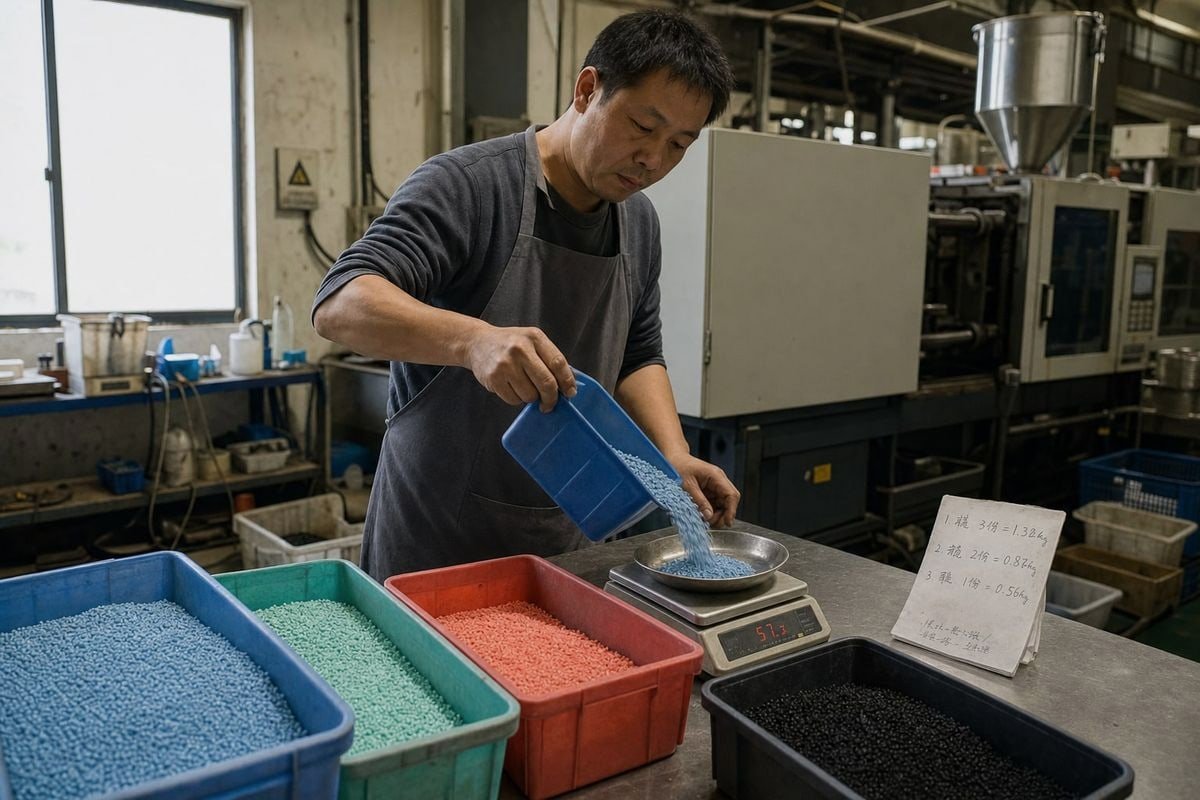
Let me make this concrete with a scenario we see often. Three retailers each want 120 pairs of the same kids' frame in different colors. The factory model MOQ is 500. Combined, they have 360 pairs. That is short by 140. So how do you close the gap and split the run?
A four-step allocation process
- Confirm production compatibility. All three orders must share the same frame, lens spec, and run schedule. If one client wants polarized lenses and the others want standard tinted UV400 lenses, check whether the lens swap breaks the batch.
- Satisfy the hardest constraint. The model MOQ of 500 is the binding rule. Someone must absorb 140 extra units, or the group pays a small under-MOQ surcharge if the factory offers one.
- Allocate by demand, not by division. Demand-driven allocation works best. If Client A has strong pre-order data, they take 200. Clients B and C take 150 each. The anchor customer's color preference can also lead, since their volume helps meet color minimums for everyone.
- Recalculate landed cost per client. Each client's share of freight, duties, and storage changes their break-even point. Confirm this before anyone commits.
Comparing common split methods
| Split Method | How It Works | Idéal pour |
|---|---|---|
| Even split | Divide total units equally | Clients of identical size and risk appetite |
| Demand-driven | Allocate by pre-orders or sales history | Groups with real sell-through data |
| Anchor subsidization | Largest client takes the surplus for a discount | One dominant buyer plus small boutiques |
| Batching window | Collect orders over 30 days, trigger at MOQ | Agents pooling many small clients |
One warning from a lesson I learned the hard way: always settle inventory distribution and ownership of leftover units in writing before production starts. Order consolidation strategy fails most often not at the factory, but in the paperwork between partners. Clear terms protect the relationship and keep supply chain logistics simple when the goods land.
Can I mix custom OEM/ODM features into a combined MOQ order without raising my costs?
When we calibrate a combined run in our Réalités du transit par mode 5, the question I weigh most carefully is where customization enters the process. Timing decides whether custom features cost you extra or almost nothing.
Yes, within limits. Post-production customization — logos, cases, stickers, and packaging sleeves — can differ per client without breaking the shared MOQ or raising unit costs meaningfully. In-mold changes like custom frame colors or new shapes trigger separate minimums and setup fees.
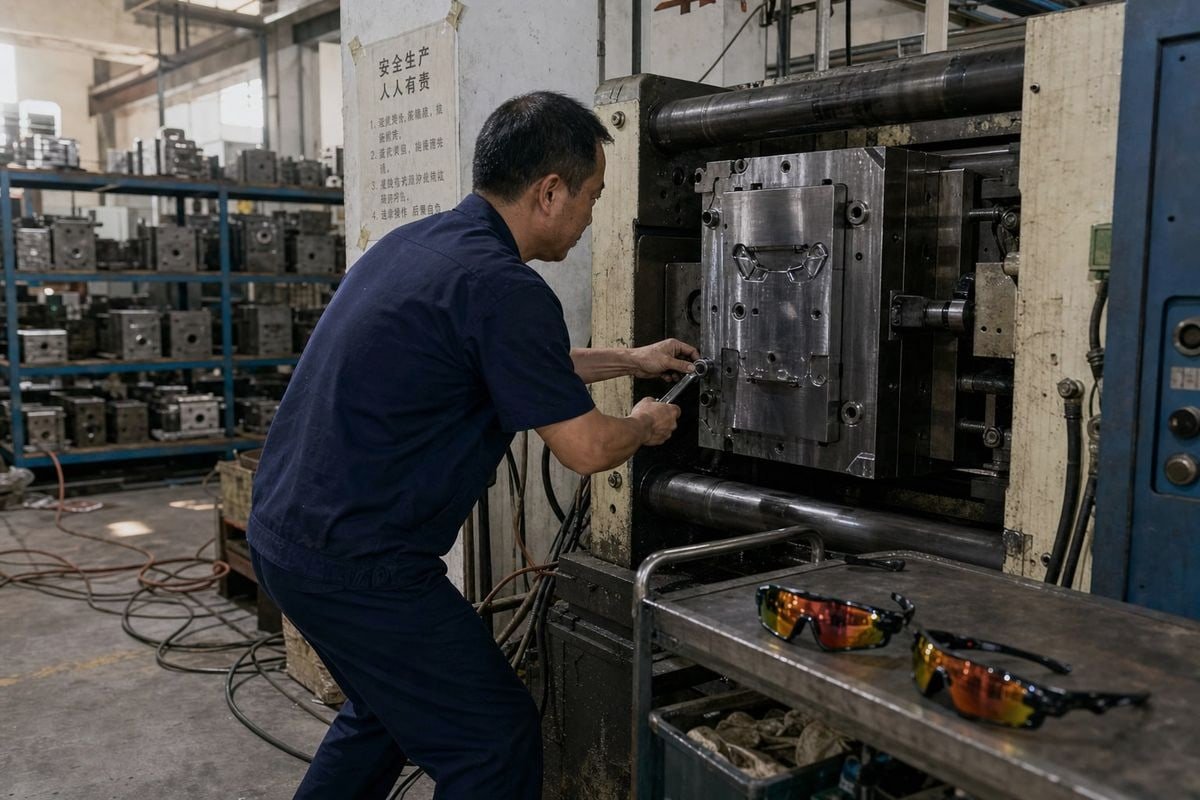
The key concept is the customization point. Picture the production line as a river. Upstream sits injection molding, where our TPEE flexible frames 6 and TR90 components are formed. Midstream sits lens cutting, coating, and assembly. Downstream sits printing, packaging, and cartonization. The further downstream your customization happens, the cheaper and more flexible it is.
Upstream vs. downstream customization
Upstream changes are expensive to mix. A custom frame color means a separate material batch, which means the color MOQ applies to that client alone. A custom mold means a whole new model MOQ. These cannot ride along inside a shared run without their own minimums.
Downstream changes are cheap to mix. This is where modular packaging differentiation shines. We can run 500 identical frames, then split the batch at the finishing stage: Client A gets pad-printed logos and retail boxes, Client B gets temple stickers and pouches, Client C takes unbranded units for their own kitting. The production run stays unified. Each brand still gets retail-ready presentation. Bulk purchasing power stays intact because the core units were made together.
Lens options sit in the middle. Mixing standard UV400 tinted lenses with polarized upgrades 7 in one run is often possible, since both fit the same frame groove. But the polarized portion may carry its own lens-sourcing minimum. Cluster your combined orders around one lens category when you can — it keeps the whole batch inside the lens supplier's minimums too.
A realistic cost picture: expect logo printing and custom packaging to add a small, predictable per-unit fee. Expect custom colors to add a color MOQ. Expect custom molds to add tooling costs and months of lead time. Plan your combined order around those three tiers, and OEM/ODM flexibility becomes an asset instead of a cost trap.
Conclusion
Pooled orders fail when buyers guess. They succeed when buyers allocate by production compatibility: shared model first, color blocks second, demand-based client splits third. Follow that order, and one factory MOQ serves everyone.
Notes de bas de page
1. Scientific explanation of how polarized lenses reduce glare and improve visual clarity. ↩︎
2. Technical specifications of Thermoplastic Polyester Elastomer (TPEE) used in flexible eyewear frames. ↩︎
3. Explanation of Stock Keeping Unit (SKU) management for inventory control and production planning. ↩︎
4. Definition of Original Design Manufacturing (ODM) and how factories utilize existing mold collections. ↩︎
5. Explains the 5S workplace organization methodology referenced for the production workshop. ↩︎
6. Background reference explaining the TPEE polymer material used in flexible frame construction. ↩︎
7. Reference explains the underlying optical principle behind polarized lens technology mentioned. ↩︎
Plus d'articles que vous pourriez aimer
1 août 2026
L'usine doit-elle gérer l'emballage et l'étiquetage des lunettes pour enfants, ou utiliser un fournisseur désigné ?
1 août 2026
Entrepôt propre vs. exécution directe par le fournisseur : lequel réduit les coûts de retour pour les marques de lunettes pour enfants ?
1 août 2026
Entrepôt direct au port ou staging outre-mer : lequel permet d'économiser le plus sur l'expédition des lunettes pour enfants ?
Vous recherchez un partenaire fiable en lunetterie pour enfants ?
Explorez plus de 800 styles prêts et un support OEM/ODM complet adapté à votre marque.
Contactez-nous English
  Español de México
  Deutsch
  Français
  日本語
日本語  العربية
  Português do Brasil