What Documentation Is Needed for Kids’ Optical Frames in Insurance Reimbursement Catalogs?

Getting documentation for kids’ optical frames in insurance reimbursement catalogs wrong can freeze a launch OEM/ODM supplier 1. I have watched buyers lose whole seasons over one missing test report from our Taizhou factory files.
Documentation for kids’ optical frames in insurance reimbursement catalogs typically includes product safety certifications and test reports, material and chemical compliance declarations, itemized invoices with clear frame descriptions, prescription eyewear classification proof, and manufacturer conformity documents that let insurers verify the frames as eligible pediatric vision hardware.
Every insurer and every country asks for a slightly different bundle of paperwork. Below, I break the requirements into four practical areas so you can prepare your catalog submission with confidence.
What certifications and test reports do I need to include for insurance-approved kids' optical frames?
A German buyer once emailed me at midnight because her insurer's catalog reviewer rejected a submission over an outdated test report. That single page delayed her pediatric vision care listing by six weeks.
Insurance-approved kids' optical frames usually need optical frame standard test reports, impact and durability testing, chemical safety reports covering restricted substances, and market-specific conformity documents such as CE-related declarations for Europe or FDA-relevant records for the US, all matched to the exact frame model submitted.

The first thing I tell buyers is simple. Insurers do not test frames themselves. They rely on paperwork. So your documents must speak for the product. In our fifteen years of exporting children's eyewear to more than twenty countries, we have seen the same core documents requested again and again, even when the claim submission process differs.
The core certification stack
Most reimbursement programs, whether run by vision insurance plans or national health systems, want proof in three layers. First, product performance. Second, material safety. Third, legal conformity for the destination market.
| Tipo de documento | Lo que demuestra | Who Usually Asks For It |
|---|---|---|
| Optical frame standard test report (e.g., ISO-based frame testing) | The frame meets dimensional, mechanical, and durability standards | European insurers, optical chains |
| Impact resistance and drop-test results | The frame is safe for active children | Pediatric vision care programs |
| Chemical safety report (restricted substances 2) | No harmful levels of banned substances in materials | EU and Japanese buyers, eco-conscious insurers |
| Declaración de conformidad 3 | The manufacturer legally stands behind compliance | Catalog reviewers in regulated markets |
| Lens documentation (UV, optical class) | Demo or prescription lenses meet optical rules | Plans covering prescription eyeglasses |
Match documents to the exact SKU
Here is where many catalog submissions fail. The test report must reference the exact model, material, and color family you are listing. A report for a TR90 frame with rigid temples may not cover the same frame fitted with soft Templo TPEE 4. When we run testing for our flexible frames, we make sure the report names the material combination precisely, because catalog reviewers compare the description on the invoice line against the report. If they do not match, the reviewer flags it, and your frames may be treated as ineligible retail eyewear instead of reimbursable pediatric vision hardware. Some medical-benefit programs also want frames linked to HCPCS codes or similar billing classifications, so ask your insurer contact early whether coding references belong in your document pack.
How can I get compliance documentation from my manufacturer without delaying my catalog submission?
There is a trade-off I weigh with every new client: start testing before molds are final and risk retesting, or wait and risk missing the insurer's catalog window. Timing is everything.
Request the manufacturer's existing test reports and declarations during sampling, not after production. Confirm which documents transfer to your brand name, order any brand-specific retests early, and set document delivery milestones in your purchase order so paperwork arrives before your catalog submission deadline.
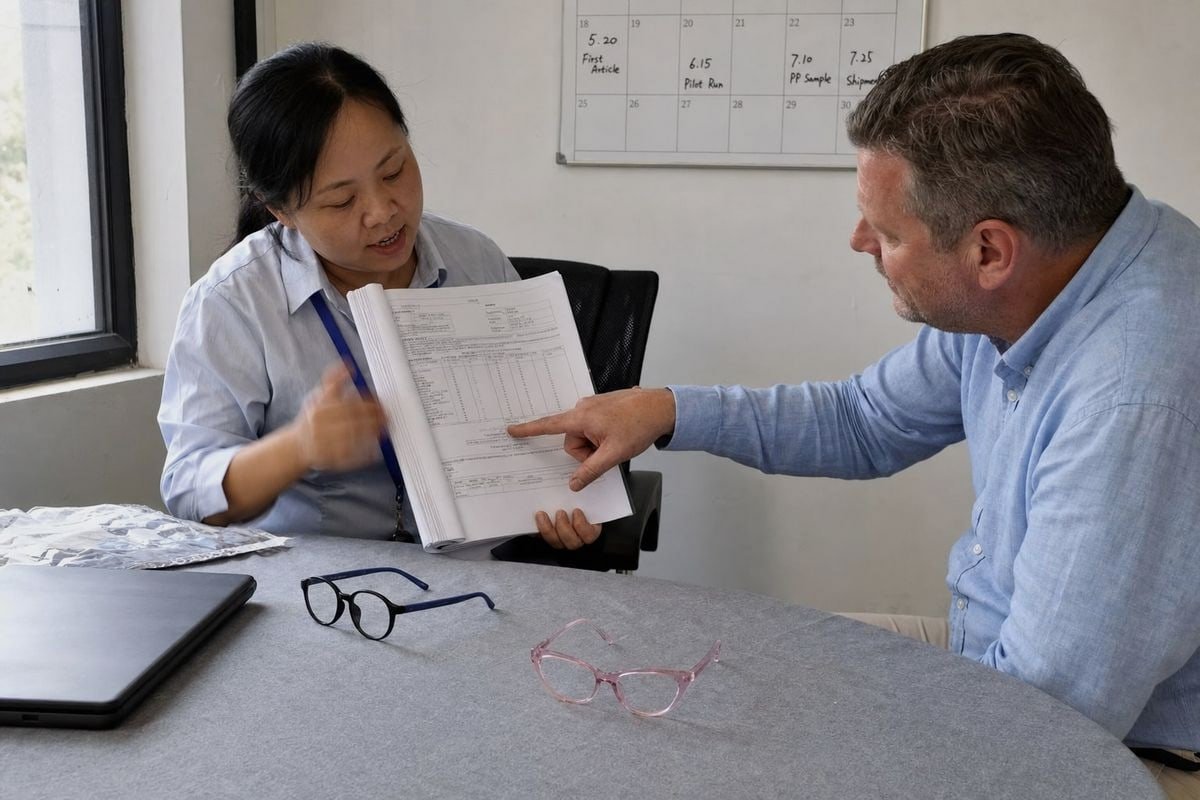
The biggest delays I see are not caused by testing itself. They are caused by asking too late. Testing a children's frame takes weeks. Shipping takes weeks. If you run them in sequence instead of in parallel, you lose a season. At our factory, we keep a document library covering our roughly 800 existing styles, and that library is exactly why many first-time brands choose an existing style rather than a fully custom mold. The paperwork already exists, so the catalog submission can move quickly.
A practical timeline that works
- At inquiry stage: ask which certifications, test reports, and chemical declarations already exist for the styles you shortlisted. A serious factory answers within days.
- At sampling stage: confirm whether existing reports can support your submission, or whether your insurer requires reports issued in your brand's name. Some vision insurance plans accept manufacturer-held reports; others want importer-held ones.
- At order confirmation: write document deliverables into the purchase order. List each report, each declaration, and a delivery date for each.
- During production: run any brand-specific retesting in parallel with manufacturing, not after it.
- Before shipment: receive scanned copies of the full pack, so your catalog submission and any prior authorization discussions can start while goods are still on the water.
Preguntas que separan fábricas de comerciantes
Ask who actually holds the test reports. A trading company often cannot produce originals or explain what was tested. A factory can walk you through its QC records, its 5S-managed workshop process, and the lab that issued each report. We have had buyers visit us in Taizhou purely to verify that our documents trace back to our own production line. That traceability matters when an insurer audits your listing later, because reviewers may request supporting evidence long after approval.
What material and safety declarations do insurance reimbursement programs typically require for children's frames?
During a QC round last year, I pulled a batch of TPEE temples for flex testing, and it struck me how differently insurers and children treat the same frame. Kids bend it. Insurers read about it.
Insurance reimbursement programs typically require declarations confirming the frame materials, restricted-substance compliance for chemicals like heavy metals and phthalates, skin-contact safety statements, flammability and mechanical safety confirmations, and often documentation of hypoallergenic or flexible material properties supporting medical necessity for pediatric use.

Children's frames get stricter scrutiny than adult frames, and for good reason. A child chews temple tips. A child sleeps in glasses. A child falls while wearing them. Reimbursement programs treat pediatric eyewear as a medical benefit tied to conditions like amblyopia or strabismus, not as a fashion purchase, so the material story must be complete. In Japan, for example, coverage for young children applies only when a doctor deems glasses medically necessary, and the supporting paperwork trail runs from clinic to catalog. Diagnosis references such as ICD-10 codes 5 may appear on the clinical side of the claim, but the product side still has to prove the frame itself is safe.
What the declarations actually cover
| Declaration Area | Typical Content | Why Insurers Care |
|---|---|---|
| Material identity | Named polymers such as TR90, TPEE, acetate | Confirms the frame matches catalog coverage details |
| Chemical compliance | Limits on heavy metals, phthalates, restricted substances | Child skin contact and mouthing risk |
| Seguridad mecánica | Flexibility, hinge integrity, no sharp edges | Injury prevention for active children |
| Skin-contact safety | Hypoallergenic statements for temples and nose areas | Long daily wear on sensitive skin |
| Lens materials | Impact-resistant options like polycarbonate, UV performance | Eye protection standards in pediatric vision care |
Flexibility as a documented safety feature
Here is something we learned developing TR90 frames with TPEE temples: flexibility is not just a comfort claim, it is a documentable safety property. A frame that bends instead of snapping cannot leave sharp broken edges near a child's eye. When your declaration pack describes flexible, lightweight construction with soft silicone temple tips, you give the catalog reviewer concrete evidence that the frame suits daily pediatric wear. Environmentally friendly material statements also help, since some programs now note sustainability characteristics in their coverage details. Keep every declaration dated, signed, and tied to a specific production batch, because audit requests can arrive years after approval.
Can my OEM/ODM supplier help me prepare consistent documentation across multiple markets and insurers?
A lesson I learned the hard way: an Australian buyer of ours once assumed her EU document pack would satisfy a Japanese optical chain. It did not, and we rebuilt the file together from scratch.
Yes. An experienced OEM/ODM supplier can maintain a master compliance file per frame model, adapt test reports and declarations to each market's standards, keep documentation consistent across custom colors and branding variations, and supply itemized commercial paperwork that aligns with each insurer's claim requirements.

Selling into multiple markets multiplies your paperwork, but it should not multiply your confusion. The trick is a master-file approach. For each frame family we produce, we keep one central compliance file: material specifications, test reports, chemical declarations, and production QC records. When a client enters a new market, we do not start over. We map the master file against that market's requirements and fill only the gaps. Over fifteen years serving brands in twenty-plus countries, this approach has cut weeks off repeat submissions.
One product, several document dialects
Different insurers ask the same questions in different formats. A US vision plan handling out-of-network claims may focus on itemized receipt structure and billing identifiers. A European program may focus on conformity declarations. A Japanese program may focus on date-order rules between medical certificates and receipts. Your product does not change. Only the paperwork dialect changes.
| Market Situation | Documentation Emphasis | How the Supplier Helps |
|---|---|---|
| US vision insurance plans | Itemized invoices, frame-versus-lens separation, billing identifiers | Provides clear model names and per-item descriptions on commercial documents |
| EU reimbursement catalogs | Conformity declarations, standard-based test reports | Maintains updated reports per material combination |
| Japanese medical-necessity programs | Precise dating, prescription eyewear linkage | Supplies batch-dated certificates matching shipment records |
| Multi-insurer distribution | Consistency across all listings | Locks specifications so custom colors and logos stay covered |
Why customization must not break your compliance chain
Full OEM/ODM support means more than custom colors, logos, lenses, and packaging. It means every customization stays inside the documented specification. If your branded version uses a different temple material or a new coating, the documentation must reflect that change before submission, not after a reviewer notices it. We hold this line with clients even when it slows a launch by a week, because a mismatch discovered during an insurer audit costs far more. A supplier who treats documentation as part of the product, not an afterthought, is the partner who keeps your listings alive across every market you enter.
Conclusión
Missing paperwork sinks more catalog listings than product flaws ever do. Prepare certifications, safety declarations, and itemized documents early, keep them SKU-specific, and choose a manufacturing partner who treats documentation as seriously as the frames themselves.
Notas al pie
1. Explains the roles of Original Equipment Manufacturers (OEM) and Original Design Manufacturers (ODM). ↩︎
2. Industry guidance on regulations and laws restricting chemicals in consumer products. ↩︎
3. Explains the EU Declaration of Conformity, a key document for product compliance in Europe. ↩︎
4. Describes the physical and chemical properties of TPEE, a common material in optical frames. ↩︎
5. Official WHO online browser for the International Classification of Diseases, Tenth Revision, providing access to codes. ↩︎
Más artículos que te podrían gustar

5 de agosto de 2026
Bio-Based vs Regular Cellulose Acetate: What's the Difference for Kids' Frames?

5 de agosto de 2026
How Recyclable Are Kids' Optical Frame Materials, and What Eco-Friendly Alternatives Exist?
5 de agosto de 2026
Do Kids Optical Frames Whiten or Age in Storage, and How to Control Warehouse Conditions?
¿Buscas un socio confiable en gafas para niños?
Explore más de 800 estilos listos y soporte OEM/ODM completo adaptado a su marca.
Ponte en contacto English
  Español de México
  Deutsch
  Français
  日本語
日本語  العربية
  Português do Brasil