Kids Optical Frames Supplier Audits: In-House or Third-Party Inspection?
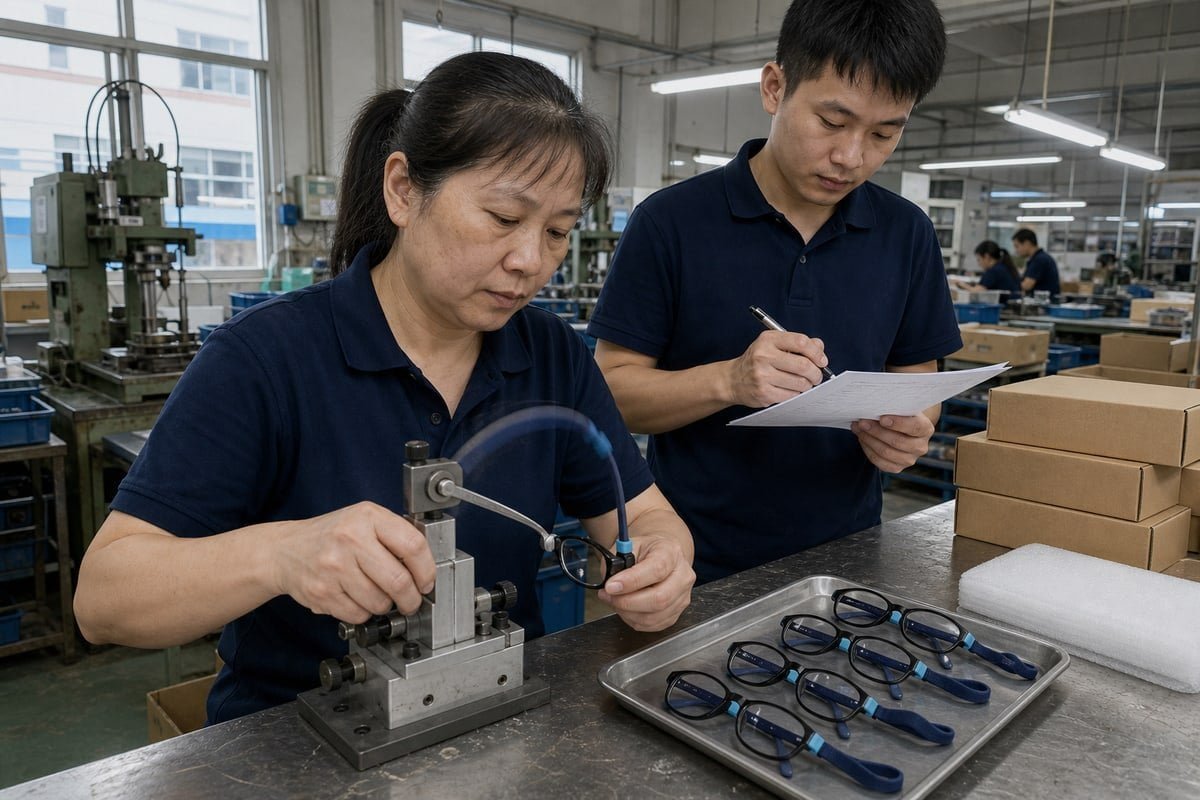
Kids optical frames supplier audits can make or break a launch ISO 8624 sizing 1. I have watched buyers lose whole seasons to hinge failures our 5S workshop would have caught in minutes.
For kids optical frames supplier audits, use both models: in-house audits for product depth, supplier development, and fast corrective actions, and third-party inspections for independent verification, CPSIA-related testing evidence, and pre-shipment checks. A hybrid approach controls child-safety risk better than either method alone.
That short answer hides a lot of detail. Children’s eyewear carries higher safety, compliance, and traceability demands than ordinary consumer goods. So the audit model you choose matters more here than almost anywhere else. Below, I walk through the decision step by step, using what happens on real production lines.
How do I choose between in-house and third-party inspection when auditing a kids optical frames supplier?
Last spring, an Australian buyer asked me whether her team should audit our Taizhou factory themselves or hire an inspector. My honest answer surprised her: it depends on the stage.
Choose in-house inspection when you need deep product knowledge, long-term supplier development, or IP protection. Choose third-party inspection when you need independence, external credibility, or scale across factories. Most kids eyewear buyers get the best results by combining both across the supplier lifecycle.
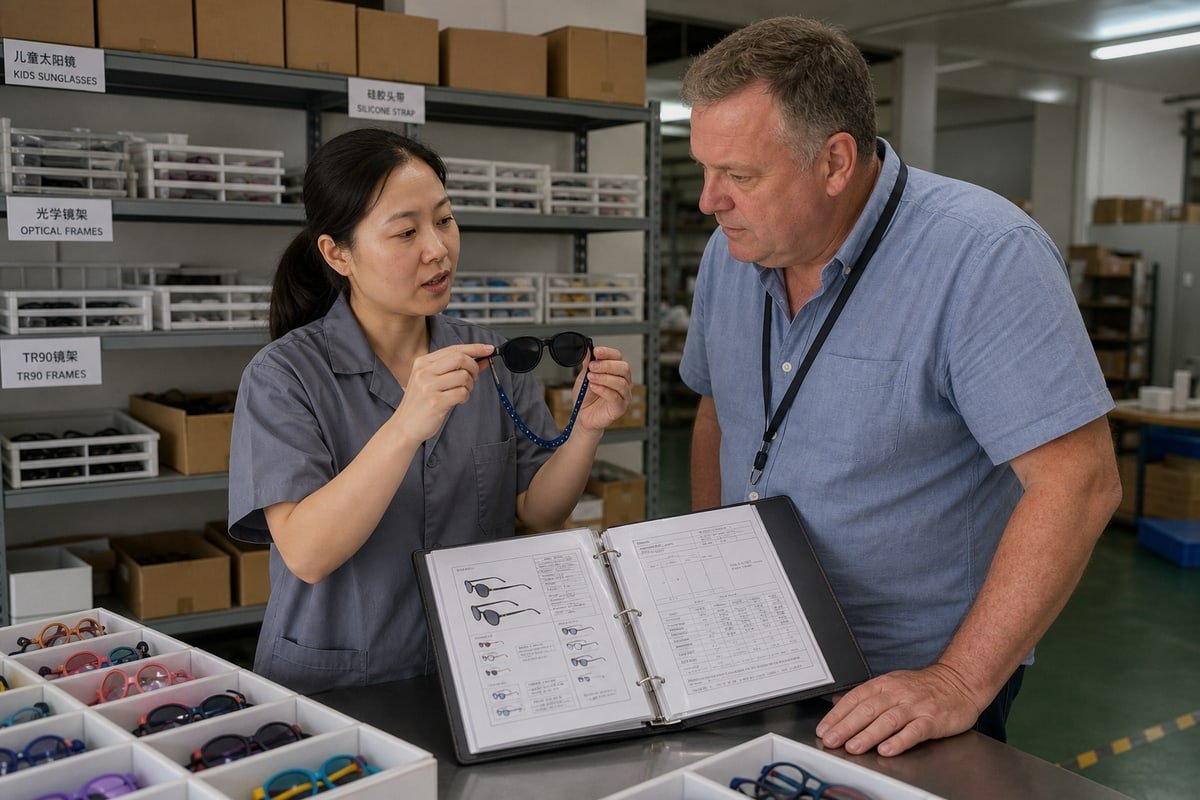
First, let me clear up the terminology, because it confuses many buyers. A first-party audit is a factory's self-assessment. A second-party audit is a buyer-led supplier audit, done by your own QA or sourcing team. A third-party audit is an independent check by an outside firm. When people say "in-house audit," they usually mean the second type. Here is how the two buyer options compare:
| Factor | In-House (Buyer-Led) Audit | Third-Party Inspection |
|---|---|---|
| Independence | Lower; relationship pressure exists | High; neutral by design |
| Product knowledge | Deep, tailored to your frame specs | Generic unless you supply criteria |
| Credibility with retailers and customs | Moderado | High; reports widely accepted |
| Monthly coverage | Often only 1–2 suppliers | Often 5–10 suppliers |
| Mejor uso | Supplier development, complex specs, sensitive IP | New suppliers, final gates, multi-country sourcing |
Match the audit model to the supplier stage
In my experience hosting audits from buyers in more than 20 countries, the stage decides the model. Early qualification suits a buyer-led visit, because you check whether the factory can meet your design and safety requirements. Ongoing monitoring suits internal audits too, since your team can tie the factory audit report directly to corrective actions. But critical checkpoints, like final acceptance before shipment, favor third parties, because neutrality matters most there.
Some buyers object that outside inspectors miss subtle product issues. That concern is fair. A general-purpose auditor may not notice a soft hinge or a slightly rough temple edge on a child's frame. The fix is not to skip third parties. The fix is to give them a detailed quality control checklist and to pair inspections with manufacturing process verification during your own visits. One eyewear sourcing guide even recommends hiring a bilingual, industry-specialized inspector for exactly this reason. Coverage is the other deciding factor. If your internal team can only visit 1–2 suppliers per month while a third-party firm covers 5–10, scale alone may settle the question.
What safety and quality standards should I check during a children's eyewear factory audit?
During one incoming-material check at our workshop, a TR90 batch arrived without its supplier test report. We quarantined it immediately, because paperwork gaps in children's eyewear are never small problems.
Check CPSIA compliance, ISO 8624 sizing, and chemical safety for lead, phthalates, and BPA in frame materials and coatings. Also verify hinge durability, UV400 lens claims, labeling accuracy, raw material traceability, and documentation such as ISO 9001, CE, FDA, UKCA, REACH, and RoHS test reports.
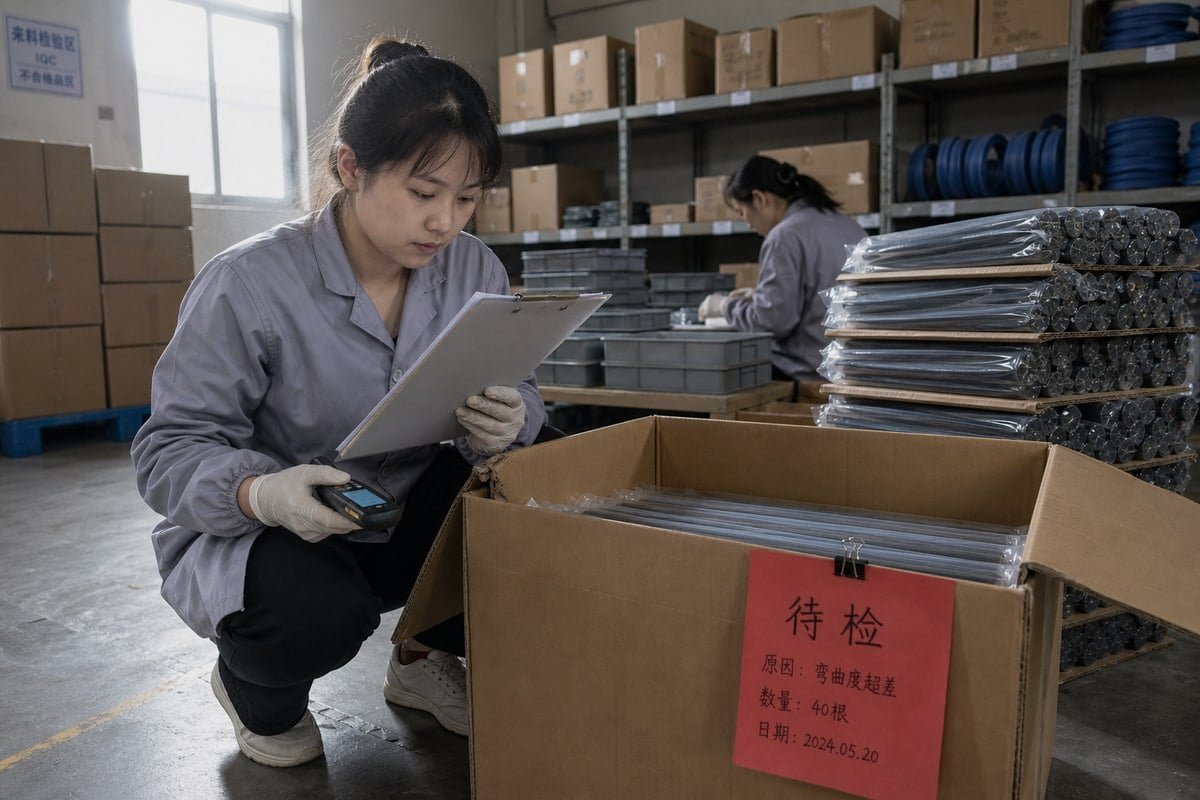
Children's frames face a double layer of risk. There is system risk, meaning weak factory processes. And there is product risk, meaning defects that only show up on the actual frame. A factory can look compliant on paper and still ship inconsistent hinges or mislabeled packaging. So your audit needs to cover both layers. This is the checkpoint structure I recommend to buyers who visit us:
| Audit Area | Qué verificar | Por qué importa para los niños |
|---|---|---|
| Seguridad química | No lead, phthalates, or BPA in acetate, TR90, TPEE, or coatings | CPSIA compliance and child health protection |
| Fit and sizing | ISO 8624 dimensions; age-appropriate geometry | Poor fit causes slipping and pressure on growing faces |
| Hinges and durability | Cycle testing, screw retention, flex behavior | Kids drop, bend, and sit on frames daily |
| Lentes | UV400 verification, impact resistance | UV claims must survive regulatory compliance testing |
| Sub-tier components | Origins of hinges, screws, and nose pads | Sub-tier traceability is increasingly expected by retailers |
| El próximo Pasaporte Digital de Producto de la UE requerirá un registro de transparencia escaneable para EPP. Las marcas que solo tienen informes de prueba en papel tradicionales, comunes en las cadenas de suministro centradas en Australia, deberían comenzar a estructurar archivos de cumplimiento digital ahora. | ISO 9001, CE, FDA, UKCA, REACH, RoHS reports; business license | Legal market entry and defensible records |
Chemical and material verification comes first
Mandatory rules like CPSIA in the US often require accredited third-party lab testing, not just supplier claims. So during any children's eyewear factory audit, ask to see current test reports tied to the exact material batches in production. Raw material traceability is the backbone here. At our factory, every TPEE and TR90 lot links back to its supplier certificate, and we retain samples so a claim can be verified months later. Newer trends push this further. Buyers now ask for bio-integrity checks on bio-acetate, to confirm sustainable material is not diluted with petroleum-based polymer during high-volume runs.
Fit, function, and paperwork
Advanced buyers also audit ergonomics. Some now use 3D anthropometric verification to confirm frame geometry matches real pediatric face shapes at different ages, not just scaled-down adult sizing. Finally, check the document system. A few of our European optical customers even ask about ISO 13485 certification frameworks 2, because optical frames touch the medical-device channel in some markets. Even where it is not mandatory, a factory that understands that documentation standard usually runs tighter records overall.
Is third-party inspection worth the extra cost for my kids optical frames order?
Every new purchase order that crosses my desk at our Taizhou factory raises the same trade-off: pay a few hundred dollars for independent inspection, or trust our reports alone?
Yes, third-party inspection is usually worth it for children's eyewear. At roughly $100–$300 for local inspectors or $300–$700 per day for international firms, the cost is small compared with recall risk, rejected shipments, and lost retailer trust in a child-safety product category.
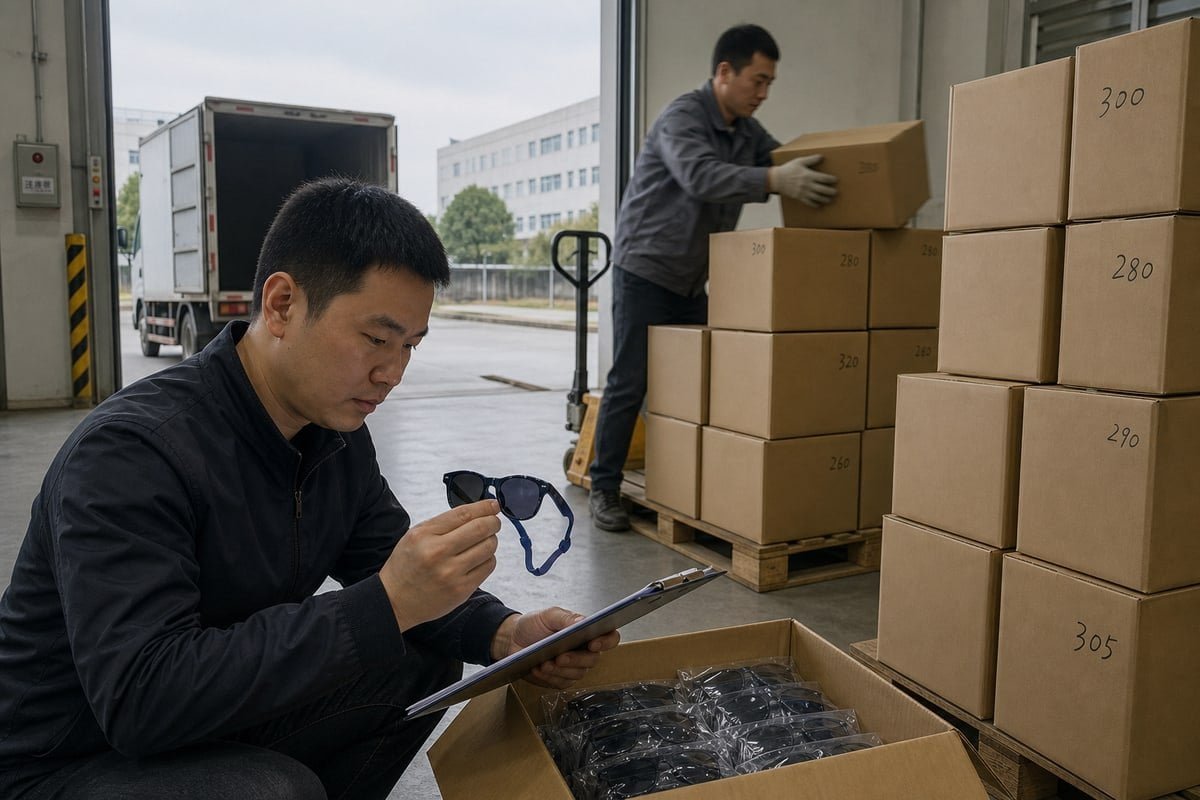
Let me put those numbers in context, because pricing varies widely by region and scope. Treat these figures as examples, not universal rates:
| Verification Option | Costo Típico | Best Used For |
|---|---|---|
| Supplier self-inspection | Free or built into unit price | Routine internal checks; lowest credibility |
| Local inspection company | About $100–$300 per visit | Smaller orders; quantity, defect, and packaging checks |
| International third-party firm | About $300–$700 per day | High-volume orders; formal reports for banks, customs, retailers |
The real question is not the fee. It is what a missed defect costs you. A children's product recall brings extreme financial and reputational damage, far beyond the value of one shipment. That is why multi-stage auditing has become the industry standard: a pre-production check on materials, an in-line check during assembly, and a pre-shipment inspection before goods leave the factory. Each stage catches problems while they are still cheap to fix.
How inspectors actually check your frames
A typical pre-shipment inspection uses AQL sampling standards 3 to pull a statistically valid sample from finished cartons. The inspector checks quantities, cosmetic defects, lens quality, hinge function, labeling, and packaging accuracy, then issues a photo-rich pass/fail report. In our experience exporting kids frames with silicone ear straps and flexible TPEE temples, these final gates catch exactly the issues that matter at retail, like a mismatched packaging insert or a strap batch with inconsistent texture.
Some buyers still object that inspectors lack product intimacy. True, but solvable. Send the inspector your approved sample, your tolerances, and your quality control checklist. A third-party report also serves a second purpose: it signals to the factory that your benchmarks are enforced by an external authority. Honest factories welcome that pressure. We do, because it protects both sides when a dispute arises.
How can I trust a supplier's in-house quality control without an independent audit?
Fifteen years of running eyewear production taught me one uncomfortable lesson: no factory, including ours, should ask buyers for blind trust. Verification systems earn trust; promises do not.
You can trust in-house quality control only when the supplier proves it: documented quality control checklists, AQL sampling records, traceable factory audit reports, third-party test certificates, and open access for spot checks. Without verifiable evidence and supply chain transparency, self-inspection alone carries conflict-of-interest risk.
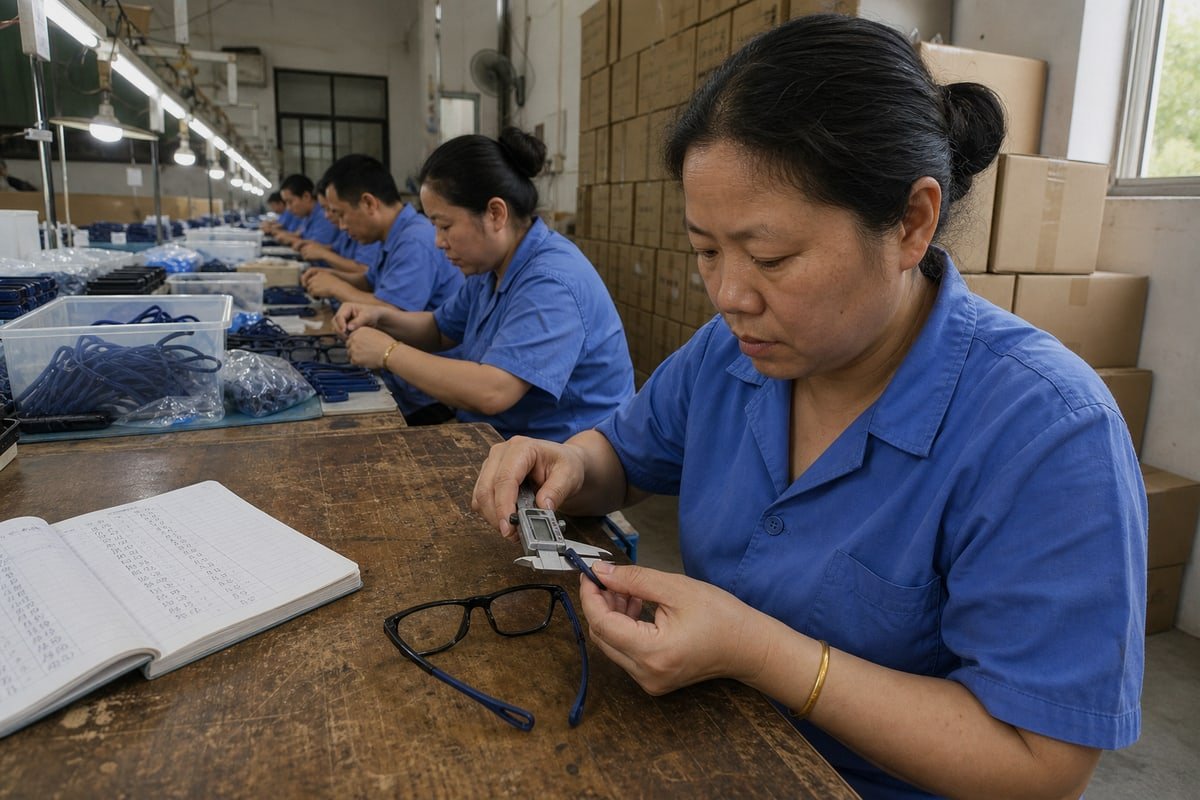
Supplier self-inspection has lower credibility for a structural reason: the person grading the work also profits from passing it. That does not mean in-house QC is worthless. It means you should verify the system behind it before you rely on it. Here is the process I suggest to buyers who cannot visit China immediately:
- Request the document trail. Ask for the factory's business license, export authorization, ISO 9001 certificate, and recent product test reports. Check that report dates match current production, not a batch from three years ago.
- Ask for batch-level records. A credible factory shows raw material traceability from resin lot to finished frame. At our workshop, TPEE and TR90 lots carry IDs through every station, so one defective frame traces back to its source.
- Review the inspection method. Ask which AQL level they apply and request a sample factory audit report or internal inspection sheet. Vague answers are a red flag.
- Run a video walkthrough. A live tour of the workshop floor reveals more than a brochure. Look for 5S organization, retained golden samples, and visible manufacturing process verification at each station.
- Verify sub-tier sourcing. Ask where hinges, screws, and nose pads come from. Sub-tier traceability is moving from nice-to-have to mandatory in serious retail programs.
- Schedule periodic independent checks anyway. Combine internal supplier QC for routine work with third-party deep dives at set intervals. Some hybrid programs now go further, using IoT-enabled production data that outside experts verify in real time.
The pattern behind all six steps is simple. Trustworthy in-house QC leaves evidence everywhere. When a buyer asks us hard questions, we can answer from records, not memory. A factory that resists this level of supply chain transparency is telling you something important. Listen to it, and keep independent verification in your program regardless of how good the relationship feels.
Conclusión
Kids optical frames supplier audits work best layered: in-house depth plus third-party independence. If you want a factory that welcomes both, contact Alan Kong at sales@okayeyewear.com.
Notas al pie
1. International standard for spectacle frame measuring systems, crucial for pediatric eyewear fit. ↩︎
2. Quality management standard for medical devices, often relevant for optical frames in regulated markets. ↩︎
3. Explains the statistical sampling method used by inspectors to determine batch quality. ↩︎
Más artículos que te podrían gustar
21 de agosto de 2026
¿Cómo garantizar que los obsequios de monturas ópticas para niños no presenten riesgo de asfixia?

21 de agosto de 2026
Auditorías in situ vs. de terceros: ¿Cómo difieren en la cobertura para proveedores de monturas ópticas para niños?
21 de agosto de 2026
¿Cómo garantizar que los artículos de regalo con monturas ópticas para niños no supongan un riesgo de asfixia?
¿Buscas un socio confiable en gafas para niños?
Explore más de 800 estilos listos y soporte OEM/ODM completo adaptado a su marca.
Ponte en contacto English
  Español de México
  Deutsch
  Français
  日本語
日本語  العربية
  Português do Brasil