How to Safely Disinfect Kids’ Optical Frames in Schools and Kindergartens?
Disinfecting kids’ optical frames sounds simple until a bleach wipe ruins a coating hydrogen peroxide wipes 1. On our production line, we see returned frames damaged by harsh cleaners far more often than by drops.
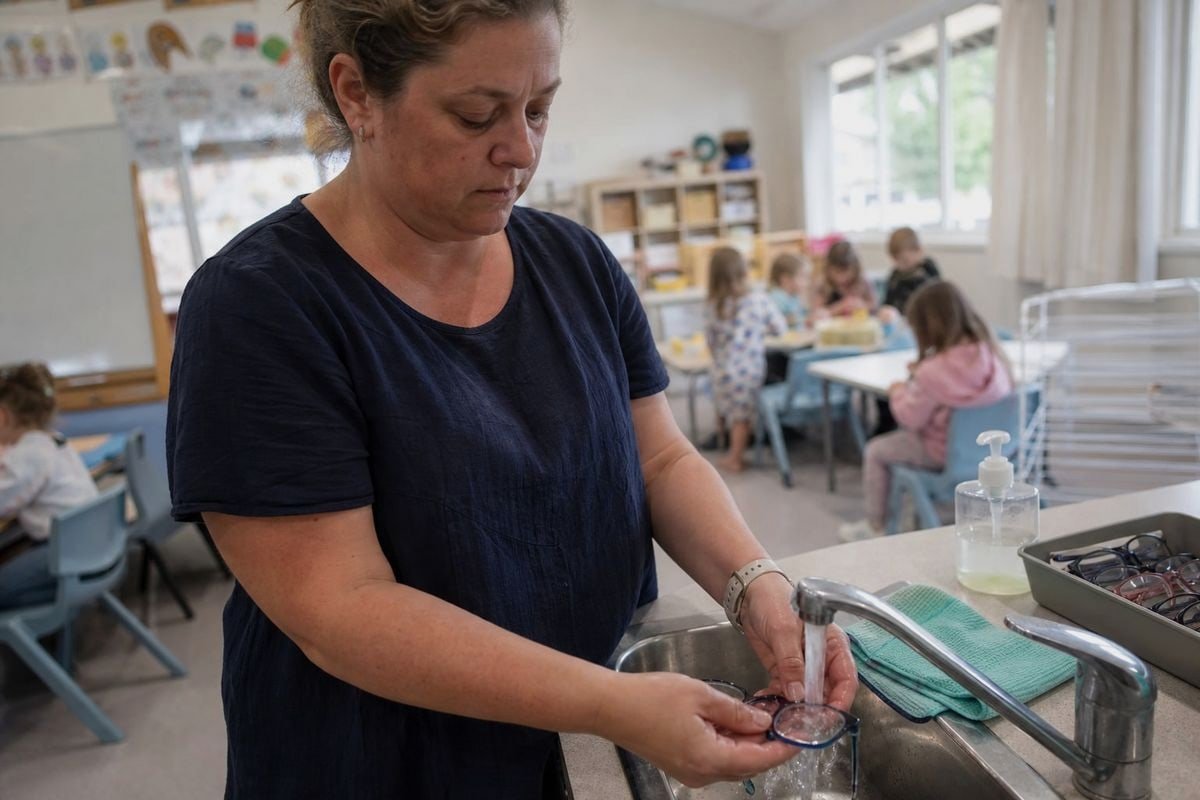
To safely disinfect kids’ optical frames in schools, wash hands first, rinse frames in lukewarm water, clean with mild lotion-free soap, dry with a microfiber cloth, and use only eyewear-approved disinfectant wipes or UV-C sanitizing when the frame manufacturer explicitly allows them.
Glasses are high-touch items. Children grab them, drop them, and share handling with teachers all day. Below, I walk through what actually works, what causes damage, and how to build a school-safe routine.
What disinfection methods are safe for my TR90 and TPEE kids' optical frames?
During material testing at our Taizhou factory, we soak TR90 and TPEE samples in common cleaning agents. The results shaped every care card we ship with our kids' optical frames.
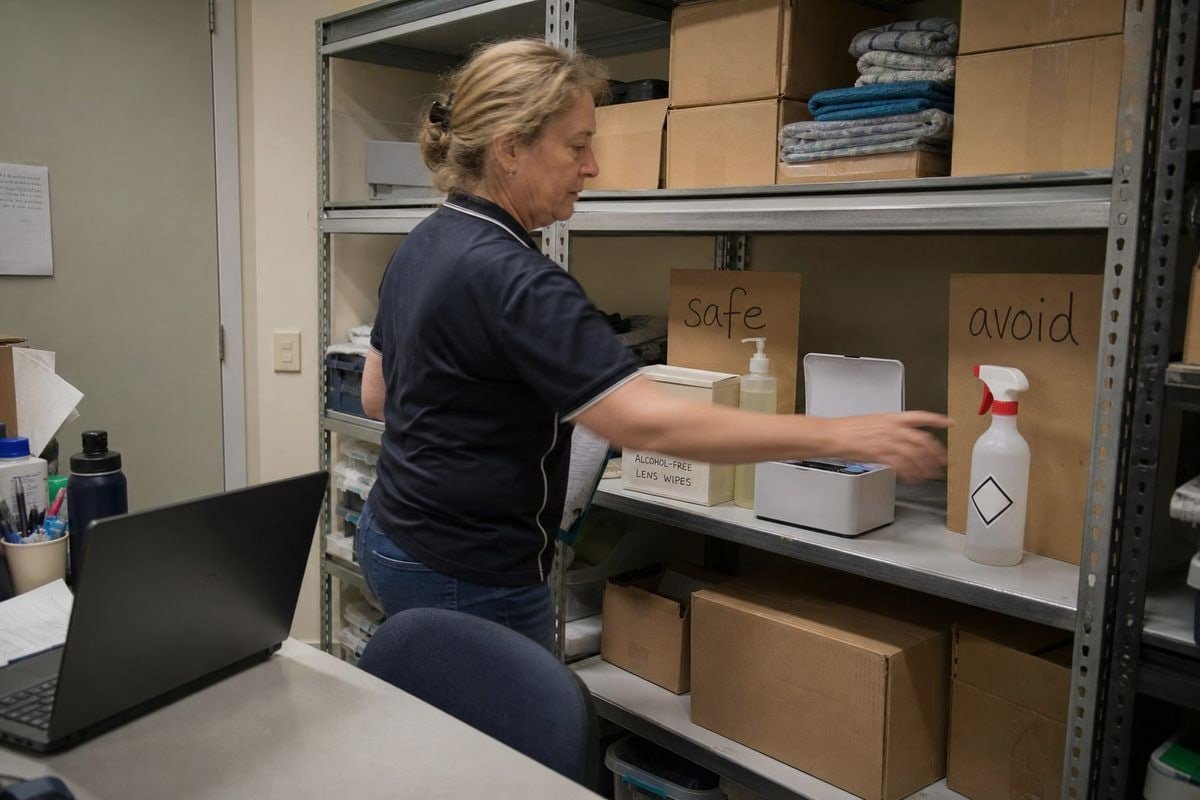
Soap and water is the safest disinfection baseline for TR90 and TPEE kids' optical frames. Mild lotion-free dish soap breaks down viral envelopes and bacteria without harming the material. Alcohol-free lens sanitizing wipes and short UV-C cycles are acceptable; bleach, ammonia, and acetone are not.
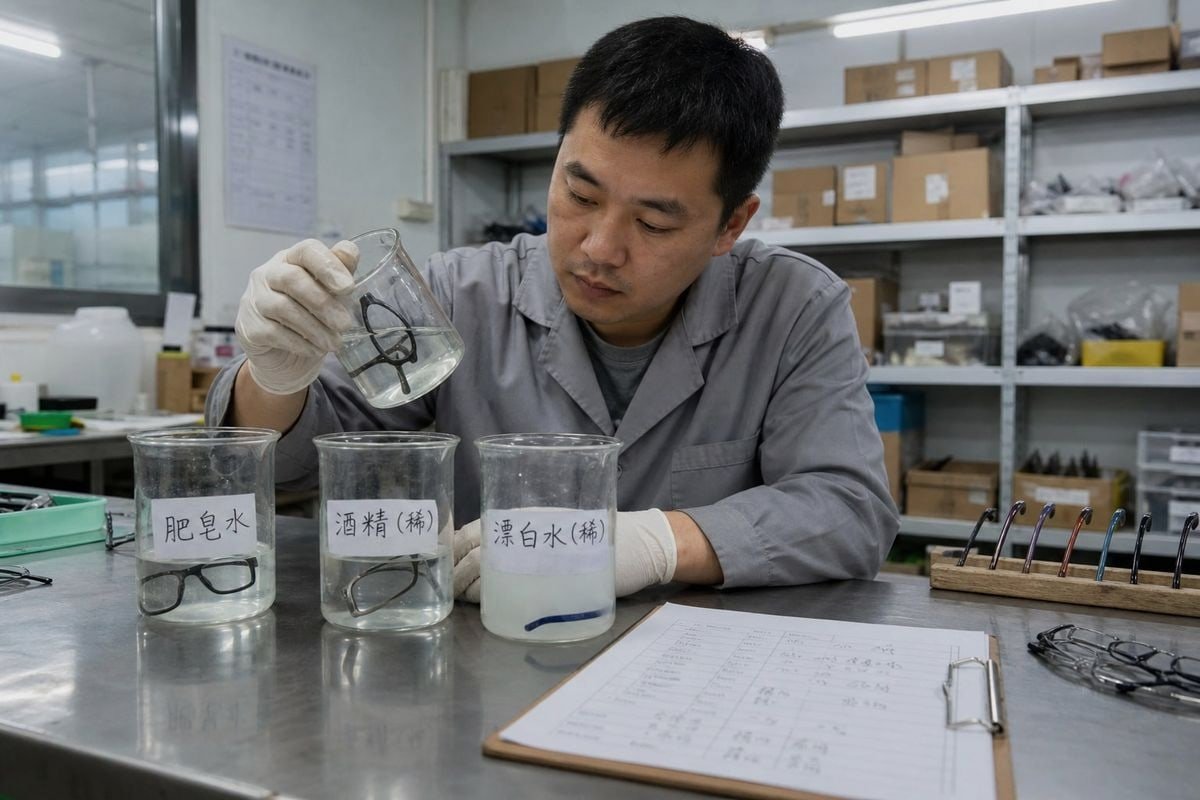
TR90 is a thermoplastic with excellent chemical stability. TPEE, the flexible elastomer we use for soft temple tips, is also resilient. But "resilient" does not mean "immune." Repeated exposure to strong solvents will still dull surface finishes, weaken silicone-touch coatings, and cause skin irritation for the child if residue remains on nose pads and ear hooks.
The safe list versus the risky list
Here is how common methods stack up against the materials we work with every day:
| Método | montura TR90 | TPEE temple tips | Lens coatings | School-friendly? |
|---|---|---|---|---|
| Mild soap + lukewarm water | Safe | Safe | Safe | Yes — best default |
| Alcohol-free lens sanitizing wipes | Safe | Safe | Safe | Sí |
| Isopropyl alcohol 70% | Tolerated occasionally | Risk of surface dulling | Risky on coatings | Only if maker approves |
| UV-C sanitizing box | Safe | Safe | Safe | Yes, but slow (30–45 min in some units) |
| Bleach / ammonia wipes | Damages finish | Degrades softness | Strips anti-reflective coating 2 | No |
| Acetone / nail polish remover | Dissolves surface | Destroys material | Destroys coatings | Never |
The nuance matters. Some sanitation guidelines do permit isopropyl alcohol 70% sprays on frame surfaces after hand hygiene 3, and others suggest hydrogen peroxide wipes or a 50/50 mix of 3% hydrogen peroxide and water when wipes are unavailable. But other eyewear makers warn against disinfectants of any kind on their products. That contradiction is exactly why school policy should defer to the frame manufacturer's instructions first. A "stronger" cleaner is not a better cleaner. It is simply a bigger gamble with a product a family paid for.
One practical rule we give buyers: keep total contact time of any cleaning solution on the frame under one minute, then rinse and dry completely.
How can I prevent frame damage when disinfecting glasses daily in a classroom setting?
A kindergarten distributor in Japan once sent us photos of cloudy lenses across a whole classroom set. The culprit was not our frames. It was daily wiping with alcohol-based household cleaner.
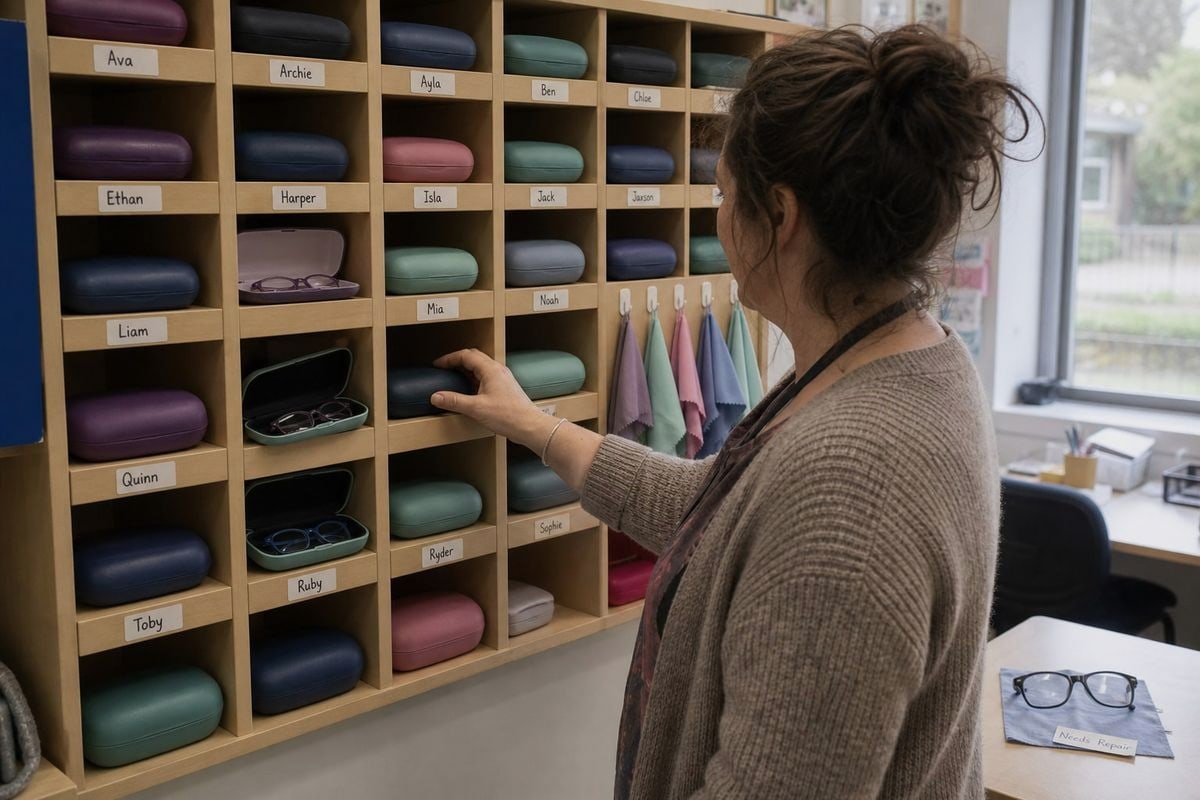
Prevent frame damage by using cool or lukewarm water only, never hot; applying mild detergent solution instead of household disinfectants; drying with a dedicated microfiber cleaning cloth per child; keeping chemical contact under one minute; and storing glasses in hard-shell cases between cleanings.

Daily cleaning is where slow, invisible damage happens. One wrong wipe does little. Two hundred wrong wipes over a school year cause crazing on lenses, brittle hinges, and faded temple colors. So the goal is a routine that staff can repeat safely on autopilot.
The three damage pathways to control
First, heat. Hot water can warp plastic frames and stress the anti-reflective coating on lenses. Always rinse in lukewarm or cool water. Second, chemistry. Ammonia, bleach, acetone, and vinegar all attack either the frame surface or the lens coating. Lysol- and Clorox-type wipes should stay off eyewear unless the product is specifically approved for optical use. Third, abrasion. Paper towels and tissues contain wood fibers that scratch lenses at a microscopic level. A clean microfiber cleaning cloth is the only drying tool that belongs in a classroom eyewear kit.
A repeatable daily routine
- Wash your hands before touching any pair. This is the "clean hands first" protocol, and it prevents immediate re-contamination.
- Rinse the frame under lukewarm water to flush away grit before wiping. Wiping dry grit is how lenses get scratched.
- Apply a drop of mild, lotion-free soap. Work it into hinges, nose pads, and ear tips where oils collect.
- Rinse thoroughly so no soap residue remains to cause skin irritation.
- Dry with that child's dedicated microfiber cloth.
- Return the glasses to a labeled hard-shell case during PE, recess, or naptime.
A French industry procedure puts the soap-washing step at roughly 30 seconds, followed by rinsing and drying. That is fast enough for a real classroom. The whole cycle takes under two minutes per pair, and it protects both hygiene and the product.
Which frame materials hold up best to frequent cleaning and sanitizing in schools?
Fifteen years of eyewear production has taught our team one clear lesson: the material decision made at sourcing determines whether a frame survives institutional hygiene routines or fails within a semester.
TR90 and TPEE hold up best to frequent school cleaning because they resist water, mild detergents, and flexing without cracking. Acetate frames tolerate soap but grow brittle with alcohol exposure. Metal frames handle chemicals better but have crevices and nose pads that trap bio-burden.
Not all children's frames start from the same place. A frame that gets cleaned once a week at home faces a very different life than one cleaned daily in a kindergarten. Material choice is the difference.
Material-by-material durability under frequent cleaning
| Material | Water + soap tolerance | Alcohol tolerance | Flex durability | Institutional suitability |
|---|---|---|---|---|
| TR90 (nylon-based thermoplastic) | Excelente | Moderate, occasional only | Excellent — returns to shape | Muy alta |
| TPEE (flexible elastomer) | Excelente | Moderado | Outstanding — bends without breaking | Muy alta |
| Acetate frame materials | Buena | Poor — becomes brittle over time | Moderado | Medium; needs gentle care |
| Metal alloy | Excelente | Buena | Poor for active kids | Medium; hinge and pad crevices trap grime |
| Standard injection plastic | Buena | Poor — surface clouds | Poor — snaps under stress | Baja |
Acetate deserves a special note. Many premium kids' frames — like the translucent pale pink rounded-rectangular styles popular in our catalog — use acetate for its beautiful color depth. Acetate cleans well with soap and water, but repeated alcohol exposure leaches plasticizers and leads to brittleness. If a school knows a child wears acetate, alcohol wipes should be off the table for that pair.
There is also a newer trend worth flagging for procurement teams: frames manufactured with silver-ion antimicrobial additives, which give the surface a persistent resistance to bacteria and fungi. These reduce, but do not eliminate, the need for cleaning. And for deep maintenance, quarterly professional ultrasonic cleaning 4 removes skin oils and bio-burden trapped in hinges and nose pad mounts — areas manual wiping simply cannot reach. We recommend schools coordinate this with a local optician rather than buying ultrasonic units themselves.
For our own designs, we pair a TR90 front with soft TPEE or silicone temple tips. That combination survives daily soap washing, resists flex fatigue when kids yank the glasses off one-handed, and keeps soft contact points comfortable against sensitive skin.
How do I choose a supplier whose kids' eyewear can withstand institutional-level hygiene routines?
A procurement manager from an Australian kids' brand once asked us a question I still quote internally: "Will these frames survive a kindergarten, not just a photoshoot?" That question should drive every sourcing decision.
Choose a supplier who specifies exact frame materials, provides written cleaning-compatibility guidance, tests coatings and colors against soap and disinfectant exposure, offers flexible TR90/TPEE constructions, and supports OEM details like labeled cases and care cards that fit school hygiene workflows.
Institutional buyers face a hidden risk. Two frames can look identical in a catalog photo, yet one survives two years of daily washing while the other clouds, cracks, or sheds its coating in three months. The difference sits in material grade, coating quality, and honest documentation. Here is what I would verify before placing an order.
The supplier due-diligence checklist
| What to ask | Por qué importa | What a strong answer looks like |
|---|---|---|
| Exact material specification | "Plastic" hides quality gaps | Named TR90, TPEE, or acetate grades in writing |
| Cleaning compatibility statement | Schools need to know what wipes are safe | Written guidance covering soap, isopropyl alcohol 70%, and UV-C exposure |
| Color and coating durability | Daily washing fades cheap finishes | Rub-test and wash-cycle validation on painted temples |
| Flex and hinge testing | Kids stress frames constantly | Documented flex-cycle testing on temples and bridges |
| Care instructions with each pair | Parents and teachers need the rules | Printed care cards and manufacturer cleaning instructions included |
| Case and packaging options | Storage prevents cross-contamination | Hard-shell cases, customizable and labelable per child |
Why existing styles reduce your risk
At our factory, buyers can select from roughly 800 existing styles. For a brand supplying school or optical channels, that matters in a specific way: you can order proven, hygiene-tested constructions without heavy mold investment, then test the market before committing to custom tooling. Our OEM/ODM support then adds your logo, colors, lens options, and packaging — including the labeled hard-shell cases that make classroom storage systems and Red Bin/Green Bin quarantine workflows practical for shared eyewear programs.
One more thing to ask any supplier: how they handle communication with parents downstream. We encourage our brand customers to include a simple care card in every box, telling families and teachers exactly which products are safe on that specific frame. It costs pennies and prevents most disinfection damage before it happens.
Conclusión
Harsh disinfectants quietly destroy kids' optical frames. The fix is simple: soap, lukewarm water, microfiber cloths, approved wipes only, and durable TR90/TPEE frames from a supplier who documents cleaning compatibility.
Notas al pie
1. Official FDA resource for medical device safety, including regulated cleaning agents like hydrogen peroxide used for disinfection. ↩︎
2. Technical overview of anti-reflective coatings and their susceptibility to damage from heat and harsh chemical cleaners. ↩︎
3. Updated CDC landing page for hand hygiene guidelines. ↩︎
4. Scientific explanation of ultrasonic cleaning technology used for deep maintenance of complex optical frame components. ↩︎
Más artículos que te podrían gustar

5 de agosto de 2026
Bio-Based vs Regular Cellulose Acetate: What's the Difference for Kids' Frames?

5 de agosto de 2026
How Recyclable Are Kids' Optical Frame Materials, and What Eco-Friendly Alternatives Exist?
5 de agosto de 2026
Do Kids Optical Frames Whiten or Age in Storage, and How to Control Warehouse Conditions?
¿Buscas un socio confiable en gafas para niños?
Explore más de 800 estilos listos y soporte OEM/ODM completo adaptado a su marca.
Ponte en contacto English
  Español de México
  Deutsch
  Français
  日本語
日本語  العربية
  Português do Brasil