How to Fix Kids’ Sunglasses When the Lens Falls Out?
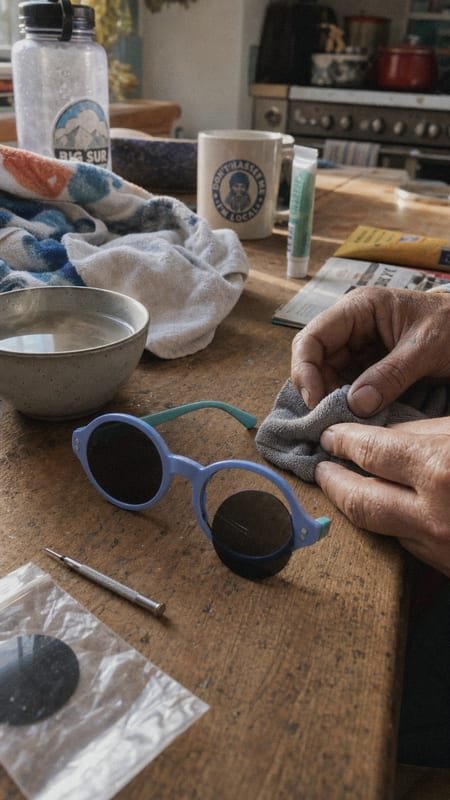
A popped-out lens in kids’ sunglasses can ruin a beach day fast. On our production line in Taizhou, we see exactly why this happens — and how to fix it safely.
To fix kids’ sunglasses when the lens falls out, clean the lens and frame groove, check for loose screws or cracks, then align the lens at the nose bridge and press it evenly into the rim. Warm plastic frames gently first, and never use superglue near the lens.
That is the short version. The full picture involves knowing why the lens came out, which repair method matches your frame type, and when a fix is no longer worth it. Let me walk you through each part.
What causes the lens to pop out of kids' sunglasses in the first place?
Last spring, our QC team pulled apart a batch of returned samples from a distributor. Almost every popped lens traced back to one of four root causes — none of them random.
Lenses pop out of kids' sunglasses because of loose or stripped hinge screws, worn or shallow lens grooves, frames warped by heat or rough handling, or a flattened lens bevel. Kids sitting on, twisting, or dropping their sunglasses accelerates all four failure modes.
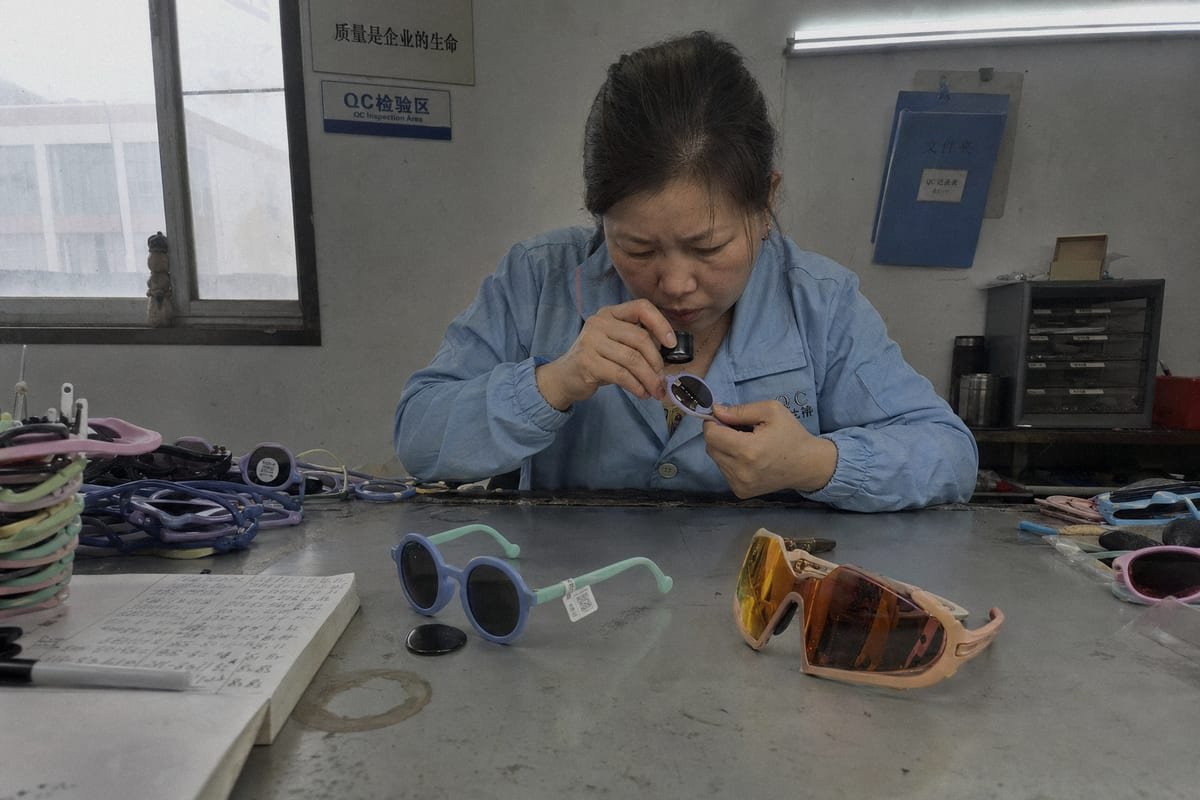
Understanding the cause matters because the wrong repair on the wrong problem just guarantees the lens pops out again. In our fifteen years of building gafas para niños 1, we have learned that a lens rarely falls out for no reason. Something in the mechanical system — the groove, the bevel, the screw, or the frame geometry — has changed.
The four failure points
Here is how we break it down when we inspect a returned frame:
| Failure point | Qué sucede | Desencadenante típico |
|---|---|---|
| Loose or stripped screw | Rim opens slightly, lens loses tension | Vibration from active play, cheap hardware |
| Worn lens groove | Groove widens, lens no longer grips | Repeated pop-outs, low-grade plastic |
| Warped frame | Rim shape no longer matches lens shape | Left in a hot car, sat on, twisted |
| Flattened V-bevel | Lens edge loses mechanical friction | Forcing the lens in and out repeatedly |
Why kids' sunglasses fail faster than adult frames
Children treat sunglasses like toys. They pull them off with one hand, which twists the frame. They stuff them into backpacks without a case. They chew the temple tips. Adult frames are not engineered for this abuse, and honestly, many cheap kids' frames are not either. That is why we build most of our children's styles in flexible TPEE y TR90 2 — materials that bend and return to shape rather than warping permanently. A rigid frame that warps by even one millimeter changes the rim circumference enough to release the lens. Also watch for stress whitening 3 — pale marks in the plastic near the rim. Those marks mean the material has been strained past its limit and can no longer hold a lens reliably.
How can I safely reinsert a loose lens without damaging the frame?
Before any of our kids' sunglasses leave the factory, workers seat every lens by hand. The technique they use is exactly what I recommend to parents at home.
Wipe the lens and rim with a microfiber cloth, then set the lens into the groove at the nose bridge first. Press evenly around the perimeter with your thumbs until it snaps in. For stiff plastic frames, soften them briefly in warm water before seating the lens.
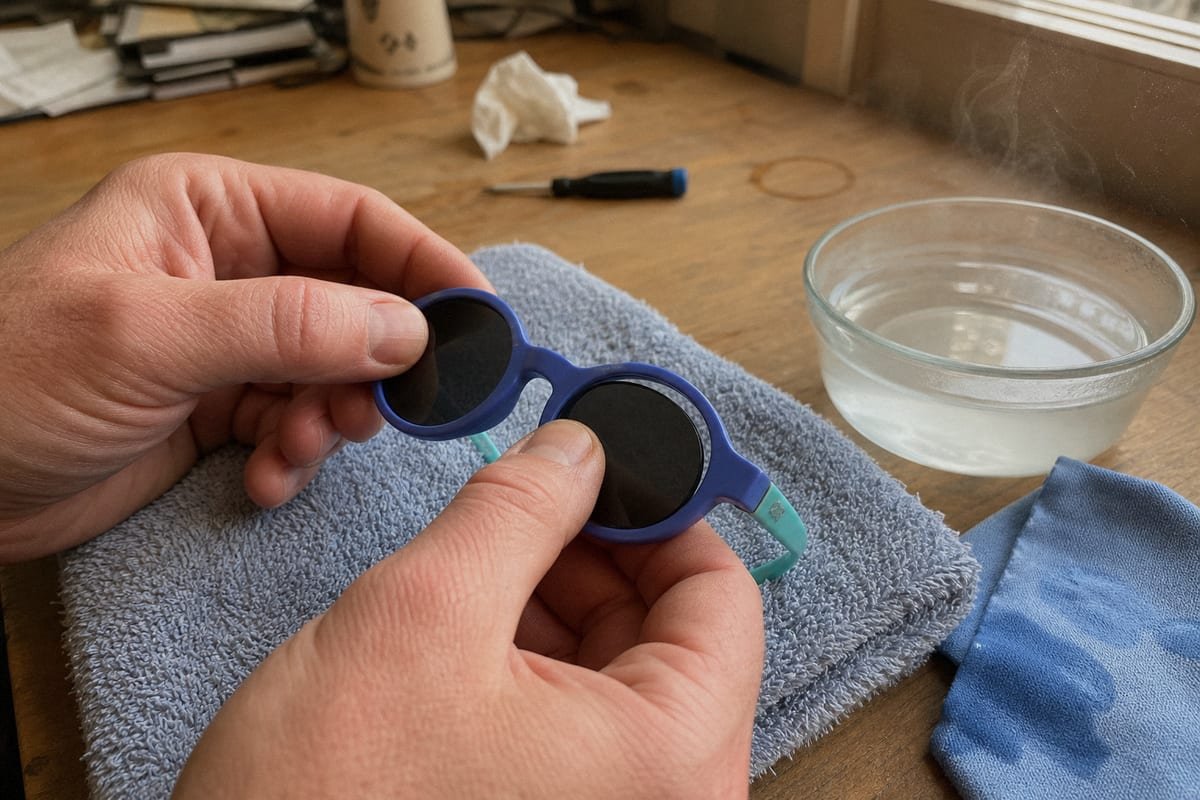
The number one mistake I see is force. People push the lens straight into the middle of the frame and hope it snaps in. That approach flattens the V-bevel on the lens edge and can crack the rim. The right method uses leverage and, for plastic frames, a little heat.
Step-by-step for full-rim plastic frames
- Clean everything first. Dust trapped in the groove will scratch the lens during reinstallation, so start by cleaning lens grooves and the lens edge with a microfiber cloth.
- Inspect before you press. Look for cracks, stress whitening, and loose hardware. Tightening loose screws with an optical screwdriver takes ten seconds and often solves the whole problem.
- Warm the frame. Soak the rim in hot tap water — around 60°C / 140°F — for thirty seconds. This mild plastic frame expansion makes the rim pliable enough to accept the lens without cracking.
- Seat the nose-bridge edge first. This anchors the lens and gives you leverage for the outer edge.
- Press evenly from the front. Insert from the front of the frame, following the safety-bevel direction the factory designed in. Work your thumbs around the perimeter until you hear a clean snap.
- Check lens alignment. Look through the lens for distortion. On polarized round lenses 4, rotation matters — a misaligned polarized lens can cause visual distortion or screen blackout.
Matching the method to the frame type
| Frame type | Correct method | Key tool |
|---|---|---|
| Full-rim plastic (like our TPEE kids' rounds) | Warm water, press from front | Warm water, microfiber cloth |
| Metal full-rim | Loosen rim screw, insert lens, retighten | Eyeglass repair kit with jeweler's screwdriver |
| Semi-rimless | Reseat retention wire, tighten hardware | Optical screwdriver |
| Shield / wraparound sport lens | Snap tabs back into slots, no heat needed | Hands only |
One more trick from repair shops: if the frame lip will not stretch over the last section of lens, loop a strand of dental floss between the lens and rim, then pull the floss to guide the lip over the edge. It works without sharp tools. And for TPEE frames, a quick cold-water plunge after heating helps the plastic "lock" its memory around the lens.
When should I contact my manufacturer instead of trying a DIY fix?
A buyer in Australia once emailed us photos of frames with cracked rims, asking for a repair method. My honest answer: stop repairing, and let us look at the batch.
Contact your manufacturer when the frame is cracked, the screw hole is stripped, the lens groove is worn out, hinges are broken, or the lens pops out repeatedly after correct reseating. These are structural failures that DIY fixes cannot safely solve on children's eyewear.

DIY is great for simple looseness. But children's eyewear has a safety dimension that adult sunglasses do not. A lens held in by tape can detach and expose a sharp edge near a child's eye. Small loose parts can become peligros de asfixia 5 for toddlers. So the line between "fix it at home" and "escalate it" needs to be drawn conservatively.
The decision line
| Situation | DIY fix | Contact manufacturer / replace |
|---|---|---|
| Lens popped out, frame intact | ✔ Reseat as described above | — |
| Screw loose but threads intact | ✔ Use an eyeglass repair kit | — |
| Screw hole stripped | ✘ | ✔ Hardware or frame replacement |
| Cracked rim or stress whitening | ✘ | ✔ Structural failure, replace |
| Repairing broken hinges | ✘ Temporary tape only | ✔ Hinge repair needs proper parts |
| Lens pops out repeatedly | ✘ | ✔ Groove or bevel is worn |
Why this matters more for B2B buyers
If you run a kids' brand and one unit fails, it is a repair question. If a pattern of units fails, it is a quality-control question — and your factory should want to know. When our OEM clients 6 report an issue, we trace it to the specific mold, material batch, or assembly step. Sometimes the cause is a lens bevel cut slightly under tolerance; sometimes it is a groove depth issue on one cavity of a mold. A factory with real QC systems 7 can correct the root cause for future production runs. A parent with a screwdriver cannot. That is also why we advise brand buyers to keep a few production samples from every shipment. They make failure comparisons fast and disputes short.
For end customers, the practical rule is simpler: safe temporary fixes like clear tape, a twist-tie, or dental floss are fine for an afternoon — not for a week of daily wear on a child's face.
How do I choose a frame material that prevents lenses from falling out again?
Material choice is the trade-off we weigh most in product development: too rigid and the frame snaps or warps; too soft and the groove will not grip the lens.
Choose flexible, memory-retaining materials like TPEE or TR90 with deep lens grooves and quality hinges. These frames bend under abuse and return to shape, keeping the rim geometry — and lens retention — intact. Pair them with impact-resistant polycarbonate lenses for children's eyewear.
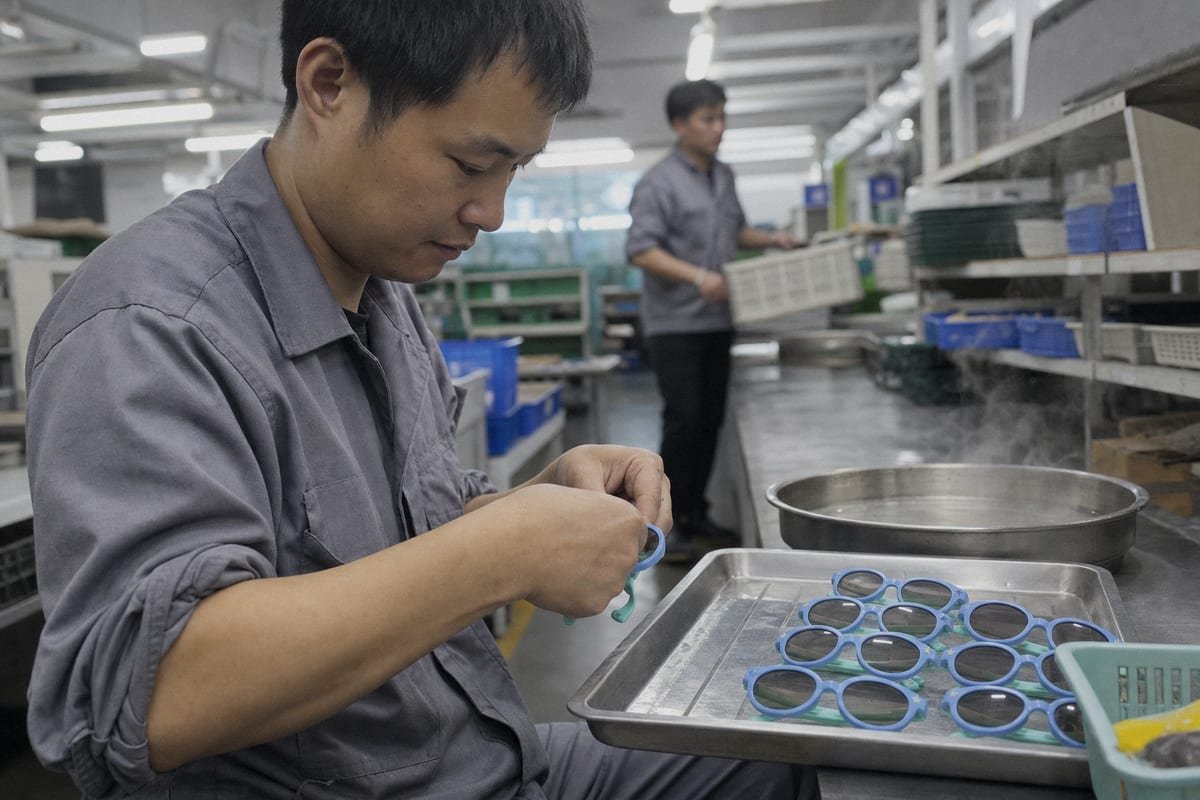
The best repair is the one you never have to make. After fifteen years of building children's frames — and roughly 800 styles in our current catalog — the pattern is unmistakable: lens retention is designed in, or it is not.
Comparing common kids' frame materials
| Material | Flexibilidad | Lens retention over time | Lo mejor para |
|---|---|---|---|
| TPEE (flexible rubber-like) | Excellent — bends and recovers | Excellent; groove keeps shape | Toddlers, babies, very active kids |
| TR90 | Very good — lightweight memory plastic | Muy buena | Niños en edad escolar, monturas ópticas |
| Standard injection plastic | Poor — warps or snaps | Fair to poor | Budget promotional items |
| Metal | Rigid; bends permanently | Depends on screw quality | Older kids, fashion styles |
Our own preferred build for active children combines a TR90 front with TPEE temples. The front holds the lens groove precisely, while the flexible rubber frames' temples absorb the twisting and pulling that kids inflict daily. Take the pastel round style on our line: the periwinkle TPEE front flexes when a toddler yanks it off one-handed, then returns to its molded shape — so the groove never loosens its grip on the lens.
Design details that keep lenses seated
Material is only half the story. When evaluating samples, check these construction points:
- Groove depth. A deep, sharply cut groove grips the lens V-bevel firmly. Shallow grooves are the top cause of repeat pop-outs.
- Material de la lente. Lentes de policarbonato 8 resist impact far better than acrylic, so the lens edge stays intact and keeps its bevel.
- Hinge quality. Solid hinges with properly threaded screws keep rim tension stable. Cheap hardware loosens within weeks.
- One-piece shield designs. For sport styles like wraparound shields, the lens locks into tabs rather than a stretched rim — a robust system for high-activity use.
Finally, pair good design with good habits: a hard case, a periodic screw check with a small optical screwdriver, and a microfiber cloth in the case pocket. Prevention costs minutes; replacement costs a customer.
Conclusión
A popped lens is fixable in minutes with cleaning, gentle warmth, and even pressure. But repeat failures signal a worn frame — and better materials prevent the problem entirely.
Notas al pie
1. CDC vision health resource supports the safety considerations unique to children’s eyewear. ↩︎
2. TR90 is a nylon-based copolymer; background on nylon properties explains its flexibility and memory. ↩︎
3. Crazing/stress whitening in plastics is a documented polymer failure mode relevant to warped frames. ↩︎
4. Explains how polarized lens orientation works, supporting the alignment and rotation claim. ↩︎
5. CPSC guidance on choking hazards supports the safety warning for small loose eyewear parts. ↩︎
6. Alibaba is a leading B2B platform where OEM buyers source and manage manufacturing relationships like this. ↩︎
7. ISO 9001 quality management standards underpin factory QC systems referenced in root-cause analysis. ↩︎
8. Authoritative AAO guide explaining the safety benefits and properties of polycarbonate lens materials. ↩︎
Más artículos que te podrían gustar
1 de agosto de 2026
¿Debería la fábrica encargarse del embalaje y etiquetado de las gafas de sol para niños, o utilizar un proveedor designado?
1 de agosto de 2026
Almacén propio vs. Cumplimiento directo del proveedor: ¿Qué reduce los costos de devolución para las marcas de gafas de sol para niños?
1 de agosto de 2026
Directo al almacén del puerto o staging en el extranjero: ¿Cuál ahorra más en el envío de gafas de sol para niños?
¿Buscas un socio confiable en gafas para niños?
Explore más de 800 estilos listos y soporte OEM/ODM completo adaptado a su marca.
Ponte en contacto English
  Español de México
  Deutsch
  Français
  日本語
日本語  العربية
  Português do Brasil