How to Design a “Free Replacement If Broken” Guarantee for Kids’ Sunglasses?
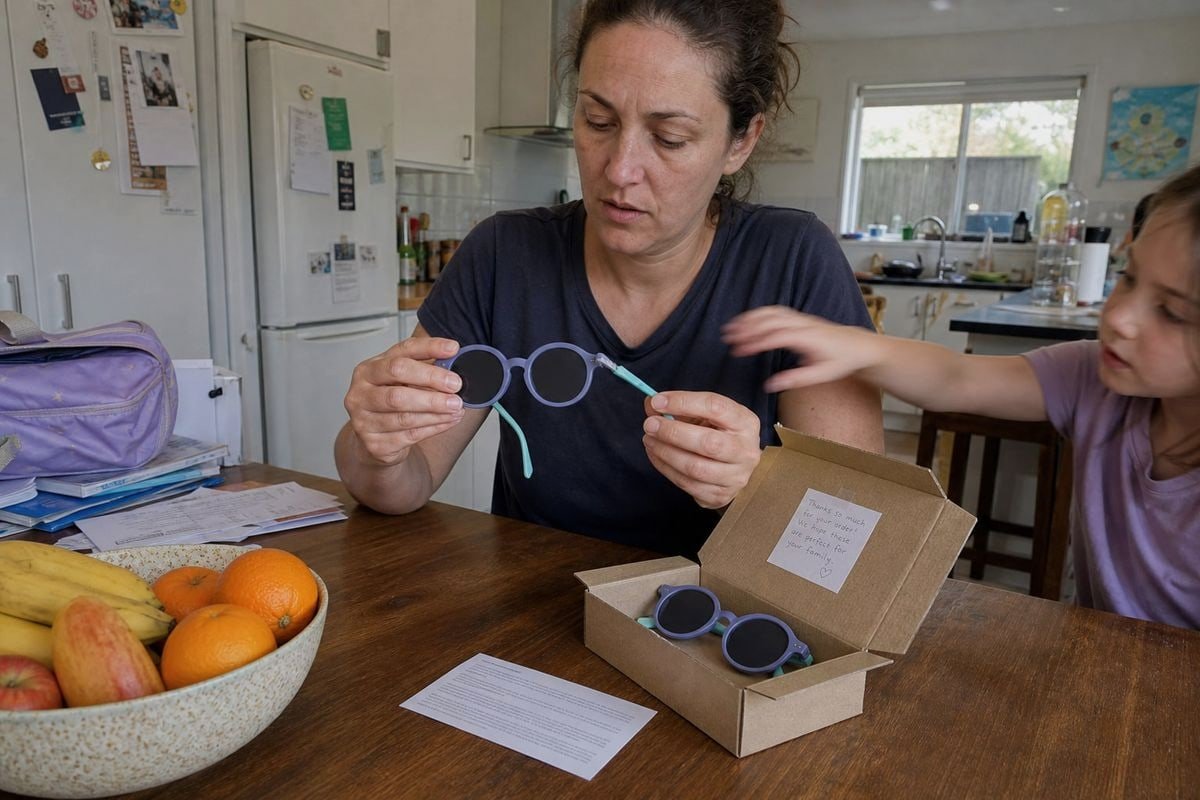
Parents expect a free replacement if broken guarantee for kids’ sunglasses. On our production line in Taizhou, we hear this from buyers constantly. Broken frames destroy repeat purchases. A [well-designed guarantee](https://okayeyewear.com/how-design-warranty-replacement-policy-kids-sunglasses-retailers/) fixes that.
A free replacement if broken guarantee for kids’ sunglasses works best as a one-time replacement within 12 months, activated by product registration within 30 days, verified with photos and proof of purchase, with the customer paying only flat-rate shipping and handling fees.
That single sentence hides a lot of design decisions. Below, I break down each one. I will cover terms, coverage scenarios, materials, and communication. Let us start with the structure of the guarantee itself.
How do I structure the terms of a free replacement guarantee without hurting my margins?
Last year, a buyer from Australia asked us to help her model replacement costs before launching her kids' brand. Her fear was simple: would a generous promise quietly eat her profit?
Structure the guarantee with four controls: a 12-month coverage window, a strict one-time replacement limit per pair, mandatory product registration within 30 days, and a flat shipping and handling fee per claim. These four levers cap your maximum exposure while still sounding generous to parents.
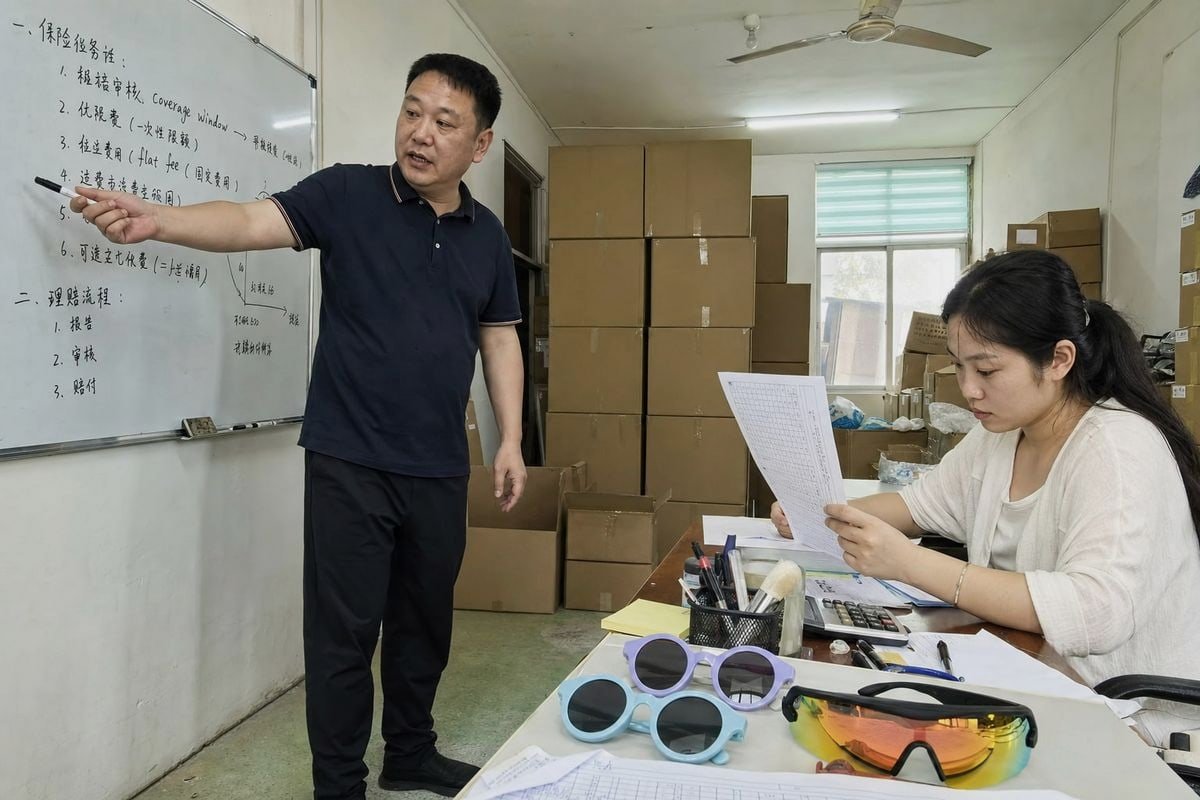
The core tension is real. Parents want certainty. Brands need sustainability. The good news is that you do not need an unconditional lifetime warranty policy 1 to win trust. You need a clear, honest promise with defined edges. In our experience supplying children's brands in more than twenty countries, the buyers with the healthiest margins all use variations of the same architecture.
The four levers, explained
First, the time window. Two-year programs exist in adult sunglasses, but children's eyewear brands usually choose one year. Kids grow, styles rotate seasonally, and breakage rates are higher. Twelve months balances both realities.
Second, the one-time limit. One free replacement per original pair keeps the math predictable. If you want a stronger promise, allow a second claim with an escalating fee rather than making it free.
Third, registration. Requiring the product registration process within 30 days does two things. It filters out casual abuse, and it captures the parent's email for your customer retention strategy 2.
Fourth, fees. "Free replacement" should mean a free product, not necessarily free logistics. A flat shipping and handling fee of a few dollars covers fulfillment and discourages frivolous claims.
| Lever | Recommended setting | Margin effect |
|---|---|---|
| Coverage window | 12 months from purchase | Caps long-tail liability |
| Replacement limit | One per original pair | Makes worst-case cost predictable |
| Registration | Within 30 days of purchase | Reduces abuse, builds email list |
| Customer fee | Flat shipping and handling | Offsets fulfillment cost per claim |
There is a counterargument worth addressing. Some founders worry that any restriction weakens the marketing message. In practice, the opposite is true. A "no-questions-asked lifetime" promise invites abuse, forces price increases, and often gets quietly watered down later — which damages trust far more than clear terms ever would. The best guarantee is not the broadest one. It is the clearest one.
One more structural tip from our OEM work: price the guarantee into the product. If your expected claim rate is 5–8% and your landed cost per unit is modest, adding a small buffer to your wholesale price funds the entire program without a separate paid protection plan.
What breakage scenarios should my warranty actually cover for kids' sunglasses?
When we run pruebas de caída 3 and temple-flex tests in our QC workshop, we see exactly how children's sunglasses fail. That failure data should shape your coverage list, not guesswork.
Cover accidental breakage: cracked frames, snapped hinges, bent or broken temple arms, and detached lens shields. Exclude loss, theft, intentional damage, and deep cosmetic scratches from normal wear. Replace with the same model, or a comparable current style if discontinued.
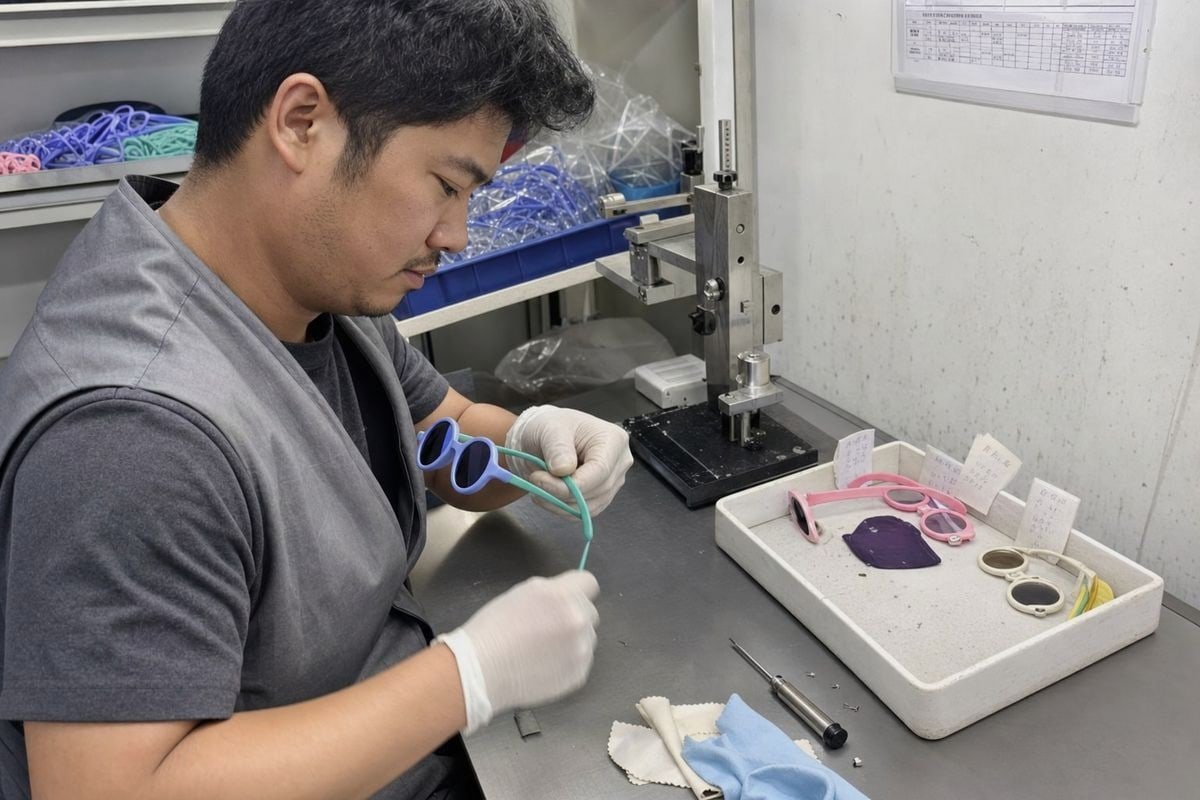
Coverage design starts with how kids actually break eyewear. A toddler chews a temple tip. A six-year-old sits on her round two-tone frames. A nine-year-old's sport wraparound shield pops out of the frame after a soccer ball hit. These are the everyday mishaps parents expect you to stand behind. A defect-only warranty ignores all of them — and that is exactly why kids-specific guarantees are more generous than adult eyewear warranties.
Cover, exclude, or decide case by case
| Scenario | Recommendation | Por qué |
|---|---|---|
| Cracked or snapped frame | Cover | Core promise; most common failure |
| Broken hinge or hinge screw | Cover | Frequent on kids' frames; cheap to fulfill |
| Bent or broken temple arm | Cover | Very common with active children |
| Lens popped out or shattered | Cover | Safety-relevant; parents expect it |
| Deep lens scratches | Opcional | Blurs into wear and tear; decide by positioning |
| Lost sunglasses | Exclude (or paid add-on) | Loss and breakage protection combined needs separate pricing |
| Theft or intentional damage | Exclude | Unpriceable risk; standard exclusion |
| Prescription changes | Exclude | Only relevant if you re-lens; most brands do not |
Same model or comparable style?
State clearly what the parent receives. The cleanest wording: "the same model in the same color, or a comparable current style of equal value if the original is discontinued." Kids' collections rotate fast. Without this clause, you will strand yourself with dead stock obligations.
Should lost sunglasses be covered?
Some brands bundle loss and breakage protection into one promise. It is a powerful marketing line, but loss claims are impossible to verify with photos. If you want to offer it, sell it as a paid protection plan at checkout rather than folding it into the free guarantee. That keeps the free promise clean and the risky coverage self-funding.
One practical validation tool: require photos of the broken pieces, and for higher-value styles, require the broken frame to be mailed back. Several of our customers turn this into a sustainability story — returned frames go into a recycling stream, which reinforces the eco-friendly positioning 4 of materiales libres de BPA 5.
How can I use TPEE and TR90 materials to reduce replacement claims in the first place?
Here is a trade-off we weigh on every new mold: a rigid frame is cheaper to produce, but a flexible one cuts breakage claims dramatically. For a brand offering a replacement guarantee, that trade-off decides your program's economics.
Use TR90 for the frame front and TPEE for the temple arms. TR90 offers memory-flex impact resistance, while flexible TPEE frames and temples bend without snapping at hinges. Combined with impact-resistant lenses, this construction can cut breakage claims to a fraction of rigid-frame rates.
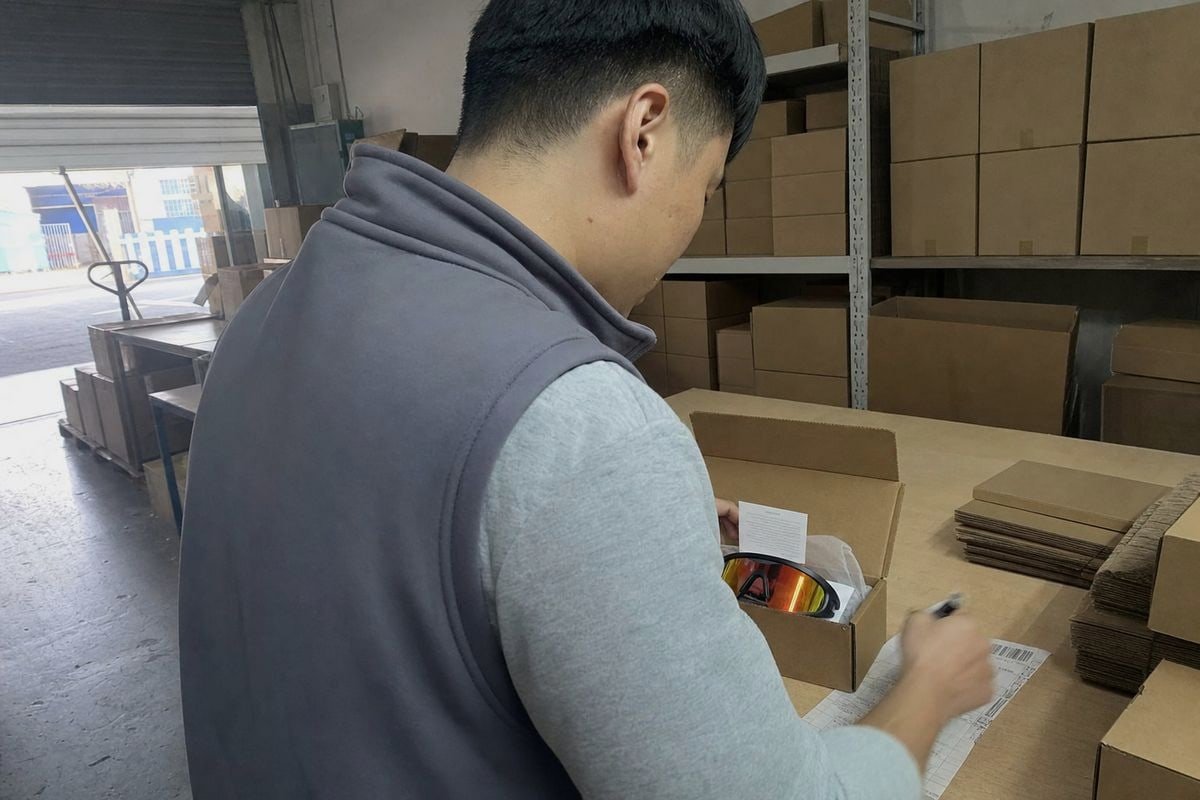
The cheapest replacement claim is the one that never happens. Your guarantee's cost structure is not decided when you write the policy. It is decided when you choose the frame material. After fifteen years of making children's eyewear, our factory has settled on two workhorse materials, and each solves a different failure mode.
Why TR90 for the frame front
TR90 is a thermoplastic memory material 6. Twist it, and it returns to shape. It is lightweight, so frames stay put on small noses, and it handles the drops and squeezes that kill acetate or cheap PC frames. On sport wraparound styles — like a single-shield visor design with a curved lens — TR90 lets the shield flex with impact instead of transferring force to the hinge.
Why TPEE for the temples
Temples are the number one breakage point in kids' eyewear. Children pull them outward far past the design angle. TPEE is a soft, rubbery elastomer that bends nearly flat and springs back. It is also gentle on skin and made from BPA-free materials, which matters enormously to the baby-brand buyers we work with. Our most claim-resistant construction pairs a TR90 front with TPEE temples: rigidity where the lens needs support, flexibility where kids apply force.
| Material choice | Typical failure behavior | Effect on claims |
|---|---|---|
| Cheap PC / acetate frame | Snaps at hinge or bridge | High claim rate |
| Full TR90 frame | Flexes, rarely cracks | Low claim rate |
| TR90 front + TPEE temples | Bends and recovers at stress points | Lowest claim rate |
| One-piece soft silicone/TPEE | Nearly unbreakable; lens retention is the risk | Very low, but check lens security |
Do not forget the lenses
Pair flexible frames with impact-resistant lenses. A polycarbonate lens 7 with Protección UV400 8 resists shattering and satisfies the safety expectations of parents and retailers alike. On mirrored gradient shield lenses, also verify coating adhesion, so cosmetic peeling does not generate soft claims.
There is a fair objection here: better materials raise unit cost. True. But run the numbers across a season. Each avoided claim saves a replacement unit, fulfillment labor, and shipping. For most of the brands we supply, the material upgrade pays for itself within the first production run — and it lets marketing make the guarantee promise with confidence rather than anxiety.
How do I communicate this guarantee to retailers and parents to build trust in my brand?
A lesson we learned the hard way: one of our ODM clients printed a beautifully worded guarantee in six-point legal text inside the box. Claim registrations were near zero, and so was the marketing benefit. Nobody read it.
Communicate the guarantee in one plain sentence on the hangtag, packaging, and product page: "Broken? We replace it once, free, within 12 months — just register and send a photo." Give retailers a shelf-talker version, and make the claim process fully digital with photo upload.
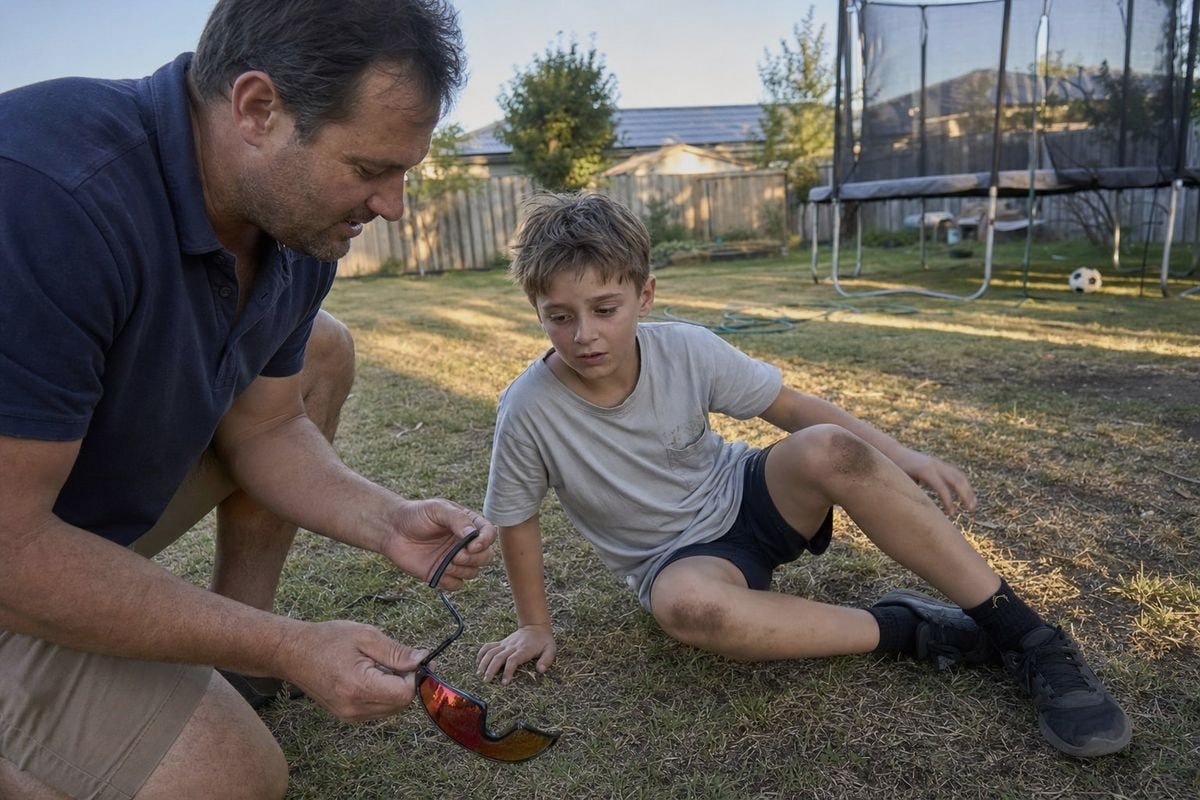
A guarantee only builds trust if parents can understand it in three seconds and claim it in three minutes. That means the communication design matters as much as the policy design. When we prepare retail-ready packaging for our OEM clients, the guarantee message goes on the front of the hangtag, not buried in the fine print.
Speak to parents in plain promises
Parents do not read warranty documents at the shelf. They read headlines. Lead with the outcome — "If your kid breaks them, we replace them" — then put the conditions in a short, honest bullet list: register within 30 days, one replacement per pair, keep your proof of purchase, small shipping fee applies. Honesty about the limits actually increases trust. Vague promises trigger suspicion.
Give retailers tools, not just terms
Retailers care about two things: does the guarantee help sell-through, and who handles the claims. Answer both. Provide a shelf-talker and a one-page explainer stating that all claims go directly to the brand online, so store staff never process returns. That single clause removes the retailer's biggest objection to stocking guaranteed eyewear.
Design a frictionless claim journey
El claim workflow should be a simple numbered path:
- Parent scans a QR code — ideally laser-etched on the inner temple arm — so claims are paperless even without a receipt.
- The form asks for the order number or proof of purchase requirements, plus two photos of the damage.
- The brand reviews and responds within two working days.
- The replacement ships after the flat fee is paid; for modular styles, ship only the broken component, such as a single temple.
Turn the guarantee into retention
Close the loop with "safe-user" incentives. If a family never files a claim, email them a discount on the next size up when the child outgrows the frame. The guarantee becomes a customer retention strategy, not just a cost center. Registration data makes this possible — which is another reason to require it.
Conclusión
Broken kids' sunglasses erode trust and repeat sales. A vague promise makes it worse. A clear, one-time, 12-month replacement guarantee — built on flexible, durable materials — solves both.
The formula is simple. Structure the terms with a one-year window, one replacement per pair, registration, and a flat fee. Cover real breakage scenarios and exclude loss. Reduce claims at the source with TR90 fronts, TPEE temples, and impact-resistant UV400 lenses. Then communicate the promise in one plain sentence that parents grasp instantly and retailers can support without effort. At our Taizhou factory, we have watched this exact playbook help new children's eyewear brands launch with confidence — because when the product rarely breaks and the promise is easy to keep, the guarantee stops being a risk and becomes your strongest selling point.
Notas al pie
1. Wikipedia background on warranty concepts underpinning the article’s guarantee design. ↩︎
2. Forbes resource on retention strategies referenced in the guarantee’s business value. ↩︎
3. ISO standards body relevant to product durability and impact testing methods. ↩︎
Más artículos que te podrían gustar
1 de agosto de 2026
¿Debería la fábrica encargarse del embalaje y etiquetado de las gafas de sol para niños, o utilizar un proveedor designado?

1 de agosto de 2026
Almacén propio vs. Cumplimiento directo del proveedor: ¿Qué reduce los costos de devolución para las marcas de gafas de sol para niños?

1 de agosto de 2026
Directo al almacén del puerto o staging en el extranjero: ¿Cuál ahorra más en el envío de gafas de sol para niños?
¿Buscas un socio confiable en gafas para niños?
Explore más de 800 estilos listos y soporte OEM/ODM completo adaptado a su marca.
Ponte en contacto English
  Español de México
  Deutsch
  Français
  日本語
日本語  العربية
  Português do Brasil