How to Complete EPR Packaging Registration for Kids’ Optical Frames from China?
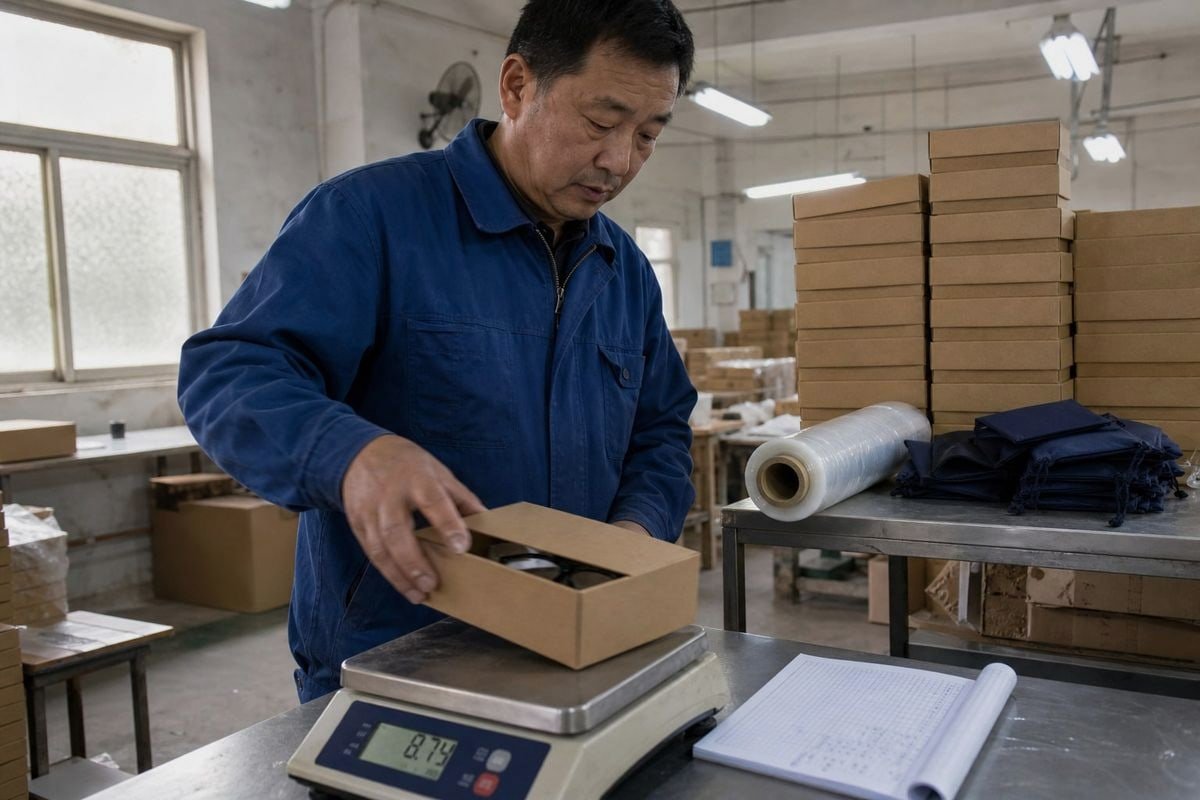
EPR packaging registration 1 for kids’ optical frames confuses many buyers who source from our Taizhou factory. Get it wrong, and your shipment stalls at customs. Get it right, and you sell freely.
To complete EPR packaging registration for kids’ optical frames from China, identify each market where you sell, confirm you are the obligated producer as the importer, collect packaging material and weight data from your manufacturer, register with each country’s national registry or Producer Responsibility Organization, then report volumes and pay fees annually.
That is the short version. Below, I will walk you through what EPR actually is, which countries enforce it, what data you need from your Chinese supplier, and how to avoid delays and fines.
What Is EPR Packaging Registration and Why Do I Need It for Imported Kids' Optical Frames?
A buyer from Germany once asked me why our factory had not "handled EPR" for her. That conversation taught me how misunderstood this rule is among eyewear importers.
EPR packaging registration is a legal requirement where the producer — usually the importer or brand owner, not the Chinese factory — registers packaging placed on a market, reports its materials and weights, and pays fees that fund packaging waste management, recycling collection, and national sustainability targets.
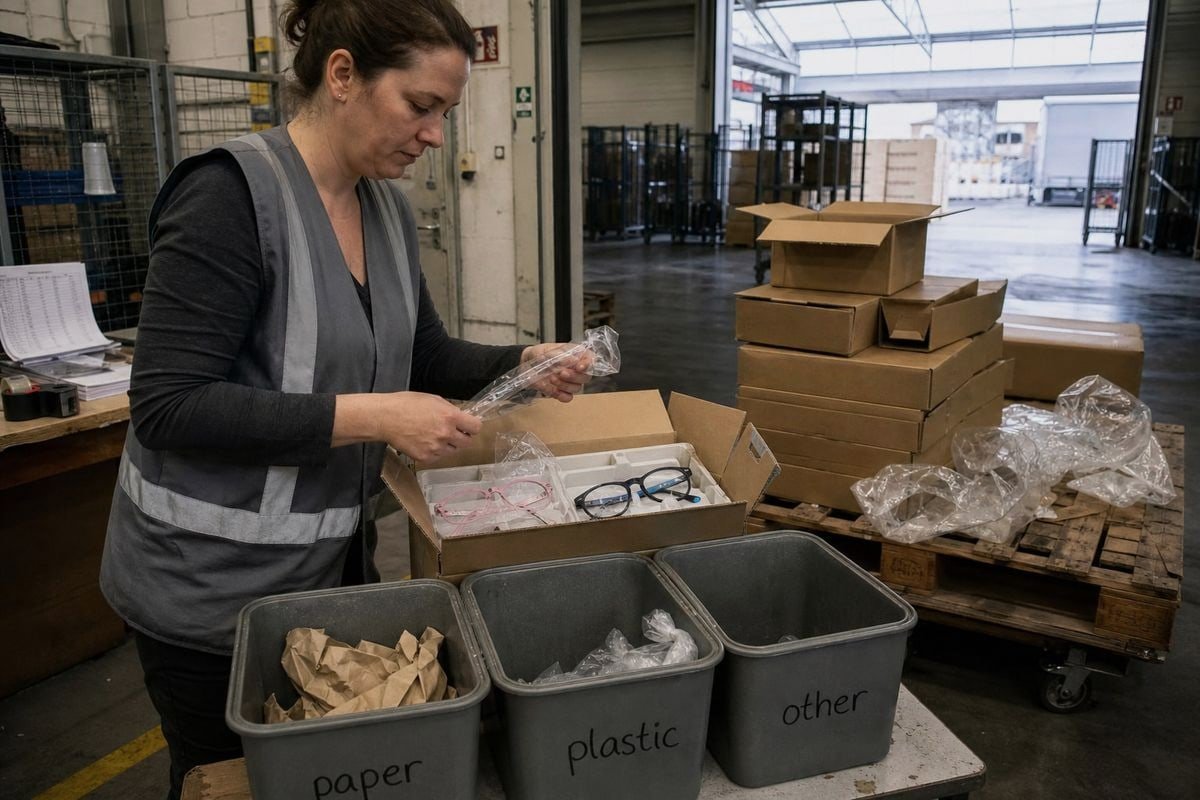
The core idea behind Extended Producer Responsibility 2 is simple. Whoever puts packaging into a country's market must pay for its end-of-life handling. For kids' optical frames, that means the boxes, pouches, mailers, and pallet wrap around the glasses — not the frames themselves.
Three Separate Compliance Issues (Don't Mix Them Up)
I see buyers confuse three different things all the time. They are related, but legally distinct:
| Compliance Area | Qué cubre | Who Is Responsible |
|---|---|---|
| Product compliance | The frames themselves (e.g., CE marking, safety standards for children's eyewear) | Manufacturer and importer together |
| Packaging EPR | Retail boxes, microfiber pouches, leaflets, mailers, cartons, pallet wrap | The importer or brand owner placing goods on the market |
| Customs/import duties | Tariffs, HS codes, import documentation | The importer of record |
Here is the point many sellers miss: the fact that your frames are made in China does not, by itself, trigger any EPR obligation. What triggers it is you first placing packaged goods on a local market under your name. Your Chinese factory usually has no direct EPR duty because it never places packaging on the destination market itself.
At our workshop, we ship roughly 800 existing styles of TR90 and TPEE children's frames to buyers in more than twenty countries. In almost every case, the buyer is the obligated producer. Our job is to supply accurate packaging data so their registration is correct — and that cooperation matters more than most buyers expect.
Which Countries Require EPR Compliance Before I Can Sell My Children's Eyewear?
When we onboard a new eyewear brand, one of my first questions is always the same: which markets are you selling into? The answer changes everything about EPR.
EPR packaging compliance is required in every EU member state (each with its own national packaging registry), in the UK through the government reporting service, and in a growing list of US states including California, Colorado, Oregon, and Minnesota. Registration is country-by-country or state-by-state, not global.

There is no single worldwide EPR registration. This surprises many new brands. One registration in Germany does nothing for France, and neither helps you in Oregon. Here is how the major markets compare:
| Mercado | How Registration Works | Key Notes |
|---|---|---|
| Germany | Register in the national packaging registry 3 before placing packaging on the market; join a system for household packaging | Registration is mandatory before first sale |
| France | Register with an authorised Producer Responsibility Organization 4, report sales, pay eco-contributions | Fees are eco-modulated by material |
| Reino Unido | Register via the government's packaging data reporting service or a compliance scheme; pay a registration fee | Small producers pay around £1,303; large producers around £2,842 annually |
| US (CA, CO, OR, MN) | Register with the designated compliance administrator or PRO, report packaging data, pay fees | State-by-state model; more states are joining |
| EU (all states, from Aug 2026) | El Packaging and Packaging Waste Regulation 5 adds stricter rules on recyclability, recycled content, and design | Applies on top of national EPR schemes |
Two Trends You Should Plan Around
First, EPR is expanding geographically. More US states and more countries are adopting packaging laws each year, so a market that is exempt today may not be next season.
Second, fees are becoming modulated. The EU's Packaging Waste Regulation and several PROs already reward recyclable packaging materials with lower EPR fees and penalize hard-to-recycle formats. In our experience exporting to European kids' brands, buyers who choose simple mono-material boxes early save real money later.
One more practical note: if you have no legal entity in a target country, some schemes require you to appoint an authorised representative locally. Marketplace sellers sourcing from China are especially exposed here, because selling online does not exempt you from being the obligated producer.
What Packaging Information Do I Need from My China Manufacturer to Register Correctly?
Weighing packaging components on a scale next to our QC line is now a routine request from European buyers. Ten years ago, nobody asked. Today, data quality decides compliance.
You need a complete packaging inventory per SKU: every component (box, pouch, leaflet, mailer, tape, carton, pallet wrap), its material type (paper, plastic, film), its weight in grams, and whether it is household or transport packaging. Your manufacturer should provide this in a documented packaging specification.
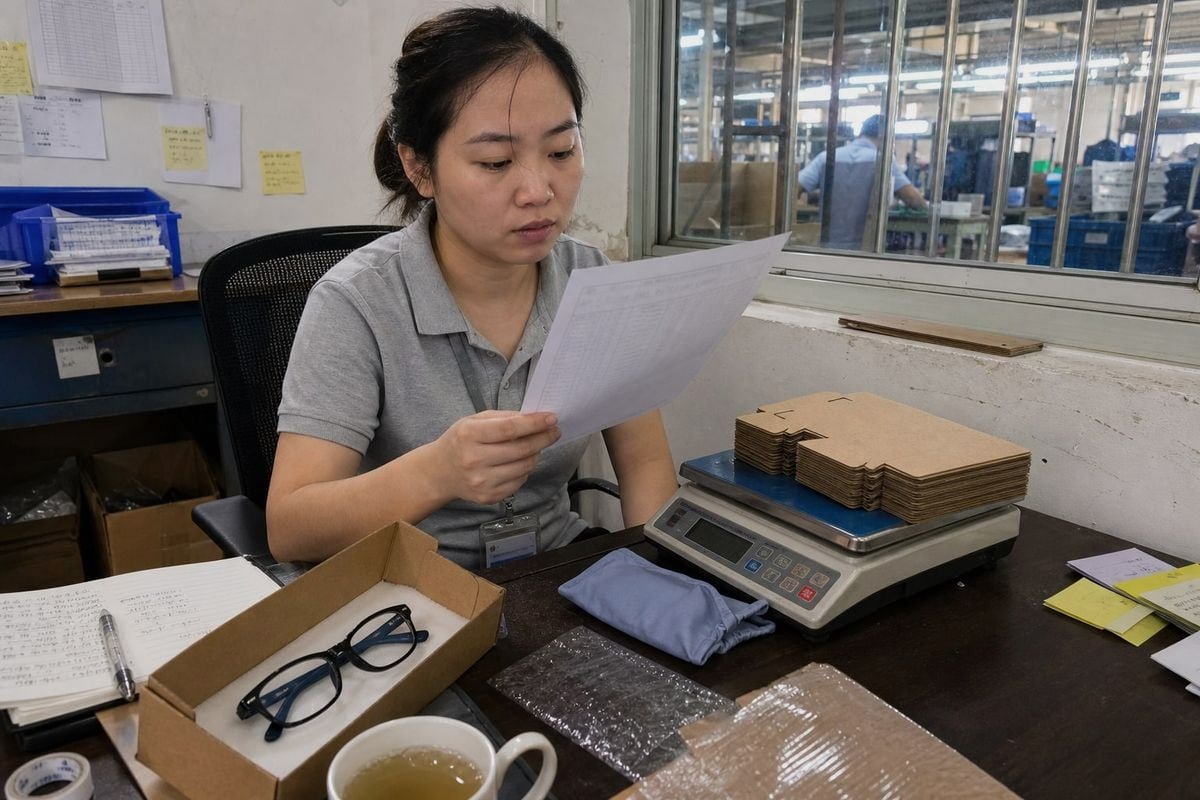
Regulators increasingly expect detailed packaging records, not rough estimates. This is where supply chain due diligence pays off. A cooperative factory can hand you audit-ready data; an uncooperative one leaves you guessing.
A Typical Kids' Optical Frame Packaging Breakdown
Take one of our popular styles — a glossy black TR90 front with flexible navy TPEE temples and silicone ear hooks, built for active kids. When it ships retail-ready, the packaging usually includes:
| Componente | Material Típico | EPR Category | Data Needed |
|---|---|---|---|
| Caja de venta al por menor | Cardboard/paper | Household packaging | Weight per unit (g) |
| Microfiber pouch or cloth | Textile/polyester | Often product accessory — check local rules | Weight, classification |
| Instruction leaflet | Paper | Household packaging | Weight per unit (g) |
| Polybag or protective sleeve | LDPE plastic film | Household packaging | Weight per unit (g) |
| Master carton | Corrugated cardboard | Transport/commercial packaging | Weight per carton, units per carton |
| Tape and labels | Plastic/paper | Transport packaging | Weight (can be estimated per carton) |
| Pallet wrap | LDPE stretch film | Transport packaging | Weight per pallet |
How to Request This from Your Supplier
Ask for a written packaging specification sheet per SKU before production, not after arrival. At our factory, we prepare these for OEM/ODM clients as part of the custom packaging service, because we learned that buyers who wait until the reporting deadline end up weighing boxes in their warehouse with a kitchen scale.
Also ask two follow-up questions. First, is the material recyclable in your destination market? Recyclable packaging materials often attract lower eco-modulated fees. Second, will the packaging change mid-order? Any change in box size or pouch material changes your reported weights, so you need change notifications in writing.
If you sell across multiple channels — branded retail boxes to optical shops, mailer bags direct-to-consumer, bulk cartons to distributors — track each configuration separately. They carry different packaging profiles and different EPR fees.
How Can I Avoid Customs Delays or Fines When Importing EPR-Compliant Kids' Frames?
A shipment of translucent pink acetate-look frames once sat in a European port for two extra weeks because the buyer's registration number was missing from their paperwork. The frames were fine. The paperwork was not.
Register before your goods arrive, keep your EPR registration numbers on file and on invoices where required, ensure packaging data matches your customs declarations, appoint an authorised representative where you lack a local entity, and submit reports and pay EPR fees on schedule to avoid seizures, fines, or blocked market access.
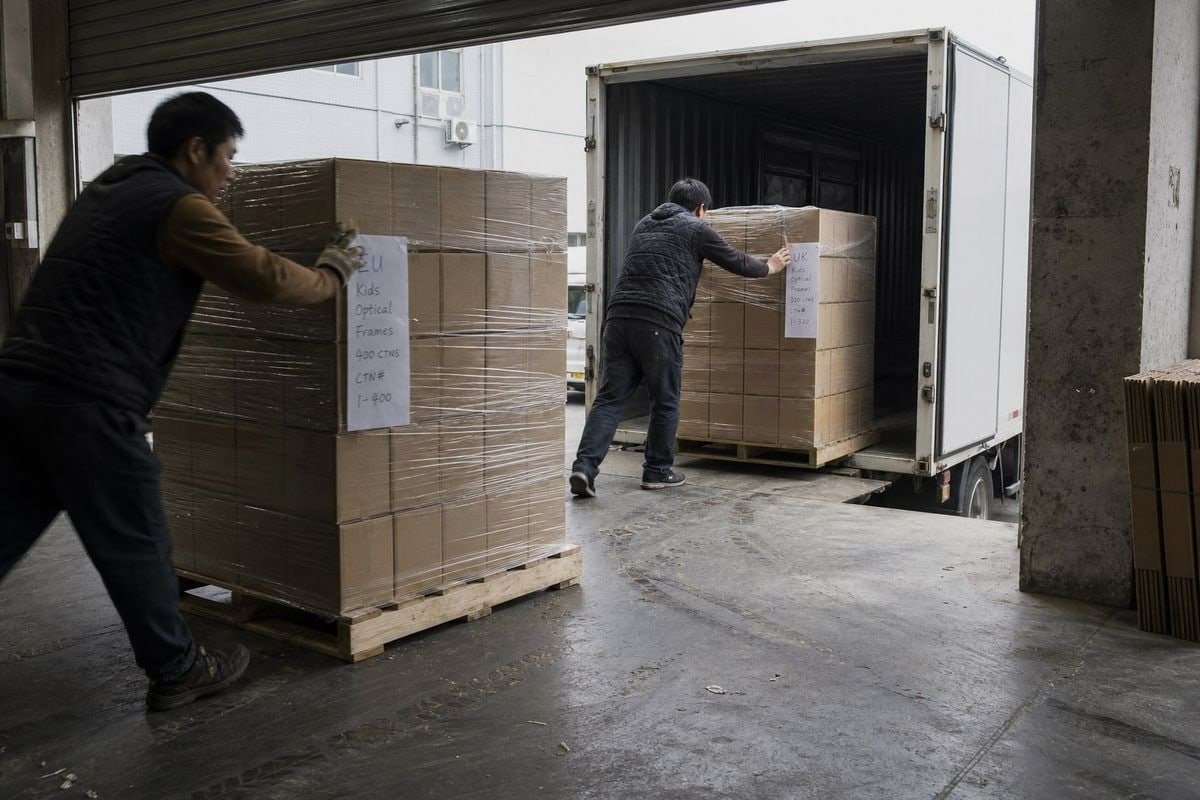
Non-compliance penalties are real: customs delays, product seizures, significant fines, and in some markets, outright sales bans. The good news is that a clear process prevents nearly all of them.
An Eight-Step Compliance Workflow
- List every market where your kids' frames will be sold, including marketplace sales.
- Confirm whether you are the obligated producer in each market. As the importer, you usually are.
- Build a packaging inventory for every SKU using your manufacturer's specification sheets.
- Check local thresholds. Some schemes distinguish small and large producers, with different fees and reporting duties.
- Register before first sale — with the national packaging registry, the government portal, or a PRO, depending on the market.
- Report packaging weights and sales volumes on the required schedule.
- Pay EPR fees and keep records for renewals and audits.
- Review annually, because thresholds, fees, and covered states change.
Design Decisions That Reduce Risk and Cost
EU import compliance is heading toward design-for-recyclability as the default. Under the incoming Packaging Waste Regulation, packaging design, recycled content, and recyclability all face stricter requirements by 2026. Future schemes will increasingly penalize non-recyclable formats, and some proactive brands now run life cycle assessments on packaging choices to optimize both fees and their sustainability claims.
Practically, that means choosing mono-material boxes, avoiding mixed laminates, and minimizing plastic film where possible. When we develop custom retail packaging for children's eyewear brands, we now raise this at the design stage rather than after the quote. Digital tracking is also coming: emerging tools like Digital Product Passports may soon fold packaging data into per-batch records, so building clean data habits now is an investment, not a burden. In the eyewear industry, compliance maturity is quickly becoming a competitive signal that retail partners look for.
Conclusión
EPR packaging registration falls on you, the importer — not your Chinese factory. Map your markets, collect accurate packaging data, register early, and report on time. A cooperative manufacturing partner makes every step easier.
Notas al pie
1. Authoritative legal firm providing relevant content on EPR packaging laws and registration requirements. ↩︎
2. Official definition and importance of Extended Producer Responsibility from a UN body. ↩︎
3. Official website for Germany’s national packaging register (LUCID), crucial for compliance. ↩︎
4. Defines Producer Responsibility Organizations and their role in fulfilling EPR obligations. ↩︎
5. Official EUR-Lex link to the full text of Regulation (EU) 2025/40 on packaging and packaging waste. ↩︎
Más artículos que te podrían gustar
5 de agosto de 2026
Bio-Based vs Regular Cellulose Acetate: What's the Difference for Kids' Frames?

5 de agosto de 2026
How Recyclable Are Kids' Optical Frame Materials, and What Eco-Friendly Alternatives Exist?
5 de agosto de 2026
Do Kids Optical Frames Whiten or Age in Storage, and How to Control Warehouse Conditions?
¿Buscas un socio confiable en gafas para niños?
Explore más de 800 estilos listos y soporte OEM/ODM completo adaptado a su marca.
Ponte en contacto English
  Español de México
  Deutsch
  Français
  日本語
日本語  العربية
  Português do Brasil