How Do Boys’ and Girls’ Sunglasses Sizing Ratios Differ?
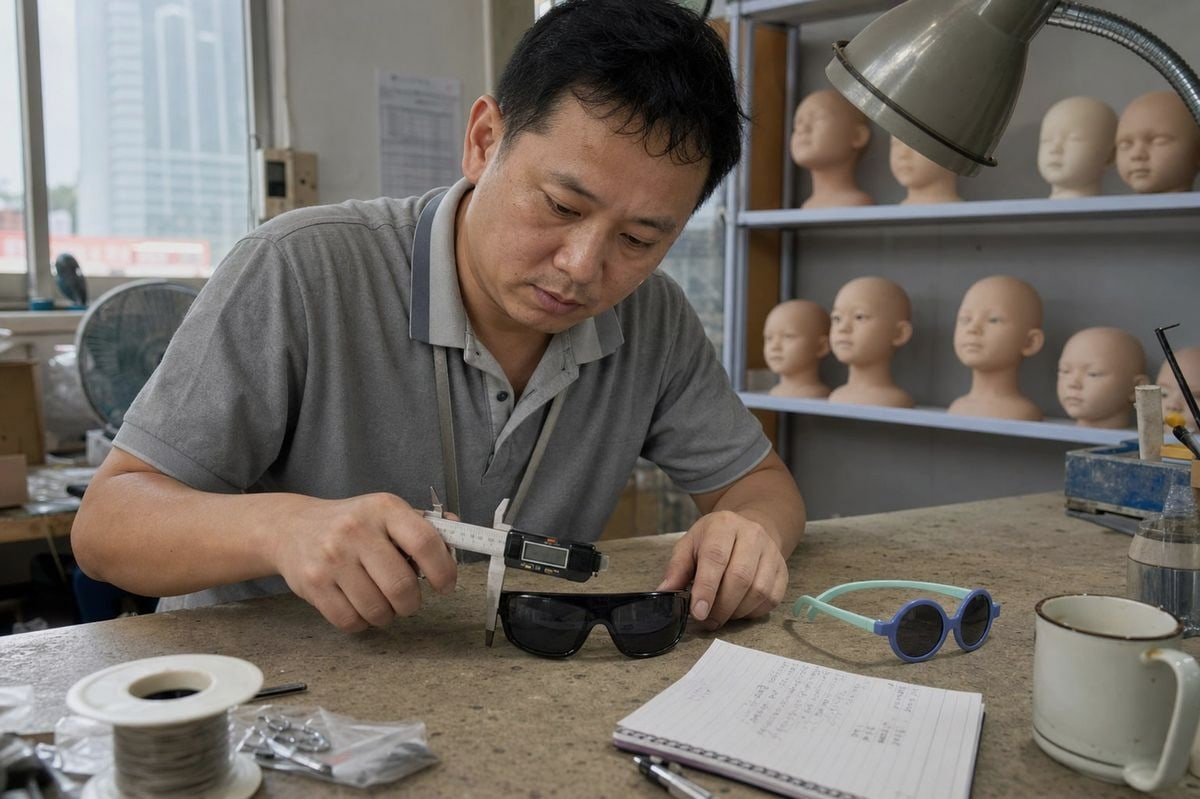
Buyers ask me about boys’ and girls’ sunglasses sizing ratios almost weekly. Get the ratios wrong, and returns pile up, reviews suffer, and your kids’ eyewear launch stalls before it starts.
Boys’ and girls’ sunglasses sizing ratios do not differ in any strict, universal way. Fit is driven by lens width, bridge width, and temple length, which scale with age and face size. Gender labels mostly reflect styling and average facial proportions, not separate measurement standards.
That is the short answer. But if you are developing a kids’ sunglasses line, you need more detail. Below, I break down frame widths, age-based ratios, unisex molds, and manufacturing consistency.
How do I determine the right frame width range for boys' versus girls' sunglasses collections?
During a sampling round for a European baby brand last spring, our team measured dozens of children's head templates in our Taizhou workshop. The frame width data told one clear story: age matters far more than gender.
Determine frame width by age bracket and face width, not gender. For children under 12, boys' and girls' faces are anatomically similar, so use one shared width range per age group: roughly 105–115 mm total frame width for toddlers, 115–125 mm for ages 4–7, and 120–130 mm for ages 8–12.

Pre-pubescent facial morphology is remarkably consistent across sexes. A five-year-old boy and a five-year-old girl typically share almost identical head circumference 1, pupillary distance 2, and nose bridge shape. So when we help brands plan a collection, we advise them to build width ranges around age, then differentiate the "boys" and "girls" lines through color, decoration, and frame shape.
The three measurements that actually control fit
Every frame we produce is defined by three numbers. Lens diameter (or lens width) sets how much of the eye area is covered. Bridge width controls where the frame sits on the nose. Temple length determines whether the arms reach comfortably behind the ears. These frame dimensions—not the gender tag on the hangcard—decide whether a child keeps the sunglasses on.
Practical width ranges we recommend to buyers
| Grupo de edad | Lens Width | Bridge Width | Temple Length | Typical Total Frame Width |
|---|---|---|---|---|
| 0–2 (baby) | 35–38 mm | 12–14 mm | 105–115 mm | 100–112 mm |
| 2.5–4 (toddler) | 40–42 mm | 13–15 mm | 110–120 mm | 108–118 mm |
| 4–7 (junior) | 43–45 mm | 14–16 mm | 115–125 mm | 115–124 mm |
| 7–10 | 45–47 mm | 15–17 mm | 120–130 mm | 120–128 mm |
| 10–16 (teen) | 47–52 mm | 16–18 mm | 125–135 mm | 125–135 mm |
Notice there is no separate boys' column or girls' column. In our 15 years of eyewear production, we have never cut a mold that was dimensionally "for girls only" in the under-10 range. What changes between a boys' collection and a girls' collection is the aesthetic layer: a glossy black wraparound sport shield reads "boys" on many retail shelves, while a soft periwinkle round frame with mint temples reads "girls"—yet both can share nearly identical frame dimensions underneath.
What age-based sizing ratios should I follow when developing a kids' sunglasses line?
One trade-off we weigh constantly on our production line is coverage versus centering. A lens that is too wide for a small pupillary distance pushes the optical center outward, and the sunglasses look and feel wrong on the child.
Follow a graduated ratio: lens width grows from 35–37 mm at ages 0–1 to 47–52 mm by ages 10–16, with bridge width and temple length scaling proportionally. Keep the lens-to-bridge ratio lower than adult frames so lenses stay centered over smaller pupillary distances.
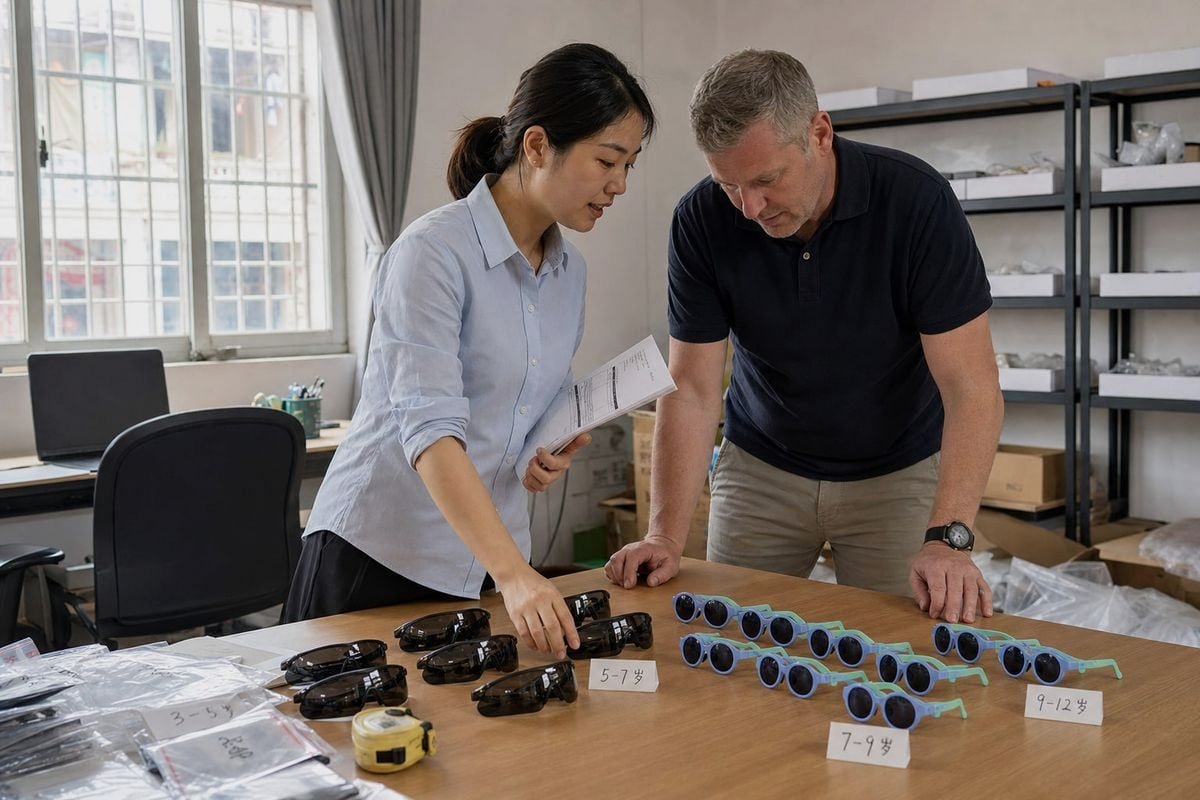
Age-based sizing is the backbone of any children's line. Kids' eye size and pupillary distance grow steadily, so a well-planned collection covers each growth stage without gaps or overlaps that confuse retailers.
The key ratios behind the numbers
Children's frames need a lower lens-width-to-bridge-width ratio than adult frames. Why? A toddler's pupillary distance is small, but the nose bridge is flat and underdeveloped. If you copy adult proportions, the frame slides down and the lenses sit too far apart. That is why we mold wider, softer bridge contact areas—and why flexible TPEE 3 bridges outperform rigid plastics on small noses that lack a defined nose bridge shape.
Temple length also runs deliberately “oversized” relative to frame width in kids’ designs. Children grow fast. Slightly generous temple length, combined with flexible tips, lets a frame survive a growth spurt 4 without pinching behind the ears. Our TR90 5 frames with TPEE temples flex outward safely for exactly this reason.
A ratio roadmap for line planning
| Growth Stage | Lens Width | Lens-to-Bridge Ratio (approx.) | Key Design Priority |
|---|---|---|---|
| Baby (0–2) | 35–38 mm | ~2.7:1 | Flat, wide bridge contact; soft materials |
| Toddler (2.5–4) | 40–42 mm | ~2.9:1 | Flexibility; impact safety |
| Junior (4–7) | 43–45 mm | ~3.0:1 | Retention during active play |
| Pre-teen (7–10) | 45–47 mm | ~3.0:1 | Style variety; durability |
| Teen (10–16) | 47–52 mm | ~3.1:1 | Transition toward adult proportions |
For comparison, adult women's frames often run 49–53 mm lens width with a 16–18 mm bridge, while men's run 54–58 mm with an 18–21 mm bridge. Genuine gender divergence in sizing ratios only begins around age 12 or later, when boys develop a broader brow and wider bridge-to-temple needs, and girls' pupillary distance tends to plateau earlier. If your line stops at age 10, one age-based ratio system serves everyone.
Can I use unisex sizing molds to cover both boys' and girls' fit needs?
A distributor in Australia once asked us to quote separate boys' and girls' tooling for the same round frame. We showed him our sample wall of roughly 800 existing styles, and he changed his plan—and saved a serious mold budget.
Yes. Unisex molds work well for children under 12 because facial dimensions are nearly identical across genders at those ages. One well-designed mold per age bracket covers both, and you differentiate collections through colorways, lens finishes, temple graphics, and packaging instead of separate tooling.
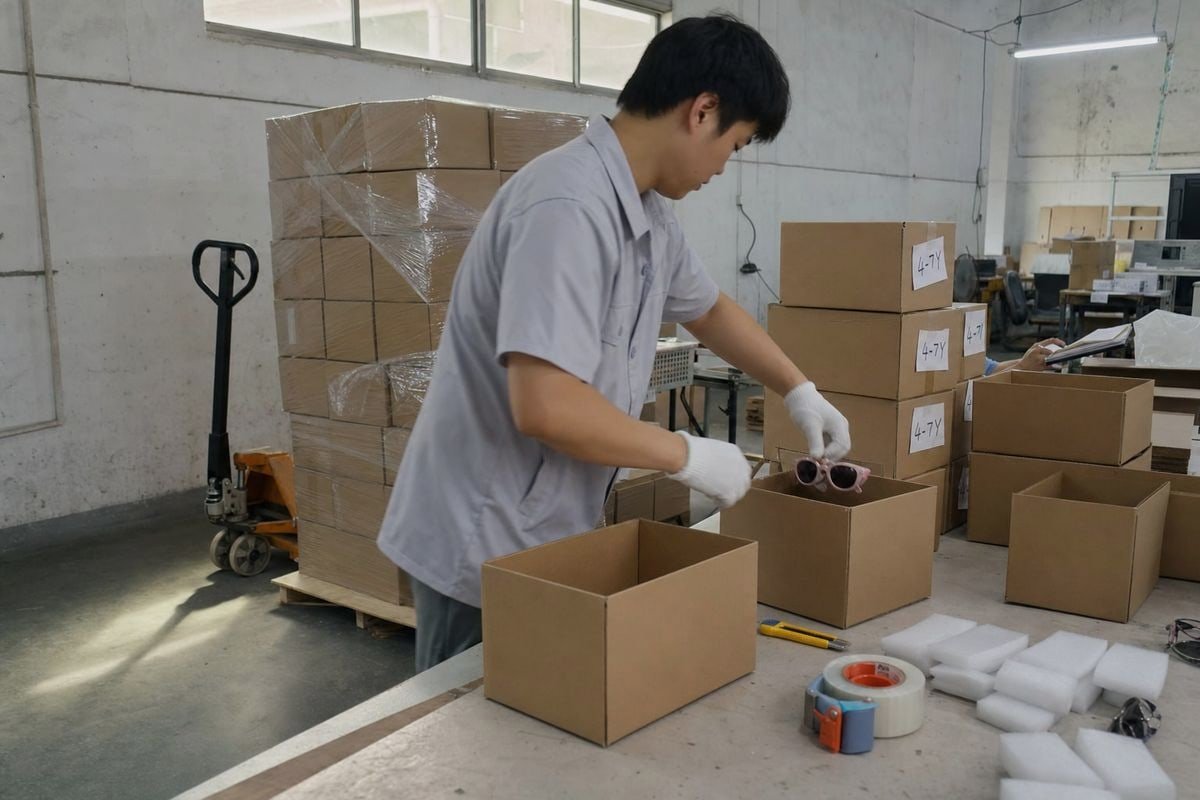
This is one of the most cost-effective decisions a new brand can make. Custom eyewear tooling is expensive. If you cut two molds where one would serve, you double your investment and split your minimum order quantities across near-identical products.
How one mold becomes two collections
Here is the process we typically walk buyers through:
- Select one base mold per age group. Choose from an existing style library or develop one custom shape. The frame dimensions stay constant.
- Split the colorways. Run the same mold in glossy black or white with mirrored gradient shield lenses for a sporty line, and in periwinkle-blue with mint-teal temples and round retro lenses for a softer line.
- Vary the lens treatment. A fiery orange-to-gold mirrored lens signals performance; a plain dark gray UV400 6 lens signals everyday casual. Same fit, different story.
- Differentiate packaging and accessories. Cases, pouches, and hangcards carry the gender-flavored branding while the frame itself stays neutral.
We produce sport wraparound shields and playful round two-tone frames from shared sizing logic all the time. The wraparound gets angular, aerodynamic styling; the round frame gets soft curves and gentle temple tips. Underneath, both respect the same bridge width and temple length targets for their age bracket.
Where unisex molds hit their limit
Above roughly age 12, consider offering two size runs—not "boys" and "girls," but "regular" and "wide." Teen boys often need extra bridge width and vertex clearance for a developing brow ridge, while many teen girls prefer frames with taller vertical lens proportions. Adjustable nose pads can extend one mold's fit range, though for young children we generally prefer molded flexible bridges, which have no small detachable parts.
How do I ensure consistent sizing accuracy across different children's face shapes when ordering from a manufacturer?
Early in my career here, a shipment taught me a lasting lesson: a frame can pass every dimensional check and still fit poorly if the wrap angle and bridge geometry were never specified. Since then, our QC checklist covers geometry, not just millimeters.
Ensure consistency by specifying tolerances for lens width, bridge width, temple length, and wrap angle in writing; approving a golden sample; requiring in-line dimensional checks against fit templates; and choosing flexible materials like TPEE and TR90 that adapt to varied face shapes within each size.
Children’s face shapes vary widely even within one age group. Some kids have wide faces with low nose bridges; others have narrow faces with prominent cheeks. A single frame cannot fit every child perfectly, but a disciplined manufacturing process ensures every unit fits the way the approved sample fits.
What to lock down before mass production
| Punto de control | What to Specify | Por qué importa |
|---|---|---|
| Golden sample | Signed reference unit for all dimensions | Removes ambiguity between buyer and factory |
| Dimensional tolerance | Typically ±0.5 mm on lens, bridge, temple measurements | Keeps every batch within fit range |
| Wrap and tilt angles | Face-form wrap and pantoscopic tilt targets | Controls how the lens sits against cheeks and brows |
| Material flex spec | TPEE/TR90 flexibility and return behavior | Lets one size adapt to wide and narrow faces safely |
| Fit-template check | Frames tested on standardized head forms | Catches geometry drift that calipers miss |
Why material choice is a sizing tool
Rigid frames must fit precisely or they fail. Flexible frames forgive. This is why we build most children's styles in TR90 with TPEE temples: the material stretches over a wider head circumference, then returns to shape, and it will not snap into sharp edges during rough play. In practice, that flexibility widens each size's effective fit window, so one accurate mold serves more face shapes without compromising comfort or safety.
Also insist on process discipline. In our taller gestionado con 5S 7, dimensional checks happen during injection, during assembly, and at final inspection—not only at the end. Ask any supplier to describe their in-line checkpoints. If they can only describe a final random inspection, sizing drift between batches becomes your risk, not theirs.
Conclusión
Boys' and girls' sunglasses sizing ratios are not truly different for children. Measure by age, lens width, bridge width, and temple length—then let styling, not tooling, tell the gender story.
Notas al pie
1. Authoritative WHO standards for child head circumference growth charts. ↩︎
2. Explains the anatomical measurement that determines lens centering and bridge fit in children’s frames. ↩︎
3. Background on thermoplastic elastomer materials like TPEE used in flexible children’s eyewear bridges. ↩︎
4. NIH-backed resource on childhood growth patterns relevant to sizing frames for growth spurts. ↩︎
5. Authoritative Wikipedia entry for Nylon 12, the chemical basis of TR90 eyewear material. ↩︎
6. Authoritative WHO background on UV radiation exposure that UV400 lenses are designed to block. ↩︎
7. Background on the 5S manufacturing methodology referenced for maintaining production quality discipline. ↩︎
Más artículos que te podrían gustar

1 de agosto de 2026
¿Debería la fábrica encargarse del embalaje y etiquetado de las gafas de sol para niños, o utilizar un proveedor designado?

1 de agosto de 2026
Almacén propio vs. Cumplimiento directo del proveedor: ¿Qué reduce los costos de devolución para las marcas de gafas de sol para niños?

1 de agosto de 2026
Directo al almacén del puerto o staging en el extranjero: ¿Cuál ahorra más en el envío de gafas de sol para niños?
¿Buscas un socio confiable en gafas para niños?
Explore más de 800 estilos listos y soporte OEM/ODM completo adaptado a su marca.
Ponte en contacto English
  Español de México
  Deutsch
  Français
  日本語
日本語  العربية
  Português do Brasil