What Are the Fragment Risks in TR90 & TPEE Kids Sunglasses, and How to Handle Them?
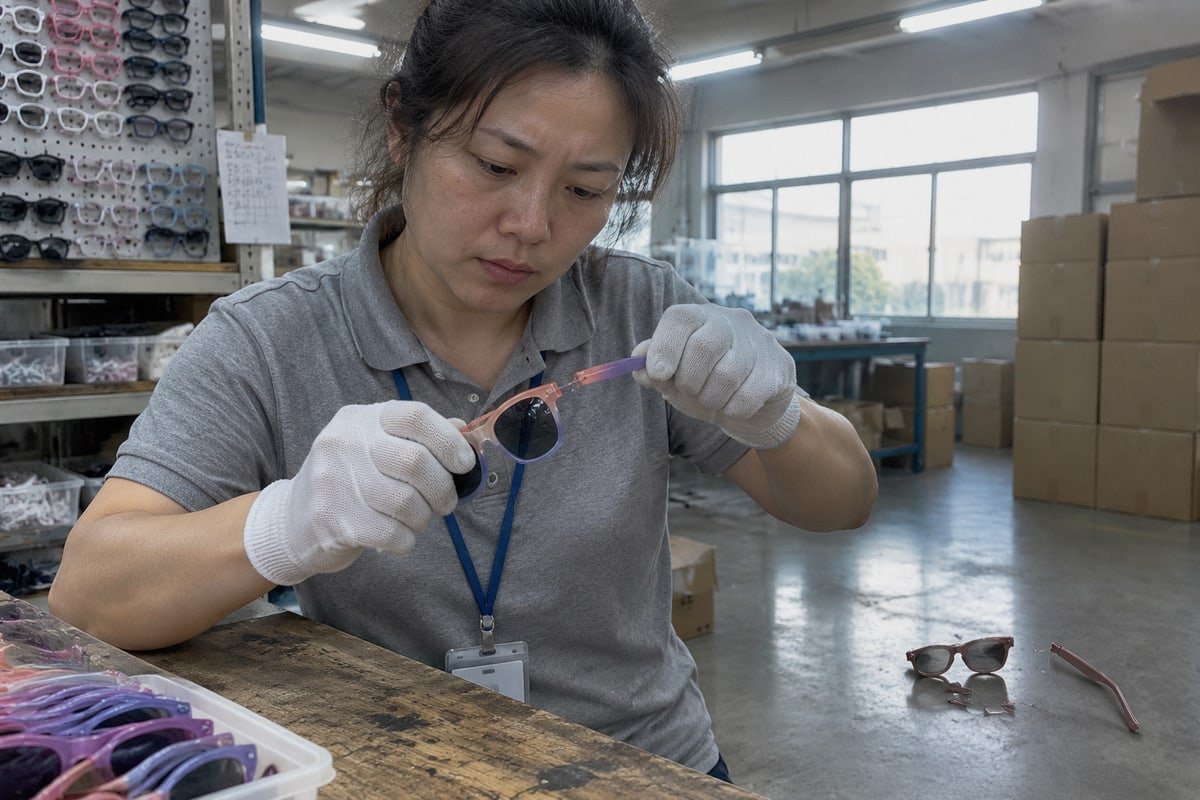
Buyers ask me about fragment risks in TR90 & [TPEE](https://okayeyewear.com/tpee-vs-tr90-pc-material-best-kids-sunglasses/) kids sunglasses daily. One sharp shard can sink a brand. Our Taizhou line tackles this before the first sample ships.
Fragment risks in TR90 & TPEE kids sunglasses come mainly from cracked lenses, loosened screws, detached nose pads, and fatigued TR90 hinges, not the flexible polymer itself. Handle them by specifying impact-resistant polycarbonate lenses, screwless or secured hardware, verified lab testing, and strict sample inspection before mass production.
This article walks through the four questions I hear most from brand owners and procurement teams. I will explain where the frames really fail, which reports to ask for, how to judge a factory, and what to check in your samples. Each section ends with something you can act on this week.
How can I confirm TR90 and TPEE frames won't shatter or splinter if my child falls or plays roughly?
Last month our QC team bent a TR90 sample temple past ninety degrees, then dropped it onto concrete. The frame held. A cheaper rival sample split at the hinge.
You confirm it by asking for bend, drop, and hinge-cycle test results, checking the frame for stress whitening after flexing, and choosing TPEE for toddlers because it tears rather than snaps. TR90 resists impact well but can fatigue into sharp shards at thin hinges and bridges.
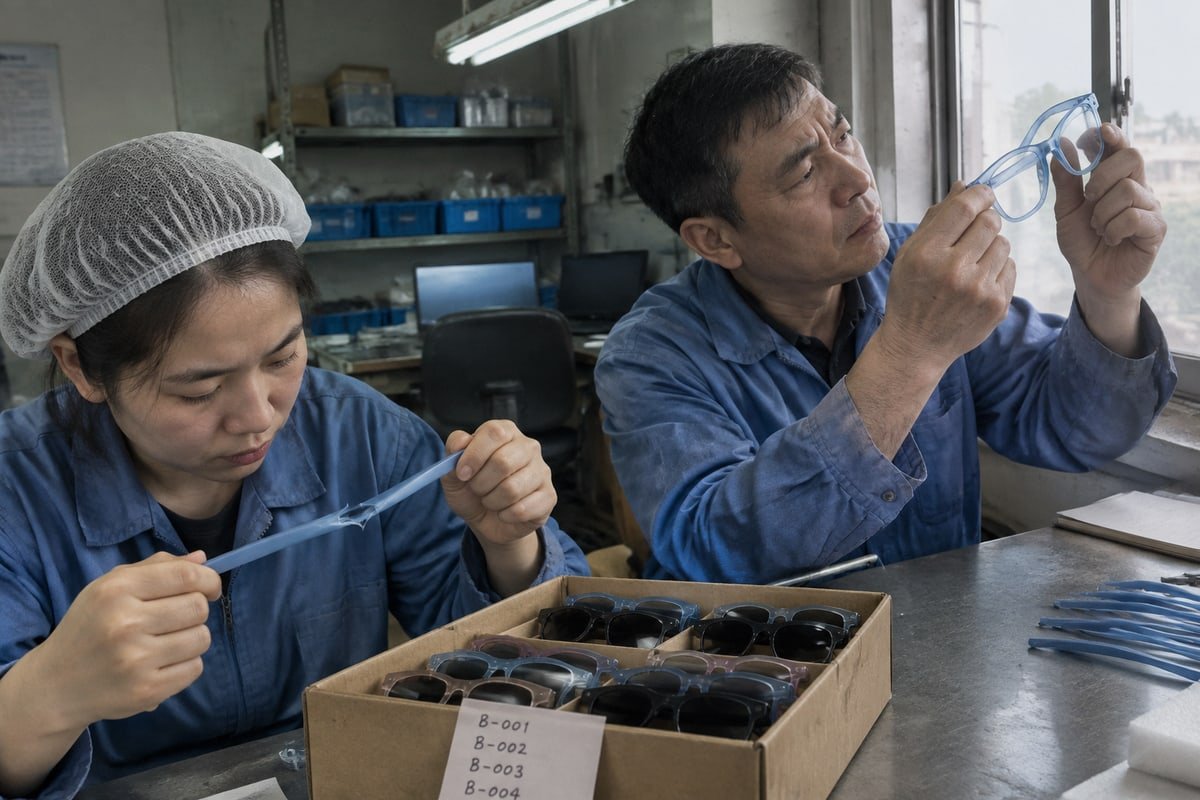
How the two materials actually fail
The honest answer starts with a comparison. The two polymers behave very differently when they finally give up.
| Faktor | TR90 (memory plastic frames) | TPEE (thermoplastisches Polyesterelastomer 1) |
|---|---|---|
| Typischer Fehler | Bends far, then can snap at its fatigue limit into jagged shards | Bends or tears; rarely leaves a sharp edge |
| Weakest points | Hinges and bridge, where the wall is thinnest and stress concentrates | Mostly uniform; joints only if metal parts are added |
| Warnzeichen | Stress whitening: cloudy, pale lines in the plastic | Surface tearing or permanent stretch |
| Kaltes Wetter | Higher glass transition temperature, so stiffer and more brittle below zero | Stays elastic in winter play |
| Chemical exposure | Sunscreen and DEET repellent can trigger Umgebungsbedingten Spannungsrissen 2 | More tolerant, but still worth checking |
| Lens on failure | A rigid snap can eject the lens | Elasticity keeps the lens seated |
| Sicherheitsverhalten | School-age and sports fronts | Infants, toddlers, temples, chewable styles |
TR90 earns its "memory plastic" name. It springs back to shape after twisting. That flexibility is real, and its impact resistance is good. But every polymer has a fatigue limit. Our engineers see the first damage at the hinge and bridge, where the wall is thin. When TR90 finally lets go, it can leave shards that cut skin. TPEE has lower tensile strength but far more stretch, so it tears instead. This is exactly why so many of our styles pair a TR90 front with TPEE temples. The front keeps the lens rigid and safe. The temples take the abuse.
Why flexible does not equal fragment-proof
You will read listings that call these frames "virtually indestructible" or "safe even when chewed." I understand why parents like that language. I do not use it. No frame is 100% unbreakable. Long UV exposure causes photo-degradation in TR90, which breaks down the polymer chains. The frame looks fine but snaps under far less force than when new. Poor drying of resin before molding, recycled regrind, and thin-walled designs make this worse. So confirmation never comes from adjectives. It comes from test evidence and from the failure mode you can see with your own hands.
The lens matters more than the frame
FDA guidance places the legal weight on the lens. Children's sunglasses in the US must use impact-resistant lenses that are actually tested. A perfect TPEE frame with a brittle acrylic lens still produces fragments. We fit shatterproof lenses, normally polycarbonate lenses, and we check that the lens groove is deep enough that flexing the front does not pop the lens loose. Ask your supplier to show you both: the frame flex behavior and the lens retention after that flex.
What certifications and lab tests should I request to verify fragment safety before placing a bulk order?
A procurement manager from Melbourne once emailed us a single question: which test report proves the lens won't shatter? Her caution was right.
Request an impact-resistance lens report (FDA drop-ball for the US, ISO 12312-1 for Europe, AS/NZS 1067 for Australia), an ASTM F963 or EN 71 small-parts and mechanical test, a UV400 transmittance report, and a material safety declaration covering BPA-free, phthalate-free compounds.
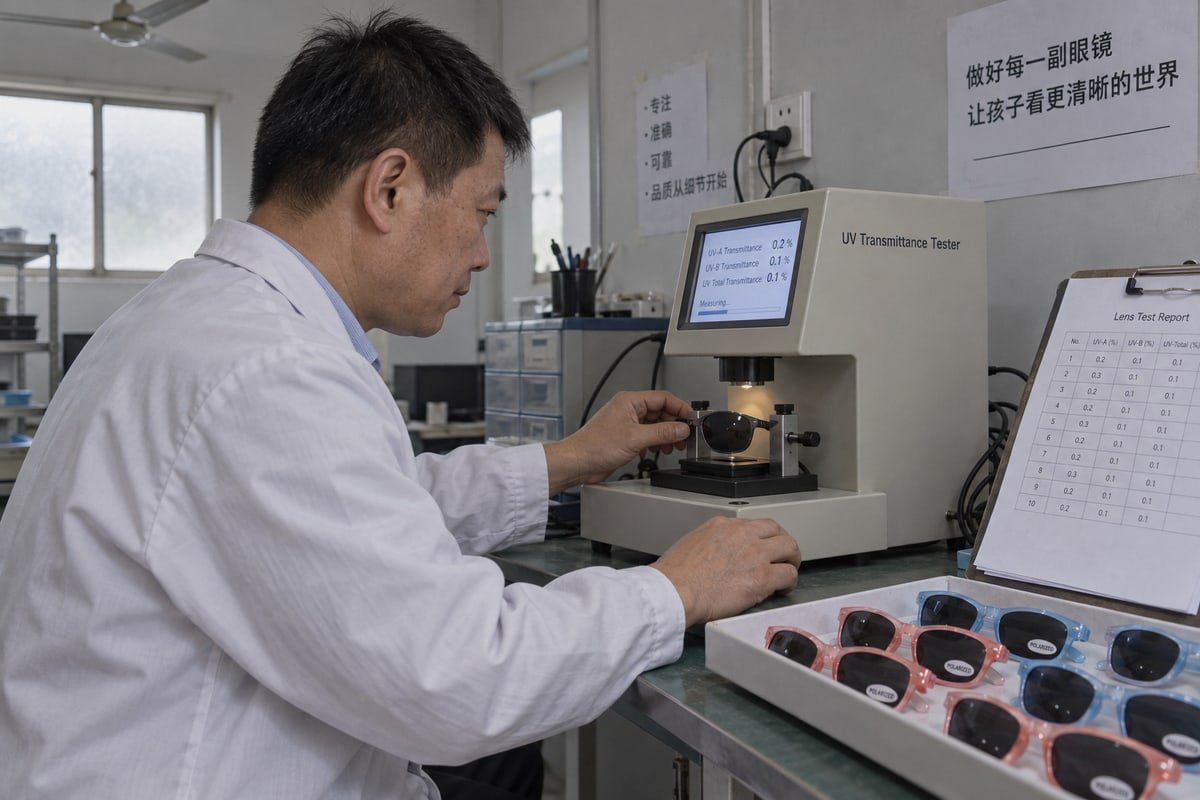
The reports that actually cover fragments
Not every certificate speaks to fragment safety. Here is how I sort them for buyers.
| Was zu beantragen ist | Was es verifiziert | Fragment risk covered | Main market |
|---|---|---|---|
| Lens impact test (FDA drop-ball method) | Lens survives a falling steel ball | Lens cracking into shards | Vereinigte Staaten |
| nur ISO 12312-1 3 | Optical, UV, and mechanical requirements for sunglasses | Lens robustness, frame durability | Europe and many export markets |
| AS/NZS 1067 | Sunglass performance and labeling | Lens and UV | Australien, Neuseeland |
| ANSI Z80.3 | Anforderungen an nicht-verschreibungspflichtige Sonnenbrillen | Impact and optics | Vereinigte Staaten |
| ASTM F963 or EN 71-1 | Small parts, sharp edges, tension and torque on components | Choking hazard safety, sharp fragments | Children's products globally |
| UV400-Transmissionsbericht | Lens blocks up to 400 nm | Not fragment related, but must be paired | Alle Märkte |
| Material declaration or SDS | Resin grade, BPA-free materials, phthalate-free compounds | Brittleness from poor or recycled resin | Alle Märkte |
Why a sticker is not a report
Look at the small lens sticker on many samples, including ours. It often reads "Polarized" and "CE." A CE mark is a declaration by the seller. It is not a lab certificate. The polarized label tells you about glare, not impact resistance. So ask for the document behind the mark. A real report names the lab, shows the date, and includes a photo of the tested item that matches your SKU and color. If the front is a translucent gradient and the tested item was an opaque black, ask again. Pigments and clear finishes change how a resin ages.
Tests that change with the child's age
For products aimed at children under three, the small-parts cylinder test in ASTM F963 compliance and EN 71-1 is not optional in my view. Nose pads, temple tips, screws, and decorative charms must stay attached under pull and twist. This is where softer TPEE styles marketed to babies deserve extra scrutiny. Soft frames invite mouthing and pulling. Flexible does not mean sealed.
What we supply on our side
On our production line we keep resin datasheets for every lot and can share them. We support buyers who want their own third-party lab to test our samples against the standard for their market. And when a customer changes a color or a lens option, we recommend a retest rather than reusing an old report.
How do I choose a reliable manufacturer that controls fragment risks through material quality and production standards?
Choosing between virgin-grade TR90 pellets and cheaper regrind is a trade-off we face every quarter. Regrind saves money. It also cuts tensile strength and invites brittleness.
Choose a factory that uses virgin, traceable TR90 and TPEE resin, controls injection temperature and cooling, offers screwless or riveted hardware, runs hinge, bend, and drop tests in-house, and documents each lot. Verify this through a factory audit, material datasheets, and consistent samples across repeat orders.
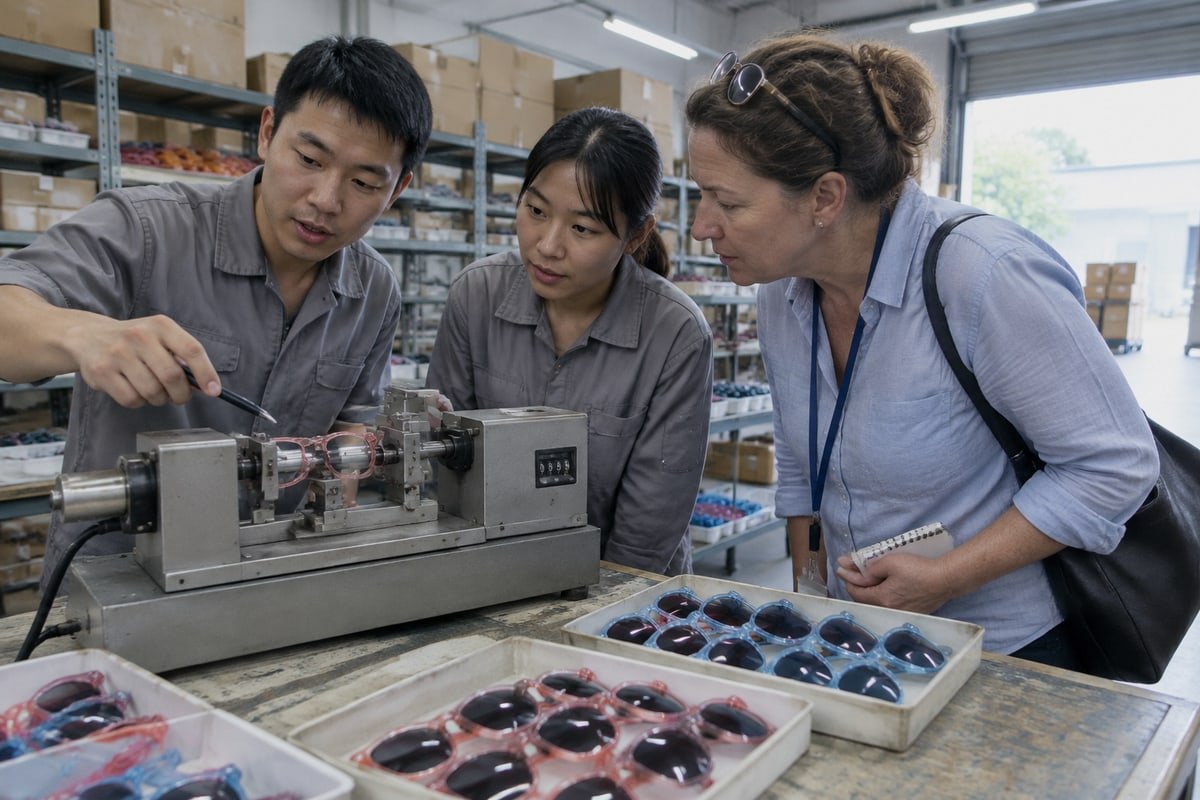
A six-step vetting process
Most fragment risks in TR90 & TPEE kids sunglasses are decided long before the product reaches a child. They are decided at the resin bag and the molding machine. Here is the order I would check things in.
- Ask where the resin comes from. You want virgin TR90 and TPEE with traceable lot numbers, BPA-free materials, and hypoallergenic properties for skin contact. Mixed regrind is the fastest route to invisible brittleness.
- Ask how the resin is dried and molded. TR90 is a polyamide and absorbs moisture. Skipping proper drying before injection leaves micro-voids that crack later. Temperature and cooling time should be set per mold, not guessed.
- Look at the hardware design. Monoblock TPEE styles with no metal screws remove a secondary projectile. Where a hinge is needed, a pressed metal rivet is harder for a child to loosen than a tiny screw.
- Ask about the in-house test routine. Bend, drop, hinge cycling, and lens push-out should happen on every new color, not once per mold.
- Check the style library and its history. We keep around 800 existing styles. Each has a production history, so a new brand can launch on a proven mold instead of paying for a new one and testing an unknown design.
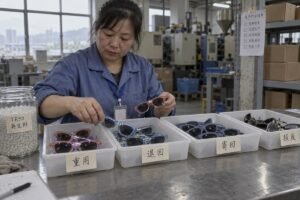
- Visit or audit. Our workshop runs about 120 workers under 5S management, with 15 years of eyewear experience. A real factory will let you watch the line.
Green flags versus red flags
| Signal | Grüne Flagge | Rote Fahne |
|---|---|---|
| Material answer | Datasheet by lot, named resin grade | "It's TR90, don't worry" |
| Preis | Explains the cost of virgin resin and testing | Far below market with no explanation |
| Design advice | Suggests TPEE temples or monoblock for toddlers | Pushes decorative charms and loose add-ons |
| Repeat orders | Samples match batch after batch | Wall thickness or color drifts between lots |
| Kommunikation | Shares failures and retests openly | Only shares marketing photos |
Why the price gap matters
We position ourselves as a long-term partner, not a low-price supplier. That is not a slogan. The price gap between two quotes is very often the resin gap. A frame that costs a little less because it uses regrind or skips drying will pass a visual check and fail a child. Full OEM/ODM support, custom colors, logos, lens options, and packaging only add value if the base flexible frame durability is right.
What should I check in samples and quality reports to catch fragment risks before mass production begins?
We learned years ago that a pretty sample can hide a weak bridge. Now every pre-production sample gets flexed, frozen, smeared with sunscreen, and inspected again.
Check the sample for stress whitening at hinges and bridge after repeated flexing, secure lens retention under twist, tight rivets or screwless joints, smooth edges, and no loose nose pads or tips. In reports, confirm lot-level resin certificates, lens impact results, small-parts pass, and UV400 data.

A hands-on sample test you can do at your desk
You do not need a lab for the first pass. You need ten minutes and a firm grip.
| Prüfen | Wie man es macht | Bestanden | Fehlschlag |
|---|---|---|---|
| Hinge flex | Open and close temples twenty times, then bend them outward | No whitening, returns to shape | Cloudy lines, sloppy hinge |
| Bridge twist | Twist the front gently in both directions | Springs back cleanly | Whitening, creaking sound |
| Linsensitz | Press each lens from behind with a thumb | Stays seated | Pops or shifts |
| Rivet or screw | Wiggle the hinge side to side | Zero play | Rattle or movement |
| Nose pads and tips | Pull firmly on every attached part | Stays attached | Detaches or stretches loose |
| Edges | Run a fingertip along rims and lens edges | Smooth | Burr, flash, sharp lip |
| Cold check | Chill briefly in a household freezer, then flex | Still flexible | Stiff, cracks, or snaps |
| Chemical check | Dab sunscreen or DEET repellent on the temple, leave overnight | No crazing | Fine surface cracks |
Notice what the sample looks like, too. On our translucent gradient fronts, whitening shows up quickly because the plastic is clear. On solid matte temples it is easier to miss, so bend those a little further and look under strong light.
Reading the quality report
A pre-shipment inspection report should classify defects. I tell buyers to set zero tolerance for critical defects: sharp edges, loose lenses, detached small parts, and visible stress marks. Then look for the paperwork behind the batch. The resin certificate should match the lot used, not a generic sheet. The lens impact result should name the lens material and thickness. The small-parts result should state the age grade. The UV400 protection reading should come from the same lens supplier and tint you approved.
The handling protocol to pass on to families
Fragment risk does not stop at your warehouse. We help brands print simple care guidance on retail-ready packaging, and this is what it should say. Replace the pair after a hard drop, a major bend, or any lens scratch or crack. Never glue a broken frame; these polymers are porous and adhesive repairs fail without warning. Check hinges, nose pads, and lens seating weekly. Store the pair in a case so scratches do not weaken the lens. And keep sunscreen and insect repellent off the frame where you can. These small habits turn a good product into a safe one over its full life.
Schlussfolgerung
Fragment risks never fully disappear, and one failure damages trust. Yet careful materials, tested lenses, and disciplined sampling shrink them. We build kids' eyewear that way in Taizhou.
Interessiert an der Beschaffung der in diesem Artikel erwähnten Produkte? Details und Angebotsanfrage hier:
Fußnoten
1. Background reference explaining TPEE polymer class properties discussed in article ↩︎
2. Wikipedia explains the polymer failure mechanism caused by chemical exposure mentioned ↩︎
3. Official ISO standard defining sunglasses optical and mechanical requirements ↩︎
Weitere Artikel, die Ihnen gefallen könnten

September 2026
Können TR90 & TPEE Kinder-Sonnenbrillen recycelte oder biobasierte Materialien verwenden?
September 2026
Sind TR90 & TPEE Kinder-Sonnenbrillen recycelbar? Entsorgungstipps erklärt?

September 2026
Wie vermeidet man Verformungen und Kratzer beim Versand von TR90 & TPEE Kinder-Sonnenbrillen?
Auf der Suche nach einem zuverlässigen Partner für Kinderbrillen?
Entdecken Sie über 800 sofort verfügbare Modelle und umfassenden OEM/ODM-Support, der auf Ihre Marke zugeschnitten ist.
Kontakt aufnehmen English
 Español de México
 Deutsch
 Français
 日本語
 العربية
 Português do Brasil