Does a TR90 & TPEE Kids Optical Frame Ensure Safety on Impact?
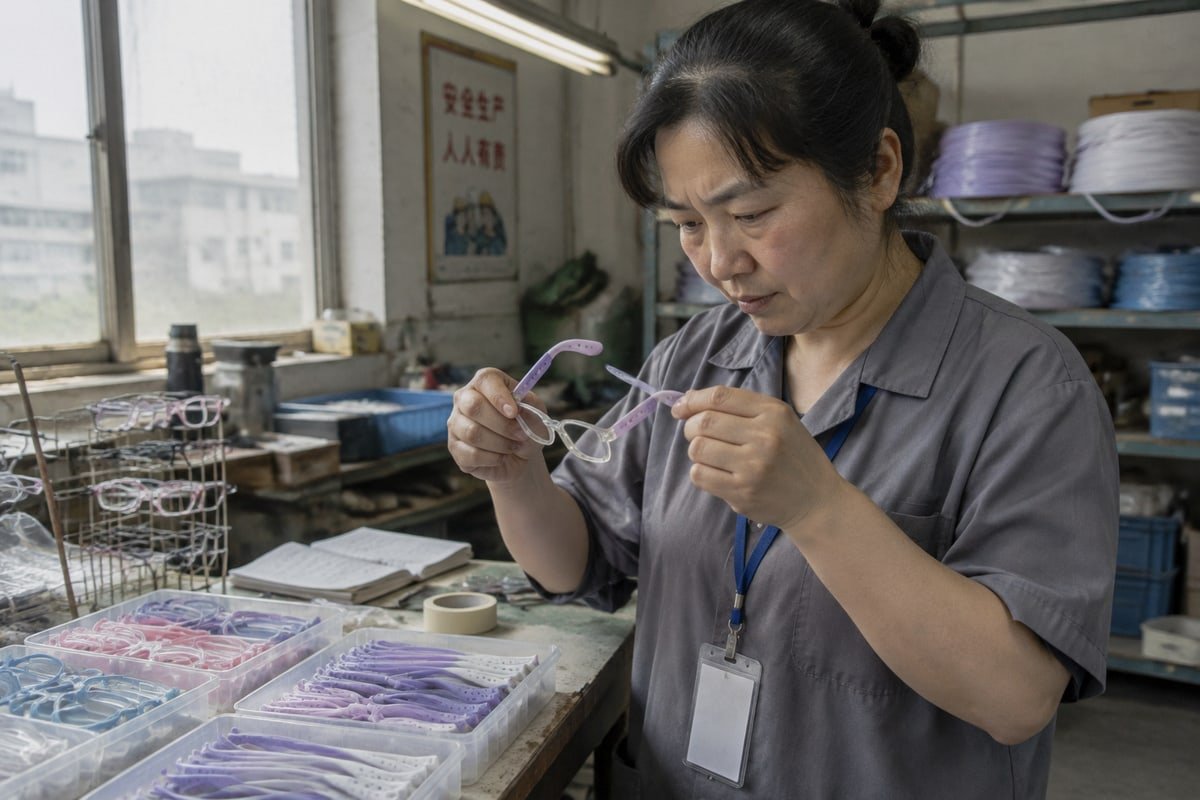
Every week our Taizhou line ships TR90 & TPEE kids optical frames to buyers whose first question is: will this hurt a child on impact? Here is the honest answer.
A TR90 & TPEE kids optical frame improves impact safety because it flexes instead of shattering, but the frame alone does not ensure it. True impact safety depends on impact-resistant lenses, secure lens retention, proper fit, and testing to standards such as FDA 21 CFR 801.410.
That distinction matters for anyone sourcing children’s eyewear. “More impact-resistant” and “impact-safe” are not the same claim. Below, I will explain how these two materials behave, which certifications you should ask for, how fit affects protection, and how to check a supplier before you commit to a bulk order.
How do TR90 and TPEE materials actually absorb impact instead of shattering?
On our line, one QC step is simple. A worker twists a finished TR90 front and folds the TPEE temples flat. Nothing snaps. That is the point of these materials.
TR90 and TPEE absorb impact through elasticity. TR90 is a flexible memory resin that bends and springs back to shape. TPEE is a rubber-like thermoplastic elastomer that stretches and dampens force. Both deform to spread energy instead of cracking into sharp fragments like rigid acetate or cheap acrylic.
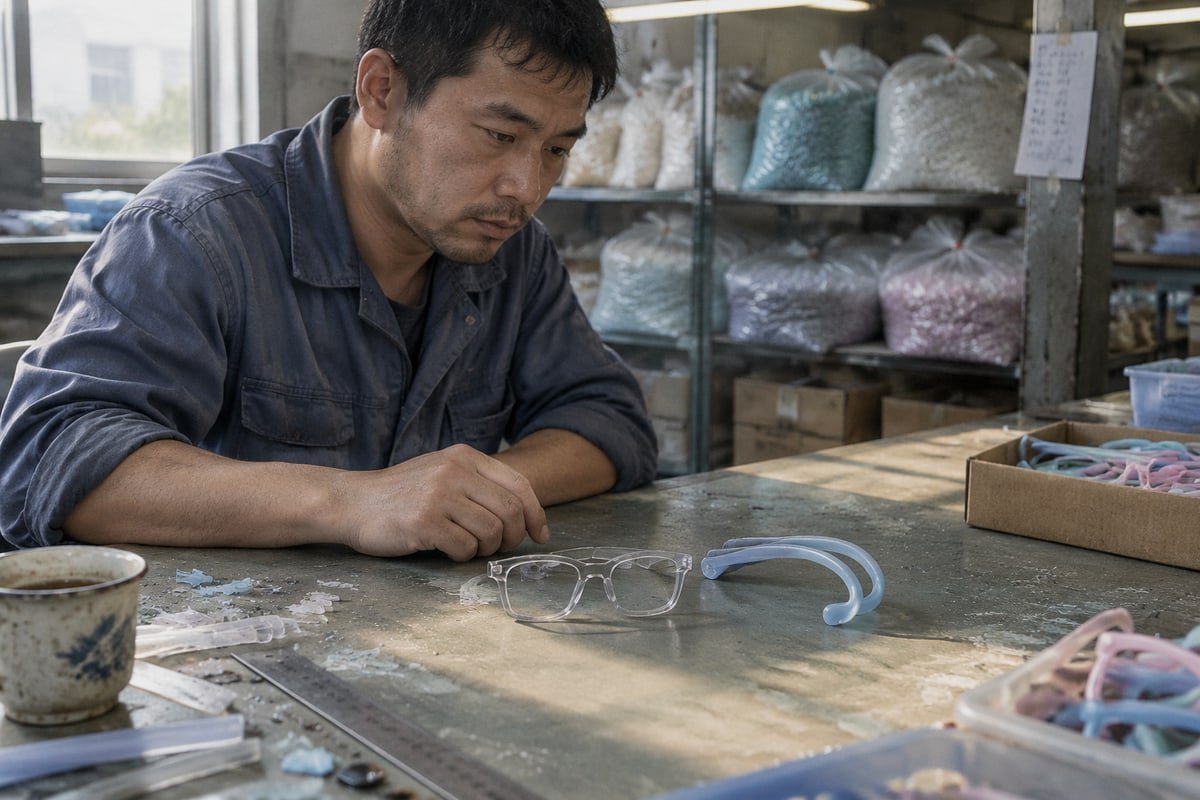
Let me start with a side-by-side view. Buyers often ask us which material is "better." The truth is that they do different jobs, and we usually combine them in one frame.
| Eigenschaft | TR90 | TPEE |
|---|---|---|
| Materialtyp | Flexible memory resin (thermoplastic polyamide) | Thermoplastic elastomer (polyester-based) |
| Beste Verwendung | Firm but bendable | Weich, gummiartig |
| Formgedächtnis | Strong; returns to form after bending or crushing | Good; very high elastic stretch |
| Gewicht | Very light; complete frames often under 20 grams | Sehr leicht |
| Cold performance | Can stiffen and lose some memory in extreme cold | Stays flexible in sub-zero temperatures |
| Typical use in our frames | Front frame, lens rim | Temples, ear hooks, nose pads |
Shape memory versus rubber elasticity
TR90 works like a spring. A child sits on the glasses, the front bends, and it returns to its original shape when the load is removed. That shape memory is why TR90 is the common choice for the lens rim, where the frame must hold a lens in a fixed position.
TPEE works more like a damper. Its rubber-like elasticity absorbs kinetic energy during a fall. In our experience, a TPEE temple can be bent almost double without any visible stress marks. That is why we use it on the parts that touch the head and take the most abuse.
Why tensile strength prevents splintering
Rigid plastics fail suddenly. They crack, and the crack leaves a sharp edge close to the eye. TR90 has high tensile strength, so it stretches under load rather than fracturing. This reduces the risk of secondary facial cuts. It is one of the real, physical reasons these materials belong in shatterproof eyewear for children.
Dynamic energy dissipation
Here is a point most product pages skip. A hard frame transfers impact force straight into the skull or the orbital bone. TPEE spreads that force across a wider surface area of the face, so the localized pressure is lower. In plain terms, the frame absorbs some of the hit so the child's face absorbs less.
Der ehrliche Vorbehalt
Some listings call these frames "unbreakable." I will not use that word. Any polymer can fail under the wrong load, a poor hinge design, or repeated fatigue at a thin section. What I can say from fifteen years of production is that a well-designed TR90 & TPEE kids optical frame fails far more gracefully than a rigid one. That is a real safety gain. It is just not a guarantee.
What safety certifications should I request from my kids eyewear manufacturer?
A procurement manager in Europe once emailed us: "Send the safety certificate." We had to ask back: which one, for which market, for which use? That question matters.
Request test reports matched to the intended use. For everyday kids optical frames sold in the US, ask for FDA drop-ball compliance under 21 CFR 801.410. For Europe, ask for EN ISO 12870 frame testing. For sports or protective eyewear, request ANSI Z87.1 or ASTM F803 certification.
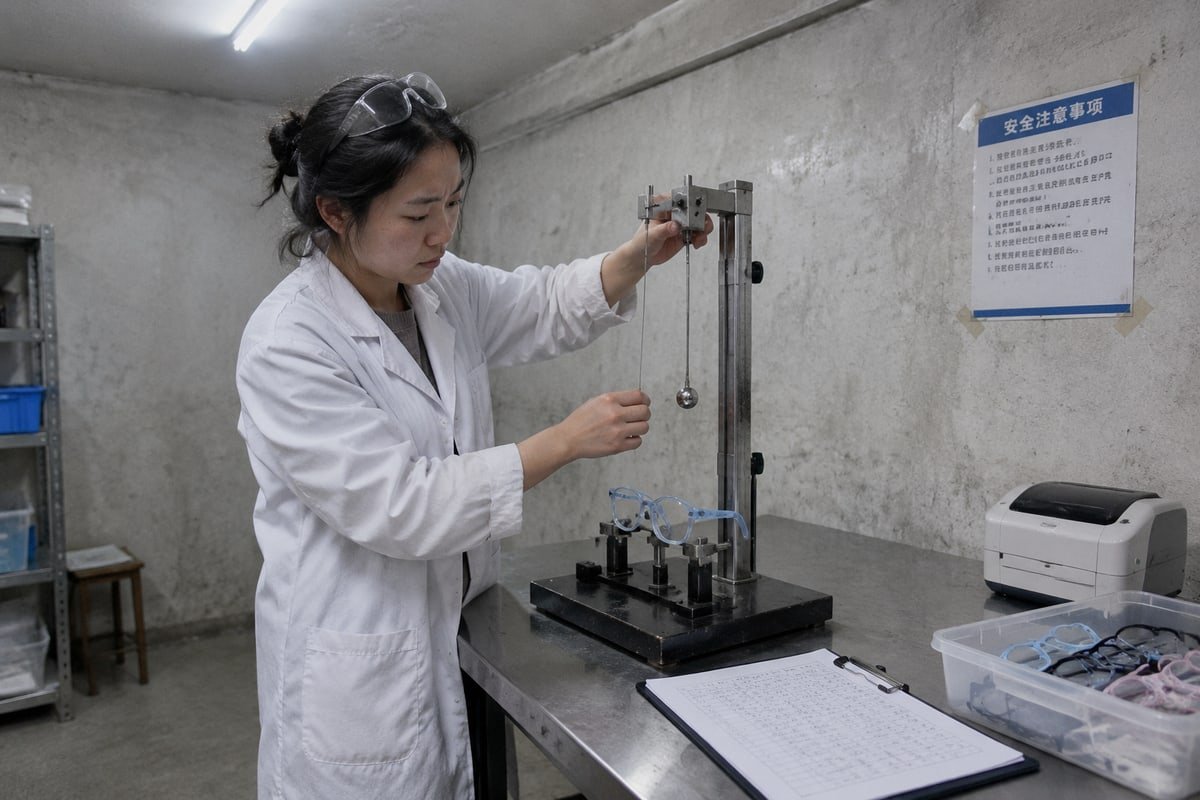
There is no single "kids glasses safety certificate." Different standards cover different risks. I find that buyers make better decisions once they see the standards laid out next to each other.
| Standard | Governing body | Was es testet | When to request it |
|---|---|---|---|
| 21 CFR 801.410 | US FDA | Lens impact resistance via Falltest 1 | All everyday optical frames and sunglasses sold in the US |
| EN ISO 12870 2 | ISO / CEN | Frame dimensional stability, bridge deformation, endurance, temple strength | Optical frames sold in the EU and many other markets |
| ANSI Z87.1 3 | ANSI / ISEA | High-mass and high-velocity impact for protective eyewear | Safety glasses, not regular kids optical frames |
| ASTM F803 | ASTM International | Sports goggle impact protection by sport | Racquet sports, basketball, and other eye-protection goggles |
| ASTM F2923-20 | ASTM International | Restricted substances in children's products | Sometimes referenced by children's brands for material safety |
The drop-ball test proves the lens, not the frame
This is the core point. The FDA drop-ball test drops a 5/8-inch steel ball from 50 inches onto the lens. The lens must not fracture. That test proves the lens. The frame's job is different: it must keep the lens in place when that impact happens. A flexible frame can help retention, but the test result belongs to the lens. So when a supplier says "our TR90 frames pass drop-ball," ask which lens was fitted.
Optical frame versus safety goggle
A kids optical frame is designed for daily wear. A safety goggle is designed for high-velocity impact. ANSI Z87.1 and ASTM F803 involve loads that no everyday optical frame is meant to survive. If a supplier offers a regular TR90 optical frame with an ANSI Z87.1 claim, be careful. It may be an honest mistake, or it may be an oversell.
Lens material is half the certificate
Impact resistance lives mostly in the lens. Polycarbonate is the standard schützt das Auge vor einem fliegenden Objekt. Die beiden arbeiten zusammen, und keiner ersetzt den anderen. 4 for children and is what most pediatric optometry practices recommend for active kids. Trivex offers similar impact resistance with better optical clarity, at a higher cost. When we quote an optical frame, we always ask which lens material the buyer intends to use, because it changes the retention design.
Material safety documents
Children chew glasses. Ask for third-party reports covering BPA-freie Materialien 5, phthalate limits, and hypoallergenic properties for skin contact. Food-grade migration testing is a reasonable request for toddler frames. These reports do not prove impact safety, but they complete the child-safety picture.
Can flexible frame materials still deliver a secure, comfortable fit for active children?
Softer is not always safer. When we tuned the TPEE hardness for our looped-temple kids series, too soft meant temples flopped and lenses loosened. Balance won.
Yes. Flexible frames deliver a secure fit when the design balances softness with structure. A TR90 front holds the lens firmly, TPEE temples grip without pressure, and wraparound ear hooks keep frames in place. Light weight under 20 grams stops slipping, so lenses stay aligned during play.

I want to raise an objection here, because serious buyers raise it with us. If a material is very flexible, can it be too flexible? The answer is yes, and it is worth understanding why.
The lens ejection paradox
TPEE has a lower shore hardness than TR90. That softness is great for comfort. But if an entire frame, including the lens rim, is made from very soft TPEE, a hard hit can stretch the rim enough for the lens to pop out. In that moment the eye is exposed. So maximum softness at the lens rim can actually reduce protection. This is why we do not build the lens rim from the softest material we have.
Warum wir eine TR90-Front mit TPEE-Bügeln kombinieren
Our most requested construction is a TR90-Front mit TPEE-Bügeln. The TR90 rim has the tensile strength and shape memory to grip the lens groove under impact. The TPEE temples handle the twisting, pulling, and chewing that come with childhood. You get retention where it matters and softness where it touches skin. Our translucent crystal front with gradient purple temples and our light-blue front with matte blue temples both follow this logic.
Fit features that keep glasses where they belong
A frame only protects when it stays over the eyes. In our design work, these details make the biggest difference:
- Schlaufenförmige Ohrhaken. The temple tip wraps around the ear so the frame cannot slide off during running or tumbling.
- Screwless hinges or hinge-less flex zones. Removing tiny screws removes a choking hazard and a loosening point. The perforated dot pattern on our temple arms adds controlled flex without a metal hinge.
- Correct bridge sizing. Children's noses have low bridges. A poorly sized bridge lets the frame drop, and a dropped frame offers no protection. We build several bridge widths across our ~800 existing styles for this reason.
- Low overall weight. A frame under 20 grams creates less downward pull, so it stays positioned over the eyes.
- Rounded, seamless edges. No sharp angles anywhere near the face.
A note on emerging construction
Some factories, including ours in development work, are exploring ultrasonic bonding to fuse TR90 and TPEE into a single monolithic body. The goal is to remove the joint, which is the traditional weak point in a multi-part frame. It is promising, but I treat it as an option to test, not a finished answer.
How do I verify a supplier's quality control before placing a bulk order?
Years ago we learned a hard lesson: a certificate on paper means little if the material batch behind it varies. Since then, our 5S workshop checks every stage.
Verify quality control by requesting a factory audit or video tour, sampling from the production line rather than a showroom, reviewing third-party test reports, and checking incoming material inspection, in-process checks, and final AQL inspection records. A real factory with documented 5S processes can show all of this.

Children's eyewear durability is built in stages. A single final inspection cannot catch a bad resin lot or a mis-set injection temperature. When buyers visit our factory of around 120 workers in Taizhou, I walk them through the checkpoints below.
| Phase | Was zu prüfen ist | Rote Fahne |
|---|---|---|
| Eingehendes Material | Resin lot certificates, BPA-free and hypoallergenic test reports, color batch match | Supplier cannot name the resin grade or its source |
| Spritzgießen | Temperature and pressure logs, first-shot approval, wall thickness at hinge zones | No process records; "we do it by experience" |
| Montage | Temple flex test, hinge cycle test, lens retention check with the intended lens | Lenses fitted only for photos, not tested in the frame |
| Finishing | Edge smoothness, no flash or burrs, logo alignment | Sharp mold lines around the nose or temple tips |
| Endkontrolle | AQL sampling, drop and twist test on random pieces, packaging check | Only "golden samples" are inspected |
Fabrik oder Handelsunternehmen?
Ask to see the injection machines on a live video call. Ask who owns the molds. A trading company can show you a catalog. A factory can show you the workshop floor, the 5S labels on the shelves, and the worker doing the temple flex test. This is not about price. It is about whether the person you email can actually change a process when something goes wrong.
What to test on a pre-production sample
Before you approve a bulk order, I suggest doing these steps yourself:
- Fit the lens you will actually sell, then press firmly on the lens center from the front. It should not pop out.
- Twist the front frame a quarter turn and release. It should return flat.
- Fold both temples inward until they touch and release. No whitening or stress marks should appear.
- Chill a frame in a freezer for an hour and repeat the bend. This shows how the TR90 behaves in cold climates, which matters for buyers in northern Europe or Japan.
- Weigh it. If you were promised a light frame, confirm the number.
Use existing styles to lower your risk
New brands often want a custom mold on the first order. I usually advise against it. Choosing from our ~800 existing styles lets you test the market, confirm fit feedback, and validate your target standard without heavy tooling cost. Once a style proves itself, we move to full OEM/ODM work: custom colors, logos, lens options, and retail-ready packaging.
Schlussfolgerung
A TR90 & TPEE kids optical frame makes glasses safer, not certified. Pair it with tested lenses, secure fit, and a factory you have verified. Then call it impact-safe.
Interessiert an der Beschaffung der in diesem Artikel erwähnten Produkte? Details und Angebotsanfrage hier:
Fußnoten
1. Official FDA resource for medical device regulations, including impact resistance standards for eyewear. ↩︎
2. Homepage of the International Organization for Standardization, which maintains the EN ISO 12870 spectacle frame standard. ↩︎
3. Official site for the American National Standards Institute, overseer of the Z87.1 safety eyewear standard. ↩︎
4. Authoritative overview of polycarbonate, the primary material used for impact-resistant lenses in children’s glasses. ↩︎
5. The EPA provides information on chemical safety and regulations regarding substances like Bisphenol A (BPA). ↩︎
Weitere Artikel, die Ihnen gefallen könnten

Auf der Suche nach einem zuverlässigen Partner für Kinderbrillen?
Entdecken Sie über 800 sofort verfügbare Modelle und umfassenden OEM/ODM-Support, der auf Ihre Marke zugeschnitten ist.
Kontakt aufnehmen English
 Español de México
 Deutsch
 Français
 日本語
 العربية
 Português do Brasil