Sport-Style Vs. Everyday TPEE Kids Sunglasses: Which Activities Suit Each?
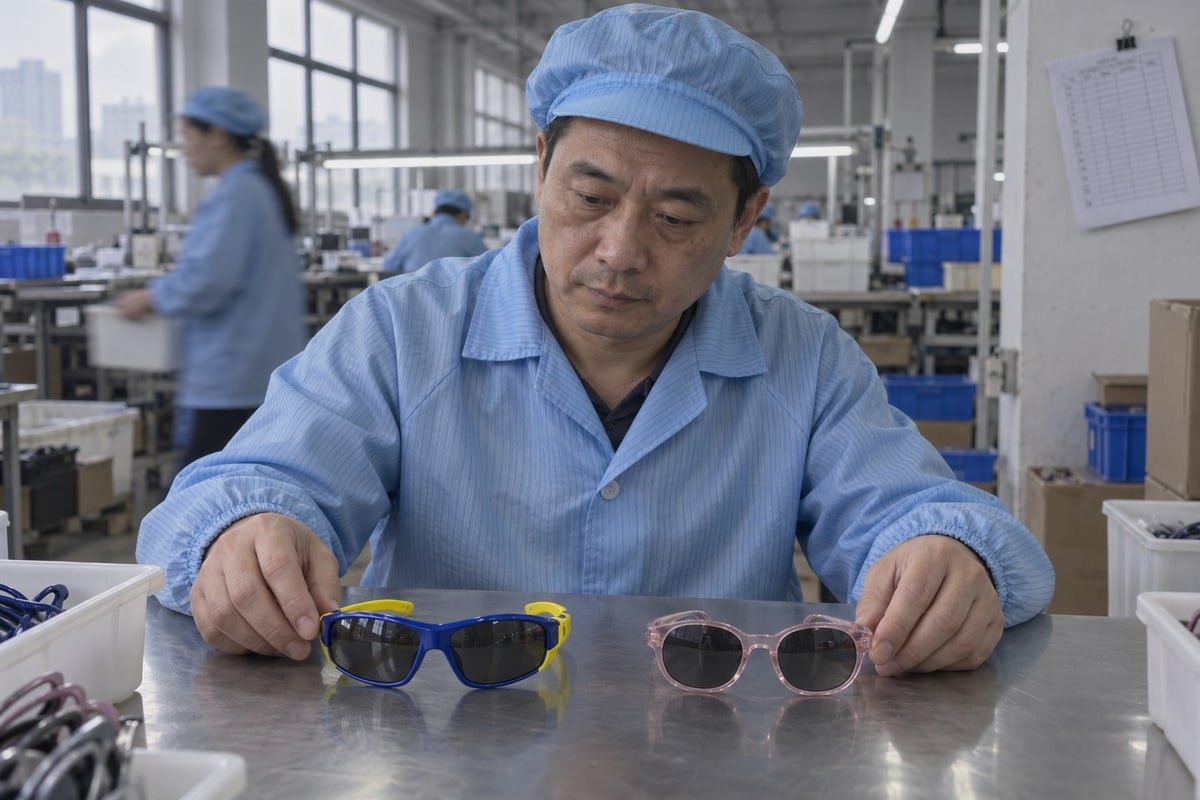
Buyers keep asking us for one TPEE kids sunglasses style that does everything. That request stalls launches. On our production line, we split the answer by activity first.
Sport-style TPEE kids sunglasses suit high-motion activities like cycling, baseball, fishing, hiking, and beach play, where wraparound coverage and secure fit matter. Everyday TPEE kids sunglasses suit school runs, errands, travel, and playground time, where lightweight comfort and versatile styling matter more than retention.
This is not a better-versus-worse choice. It is a use-case choice. Below, I will walk through how to read your customers’ activities, what to demand from a sport build, what an everyday build can still deliver, and how to structure a range around both.
How do I know if my kids' sunglasses brand needs sport-style or everyday TPEE frames?
Last spring, an Australian outdoor brand sent us a mood board full of beach photos. Their target list, though, was mostly school uniforms. That mismatch shaped our advice.
Decide by your customers' main activities, not by age or trend. If most wear happens during sports, water, or fast outdoor recreation, choose sport-style TPEE frames. If most wear happens during school runs, errands, and casual outings, choose everyday TPEE frames. Many brands need a split.
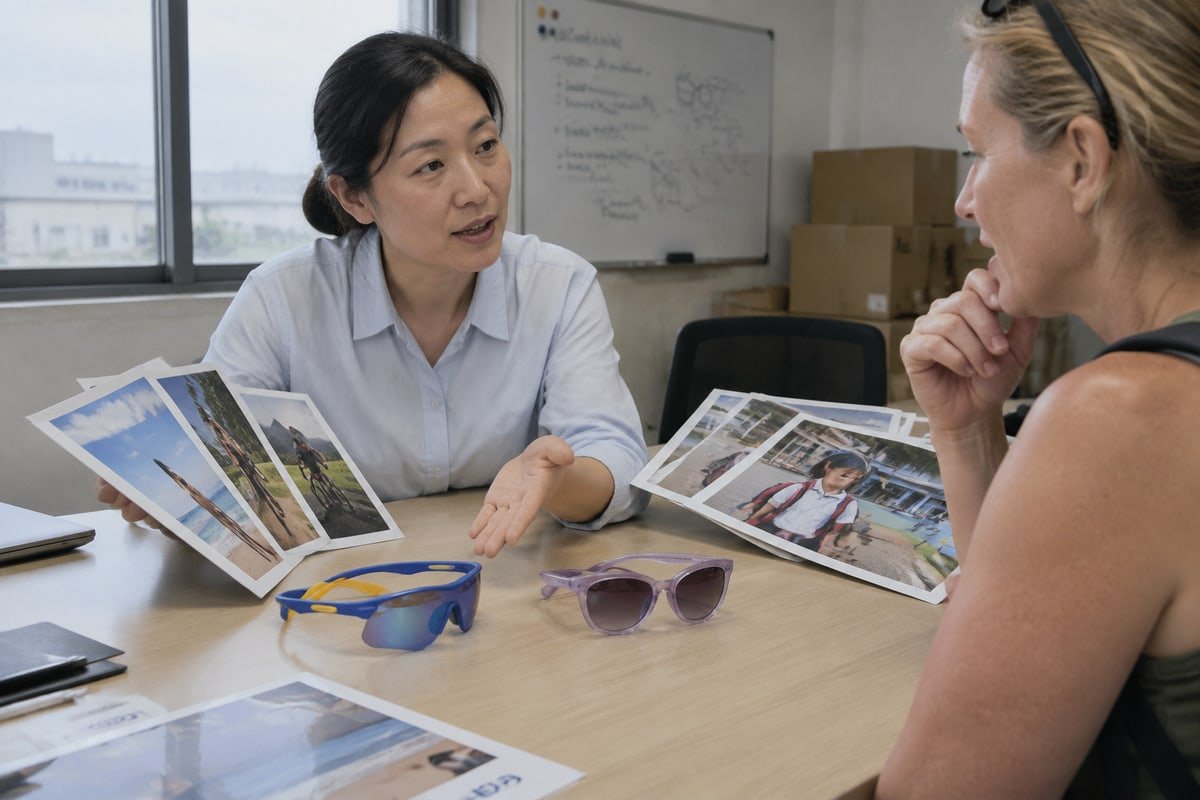
The fastest way to see the difference is to line the two builds up side by side.
| Faktor | Sport-style TPEE kids sunglasses | Everyday TPEE kids sunglasses |
|---|---|---|
| Passform | Snug, secure, often wraparound | Comfortable, general-purpose fit |
| Bewegung | Built for running, cycling, ball sports | Built for low-to-moderate activity |
| Abdeckung | More side coverage and glare blocking | Less aggressive wrap |
| Halt | Non-slip grips, often an adjustable head strap | Usually no strap unless toddler-focused |
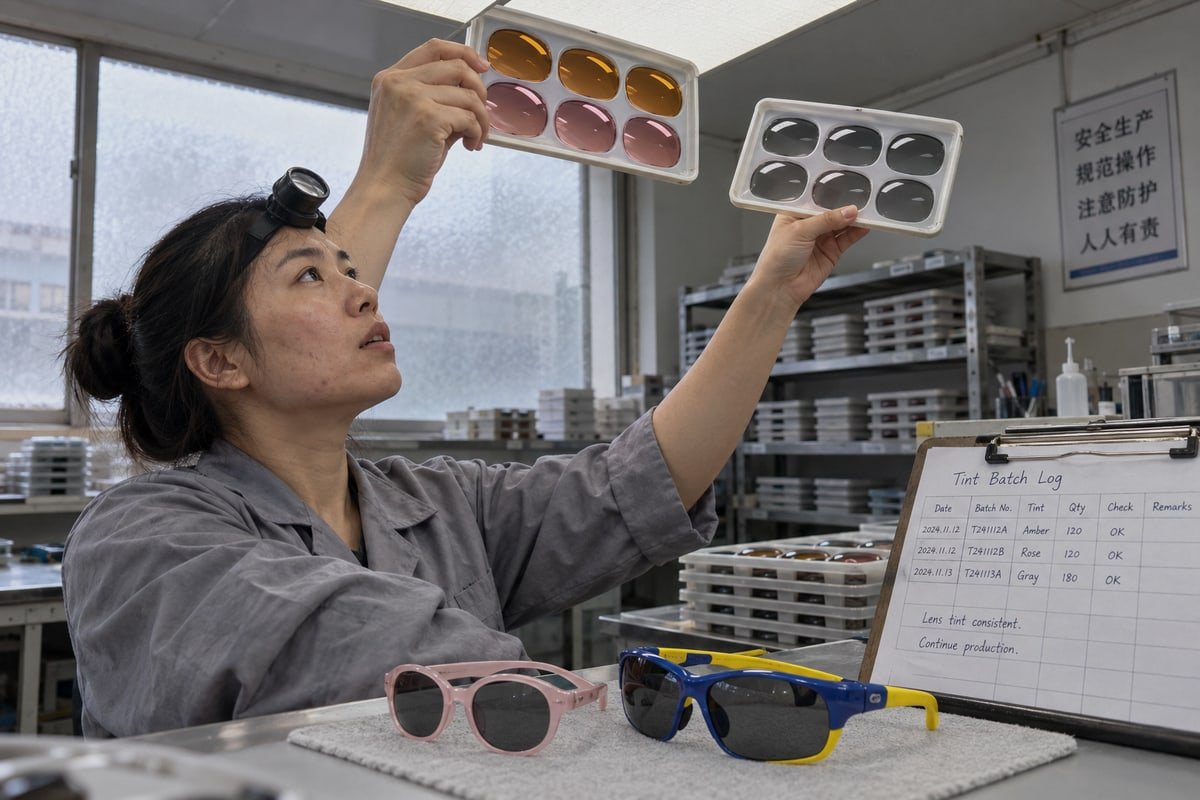
| Lens tint | Amber or rose for contrast on the field | Neutral gray for true color |
| Stil | Athletic, performance-oriented | Casual, school-friendly, versatile |
| Sicherheitsverhalten | Cycling, baseball, fishing, hiking, beach | School, errands, travel, playground |
Start with a wear-occasion audit
I ask every new buyer the same question. Where will the glasses actually be worn? Not where the marketing photos are shot. If the honest answer is the school gate, the supermarket car park, and the local playground, an everyday frame will serve better. If the answer is soccer practice, the boat, or a bike trail, a sport frame earns its extra structure.
Age is a sizing input, not a style input
Listings in this category are often age-banded, with sport models sold for roughly ages 3–7, 3–10, 5–13, or 6–12. Those bands tell you about head size. They do not tell you about activity. A six-year-old who fishes every weekend needs polarisierte Gläser 1 and a wraparound design. A ten-year-old who mostly walks to school does not. So I would use age to pick the mold size and use activity to pick the build.
What TPEE is, in plain terms
TPEE is a flexible, bendable polymer. When we mold it into flexible Rahmen 2, the temples can twist and spring back instead of snapping. That resilience is why it has become a standard durability feature 3 in children's eyewear. Both sport and everyday builds share this base. The difference lies in the geometry, the retention parts, and the lens package layered on top.
What safety and durability features should I look for in sport-style TPEE sunglasses for active kids?
During a recent QC pass, our team bent a batch of wraparound temples through repeated flex cycles. The frames sprang back. That test is where sport-style value begins.
Look for UV400 protection, flexible TPEE frames that bend instead of snapping, wraparound design for side coverage, impact-resistant polycarbonate lenses, reinforced hinges, non-slip nose and temple grips, and an adjustable head strap for younger children. Treat shatterproof and unbreakable claims as points to verify, not assume.
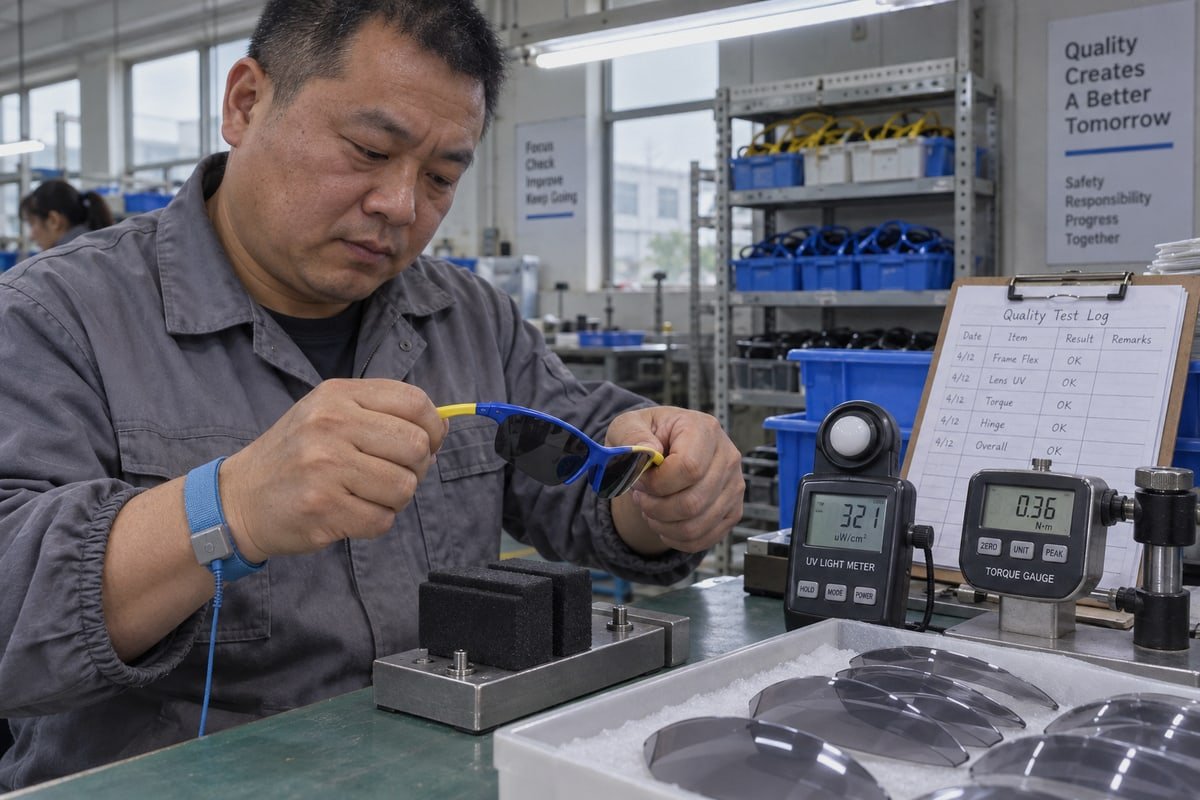
Here is how I would inspect a sport-style sample, in the order that matters most.
- Confirm the UV claim. Ask for UV400 or 99–100% UVA/UVB blocking. This is the baseline. No other feature matters if the lens fails here.
- Check lens impact resistance. Ball sports like baseball, soccer, and tennis put a lens directly in the path of a ball or an elbow. Polycarbonate lenses are the norm for this reason. Ask how the supplier tests them rather than accepting "shatterproof lenses" as a label.
- Flex the frame and hinges. A sport frame lives under repetitive stress. Reinforced hinges are a real difference from everyday builds, and they should survive repeated opening and twisting without loosening.
- Test retention. Rubberized grips at the nose and temple tips keep the frame in place during sprinting and jumping. For toddlers, an adjustable head strap adds a second layer.
- Look at the wrap. TPEE has a lower thermal memory than TR90. That is why we mold our sport frames with a permanent inward wrap, so the grip does not relax as the frame warms against the child's face over a long afternoon.
Matching features to the activity
| Aktivität | Priority feature | Was zu vergleichen ist |
|---|---|---|
| Radfahren | Wraparound design, non-slip temples | Blocks wind and stays on at speed |
| Baseball, softball, tennis | Impact-resistant lenses, side coverage | Protects against balls and contact |
| Fishing, boating | Polarized lenses, snug fit | Cuts water glare and peripheral light |
| Hiking, beach days | UV400 protection, light frame | Long exposure in bright environments |
| Snow play | Polarized lenses, tight wrap | Blocks reflected glare and cold wind |
A note on the word "unbreakable"
I raise this with buyers directly. Some product pages call TPEE frames unbreakable. Careful consumer guides describe them as flexible, durable, or semi-indestructible. Our view sits with the careful side. A well-made TPEE frame is genuinely hard for a child to break in normal rough play. It is not immune to a car door. Honest marketing protects your brand, and we would rather help you write "flexible and bend-resistant" than defend an absolute claim.
Two smaller trends are also worth asking about. Some TPEE formulations now include antimikrobielle Zusatzstoffe 4, which matter when sweat and dirt build up on sports gear. And BPA-free materials should be a standing requirement on any spec sheet for high-performance eyewear aimed at children.
Can everyday TPEE sunglasses still offer enough flexibility and comfort for my younger customers?
Every time we tune an everyday mold, we weigh two things: how far the temple should flex, and how little weight a toddler will tolerate. Both matter.
Yes. Everyday TPEE kids sunglasses use the same flexible frames as sport models, so they bend, twist, and recover during daily use. With UV400 protection, lightweight construction, BPA-free materials, and a correct size for the child's head, they are fully protective for school, errands, playgrounds, and travel.
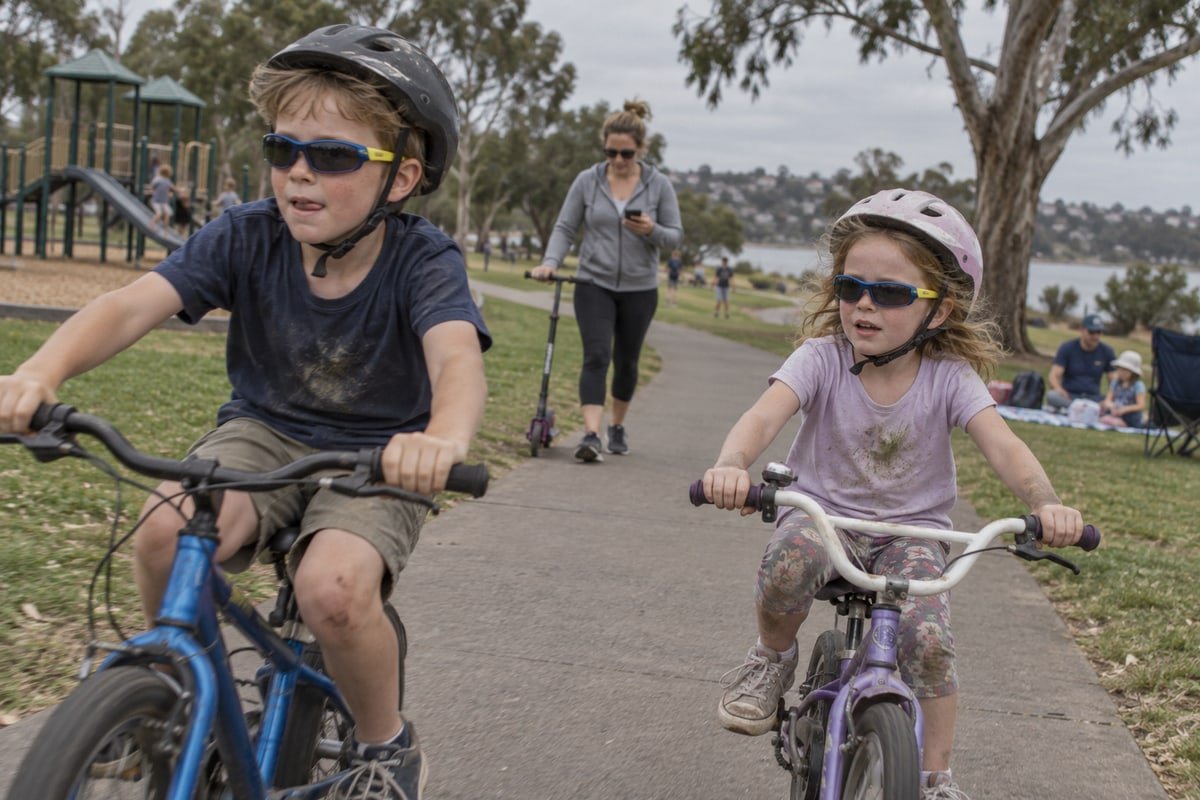
I hear a common objection from procurement teams. They worry that an everyday frame is simply a cheaper, softer version of a sport frame. In our workshop, that is not how it works. The everyday range is molded from the same TPEE compound. It goes through the same bend-and-recover checks. What we remove is the aggressive wrap and the sport retention hardware, because those parts feel overbuilt on a child who is walking to school or sitting in a stroller.
Comfort comes from fit, not from straps
Review guides in this category often point out that kids' sunglasses run smaller than advertised. That is why we treat sizing as a comfort feature. An everyday frame that pinches at the temples will end up in a bag, no matter how flexible it is. Our practice is to match the mold to a measured head width and to keep the temple pressure light, so the frame sits close to the face without squeezing.
| Wearer group | Typical listing age band | Everyday-frame priority |
|---|---|---|
| Kleinkinder | 3–7 | Very light weight, soft temple tips, optional strap |
| Vorschule | 3–10 | Low temple pressure, easy on-off |
| Schulkinder | 5–13 or 6–12 | Style versatility, secure but relaxed fit |
Styling that works with school clothes
Everyday frames are where design freedom lives. Three of our current everyday shapes show the range well: a royal-blue square frame with bright yellow temples and flat smoke lenses, a soft lavender cat-eye with slim tapered temples, and a blush-pink round frame sized for a smaller face. All three carry the same UV400 protection. None of them shout "sports". That is the point. A child will wear them at the school gate, on holiday sightseeing, and on short car-to-playground trips without feeling dressed for a match.
On polarized lenses
Buyers sometimes assume polarized lenses are mandatory. I would call them a strong preference, not a rule. They are very useful near water or bright reflective surfaces. For general daily use in mixed light, a neutral gray tint with full UV blocking does the job and keeps color perception true. We offer both, and I usually suggest polarized as an upgrade on everyday styles rather than a default.
When everyday is not enough
There is a limit. If the child is cycling fast, playing catch, or spending hours on a boat, an everyday frame will slide, let in side glare, and take hits it was not built for. That is the signal to move that customer to the sport track rather than to keep adding features to a casual frame.
Should I offer both sport-style and everyday TPEE options in my product line to cover more activities?
One lesson from fifteen years of export orders: brands that launch a small, two-track range usually sell through more smoothly than brands betting on one hero style.
Yes, for most kids' brands. Offering both sport-style and everyday TPEE options covers active outdoor recreation and daily use without overbuilding either. Start small: two or three everyday styles plus one or two sport styles, chosen from existing molds, then expand based on sell-through by activity.
The reason I recommend two tracks comes back to the opposing pull in this category. A sport frame on a school-age child can feel overbuilt for casual wear. An everyday frame on a cycling child will not stay put. If you offer only one, you either disappoint the parents at the playground or the parents on the sideline. Two tracks solve both without forcing one product to compromise.
How we help brands build a two-track range
- Map activities to tracks. List your customers' top five wear occasions. Tag each as sport or everyday.
- Select from existing molds. We keep roughly 800 existing styles across both tracks. A new brand can pick from these and skip heavy mold investment, which keeps early risk low.
- Customize the surface, not the tooling. Colors, logos, lens tints, packaging, and accessories are where a range becomes yours. That is standard OEM/ODM work for us.
- Run a small first order across both tracks. Read the sell-through by activity, not just by SKU.
- Expand the winning track. Add a strap model or a polarized upgrade where the data points.
| Track | Starter styles | Suggested lens | Add-on options |
|---|---|---|---|
| Jeden Tag | Square, round, cat-eye in pastel and color-block | UV400 neutral gray | Polarized upgrade, soft case |
| Sport | One wraparound with grips, one strap-ready model | UV400 polarized or contrast tint | Adjustable head strap, spare strap |
Two trends that make the split easier
Hybrid TPEE designs are now appearing with modular temple tips that swap for an elastic headband. This lets one everyday frame convert into a secure sport goggle. It does not replace a true sport build for ball sports, but it is a smart bridge product for brands that want a third option later.
Circularity is the second trend. A mono-material TPEE frame is easier to recycle at end of life than a multi-material casual frame. Environmentally friendly materials are already part of how we make frames, and buyers in Europe and Japan increasingly ask for that story on the packaging.
Der ehrliche Kompromiss
Two tracks mean two sets of packaging artwork, two lens specs, and two QC checklists. That is more coordination. In practice, our 5S-managed workshop handles both tracks on parallel lines, so the added complexity sits with us, not with your team. What you gain is a range that answers the real question parents ask: which pair for which day.
Schlussfolgerung
One style cannot serve both the bike trail and the school gate. Split TPEE kids sunglasses by activity, verify safety claims, and build a small two-track range with us.
Interessiert an der Beschaffung der in diesem Artikel erwähnten Produkte? Details und Angebotsanfrage hier:
Fußnoten
1. Wikipedia provides a comprehensive overview of how polarized lenses function to reduce glare in outdoor environments. ↩︎
2. Technical background on thermoplastic elastomers used to create flexible frames in the eyewear industry. ↩︎
3. ISO 12312-1 establishes the international safety and durability standards for sunglasses and related eyewear. ↩︎
4. The EPA regulates antimicrobial additives used in consumer products to ensure safety and efficacy. ↩︎
Weitere Artikel, die Ihnen gefallen könnten
September 2026
Können TR90 & TPEE Kinder-Sonnenbrillen recycelte oder biobasierte Materialien verwenden?
September 2026
Sind TR90 & TPEE Kinder-Sonnenbrillen recycelbar? Entsorgungstipps erklärt?
September 2026
Wie vermeidet man Verformungen und Kratzer beim Versand von TR90 & TPEE Kinder-Sonnenbrillen?
Auf der Suche nach einem zuverlässigen Partner für Kinderbrillen?
Entdecken Sie über 800 sofort verfügbare Modelle und umfassenden OEM/ODM-Support, der auf Ihre Marke zugeschnitten ist.
Kontakt aufnehmen English
 Español de México
 Deutsch
 Français
 日本語
 العربية
 Português do Brasil