How to Request Sample Modifications for Kids’ Optical Frames?
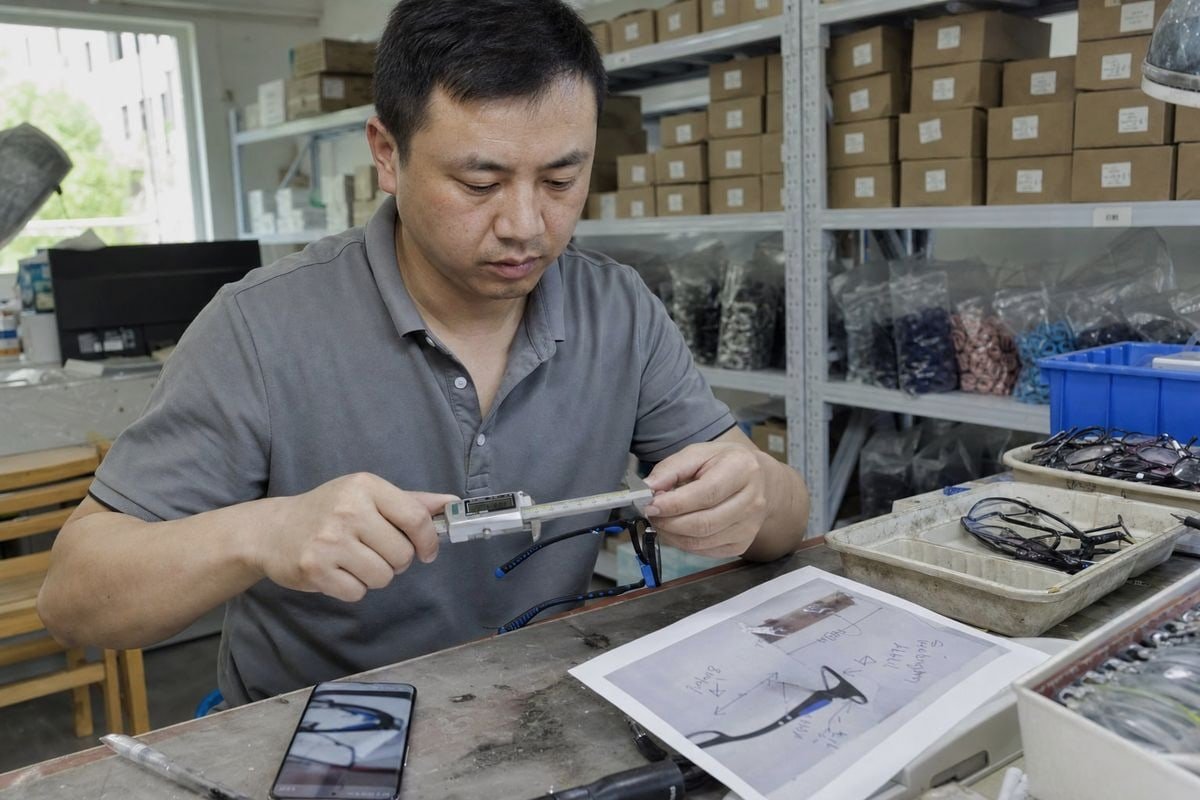
Requesting sample modifications for kids’ optical frames sounds simple — until a vague message costs you three extra weeks. On our production line in Taizhou, I see this happen constantly. Buyers say “make it smaller,” the sample comes back wrong, and the launch date slips. The fix is a factory-friendly, measurement-based request process, and I’ll walk you through exactly how we handle it.
To request sample modifications for kids’ optical frames, identify the sample by style code and version, state each change with exact measurements, explain the reason, attach annotated photos, separate must-fix items from nice-to-haves, and ask the factory to confirm feasibility in writing before making the revised sample.
That is the short answer. Below, I break down each step. I will cover what details to send, how many revision rounds to expect, how modifications affect lead time and cost, and what you can change on an existing frame style.
What details should I provide to request a specific frame modification?
A buyer from Australia once sent us a single phone photo with the note "temples feel off." Our engineers spent two days guessing before we asked for measurements. That exchange taught me why a complete brief matters more than speed.
Provide the style code, size, color, and version number; the exact change in millimeters; the reason for the change; annotated photos or CAD technical drawings; your priority ranking of fixes; and your target market or safety requirements. Then request written confirmation before the revised sample is made.
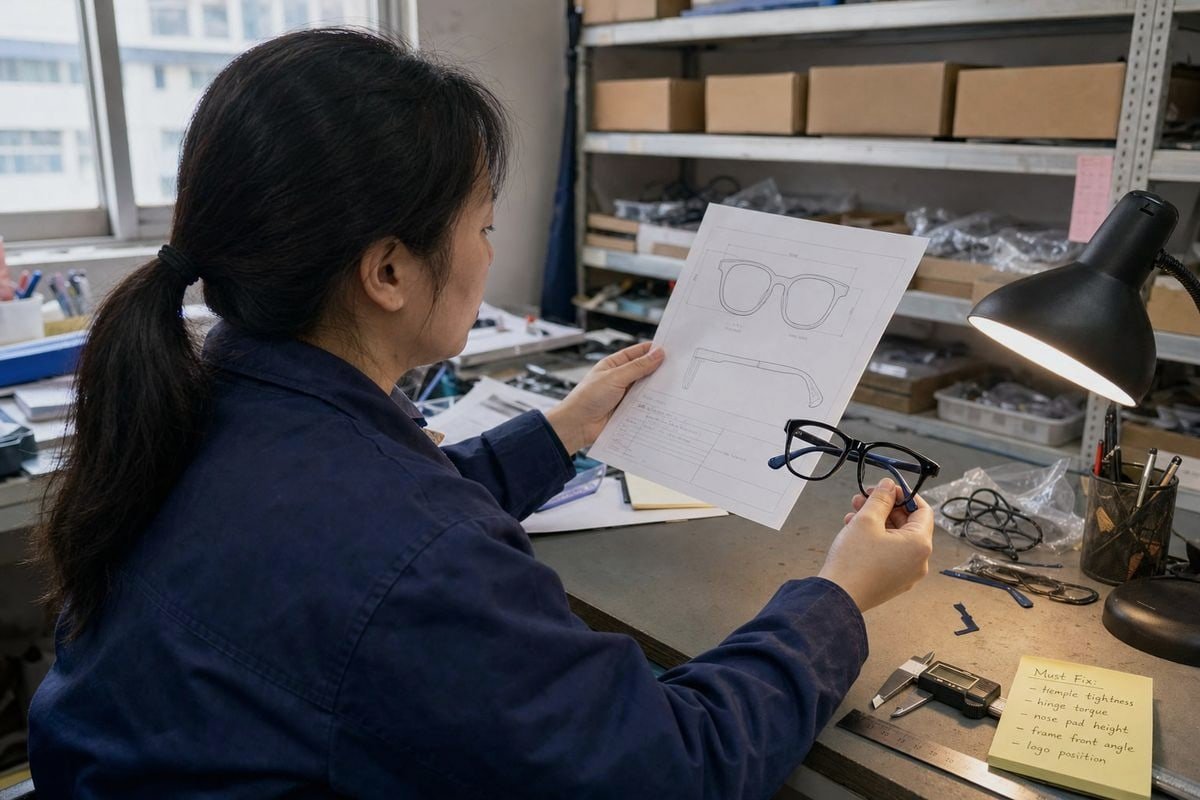
Treat the sample as a prototype, not a finished product. That mindset changes how you write your request. A prototype invites precise correction. In our fifteen years of OEM eyewear manufacturing, the buyers who get samples right in one or two rounds all send the same kind of message: measurable, documented, and easy for our workshop to execute.
The core elements of a strong modification request
Here is what our sample team needs from you, in order of importance:
| Element | Weak example | Strong example |
|---|---|---|
| Sample identity | "the pink one" | "Style OK-1082, size 46-16, blush pink, sample v2" |
| The change | "make it smaller" | "shorten temples by 3 mm; increase bend angle slightly" |
| The reason | (none given) | "frame slips forward on 5-year-old fit models" |
| Visuals | phone photo, no notes | annotated photo with arrows plus a ruler for scale |
| Priority | everything mixed together | "Must fix: bridge fit. Nice to have: logo position" |
Why the reason matters as much as the measurement
When you tell us why, our engineers can propose better solutions. If the frame slips, a temple length modification may help — but so might a wider splay angle at the nose, because children have flatter nasal bridges than adults. Pediatric bridge fit adjustments, such as a lower crest height, often solve stability problems that buyers try to fix at the temples. Give us the symptom, and we will suggest the root-cause fix.
Include safety and market context
Tell us your destination country. Impact resistance standards 1 and material rules differ by market, and modifications must not break compliance. If you need hypoallergenic materials or saliva-safe pigments 2 for toddler frames, say so in the same message. One complete brief beats five follow-up emails.
How many rounds of sample revisions can I expect before approval?
The trade-off I weigh most often with new clients is speed versus precision. Everyone wants approval in one round. But rushing a kids' frame approval can lock in a bridge that pinches or a hinge that loosens — problems you only discover after bulk production.
Most kids' optical frame projects reach approval in one to two revision rounds when feedback is specific and measurable. Vague or fragmented feedback commonly pushes projects to three or four rounds. Plan a 12–16 week development window to cover sampling, revisions, and shipping buffers comfortably.
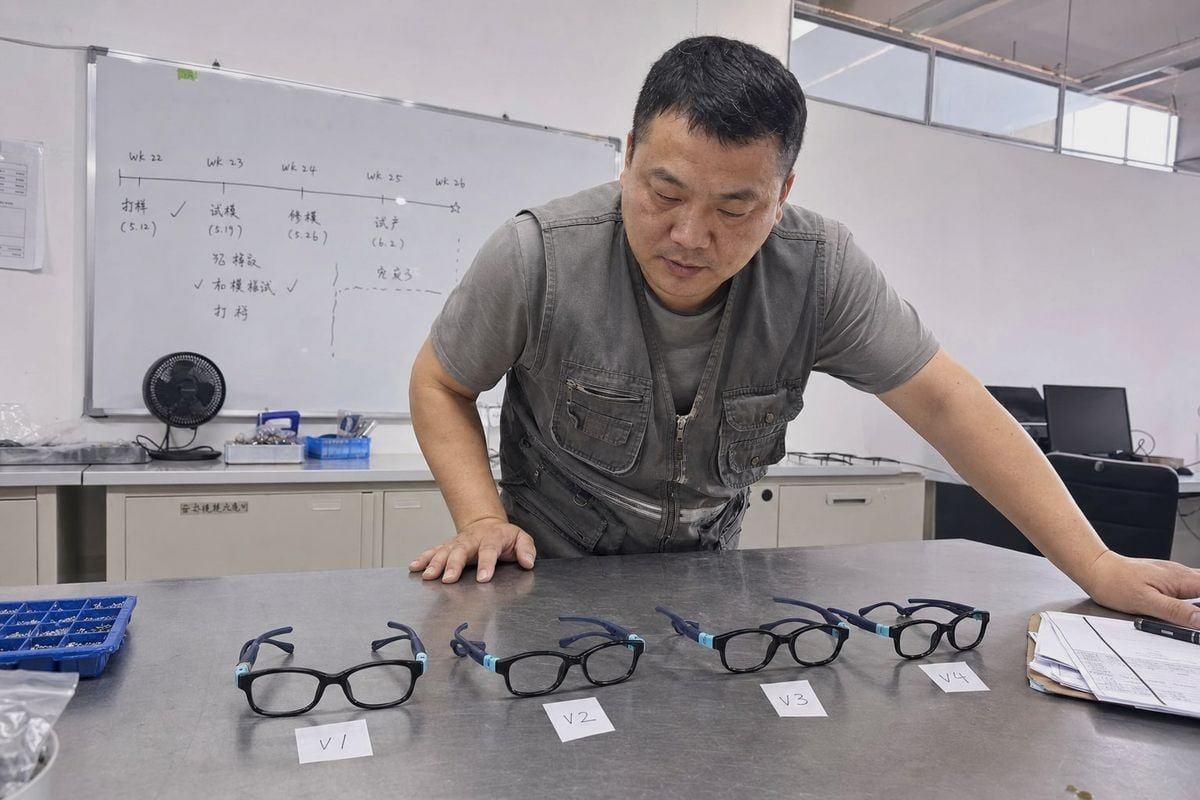
Revision count is not luck. It is a direct output of how the process is run. Let me show you the standard prototype development sequence we follow, so you can see where rounds get added or saved.
The standard sampling workflow
- You share a sketch, reference sample, tech pack, or CAD technical drawings 3.
- We confirm feasibility and quote the sample fee and unit price.
- We make the first sample, usually in about 7–14 days depending on complexity.
- You review fit, finish, color, weight, and function — by hand, not just by photo.
- You send precise, consolidated feedback in one document.
- We produce the revised sample.
- You approve a golden sample, which becomes the master reference for bulk production and QC.
What adds extra rounds — and what prevents them
| Behavior | Effect on revision count |
|---|---|
| Sending all feedback in one consolidated list | Keeps most projects at 1–2 rounds |
| Drip-feeding changes across multiple emails | Each new email can trigger a new round |
| Testing on real child-sized fit models early | Catches comfort issues before round two |
| Approving from photos only | Fit problems surface late, forcing extra rounds |
| Confirming changes in writing before remake | Prevents "that's not what I meant" rounds |
Some buyers push back here: "Can't we just approve with notes and skip the final sample?" For minor cosmetic tweaks, yes — written confirmation with photos can be enough. But when frame structure, lens function, or packaging changes, a fresh sample is the safer call, especially on higher-value orders. Skipping it to save two weeks can cost you a container of frames that don't fit.
Will requesting modifications affect my sample lead time or cost?
A Japanese buyer once asked me, half-joking, whether every change request came with an invoice attached. Fair question. The honest answer from our side of the workshop: it depends entirely on whether the change touches tooling.
Minor modifications — color, logo position, temple length, or packaging — usually add 3–14 days per revision at little or no extra cost, and sample fees are often refundable against your order. Structural changes requiring new molds add significant time and tooling cost.
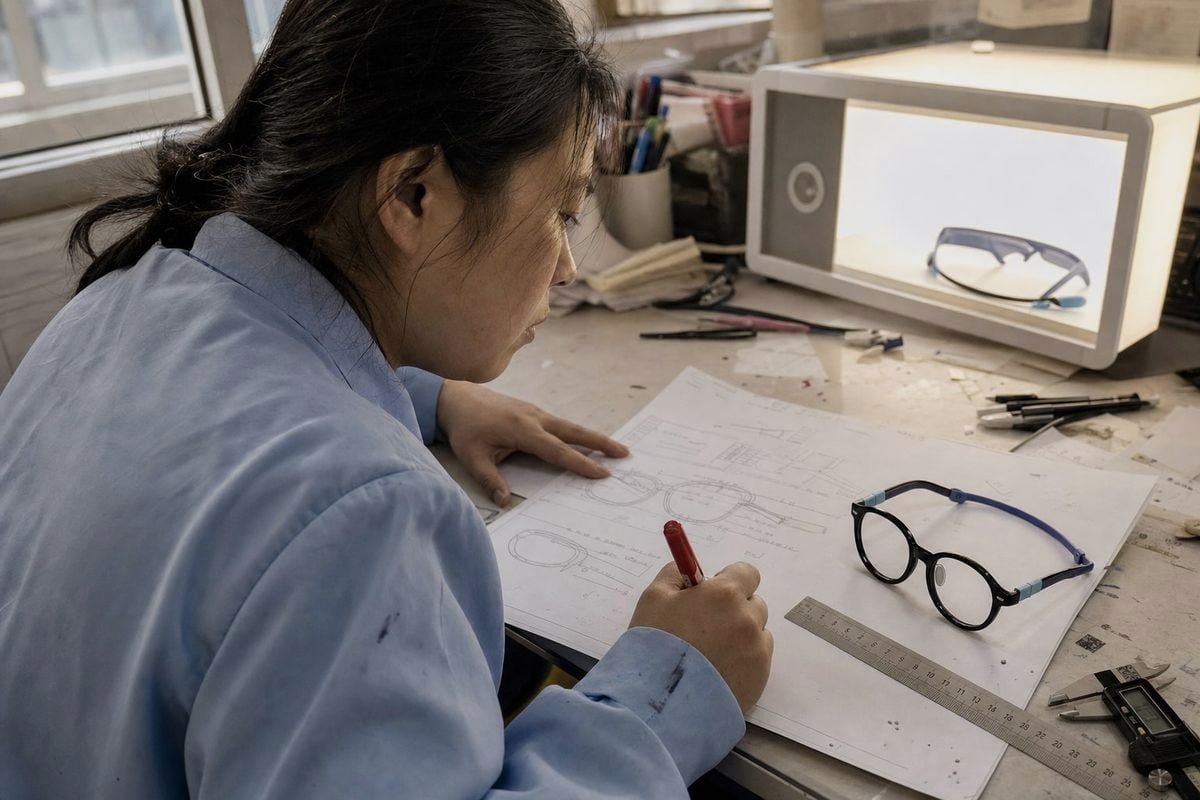
Understanding the cost logic helps you plan and negotiate. Modifications fall into three tiers, and each tier behaves differently on your calendar and your budget.
The three cost tiers of sample modification
| Tier | Examples | Typical time impact | Typische Kostenwirkung |
|---|---|---|---|
| Cosmetic | Frame color, logo print, packaging swap | 3–7 Tage | Minimal; often absorbed in sample fee |
| Adjustment | Temple length modification, bridge softening, hinge tuning | 7–14 Tage | Low; may reuse existing tooling |
| Structural | New shape, new size run, modular bridge inserts | 3–6+ weeks | Mold or tooling investment required |
How to protect your timeline
Ask these questions upfront, before the first sample is even made. In our experience exporting to twenty-plus countries, buyers who ask early avoid nearly all timeline surprises:
- What is the sample cost, and is it refundable against order volume? At our factory, sample fees are typically credited back once the bulk order is placed.
- What is the lead time for the first sample versus each revision?
- Can changes still be made after order confirmation, and how quickly must the request arrive?
- Will the factory keep the golden sample on file as the QC reference?
There is also a smart way to reduce structural-change risk: request 3D-printed fit-check prototypes 4 before committing to injection molds. A printed shell lets you run real comfort testing on children before you spend on tooling. Some buyers also request high-fidelity 3D digital assets alongside physical samples, which doubles as a head start on virtual try-on marketing tools. One more tip from our side: choosing from an existing style library — we maintain roughly 800 — lets you skip mold investment entirely and keeps your sampling phase in the fastest tier.
Can I adjust color, size, or material on an existing frame style?
Early in a project with a European baby brand, we converted a stock TR90 frame into their signature pastel palette with soft TPEE temples — no new mold, no tooling fee. That project shaped how I explain stock-frame customization to every buyer since.
Yes. On an existing kids' frame style, you can typically change frame and temple colors, logos, lens options, and packaging without new tooling. Size changes and material switches are sometimes possible within the same mold, but major dimensional changes require custom prototype development.
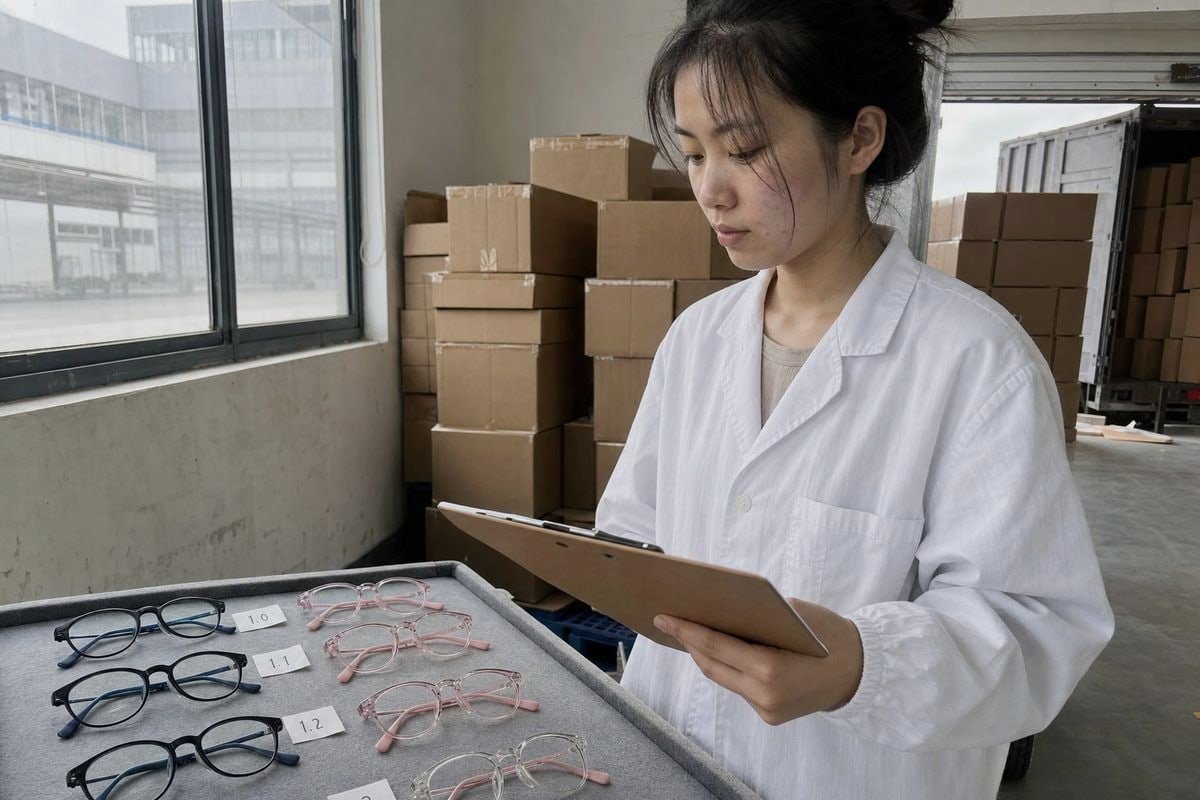
Not every attribute is equally flexible, so let me separate them clearly.
Color: the easiest change
Color is almost always adjustable. We match Pantone-Referenzen 5 for frame fronts, temples, and two-tone combinations — like the glossy black front with navy rubber temples in one of our sport styles, or the translucent blush pink used on our acetate-look frames. For toddler products, confirm that all pigments and coatings pass saliva-migration testing. That is a safety request, not a styling one, and a serious kids' eyewear factory should welcome it.
Size: possible within limits
Small ergonomic tweaks — temple length, temple bend, earpiece hook curvature, adjustable nose pads on suitable models — work within existing tooling. Full size changes (a smaller boxed lens or narrower bridge) usually need a new mold. Note that very young children are the strictest case: for kids under seven, stock frames sometimes require extensive adaptation or fully custom manufacture to fit properly. One workaround worth asking about is modular design — swappable temple tips or bridge inserts that extend the frame's usable lifecycle as a child's face grows.
Material: depends on the construction
Switching between compatible flexible materials 6, such as TR90 fronts with TPEE temples, is often feasible because both are lightweight, hypoallergenic materials suited to children's skin. Moving to a completely different construction — say, full acetate frame customization with pinned hinges — changes the manufacturing process and effectively becomes a new development project. The same applies to hardware upgrades: adding 180-degree spring hinges improves spring hinge durability for active kids, but only if the frame front was engineered to house that hinge.
When you evaluate the revised sample, inspect it by hand. Open and close the temples repeatedly, check hinge smoothness and left-right symmetry, confirm lens retention 7, and test bridge comfort on a child-sized fitting model. If your order justifies it, ask for pressure-distribution data or at least a structured comfort test to catch hot spots at the nose and behind the ears.
Schlussfolgerung
Vague change requests waste weeks and lock in fit problems. Precise, measured, written modification requests protect your timeline, your child customers, and your brand — and they usually get kids' frames approved within two rounds.
Fußnoten
1. ISO publishes international impact resistance and safety standards relevant to eyewear frames. ↩︎
2. Reference to EN 71-3, the standard for migration of elements that ensures materials are safe if ingested or chewed. ↩︎
3. Background reference explaining computer-aided design tools used to communicate frame specifications. ↩︎
4. Background on 3D printing technology used for rapid fit-check prototypes before mold investment. ↩︎
5. Explains the Pantone color-matching system referenced for frame and temple color accuracy. ↩︎
6. ASTM International sets testing standards for flexible plastic materials used in consumer products. ↩︎
7. FDA regulates impact resistance and retention testing standards for eyeglass lenses sold in the US. ↩︎
Weitere Artikel, die Ihnen gefallen könnten
August 2026
Bio-Based vs Regular Cellulose Acetate: What's the Difference for Kids' Frames?
August 2026
How Recyclable Are Kids' Optical Frame Materials, and What Eco-Friendly Alternatives Exist?
August 2026
Bleichen Kinderbrillengestelle im Lager aus oder altern sie, und wie kontrolliert man die Lagerbedingungen?
Auf der Suche nach einem zuverlässigen Partner für Kinderbrillen?
Entdecken Sie über 800 sofort verfügbare Modelle und umfassenden OEM/ODM-Support, der auf Ihre Marke zugeschnitten ist.
Kontakt aufnehmen English
  Español de México
  Deutsch
  Français
  日本語
日本語  العربية
  Português do Brasil