How to Pass CPC Certificates and Test Reports to Retailers When Sourcing Kids Sunglasses?
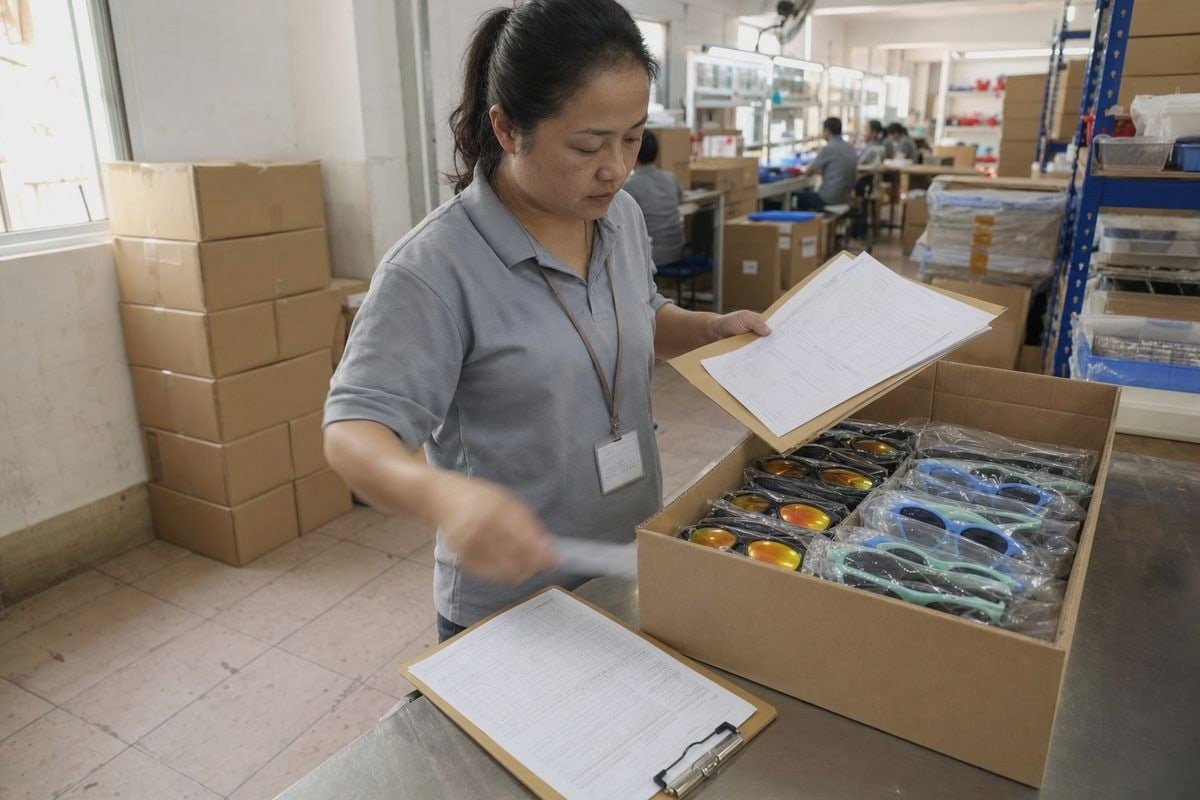
Passing CPC certificates and test reports to retailers trips up many kids sunglasses buyers. I have watched shipments from our Taizhou factory sit blocked because one document field was wrong.
To pass CPC certificates and test reports to retailers, the importer issues a Children’s Product Certificate based on CPSC-accepted third-party lab testing, matches it to the exact SKU, and delivers both the CPC and supporting test reports before shipment or listing approval.
That answer sounds simple. In practice, the details decide whether your kids sunglasses get accepted, listed, and reordered. Let me walk you through the full workflow, step by step.
What CPC Documents Do I Need to Request From My Kids Sunglasses Manufacturer?
A buyer from Australia once emailed our sales team asking for "the CPC certificate" for a TR90-Rahmen 1 she was sourcing from us. Her question revealed a common misunderstanding I see every season.
You should request third-party lab test reports from a CPSC-accepted laboratory, material declarations, production dates and locations, and tracking label details. Your manufacturer supplies the evidence, but the CPC itself must be issued by you, the importer, or the domestic manufacturer.
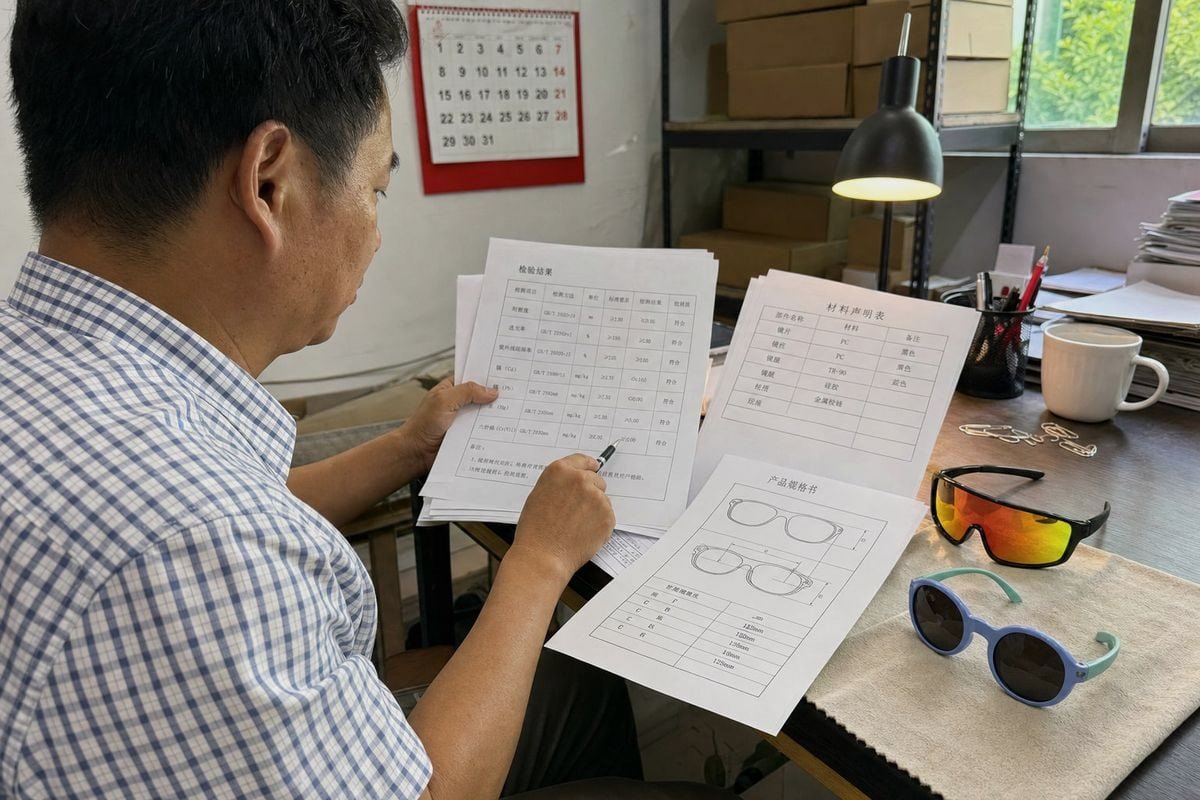
This distinction matters more than most first-time buyers realize. A CPC is not something a Chinese factory can legally issue on your behalf as the U.S. importer. When we support brands buying our flexible TPEE and TR90 kids sunglasses, our job is to hand you a complete evidence file. Your job is to turn that evidence into a valid Children's Product Certificate.
The Document Pack Your Factory Should Provide
After fifteen years of exporting children's eyewear, we have settled on a standard document pack. Here is what you should demand from any supplier:
| Dokument | Who Provides It | Why Retailers Care |
|---|---|---|
| Third-party lab results (CPSC-accepted lab) | Factory or buyer-arranged lab | Legal foundation of the CPC |
| Material and colorant declarations | Factory | Confirms lead and phthalates testing scope |
| Date and place of manufacture | Factory | Required CPC data field |
| Tracking label sample or artwork | Factory | Proves tracking label requirements are met |
| Product spec sheet with SKU and photos | Factory | Lets retailers match paper to product |
| UV400 protection certification or lens data | Factory or lens supplier | Supports marketing and safety claims |
Notice one thing. The lab report is the anchor. Supplier in-house test data is useful for quality control, but it cannot support a CPC. Only a CPSC accredited laboratory 2 produces results the CPSC recognizes. When buyers ask us, we always recommend confirming the lab's acceptance status on the CPSC website before booking any test.
One more practical point. Ask your factory to state whether components changed between orders. A new hinge screw supplier or a different colorant batch can quietly invalidate your existing reports. We flag these material changes for our clients proactively, because a surprise at customs is far more expensive than an email.
How Do I Verify Test Reports Are Valid Before Passing Them to My Retail Buyers?
Early in my export career, a client forwarded a competitor's test report to a U.S. retailer without checking the lab's accreditation. The retailer rejected the whole file. That lesson stuck with me.
Verify that the lab appears on the CPSC's list of accepted laboratories, that the report cites the correct children's product safety rules, shows passing results, matches your exact SKU and materials, and falls within the 12-month periodic testing window.

Verification is a checklist discipline, not guesswork. I suggest treating every incoming report the way a retailer's compliance team will treat it: skeptically. Here is the process we coach our B2B buyers through before they build their CPC.
Ein Fünf-Schritte-Verifizierungsprozess
- Confirm the lab. Search the CPSC's accepted-laboratory database. The lab must be accepted for the specific tests cited, not just accredited in general.
- Match the product. The report should name the exact model, colorway, and materials. A report for a periwinkle-blue rubberized frame does not automatically cover a glossy black wraparound style with a mirrored shield lens.
- Check the standards cited. Look for lead in paint and substrate, phthalates, and any applicable ASTM F963 standards references. Missing citations mean gaps in your CPC.
- Check the dates. Most children's products need retesting every 12 months. An expired report will not survive a retailer audit, and the CPC must be reissued after each periodic test.
- Check traceability. The report should tie to a production batch that your tracking labels can identify.
Where Component Part Testing Helps
Testing every single style separately gets expensive fast. This is where 16 CFR 1109 component part testing 3 becomes your friend. If several sunglass SKUs share the same TR90 pellet batch and the same TPEE temple compound, one material-level report can support multiple finished products. At our workshop, we group frame styles by material batch for exactly this reason. It lets a brand launch several colorways from our existing style library without paying for redundant lab work. But be careful: the component report only covers what is genuinely identical. Different paints, decorations, or lens coatings need their own testing evidence.
One objection I hear often: "Can't I just trust the factory's word that the report is valid?" I run a factory, and my honest answer is no. Trust your supplier's cooperation, but verify the paperwork yourself. Good manufacturers welcome that scrutiny.
Which Safety Standards Should My Kids Sunglasses Meet for CPC Compliance?
The trade-off we weigh on every new mold is this: a soft, flexible frame that survives a toddler's grip must also pass the same chemical and physical rules 4 as any children's product. Comfort never excuses compliance gaps.
Kids sunglasses marketed to children 12 and under must meet lead limits for paint and substrate, phthalates restrictions under CPSIA compliance rules, FDA impact resistance testing under 21 CFR 801.410, plus tracking label requirements. The exact rules depend on materials and construction.

There is no single "sunglasses test." The applicable rules flow from what the product is made of and who it is made for. Our two-tone rubberized kids frames and our sport-style wraparound shields go through different evidence trails, even though both leave the same 5S-managed workshop.
The Core Standards Map
| . Schlagfestigkeitsprüfungen sind eine separate Verpflichtung von CPSIA-Prüfungen. Viele Importeure müssen sich auch bei der FDA als Erstimporteur registrieren und das Produkt als medizinische Klasse-I-Gerät auflisten, um eine Beschlagnahmung der Sendung an der Grenze zu vermeiden. | Was es abdeckt | Applies To Kids Sunglasses? |
|---|---|---|
| Lead in paint and surface coatings | 90 ppm limit on coatings | Yes, if any painted or coated parts |
| Lead in substrate | 100 ppm limit in accessible materials | Yes, frames, temples, hinges |
| Phthalates | Restricted plasticizers in child-contact plastics | Yes, especially soft flexible materials |
| 21 CFR 801.410 5 | FDA-mandated impact resistance testing for lenses | Yes, all sunglasses sold in the U.S. |
| Tracking label requirements | Permanent batch traceability on product and packaging | Yes, for all children's products |
A note on phthalates. This is precisely why we invested in TPEE and TR90 rather than cheap PVC-based flexibles. Lead and phthalates testing is far less nerve-wracking when your base materials are inherently clean. Buyers focused on child safety should ask hard questions about the polymer, not just the price.
A note on lenses. Impact resistance testing under 21 CFR 801.410 sits under FDA rules rather than CPSC rules, but retailers expect it in your file anyway. The same goes for UV400 protection certification. It is a marketing claim, so back it with lens transmission data. Also remember: if a style is genuinely adult sunglasses 6, the CPC framework does not apply, but a General Certificate of Conformity may still be relevant for other regulations. Do not blur the two documents. Retailers know the difference, and mixing them signals inexperience.
Can My Manufacturer Help Me Prepare Retailer-Ready Documentation Packages?
Last spring, a Japanese kids' brand asked us to help them pass an Amazon compliance documentation review for a polarized children's style from our catalog. Their listing had been suppressed. We rebuilt the file together in one week.
Yes. A capable manufacturer supplies SKU-matched test reports, material declarations, production records, tracking label proofs, and product photos, then formats everything to your retailer's naming conventions. You still issue the CPC, but the factory makes assembling it fast and audit-proof.
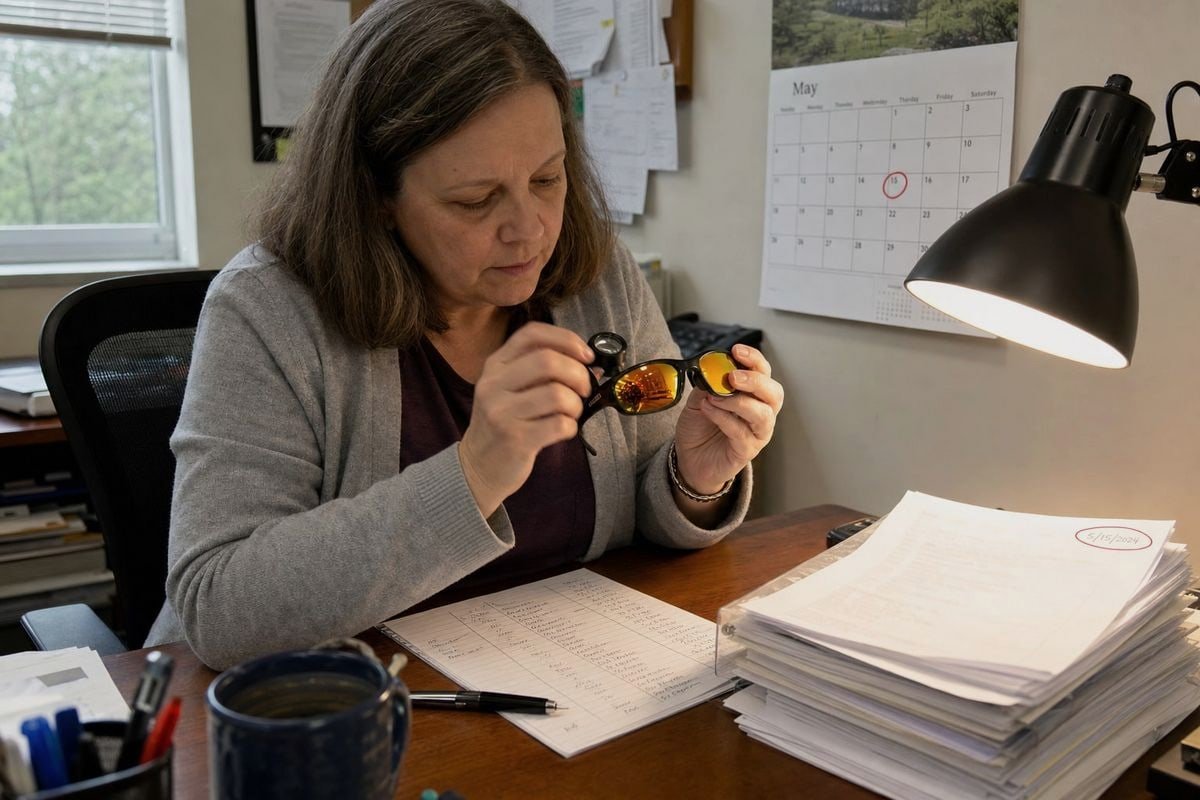
Retailers do not just want compliant products. They want documents that are easy to cross-check against the item record in their system. In my experience exporting to twenty-plus countries, most rejections are not caused by failed tests. They are caused by mismatches: a certificate that says "Model K-2035 Blue" when the purchase order says "Ocean Round Kids Shade." Same product, different name, blocked shipment.
What a Retailer-Ready Pack Looks Like
Here is the structure we help our clients assemble before their first shipment:
| Pack Element | Format Tip |
|---|---|
| CPC with all seven required data fields | In English, one certificate per product or truly identical family |
| Underlying third-party lab results | PDF, traceable to the exact variant tested |
| SKU cross-reference sheet | Maps factory model numbers to retailer item codes |
| Tracking label photos | Show label on both product and packaging |
| Lens data (UV400, impact resistance) | Include supplier lens certificates |
Delivery Method and Timing
You can furnish certificates electronically. A dedicated URL or shared compliance folder 7 satisfies the requirement, and larger buyers increasingly prefer a living compliance portal over static PDFs, because batch-specific reports update over time. Whatever the channel, deliver everything before first shipment, onboarding, or marketplace listing approval. Retailers will hold goods until the file is complete, and storage fees pile up fast.
Because we maintain roughly 800 existing styles, we keep material batch records organized so a new brand can pull a documentation trail quickly, without funding a new mold or starting testing from zero. Full OEM/ODM projects get the same treatment: custom colors and logos are logged as potential material changes, so your compliance file always reflects what is actually in the box. That discipline is what separates a long-term manufacturing partner from a low-price supplier.
Schlussfolgerung
Retailers block incomplete files, and delays cost real money. Test at a CPSC-accepted lab, issue an SKU-matched CPC, deliver both documents early, and partner with a factory that keeps evidence organized.
Fußnoten
1. Technical information on the polyamide material used for high-quality flexible eyewear frames. ↩︎
2. Searchable database of laboratories accepted by the CPSC for mandatory third-party testing. ↩︎
3. Federal regulation allowing component part testing to support finished product certification. ↩︎
4. Comprehensive guide to safety standards and chemical regulations for children’s products. ↩︎
5. FDA regulation mandating impact resistance testing for all eyeglass and sunglass lenses. ↩︎
6. General information regarding the classification and safety standards for adult eyewear. ↩︎
7. Official CPSC guidance on the electronic furnishing of compliance certificates to retailers. ↩︎
Weitere Artikel, die Ihnen gefallen könnten
August 2026
Sollte die Fabrik die Verpackung und Kennzeichnung von Kinder-Sonnenbrillen übernehmen oder einen bestimmten Lieferanten nutzen?

August 2026
Eigenes Lager vs. Direktlieferung durch den Lieferanten: Was senkt die Retourenkosten für Marken von Kinder-Sonnenbrillen?

August 2026
Direkt zum Lagerhafen oder Lagerung in Übersee: Was spart mehr bei den Versandkosten für Kinder-Sonnenbrillen?
Auf der Suche nach einem zuverlässigen Partner für Kinderbrillen?
Entdecken Sie über 800 sofort verfügbare Modelle und umfassenden OEM/ODM-Support, der auf Ihre Marke zugeschnitten ist.
Kontakt aufnehmen English
  Español de México
  Deutsch
  Français
  日本語
日本語  العربية
  Português do Brasil