How Should Kids’ Sunglasses Be Stored When Not in Use?
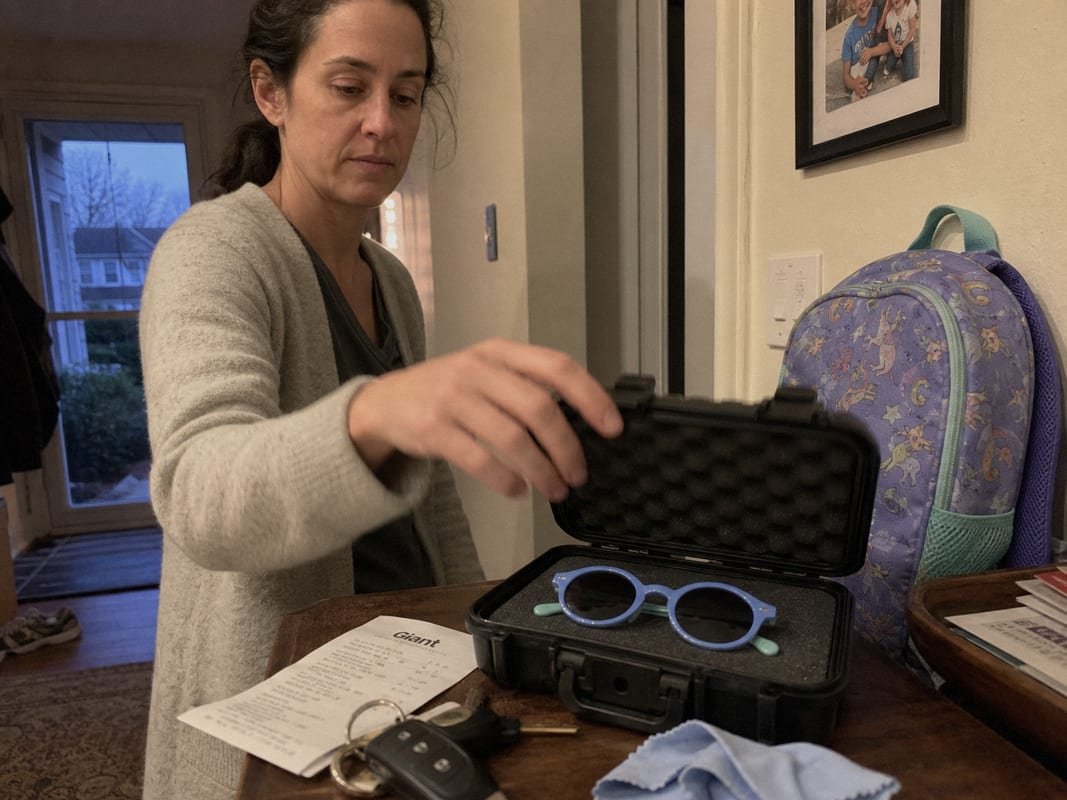
Kids’ sunglasses storage is the question our factory hears most after delivery. Frames get crushed, lenses get scratched, and parents blame the product — when careless storage is the real culprit.
Kids’ sunglasses should be stored in a hard-shell protective case, kept in a cool, dry place away from direct sunlight and heat. Wipe lenses with a microfiber cloth first, store lenses facing up, and keep the case in one consistent, easy-to-reach spot.
That is the short answer. Below, I will break down each part of it. I will cover cases, habits, and even how temperature affects frame materials.
What's the Best Way to Store Kids' Sunglasses to Prevent Scratches and Damage?
During a drop-test session in our Taizhou workshop last spring, we noticed something odd. Most returned samples from buyers failed not from drops, but from loose storage in bags.
The best way to store kids' sunglasses is inside a hard-shell protective case with the lenses facing upward. Clean the lenses with a microfiber cloth before storage, never rest them face-down, and never leave them loose in a backpack, drawer, or toy bin.
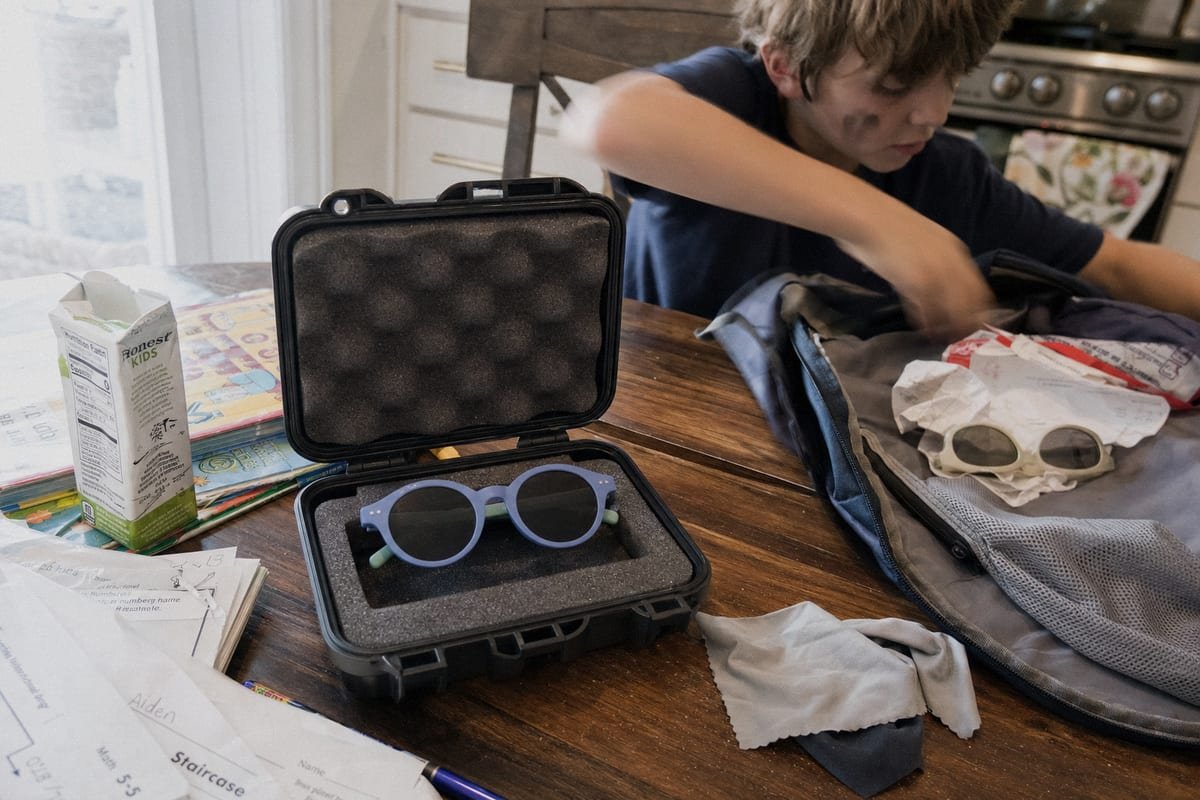
Let me explain why this matters so much. Kids' lenses take more abuse than adult lenses. Children drop their glasses, sit on them, and stuff them into pockets with rocks and snacks. Even a Beschichtungen verdienen ebenfalls besondere Aufmerksamkeit. Eine 1 cannot survive constant grinding against zippers and keys. Lens scratch prevention starts with one simple rule: the sunglasses go into a case every single time they come off the face.
Hard Case vs. Soft Pouch vs. Loose Storage
Not all storage options protect equally. Here is how the common methods compare, based on what we see in warranty feedback from our brand customers:
| Storage Method | Scratch Protection | Crush Protection | Beste Verwendung |
|---|---|---|---|
| Hard-shell protective case | Ausgezeichnet | Ausgezeichnet | Daily default storage |
| Mikrofaser-Reinigungstasche | Gut | Poor | Short-term, inside a bag pocket |
| Protective eyewear sleeve | Gut | Fair | Travel, as a second layer |
| Loose in backpack or drawer | Keine | Keine | Never recommended |
The hard case wins for one reason: it protects against both scratches and crushing. A microfiber cleaning pouch stops scratches but cannot stop a heavy textbook. We tell our B2B buyers to pair the two. A pouch inside a hard case gives double protection and doubles as a wipe.
Three Habits That Prevent Most Damage
- Wipe before storing. Skin oils, sunscreen, and salt slowly degrade lens coatings and frame surfaces. A quick pass with a microfiber cloth removes them.
- Lenses up, always. Face-down storage grinds the lens against dust and grit. Even hardened coatings pick up micro-scratches this way.
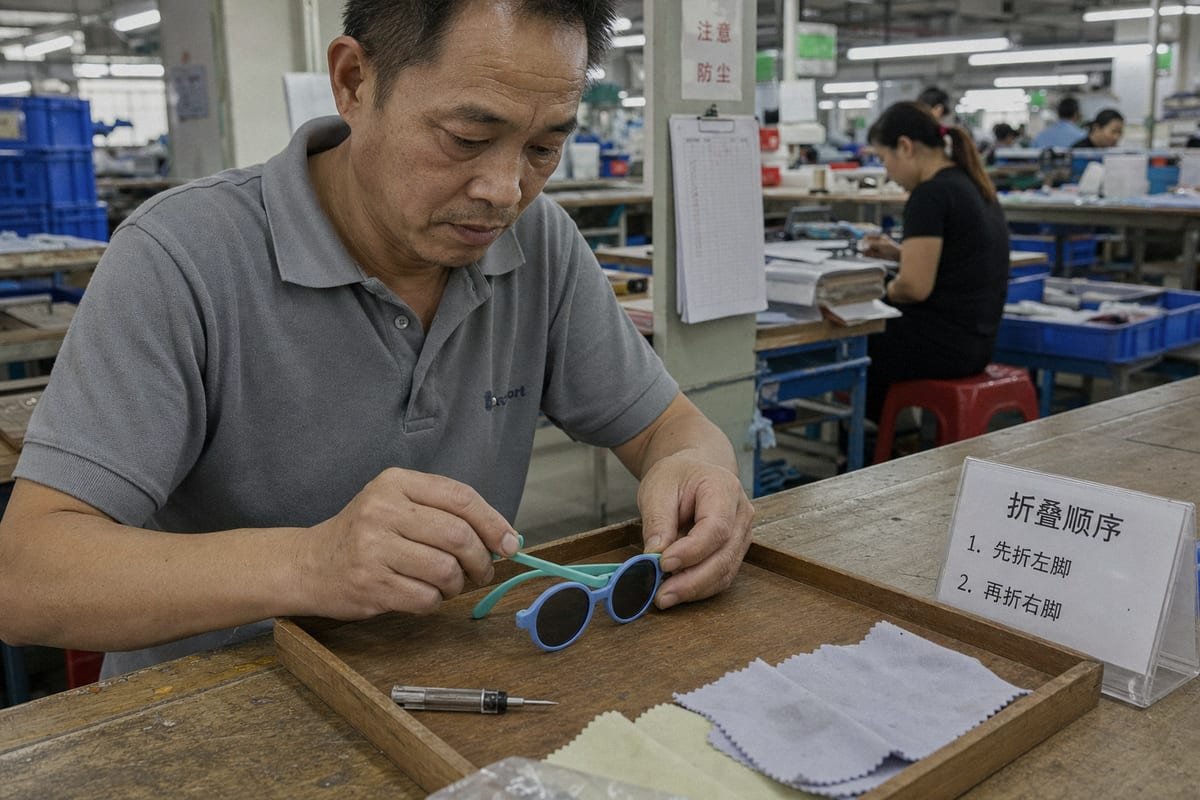
- Fold the temples gently. Forcing arms closed in the wrong order strains the hinges. Good hinge tension maintenance starts with folding the left temple first on most frames.
For polarized lens care 2, the same rules apply, but the stakes are higher. Polarized films sit inside layered lenses, and deep scratches can expose the film edge to moisture.
Should I Recommend a Protective Case for My Kids' Sunglasses Collection?
A brand buyer from Australia once asked us to quote sunglasses without cases to cut cost. Six months later, she reordered — with cases. Her return rate had told the story.
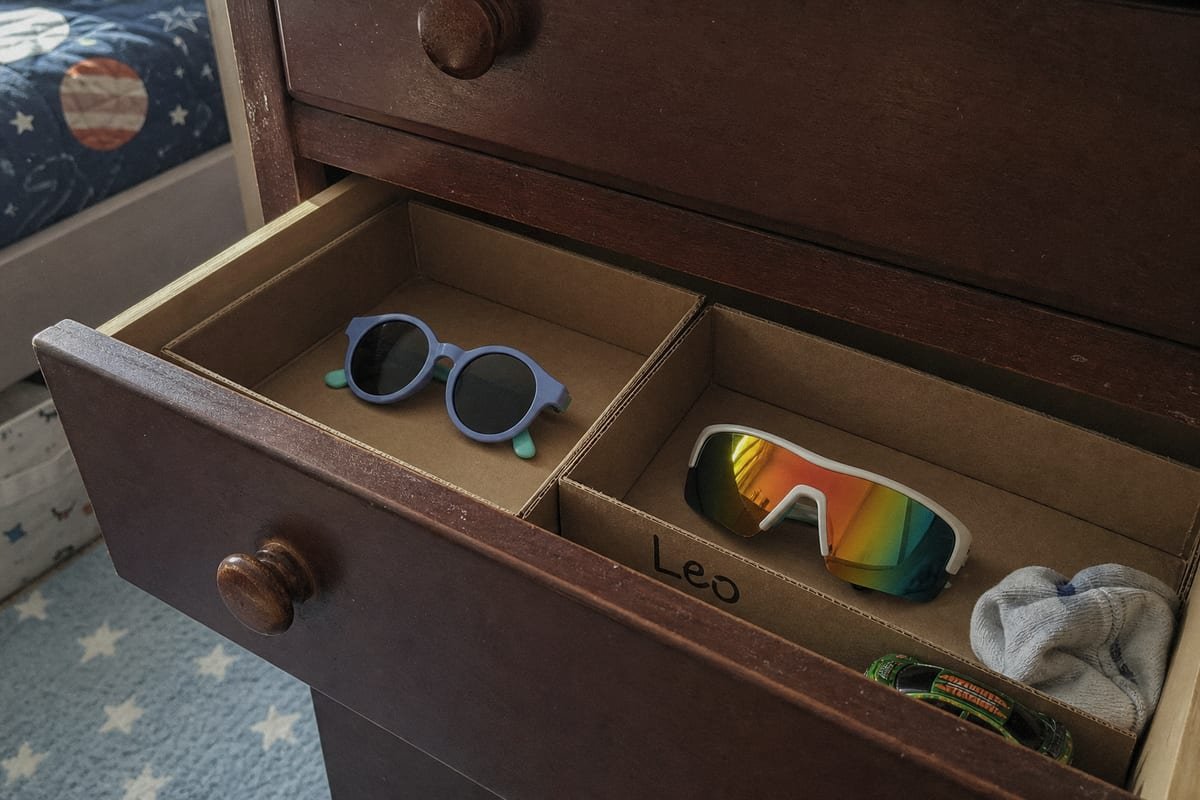
Yes, a protective case is essential for every pair in a kids' sunglasses collection. Use one hard-shell case per pair, or a sunglass organizer tray with dividers for multiple pairs, so frames never rub, stack, or press against each other.
Here is the deeper logic. One pair needs one case. But many families now own several pairs per child — a daily pair, a sports pair, and a school backup. Our own catalog reflects this. A soft pastel round frame in flexible TPEE suits everyday wear, while a wraparound shield style with a mirrored lens suits cycling and beach days. Different frames have different shapes, and stacking them together is a recipe for scratched lenses and bent temples.
Matching Storage to the Collection Size
For a single pair, a hard-shell case is enough. For two or more pairs, think in systems:
- Sunglass organizer tray: A divided tray keeps each pair in its own slot. Line it with anti-static felt to reduce dust attraction on plastic frames.
- Wall-mounted glasses rack: Good for older kids. It keeps frames visible and off flat surfaces, though it works best indoors away from windows.
- Labeled drawer with dividers: Practical for siblings sharing a room. Separate labeled compartments prevent mixed-up and squashed frames.
- Car visor clip: Useful only as a temporary holder during a drive. Never leave sunglasses clipped there in a parked car 3, because visor areas heat up fast.
What Makes a Good Kids' Case?
From our OEM packaging work, three features matter most for children. First, a bright color or fun print, so the case is easy to spot. Second, a wide, simple opening that small hands can manage alone. Third, a light but rigid shell. When we develop retail-ready packaging for our brand customers, we treat the case as part of the product, not an accessory. A great pair of sunglasses with no case rarely survives its first year.
One more point: choose cases or trays that block light. UV-opaque containers 4 prevent slow pigment fading in frames left near bright windows.
How Can I Help Parents Teach Kids Proper Sunglasses Storage Habits?
Somewhere in our fifteen years of building children's eyewear, we learned a humbling truth: the most durable frame we can engineer still loses to a five-year-old with no routine.
Teach kids one rule — case every time — and anchor it to one fixed home spot. Use a bright labeled case, a visual parking-spot marker, and a simple daily checkpoint like the bedtime routine, so storage becomes automatic rather than optional.
The core insight is this: the best storage system is the one a child can run independently. Parents cannot supervise every moment. So the system must be simple, visible, and repeatable. When we consult with kids' brands on packaging inserts, we often suggest including a short habit card for parents, because a returned "broken" pair is usually a lost-habit pair.
Build the Habit in Four Steps
- Pick one home spot. An entryway basket, a shelf near the door, or a dedicated backpack pocket. One location only. Multiple spots confuse young kids.
- Make the case unmissable. A bright color, the child's name label, or a favorite sticker turns the case into "theirs." Ownership drives compliance.
- Add a visual cue. A simple silhouette or outline sticker on the shelf creates a parking spot. The child can see when the job is done. It turns cleanup into a small game.
- Attach it to an existing routine. Shoes off, sunglasses in the case. Or add it to the bedtime checklist. Habits stick when they piggyback on habits that already exist.
Match the Method to the Child's Age
| Altersgruppe | What Works Best | Parent's Role |
|---|---|---|
| 2–4 years | Montessori-style station 5 at eye level, big open case | Model the habit, hand-over-hand practice |
| 5–7 years | Parking-spot silhouette, name-labeled case | Gentle daily reminders, praise |
| 8–12 years | Backpack case pocket, school backup pair | Spot checks, natural consequences |
A backup pair at school or daycare is worth mentioning to parents. It removes the panic when a pair is forgotten, and it lets the habit develop without pressure. Our flexible TPEE and TR90 6 frames help here too — a forgiving frame survives the learning phase while the habit takes root.
Does Storage Temperature or Humidity Affect the Durability of Kids' Sunglasses Frames?
Choosing between frame materials always involves a trade-off we weigh at the design stage: flexibility versus heat tolerance. That trade-off makes cool dry storage more important than most parents realize.
Yes. Heat above roughly 60°C, common inside parked cars, can warp plastic frames and delaminate lens coatings, while ongoing humidity promotes fogging and coating breakdown. Store kids' sunglasses in a cool, dry, shaded spot and avoid dashboards, windowsills, bathrooms, and heaters.

Frame materials behave differently under stress, and this is where our material expertise comes in. We build most of our children's frames in TR90 and TPEE precisely because kids bend, twist, and drop their glasses. These materials flex and recover. But no plastic is immune to sustained heat. Heat damage prevention is a storage job, not a material job.
How Heat and Humidity Attack Sunglasses
Heat softens thermoplastics 7. A frame left on a dashboard slowly relaxes into a new, wrong shape. The temples splay, the fit loosens, and the glasses slide down the child's nose. Heat also attacks lenses. Mirrored and polarized coatings are bonded layers, and rapid heating can cause bubbling or delamination, especially on gradient mirror lenses.
Humidity works more slowly. Moisture creeps into coating edges and hinge joints. Over months, it contributes to fogging, coating haze, and stiff or corroded hinge screws. A bathroom shelf is one of the worst long-term storage spots for this reason.
| Storage Location | Risikostufe | Main Threat |
|---|---|---|
| Parked car / dashboard | Sehr hoch | Frame warping, coating delamination |
| Sunny windowsill | Hoch | UV fading, gradual heat distortion |
| Bathroom shelf | Mäßig | Humidity, fogging, hinge corrosion |
| Near heater or vent | Hoch | Localized heat softening |
| Bedroom drawer with case | Niedrig | Minimal, if cased |
| Entryway shelf, shaded | Niedrig | Minimal, ideal daily spot |
The Simple Environmental Rules
Keep it under about 35°C. Keep it away from direct sunlight. Keep it dry. A hard case in a shaded indoor spot achieves all three with zero effort. If a car is unavoidable, use a cool compartment like the glovebox for short periods only — and always avoid direct sunlight through the windshield. A microfiber cloth inside the case adds a light moisture barrier in humid climates. These small choices decide whether a well-made frame lasts one season or three.
Schlussfolgerung
Scratched lenses and warped frames are usually storage failures, not product failures. A hard case, one home spot, and cool dry storage keep kids' sunglasses protecting young eyes for years.
Fußnoten
1. Background on optical coatings referenced for lens scratch protection. ↩︎
2. Explains the science behind polarized lenses referenced in lens care discussion. ↩︎
3. Authoritative government source explaining rapid temperature increases in parked vehicles. ↩︎
4. EPA resource on UV exposure supports the claim about UV causing pigment fading. ↩︎
5. Explains the educational method referenced for teaching young children storage habits. ↩︎
6. TR90 is a nylon-based polyamide material used in flexible eyewear frames. ↩︎
7. Wikipedia background on thermoplastic behavior under heat supports frame warping claims. ↩︎
Weitere Artikel, die Ihnen gefallen könnten

August 2026
Sollte die Fabrik die Verpackung und Kennzeichnung von Kinder-Sonnenbrillen übernehmen oder einen bestimmten Lieferanten nutzen?
August 2026
Eigenes Lager vs. Direktlieferung durch den Lieferanten: Was senkt die Retourenkosten für Marken von Kinder-Sonnenbrillen?

August 2026
Direkt zum Lagerhafen oder Lagerung in Übersee: Was spart mehr bei den Versandkosten für Kinder-Sonnenbrillen?
Auf der Suche nach einem zuverlässigen Partner für Kinderbrillen?
Entdecken Sie über 800 sofort verfügbare Modelle und umfassenden OEM/ODM-Support, der auf Ihre Marke zugeschnitten ist.
Kontakt aufnehmen English
  Español de México
  Deutsch
  Français
  日本語
日本語  العربية
  Português do Brasil