How to Create an Age-Based Size Chart for Kids Optical Frames Sold Online?
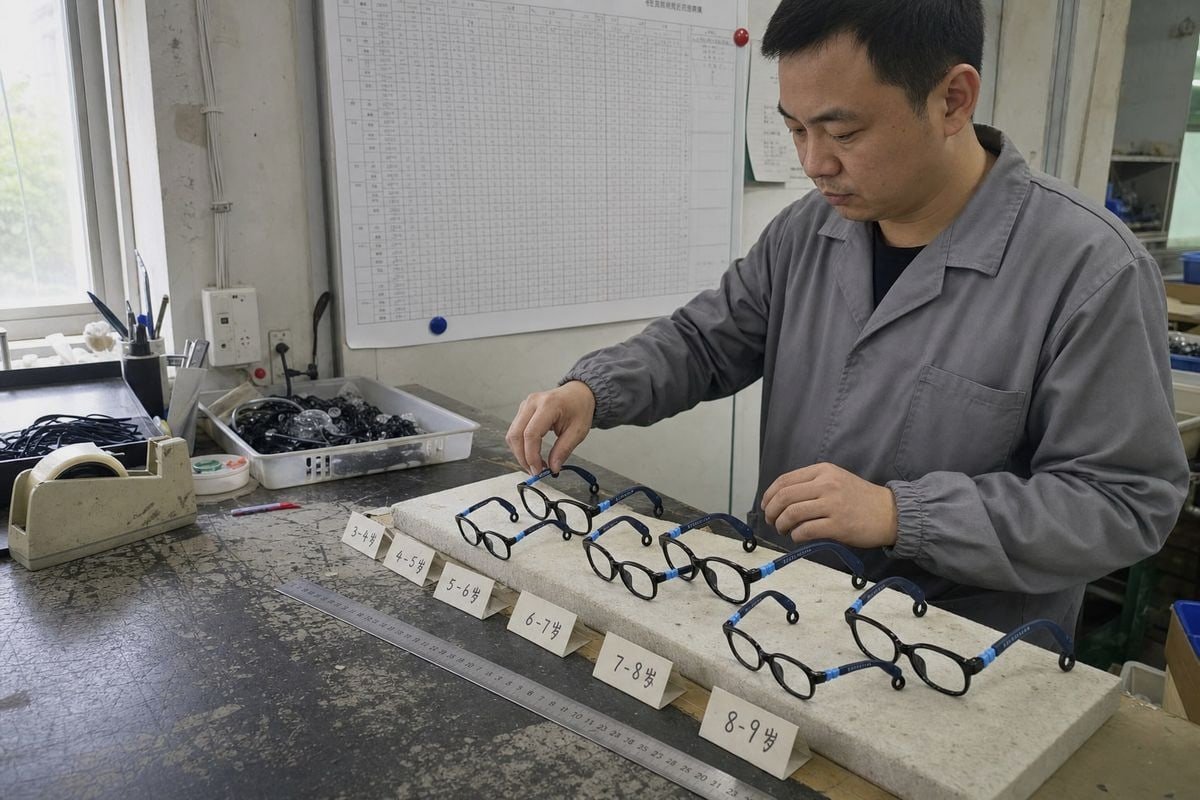
Building an age-based size chart for kids optical frames sounds simple — until our factory started fielding return complaints from online brands who relied on age labels alone. Parents guessed, frames slipped, refunds piled up. After fifteen years of producing children’s eyewear in Taizhou, we learned that a chart only works when age bands are anchored to real millimeter measurements. That is exactly what I will show you how to build here.
To create an age-based size chart for kids optical frames, group children into bands such as 0–2, 2–4, 4–6, 6–8, 8–10, and 10–16 years, then assign each band a lens width, bridge width, temple length, and total frame width, noting that age is only an approximate guide.
Let me break this down step by step. We will cover the age groups, the measurements behind them, the mistakes that cause returns, and how to present the chart so parents actually trust it.
What age groups should I use to structure my kids' frame size chart?
A buyer from Australia once asked me to label our TR90 kids optical frames with a single "ages 3–12" tag. I had to talk her out of it — that range spans three completely different face sizes.
Use six age bands: 0–2 years (baby), 2–4 years (toddler), 4–6 years (preschool), 6–8 years (early school), 8–10 years (school age), and 10–16 years (junior/teen). Each band should map to a distinct lens width, bridge width, and temple length range for accurate children's glasses sizing.
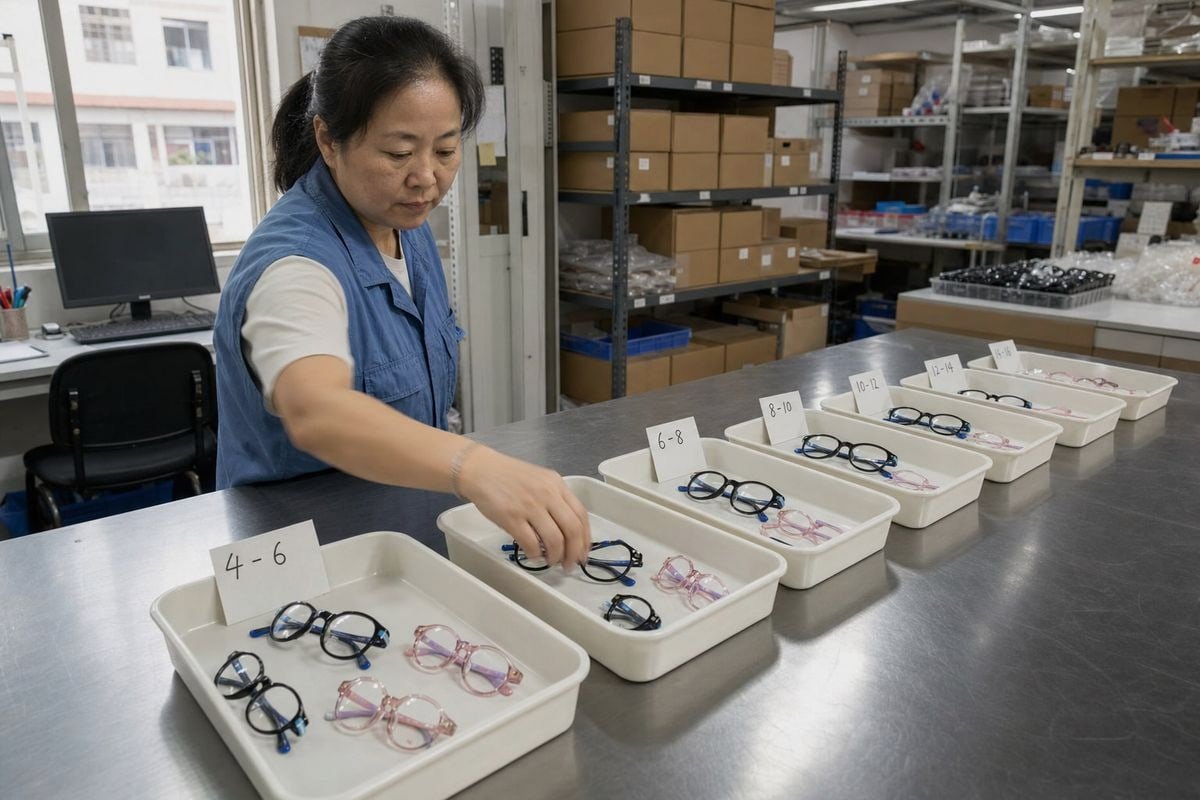
Age bands are a shopping shortcut. Most parents do not know what a 44 mm lens width means. But they do know their child is five years old. So the age label is the doorway. The measurements behind the door are what actually determine fit.
Across the roughly 800 existing styles in our catalog, we group frames into bands that follow how children's faces actually grow. Head width grows fast in the first four years, then slows. That is why the youngest bands cover shorter age spans.
A practical six-band structure
Here is the structure we recommend to the brands and importers we supply:
| Age Band | Category Label | Typische Glasbreite | Why This Band Exists |
|---|---|---|---|
| 0–2 Jahre | Baby | 35–38 mm | Rapid head growth; softest, most flexible frames needed |
| 2–4 years | Toddler | 40–44 mm | Toddler glasses need durability plus a snug bridge |
| 4–6 years | Preschool | 41–46 mm | First school years; frames worn all day |
| 6–8 years | Early school | 44–48 mm | Active play demands frame durability |
| 8–10 years | School age | 45–50 mm | Faces widen; temple length steps up |
| 10–16 years | Junior/Teen | 47–58 mm | Overlaps with adult-small sizing |
Why overlapping ranges are intentional
Notice the ranges overlap. A large-faced six-year-old may fit an 8–10 frame. A petite nine-year-old may fit a 6–8 frame. Some research briefs argue this makes age charts useless. I disagree. The overlap is honest. It tells parents the chart is a starting point, not a verdict. Your product pages should say exactly that: age ranges are approximate and vary by child.
How do I measure frame width, temple length, and bridge fit for different ages?
When we calibrate a new mold in our workshop, three numbers get checked before anything else: lens width, bridge width, and temple length. Those same three numbers should anchor your chart.
Measure lens width across one lens at its widest point, bridge width as the gap between the two lenses, and temple length from hinge to temple tip. For each age band, increase lens width by 2–3 mm and temple length by 5–10 mm as children grow.
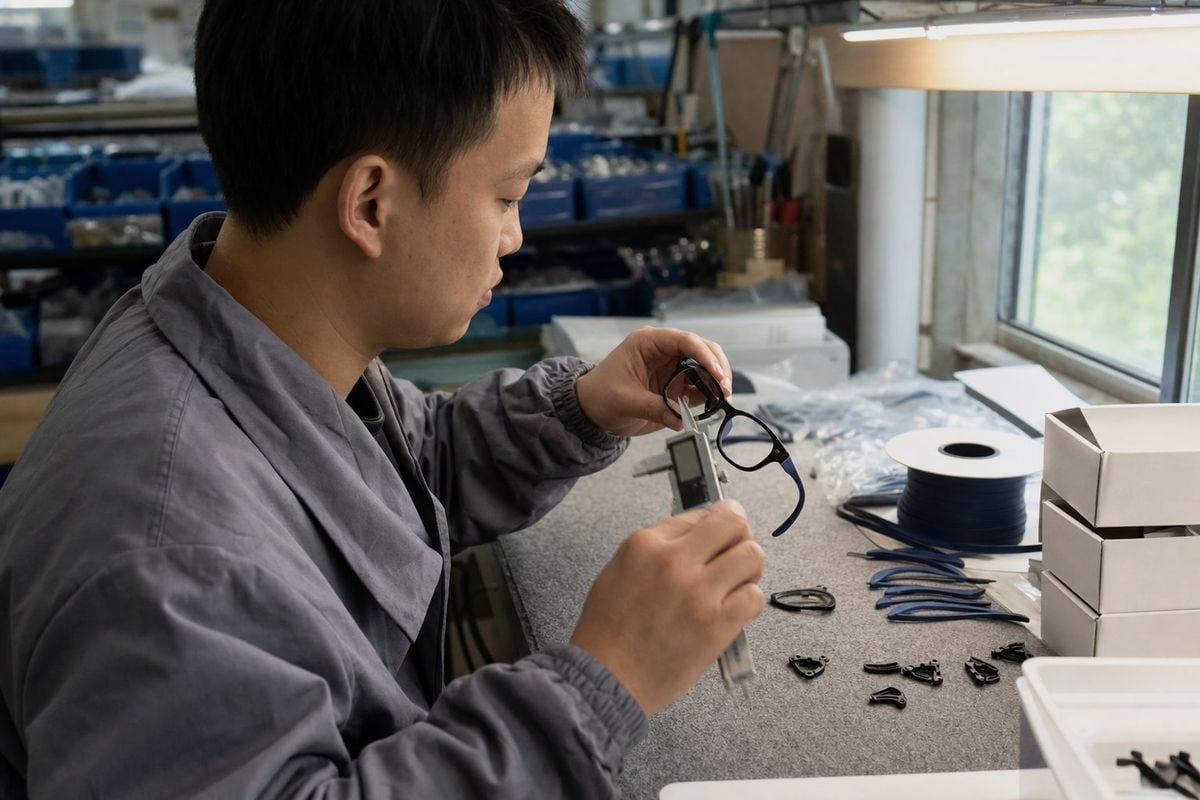
These three measurements are the language of kids eyewear fitting. Learn them once, and every frame in your catalog becomes comparable.
The four core measurements defined
Lens width (eye size). This is the horizontal width of one lens. Most kids' charts use it as the primary size label. Baby frames sit around 35–38 mm. Teen frames can reach 58 mm and overlap adult smalls.
Bridge width (DBL). This is the distance between the lenses. It keeps the frame centered on the nose. Children have low, developing nose bridges, so this number matters more than most shoppers realize. Expect roughly 12–14 mm for babies, 14–16 mm for ages 4–6, and 16–18 mm and up for ages 8–10 and older.
Temple length. This is the arm from hinge to tip. It should increase gradually with age — around 115–125 mm for toddlers, 125–135 mm for ages 6–8, and 130–140 mm or more for older kids. On our flexible TPEE temples, we add looped or curved tips for a secure ear grip on active children.
Total frame width. This is the full front width. A useful rule we share with buyers: measure the child's face temple-to-temple, then add about 5–10 mm to estimate the ideal frame width.
Reference measurements by age band
| Age Band | Lens Width | Bridge Width | Temple Length |
|---|---|---|---|
| 0–2 Jahre | 35–38 mm | 12–14 mm | 110–115 mm |
| 2–4 years | 40–44 mm | 13–15 mm | 115–125 mm |
| 4–6 years | 41–46 mm | 14–16 mm | 120–130 mm |
| 6–8 years | 44–48 mm | 15–17 mm | 125–135 mm |
| 8–10 years | 45–50 mm | 16–18 mm | 130–140 mm |
| 10–16 years | 47–58 mm | 16–20 mm | 135–150 mm |
Do not forget pupillary distance
Frame size and lens alignment are two different things. Pupillary distance (PD) determines where the optical centers of the lenses sit. If your customers order prescription lenses online, give them clear guidance on measuring PD at home — a millimeter ruler, a mirror, and a steady hand — or advise them to get it from their optometrist. A perfectly sized frame with misaligned optical centers still fails the child.
What sizing mistakes should I avoid when selling kids' optical frames online?
The costliest lesson from our export history came from a European client who sized every product page by age alone. Their return rate told the story before their emails did.
Avoid these mistakes: relying on age labels without millimeter data, oversizing frames "to grow into," ignoring bridge fit on low nose bridges, skipping temple length checks, and omitting a measuring guide. Each error increases slippage, discomfort, and online return rates.

Some brands argue that parents just want quick age labels and that measurement talk scares them off. I understand the worry. But in our experience exporting to 20+ countries, the brands that hide the numbers pay for it in returns. The answer is not choosing between age and measurements. It is layering them.
The five mistakes that drive returns
Mistake 1: Age-only sizing. Two five-year-olds can differ by a full frame size. Always pair the age label with lens width, bridge width, and temple length.
Mistake 2: Oversizing for growth. "Room to grow" sounds thrifty. But an oversized frame slips down the nose, sits on the cheeks, and pulls the optical centers away from the pupils. For children between sizes, a slightly larger frame is acceptable — a dramatically larger one is not. Growth allowance should be minimal for glasses worn daily.
Mistake 3: Ignoring bridge fit. Children have flatter, lower nose bridges than adults. A bridge that is too wide lets the whole frame slide. This is why we mold our TR90 frames with kid-specific bridge profiles rather than shrinking adult designs.
Mistake 4: Rigid materials on active kids. A frame that fits on day one but snaps in week two is still a sizing failure in the parent's eyes. Flexible TPEE temples and durable TR90 fronts survive playgrounds. Comfortable fit and frame durability sell together.
Mistake 5: No at-home measuring guidance. If parents cannot verify size before buying, they guess. Guessing generates returns.
Quick reference: mistake versus fix
| Mistake | Was passiert | The Fix |
|---|---|---|
| Age-only labels | Wrong size half the time | Show mm data on every size row |
| Oversized frames | Slipping, misaligned lenses | Minimal growing room only |
| Wrong bridge width | Frame slides down | Kid-specific bridge, adjustable pads |
| Rigid temples | Breakage, pressure behind ears | Flexible temples with grip tips |
| No measuring guide | Guesswork and returns | Two-minute home measuring steps |
How can I present my size chart clearly to reduce online return rates?
Our team once redesigned the packaging inserts for a kids' accessory brand, and the fit-guide card we added changed their support inbox more than any product tweak that season.
Present your chart as a table showing age band plus all four measurements, add a two-minute home measuring guide with diagrams, offer virtual try-on where possible, note that ages are approximate, and include a post-delivery fit-check checklist to catch problems before returns.

A chart nobody understands is decoration. A chart parents can act on is a return-rate tool. Here is the presentation system we recommend to the optical companies and children's brands we manufacture for.
Put age and millimeters on every row
Never show one without the other. The age band pulls the parent in. The measurements let them verify. Add a short line under the table: age ranges are approximate — measure your child or their current glasses for the best fit.
Add a two-minute measuring guide
Parents will follow three simple steps if you show them how:
- Face width. Use a soft tape measure temple-to-temple across the face. Add 5–10 mm for the ideal frame width.
- Current glasses. Check the numbers printed inside the temple arm, or measure lens width, bridge, and temple length with a ruler.
- Bridge check. Look at where the child's current frames rest. If they slide, recommend a smaller bridge width or adjustable nose pads.
For toddlers, suggest measuring during a nap or while they watch a show. Cooperation is half the battle with toddler glasses.
Use technology and photos where they help
Virtual try-on tools that estimate face measurements from a photo are becoming standard, and they genuinely boost buyer confidence for kids' frames. Even without AI tools, clear diagrams beat text alone. Show arrows on a frame photo pointing to lens width, bridge width, and temple length.
Include a post-purchase fit check
Ship a fit-check card or add one to the confirmation email. The checklist we suggest: lenses centered over the pupils, no frame contact with the cheeks, temples resting without pressure behind the ears, and no pinching at the bridge. Frames with flexible temple tips and adjustable components can absorb small fit differences, which turns a would-be return into a minor at-home adjustment. When we develop OEM styles with clients, we often build this checklist directly into the retail packaging so it reaches every parent.
Schlussfolgerung
An age-based size chart for kids optical frames works when age bands map to lens width, bridge width, and temple length, backed by home measuring guides and fit checks.
Weitere Artikel, die Ihnen gefallen könnten

August 2026
Bio-Based vs Regular Cellulose Acetate: What's the Difference for Kids' Frames?

August 2026
How Recyclable Are Kids' Optical Frame Materials, and What Eco-Friendly Alternatives Exist?

August 2026
Bleichen Kinderbrillengestelle im Lager aus oder altern sie, und wie kontrolliert man die Lagerbedingungen?
Auf der Suche nach einem zuverlässigen Partner für Kinderbrillen?
Entdecken Sie über 800 sofort verfügbare Modelle und umfassenden OEM/ODM-Support, der auf Ihre Marke zugeschnitten ist.
Kontakt aufnehmen English
  Español de México
  Deutsch
  Français
  日本語
日本語  العربية
  Português do Brasil