How to Ask Suppliers for Kids Optical Frame Fitting by Head Size and PD?
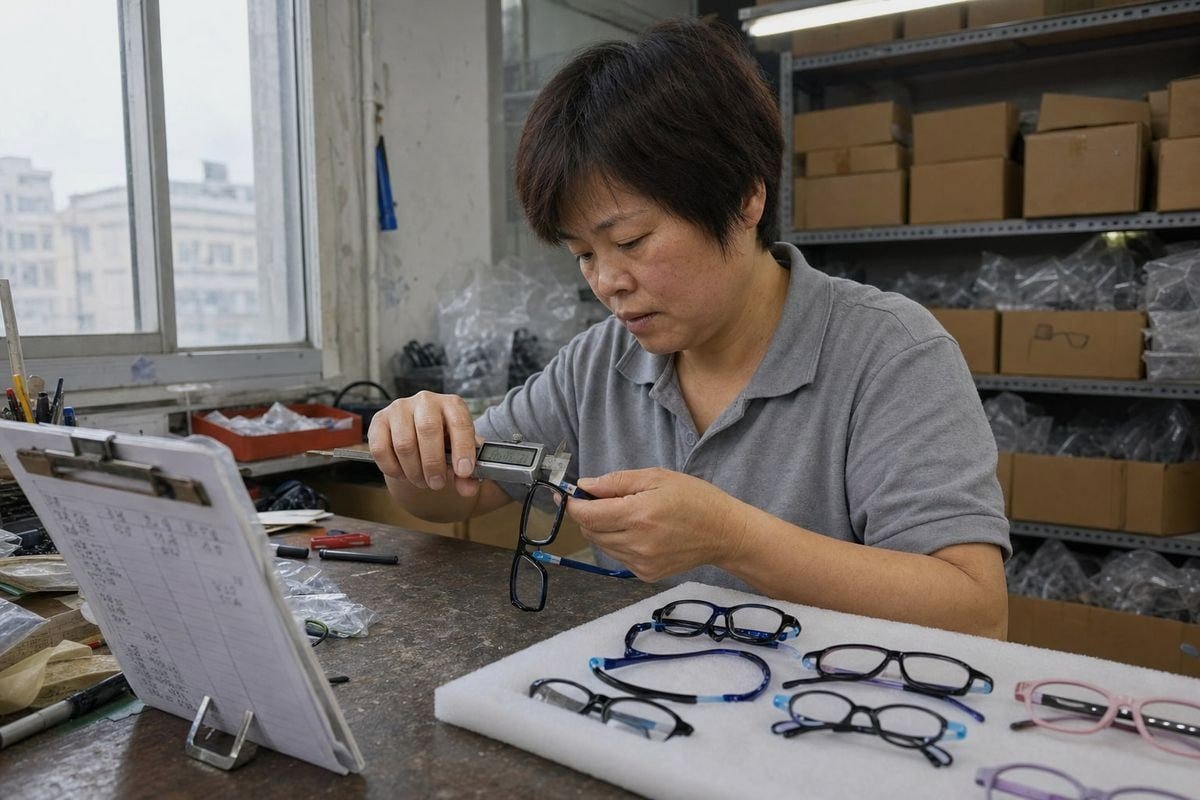
Kids optical frame fitting by head size and PD is the question our Taizhou factory hears most from new buyers. Get it wrong, and returns pile up while children refuse to wear the glasses.
To get kids optical frame fitting right, give your supplier two data sets: head-size dimensions (frame width, bridge width, temple length in millimeters) and target PD ranges per size. Then request a spec sheet with tolerances and physical fit samples before approving bulk production.
That is the short answer. The rest of this guide breaks it into four practical conversations you should have with any factory before placing an order.
How do I explain my brand's target age range and head size range to a supplier?
A buyer from Australia once told us she wanted frames "for kids around six." Our engineers had to ask five follow-up questions before we could recommend anything from our 800 existing styles.
Explain your target market by pairing each age band with millimeter measurements: front frame width, lens width, bridge width, and temple length. Add typical face-width data, measured temple to temple, so the supplier can match your range to real pediatric head proportions, not just an age label.
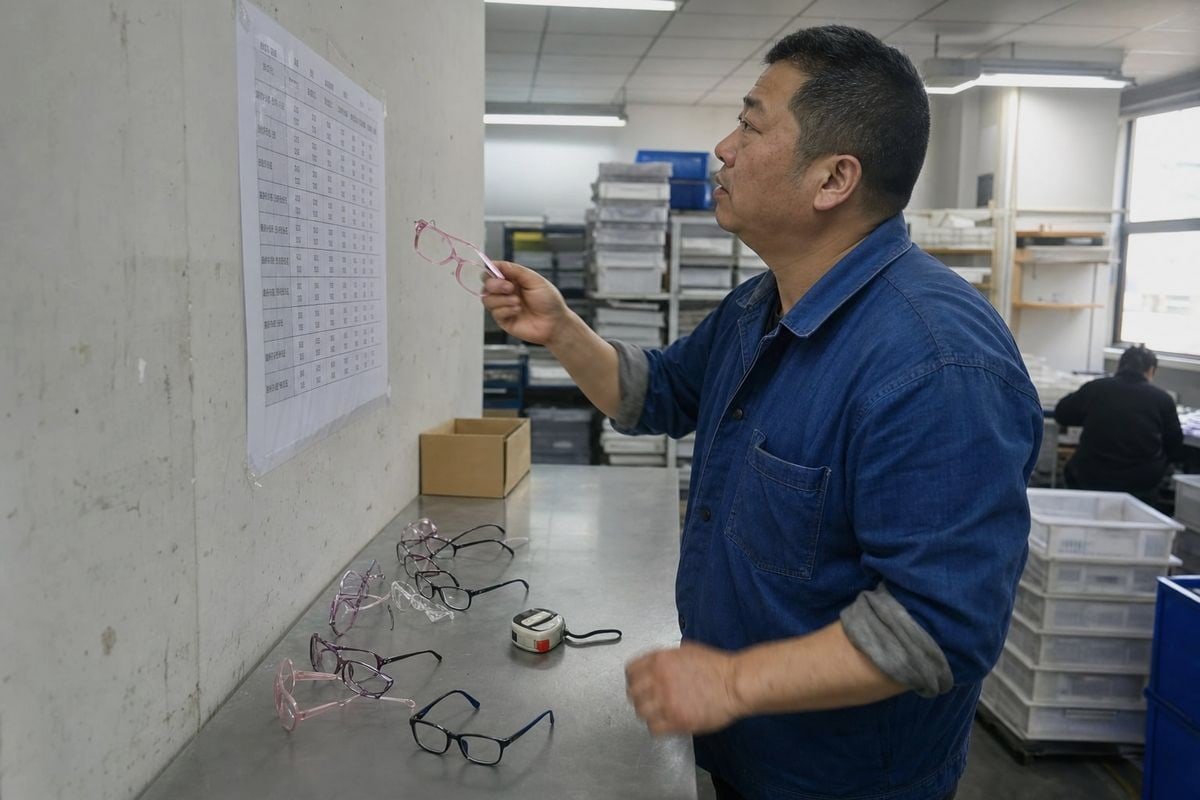
Age is a starting point, never a spec. Two six-year-olds can differ by 10 mm or more in face width. That is why measurement-led ordering has replaced age-only ordering across serious pediatric eyewear buyers. When we develop TR90 kids optical frames with TPEE temples, we design around head-width bands first and attach age labels afterward for retail convenience.
Translate age bands into supplier language
Give your factory a table like this in your first inquiry. It removes guesswork on both sides.
| Age band | Typical face width (temple to temple) | Frame front width | Bridge width | Temple length |
|---|---|---|---|---|
| 1–3 years (infant optical frames) | 95–105 mm | 100–110 mm | 12–14 mm | 105–115 mm |
| 4–6 years | 105–115 mm | 110–120 mm | 14–16 mm | 115–125 mm |
| 7–9 years | 112–122 mm | 118–128 mm | 15–17 mm | 120–130 mm |
| 10–12 years | 118–128 mm | 124–134 mm | 16–18 mm | 125–135 mm |
Treat these numbers as a conversation starter, then adjust them to your market. Children in different regions have different average facial proportions. Buyers serving Asian markets, for example, often ask us about low bridge glasses for kids, because a standard bridge can slide down flatter nose profiles.
State the anatomy, not just the size
Tell the supplier explicitly that you need pediatric-specific molds. Children have flatter nose bridges and proportionally wider heads than adults. A scaled-down adult frame fails on both points. Ask directly: are these frames designed on children's head data, or shrunk from adult designs? A factory with genuine pediatric design experience will answer with mold data, not marketing language.
What details do I need to give a factory to get accurate PD measurements for kids' frames?
In our experience exporting wholesale optical frames for kids to more than 20 countries, PD is the measurement buyers understand least — yet it decides whether the lenses actually work.
Give the factory your target PD range for each size (typically 40–54 mm across childhood), ask for the boxed center distance of every model, and confirm the two numbers sit within a few millimeters of each other so lens optical centers align with the child's pupils.
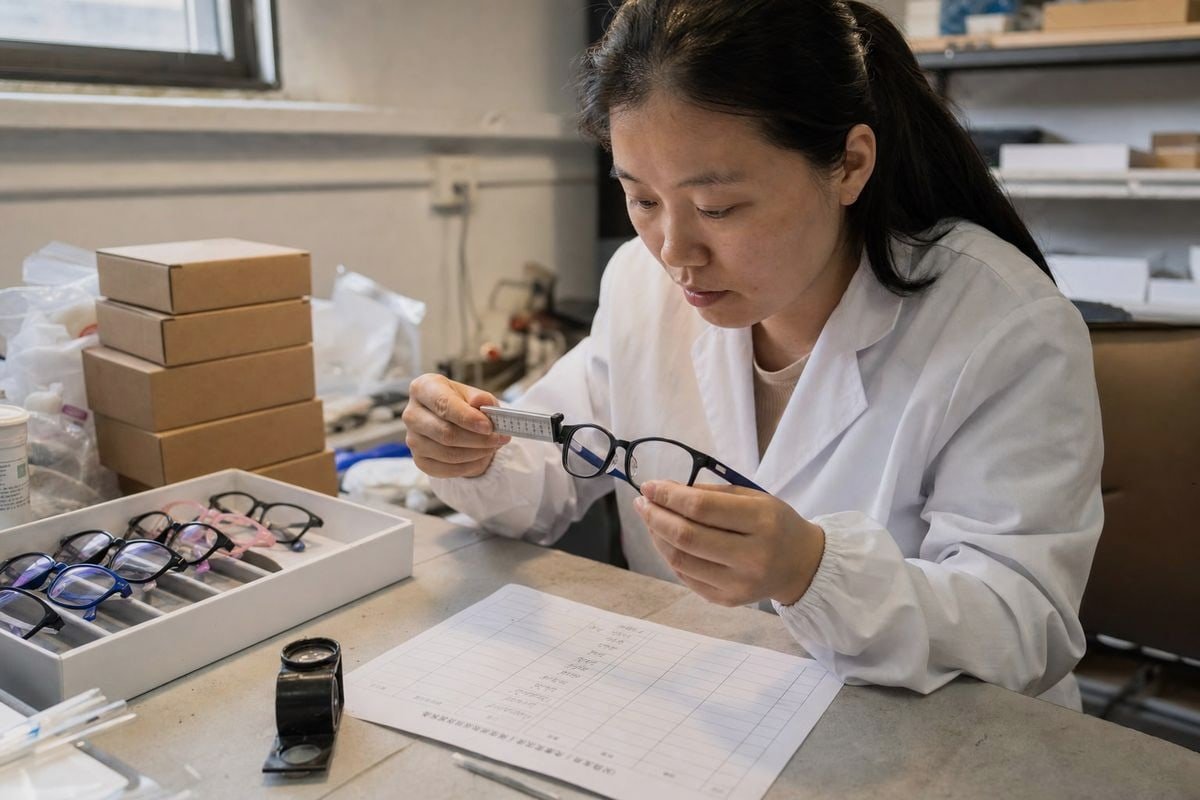
Head size and PD are related, but they are not interchangeable. Head size tells you whether the frame physically fits the face. Pupillary distance measurement tells you whether the optical centers of the lenses will line up with the child's pupils. A frame can fit the head perfectly and still put the lens centers too far apart, forcing the optician to decenter the lenses. That creates thicker lens edges and, in stronger prescriptions, real visual discomfort.
The PD data your supplier needs
Send these three items with your inquiry:
- Target PD range per size. Children's PD typically runs from about 40 mm in toddlers to 54 mm or more in pre-teens. Match each frame size to a PD band.
- Boxed center distance per model. This is lens width plus bridge width. Ask the factory to publish it on every spec sheet. The closer it sits to the wearer's PD, the less decentration the lens lab must apply.
- Tolerance expectations. For higher prescriptions, opticians may need monocular PD accuracy. Ask whether the frame geometry leaves room for asymmetric centration.
Why PD changes matter for your product line
Children grow, and their PD grows with them. We advise buyers not to base a whole collection on one old measurement set. If your brand sells online, publish a simple home pupillary distance measurement method: place a millimeter ruler against the child's brow, have them look straight ahead, and repeat the reading two or three times. Some parents will still get a professional measurement — encourage that for strong prescriptions — but home guidance reduces sizing errors dramatically.
| Child's PD range | Recommended boxed center distance | Typical frame size band |
|---|---|---|
| 40–44 mm | 42–46 mm | Infant / toddler |
| 44–48 mm | 46–50 mm | Small child |
| 48–52 mm | 50–54 mm | Mid child |
| 52–56 mm | 54–58 mm | Pre-teen |
How can I make sure a factory's size chart actually matches real children's faces?
A hard lesson from our early years: a size chart drawn in CAD can look perfect and still fail on a real child's nose. We now test new molds on real children before mass production.
Verify a size chart by asking how it was created: request the head-scan or wear-test data behind it, order a sample set across sizes, and check bridge fit, temple reach, and frame width on real children in your target market before committing.

A size chart is a claim. Your job is to test the claim. Here is how I recommend buyers approach it, based on the wear-testing routine we run in our own 5S-managed workshop.
Ask where the numbers came from
Some charts are copied from competitors or scaled from adult data. Ask the factory three questions. First, was the chart built from pediatric head data or adapted from adult frames? Second, have the molds been wear-tested on real children, and at what ages? Third, how often is the chart updated? A supplier with 15 years of pediatric eyewear measurements behind them should answer all three without hesitation.
Run your own three-point fit check
When samples arrive, test them on real children from your target market — not on mannequins. Check three zones:
- Frame width. The front should sit flush with the face, extending no more than a few millimeters past the temples. If the child does not already wear glasses, measure temple to temple just above the cheekbones and allow roughly 5–10 mm of growing room.
- Bridge fit for kids glasses. The frame should rest evenly on the nose without pinching or sliding. Watch for gaps under the bridge, a common sign the design needs a lower, wider bridge profile.
- Temple length on children's frames. Temples should reach comfortably behind the ears without pressing. Too short causes pressure headaches; too long causes slipping.
Now, a fair objection: retail age-based charts exist because parents find them easy. Keep them for your customer-facing pages. But behind the scenes, your purchase orders should reference millimeters, not ages. The chart is marketing; the measurement is engineering.
What should I ask before approving a fit sample to avoid sizing complaints later?
Before any bulk order leaves our line, we walk buyers through a sample-approval checklist. The buyers who skip it are almost always the ones emailing us about fit complaints six months later.
Before approving a fit sample, confirm the full spec sheet with tolerances, weigh the frame and check weight distribution, test flexibility and hinge durability, verify safety-certified materials, and wear-test the sample on children matching your target head size and PD range.
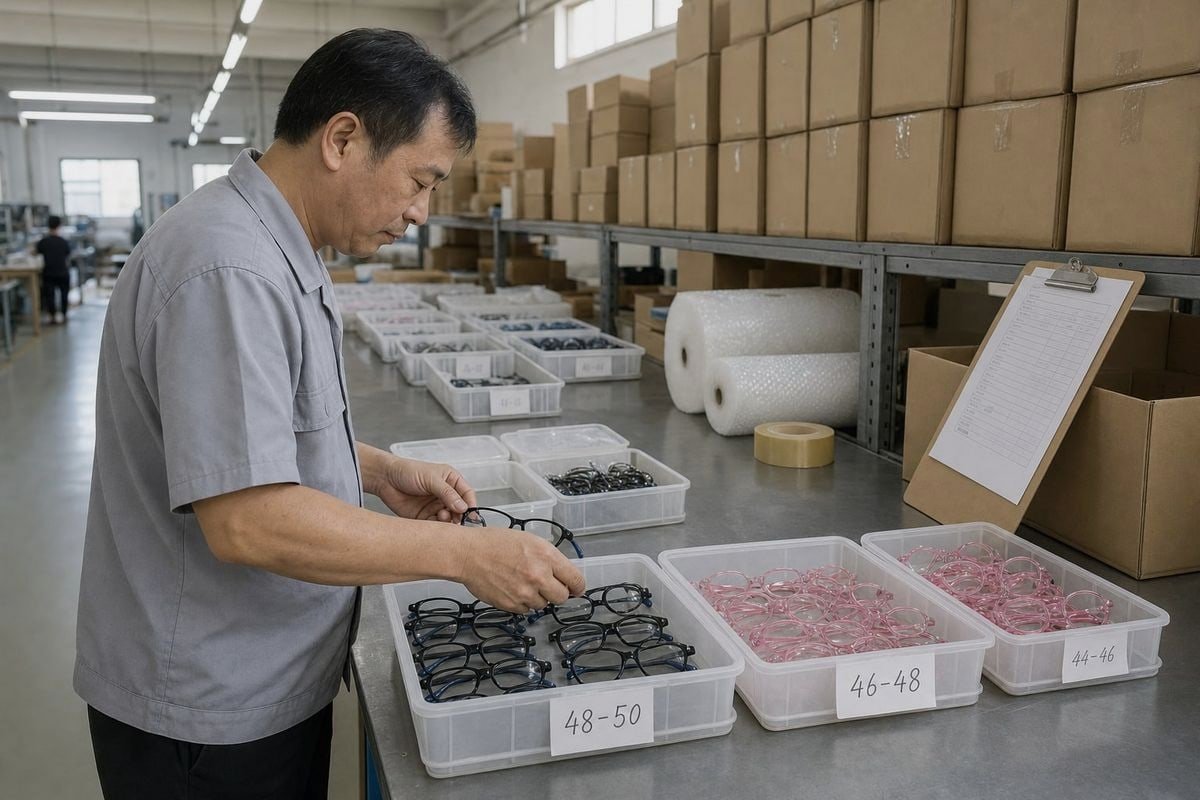
Sample approval is your last cheap chance to fix a problem. After mass production, every correction costs money and time. Treat this stage as a formal gate, not a formality.
The approval checklist we recommend
| Frage zu stellen | Was zu vergleichen ist | What good looks like |
|---|---|---|
| Does the spec sheet list all dimensions with tolerances? | Catches production drift before it reaches your warehouse | All optical frame specifications in mm, with stated tolerance per dimension |
| What does the frame weigh, and where does the weight sit? | Heavy fronts slide down small noses and create pressure points | Lightweight TR90 front, balanced by flexible TPEE temples |
| Are materials child-safe and impact-resistant? | Active kids drop, bend, and sit on glasses | Non-toxic, flexible frame material; polycarbonate or Trivex demo lens compatibility |
| Are adjustable components available? | Extends usable life as the child grows | Adjustable temple tips or nose fit options an optician can tune |
| Does the sample match the approved size chart? | Confirms the mold, not just the drawing | Measured sample matches spec within tolerance |
| Can the design support virtual try-on tools? | Online kids' eyewear sales increasingly rely on VTO | Supplier provides 3D files or VTO-ready assets |
Test flexibility like a child would
Flexible kids eyewear should survive rough handling. On our line, TPEE temples are twisted, bent flat, and cold-tested before approval. Ask your supplier to demonstrate the same on your sample — on video if you cannot visit. Then repeat the abuse yourself. If a hinge loosens or a temple whitens at the bend, reject the sample and ask for the fix in writing.
Document everything
Photograph the approved sample, sign the spec sheet, and state that mass production must match it within tolerance. This single step resolves most disputes before they start.
Schlussfolgerung
Sizing complaints start with vague orders. Ask suppliers for head-size dimensions, PD ranges, tested size charts, and toleranced spec sheets — then approve samples on real children, and your kids' frames will actually get worn.
Weitere Artikel, die Ihnen gefallen könnten

August 2026
Bio-Based vs Regular Cellulose Acetate: What's the Difference for Kids' Frames?

August 2026
How Recyclable Are Kids' Optical Frame Materials, and What Eco-Friendly Alternatives Exist?
August 2026
Bleichen Kinderbrillengestelle im Lager aus oder altern sie, und wie kontrolliert man die Lagerbedingungen?
Auf der Suche nach einem zuverlässigen Partner für Kinderbrillen?
Entdecken Sie über 800 sofort verfügbare Modelle und umfassenden OEM/ODM-Support, der auf Ihre Marke zugeschnitten ist.
Kontakt aufnehmen English
  Español de México
  Deutsch
  Français
  日本語
日本語  العربية
  Português do Brasil