What Are the Key Design Differences Between Infant and School-Age TR90 & TPEE Kids Optical Frames?
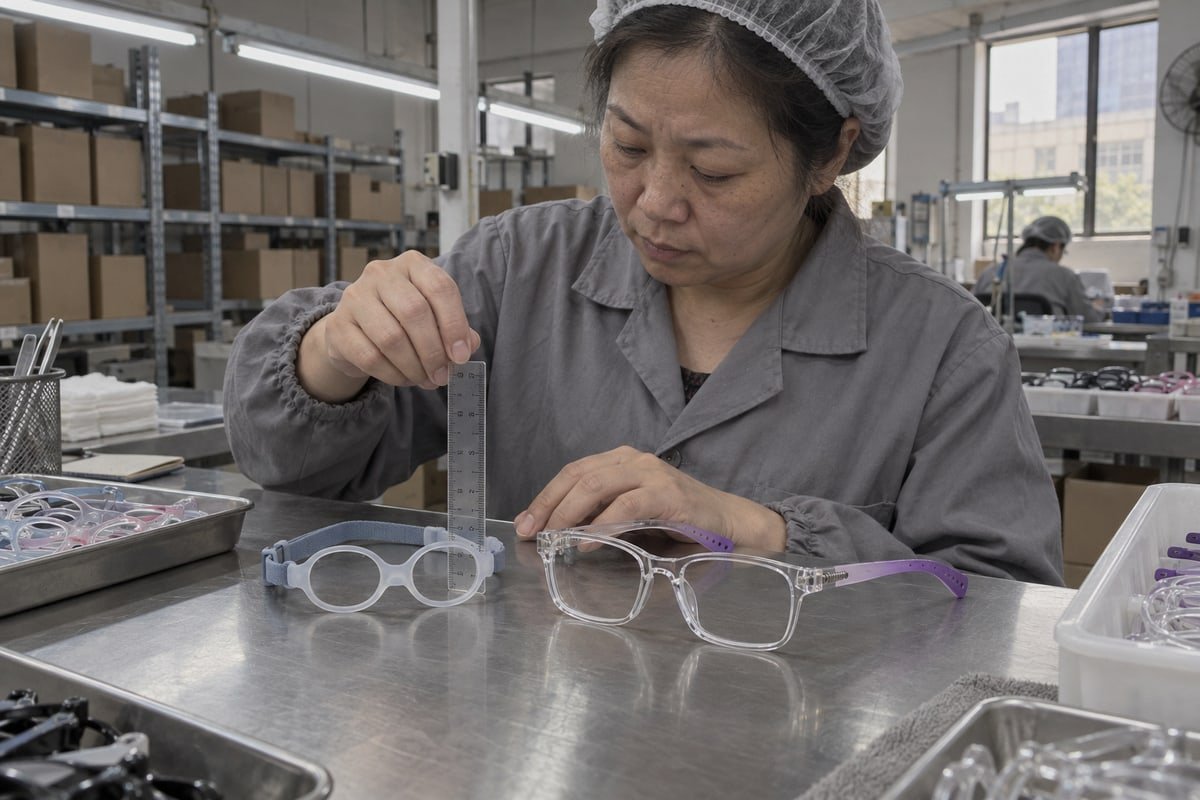
Choosing TR90 and TPEE kids optical frames by age is harder than it looks rigid nylon 1. On our Taizhou production line, we see the same mistake: one frame design for every child.
Infant TR90 and TPEE kids optical frames prioritize soft TPEE, screwless one-piece builds, low integrated bridges, and head straps for retention. School-age frames shift to lightweight TR90, spring hinges, adjustable bridges, standard temples, and adult-style shapes that hold their form through daily play.
The rest of this article breaks that answer down. I will cover fit, safety, material behavior, and activity-based design. Each section ends with practical guidance you can use in a product brief.
How do I choose the right frame size and fit for infants versus school-age children?
A procurement manager in Australia once asked us for a toddler frame in three sizes. Her sample brief listed lens widths but no bridge height. That gap changed how we write size charts.
For infants, choose a frame with a low, wide anatomical nose bridge, oversized rounded lenses, and an adjustable head strap, then recheck fit every few months. For school-age children, match eye width, bridge, and temple length so eyes sit centered, and prefer adjustable geometry over oversized fashion fit.
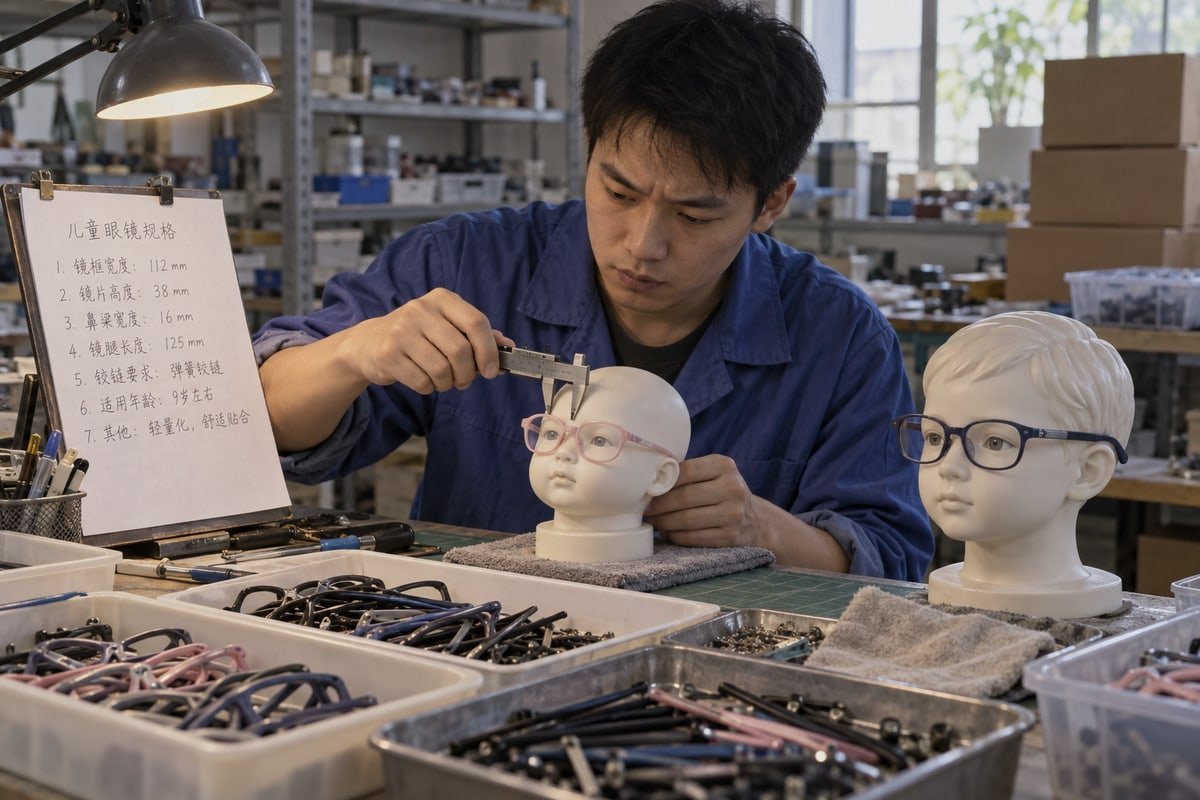
Fit is the first place where infant and school-age frames split apart. A baby's face has almost no nasal bridge. A nine-year-old's face is already moving toward adult proportions. So the same lens width, bridge, and temple numbers cannot work for both. In our experience, pediatric frame fitting 2 comes down to three measurements and one behavior question: can the child put the glasses on alone?
Three measurements that matter in pediatric frame fitting
| قياس | إطارات للرضع والأطفال الصغار | إطارات سن المدرسة |
|---|---|---|
| Lens width and shape | Oversized, rounded, wraps the eye so the child cannot peek over the top | Sized to the eye, eyes centered, rectangular or cat-eye silhouettes acceptable |
| الجسر | Low, wide, integrated into the front, no nose pads | Defined arch or adjustable nose pads for a growing bridge |
| طول الذراع الجانبي | Often replaced by cable temples or a strap | Standard skull temples, sized so the tip curves behind the ear |
Why infant bridges are low and wide
An infant frame that sits too high slides down at once. There is no bone to hold it. That is why we mold the anatomical nose bridge 3 as one piece with the front on our TPEE baby styles. There is nothing to adjust and nothing to fall off. The wide flat bridge spreads pressure across soft skin instead of pinching one point.
School-age frames can afford a more defined bridge. Some buyers ask us for adjustable nose pads on TR90 optical frames for older kids. These let an optician fine-tune fit as the child grows over a year or two.
Temple length ergonomics and growth tolerance
Temple length ergonomics matter more once a child wears standard temples. If the temple is too short, the tip presses on the ear and the frame tips forward. If it is too long, the frame slides. School-age TR90 frames are usually designed with a wider adjustment range, so one size can follow a child for longer. Infant frames are different. They are checked and replaced more often, because a baby's head grows fast and the strap or cable temple has a limited range.
One practical tip from our sampling work: ask for a fit sample on a head form for each age band, not just a flat photo. A frame that looks compact on a table can still sit wrong on a real face.
What safety features should I look for when comparing infant and school-age optical frames?
During a final inspection last spring, our QC team pulled an infant sample because one temple tip had a visible parting line. That tiny edge was enough to reject it.
Infant optical frames should have screwless hinge construction, no removable parts, rounded edges, chew-safe non-toxic material, and soft retention straps. School-age frames should add impact resistance, flexible spring hinges, hypoallergenic skin contact surfaces, and shatter-resistant lenses, because falls and sports replace chewing as the main risk.
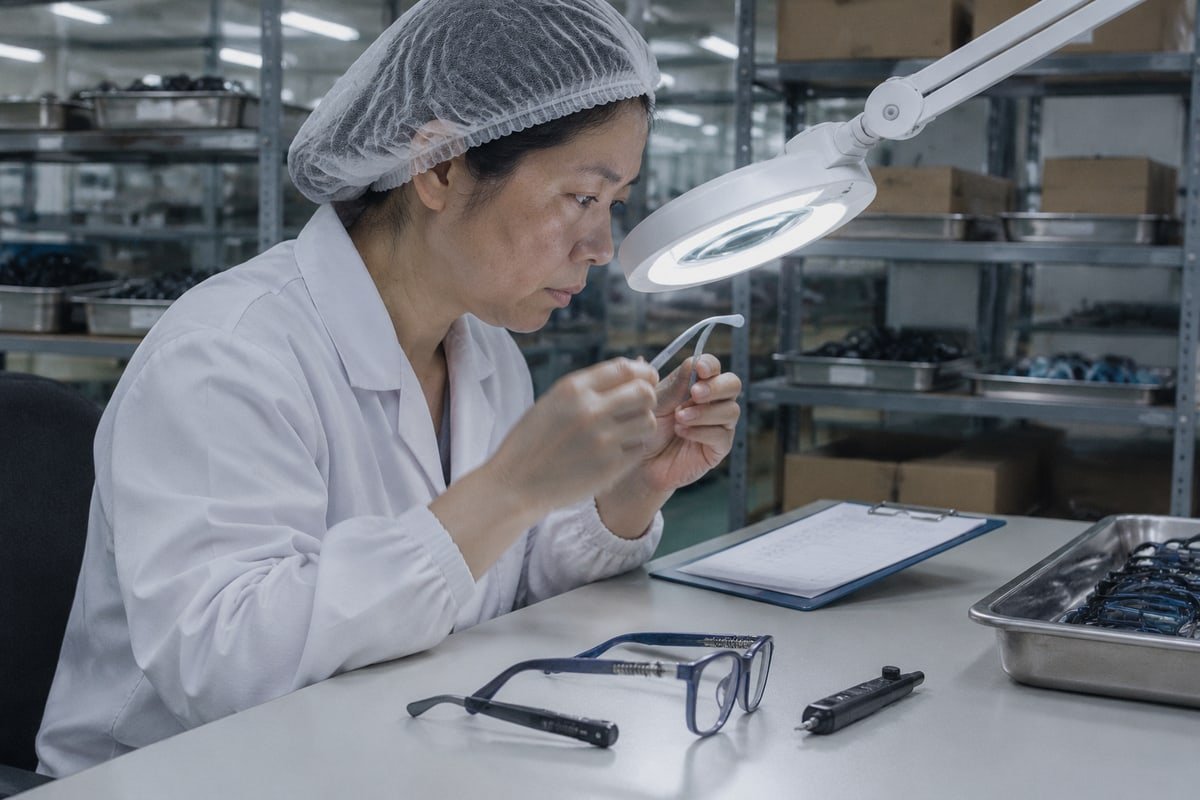
Safety is not one fixed list. It changes with what the child actually does with the glasses. A baby chews them, drops them, and rubs them against the face. A school-age child sits on them, catches a ball with them on, and drops them in a school bag. So the safety priorities move as the child grows.
Safety priorities by age
| منطقة الخطر | Infant and toddler focus | School-age focus |
|---|---|---|
| أجزاء صغيرة | Screwless hinge construction, monolithic build, no nose pads, no metal cores | Screws and spring hinges allowed, but must be secured and inspected |
| Edges and pressure | Fully rounded, no sharp corners, no rigid pressure points | Smooth edges, but thinner and more structured profiles are acceptable |
| Material contact | Chew-safe, non-toxic, BPA-free food grade plastic for teething children | Hypoallergenic material properties for long classroom wear against skin |
| تأثير | Absorb and flex on a fall from crawling height | Meet impact resistance standards for playground and sports use |
| الثبات | Adjustable head straps or cable temples so the frame cannot fly off | Standard temples with curved tips so the child can put them on and take them off |
A step-by-step safety check we use on infant samples
- Flex the front fully inward and release it. It must return to shape with no whitening or stress marks.
- Pull on the temple at the hinge. A one-piece TPEE hinge should bend, not separate.
- Run a fingertip along every edge and the temple tip. Any burr or parting line fails the sample.
- Check the strap attachment. It must stay soft and must not create a loop that can catch.
- Confirm the material declaration. Buyers in Europe, Japan, and Australia usually ask for BPA-free and non-toxic documentation 4, so we prepare it before the sample ships.
What changes for school-age frames
Once a child can put on glasses alone, the biggest risk is impact. A TR90 front is built to take a knock and spring back. Many school-age styles use a flexible 180-degree spring hinge. The temple folds outward past the normal stop and returns without breaking. That single feature saves a lot of frames from the trash.
Hypoallergenic material properties also matter more at this age. A school-age child wears the frame six to eight hours a day. Sweat, sunscreen, and skin oil build up on the temples. We keep TPEE temple tips on many of our TR90 frames for this reason. The soft tip is gentle behind the ear, and it grips without pinching.
One buyer objection we hear is that spring hinges add screws, and screws are a hazard. That is true for infants. It is not a real problem for a school-age child. At that age, the durability gain from the spring hinge 5 outweighs the small-part risk, provided the screws are properly seated and the hinge is checked during QC.
Why do TR90 and TPEE materials perform differently across these age groups?
Every time we spec a new style, we weigh softness against shape retention. Softer TPEE feels kinder on a baby's face. Stiffer TR90 keeps its form on a playground.
TPEE is a soft, rubber-like elastomer with high shape memory flexibility, so it suits infants who chew, roll, and fall on their frames. TR90 is a lighter, more rigid nylon that resists deformation better, so it suits school-age children who need structure, style, and all-day lightweight durability.
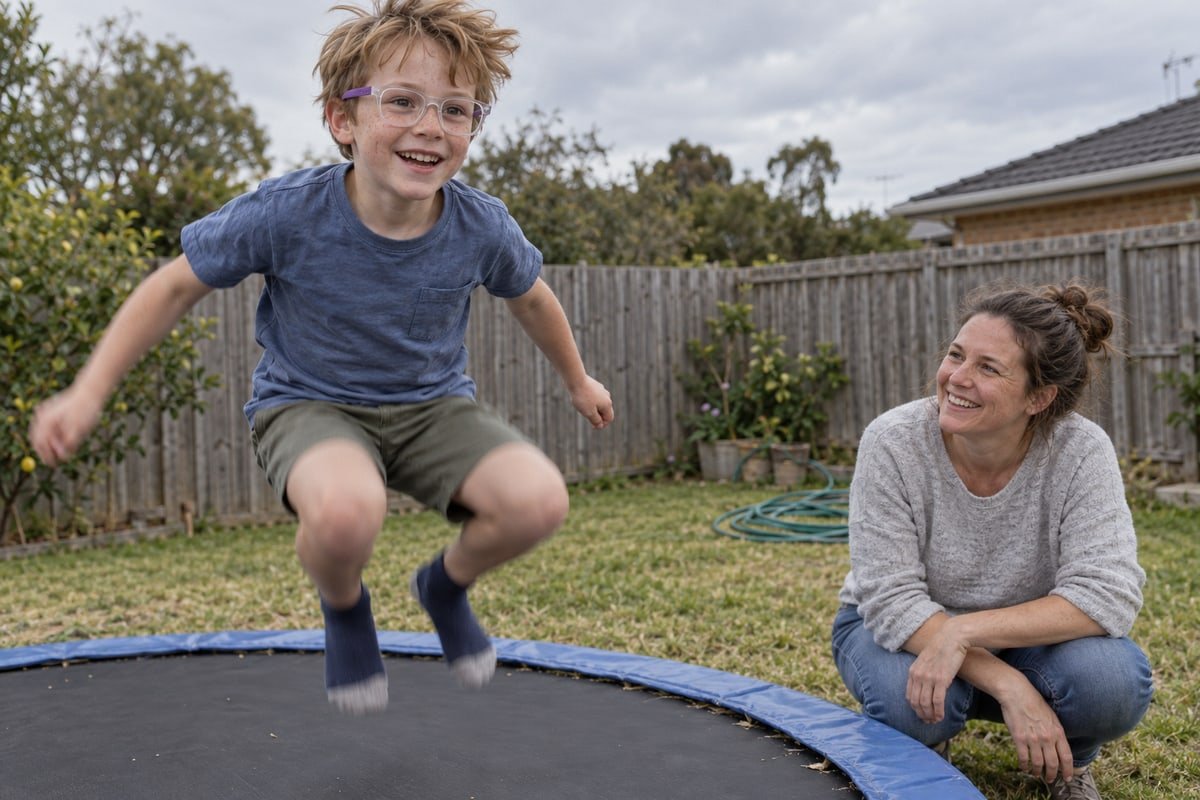
Both materials get marketed as flexible and unbreakable. That is fair as far as it goes. But they are not the same material, and they do not behave the same on a child's face. Here is a quick comparison before I go deeper.
| خاصية | TPEE | TR90 |
|---|---|---|
| صلب ولكنه مرن، تأثير الذاكرة | Soft, rubber-like, warm to the touch | Smooth, light, slightly firm |
| المرونة | Very high, can be twisted and rolled | High, bends and returns, but resists twist |
| استعادة الشكل | Good, but very soft grades can relax under heat | Excellent, strong shape memory |
| الوزن | خفيف | خفيف جدا |
| العمر النموذجي | الرضع والأطفال الصغار | Preschool through pre-teen |
| Common build | One-piece front and temples, no screws | Structured front, spring hinges, standard temples |
Why TPEE wins for infants
TPEE behaves like a thermoplastic rubber. You can fold a TPEE baby frame in half and it opens back up. That is the core of shape memory flexibility 6. It also absorbs impact instead of transmitting it. When a crawling baby face-plants, the frame squashes and the face does not take a hard edge. Because the whole frame is one soft piece, there is nothing to snap off.
Some suppliers now describe thermal memory TPEE that can be boiled for sterilization and still return to its molded shape. I treat this as a product-specific claim. If sterilization matters to your brand, ask for a sample and test it yourself before you print it on packaging.
Why TR90 wins for school-age children
TR90 is a nylon-based material. It is extremely light, and it holds a defined shape better than soft TPEE. That matters once a child wants glasses that look like real glasses. A rectangular or cat-eye front stays crisp in TR90. In very soft TPEE, that same shape can look slightly slumped after a season in a hot school bag.
This brings up the opposing view we hear from some buyers: softer is always better for children. For infants, I agree. For a ten-year-old, I do not. Very soft frames sit less precisely, can feel less premium, and give the optician less to work with when adjusting fit. School-age children benefit from TR90's stronger architecture.
الإجابة الهجينة التي نستخدمها أكثر
The design we ship most often for the preschool-to-school-age range is a TR90 front with TPEE temples. The front holds the lens shape and the bridge geometry. The temples stay soft, grip behind the ear, and flex outward without a spring hinge. The translucent crystal or light blue fronts with gradient colored temples in our line are built this way. It gives lightweight durability where structure is needed and softness where skin contact happens.
Environmental questions also come up more now. Some suppliers offer bio-based TR90 grades made from castor oil. We focus on environmentally friendly material choices across our range, and we can discuss options at the sampling stage. For infant TPEE, the priority remains purity and impact absorption rather than bio-content claims.
How can I select flexible frame designs that match each child's activity level and lifestyle?
Fifteen years of making kids' eyewear showed us one thing: activity level predicts frame survival better than age alone. A calm six-year-old and a climbing six-year-old need different temples.
Match retention to movement. Crawling infants need full-wrap TPEE frames with adjustable head straps. Preschoolers do well with looped ear hooks and one-piece hinges. Active school-age kids need TR90 fronts with spring hinges or modular temples, while desk-focused kids benefit from a pantoscopic tilt for reading and screens.
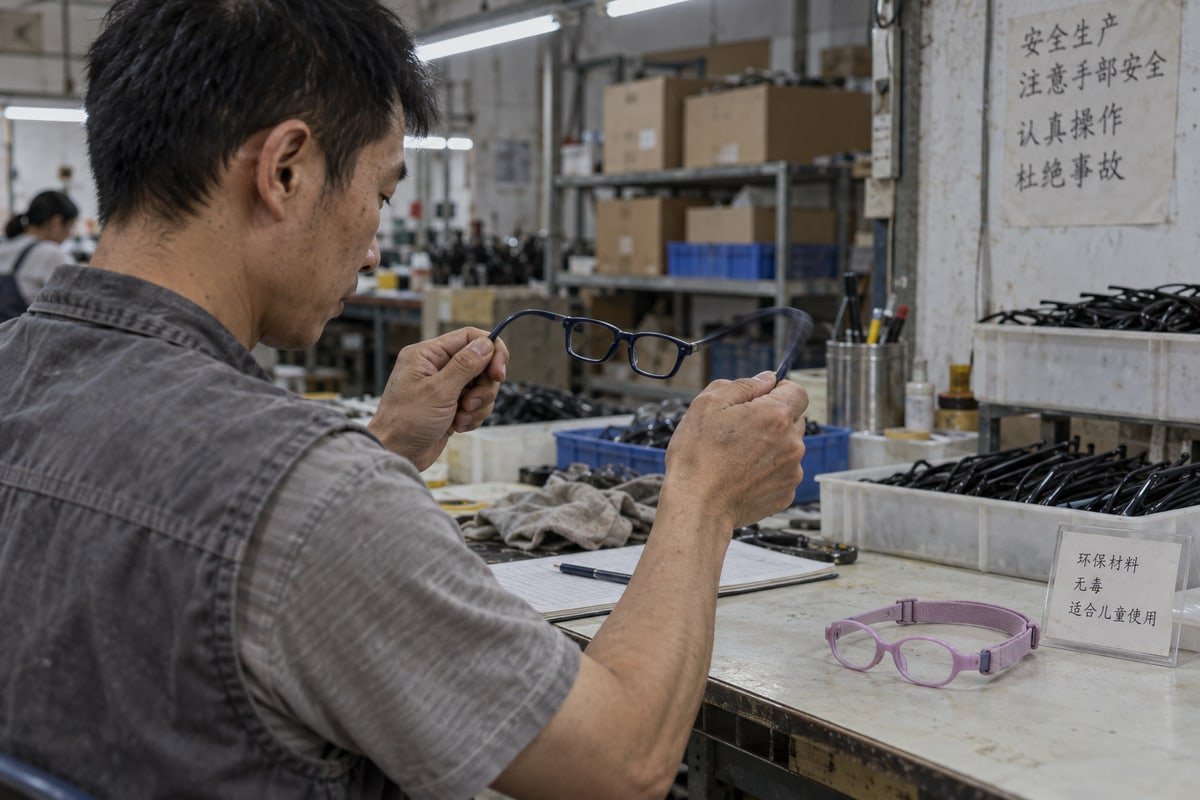
Age tells you where a child's face is. Lifestyle tells you what the frame will go through. When we help a brand build a range, we ask about both. Below is the use-case matrix we work from, followed by a short buying guide.
Use-case matrix for flexible kids optical frames
| Daily reality | Best retention system | Best structure | Material lean |
|---|---|---|---|
| Crawling, rolling, chewing, parent-managed fit | Adjustable head straps or full wrap | Monolithic, screwless, oversized round lenses | TPEE |
| Toddler walking, falling, pulling frames off | Cable temples or looped ear hooks | One-piece hinge, soft rounded front | TPEE or TR90 front with TPEE temples |
| Preschool, first self-donning | Looped or curved TPEE temple tips | Light TR90 front, no screws or minimal screws | واجهة TR90 مع أذرع TPEE |
| School-age playground and sports | Standard skull temples, curved tips | TR90 front, 180-degree spring hinge | TR90 |
| School-age desk work and screens | معابد قياسية | TR90 front with pantoscopic tilt | TR90 |
| Rough on frames, frequent breakage | معابد قياسية | Modular temple system, replaceable arms | TR90 |
Two design details worth explaining
Pantoscopic tilt means the lens front angles slightly downward. On school-age TR90 frames, this brings the lower part of the lens closer to the eye when the child looks down at a book or a tablet. It is a detail that only makes sense once a child sits at a desk. Infant frames do not need it.
Modular temple systems are a newer trend for school-age TR90. The temple clicks or screws off so a parent can swap a broken arm or change the color. This adds complexity, so we keep it away from infant builds, where a monolithic frame is safer.
A buying guide by age and use case
- Infant, under about two years: choose a soft TPEE wrap frame with an adjustable strap, integrated low bridge, and no removable parts. Plan to recheck fit often.
- Toddler and early preschool: move to looped ear hooks or soft cable-style temples. A TR90 front with TPEE temples gives lens stability and a gentle feel.
- School-age, active: choose a full TR90 frame with spring hinges, curved temple tips, and colors the child will actually wear. Appearance matters at this age, and a frame that stays in the drawer protects nothing.
- School-age, desk and screen heavy: add pantoscopic tilt and a lens shape that keeps the eyes centered.
- Any age with a history of broken frames: look at modular temples or thicker TR90 sections.
For a brand starting out, the fastest route is to pick from an existing style library rather than open new molds. We keep roughly 800 existing styles across these age bands, so a buyer can test two or three designs per age group with low risk. Custom colors, logos, lens options such as UV400 or polarized, and retail-ready packaging can then be layered on once the market responds.
الخلاصة
One frame cannot serve every child. Infant frames must protect; school-age frames must endure and look right. Choose the design by age and activity, and the material will follow.
هل أنت مهتم بتوريد المنتجات المذكورة في هذه المقالة؟ انظر التفاصيل واطلب عرض أسعار هنا:
ملاحظات ختامية
1. Technical database entry for Polyamide 12, the chemical basis for TR90 eyewear material. ↩︎
2. Authoritative pediatric ophthalmology source explaining the specialized requirements for fitting eyewear to children. ↩︎
3. Scientific reference for facial morphology, relevant to the design of integrated bridges for infants. ↩︎
4. FDA guidance on BPA safety, essential for verifying material safety in products for teething infants. ↩︎
5. ISO 12870 provides international standards for spectacle frame durability and mechanical requirements. ↩︎
6. Technical explanation of thermoplastic elastomers (TPEE) and their characteristic shape memory properties. ↩︎
مقالات أخرى قد تعجبك


هل تبحث عن شريك موثوق به للنظارات للأطفال؟
استكشف أكثر من 800 نمط جاهز ودعم OEM/ODM كامل مصمم خصيصًا لعلامتك التجارية.
اتصل بنا English
 Español de México
 Deutsch
 Français
 日本語
 العربية
 Português do Brasil