TR90 vs TPEE Kids Sunglasses: How Do Structure & Safety Differ from Adult Sunglasses?
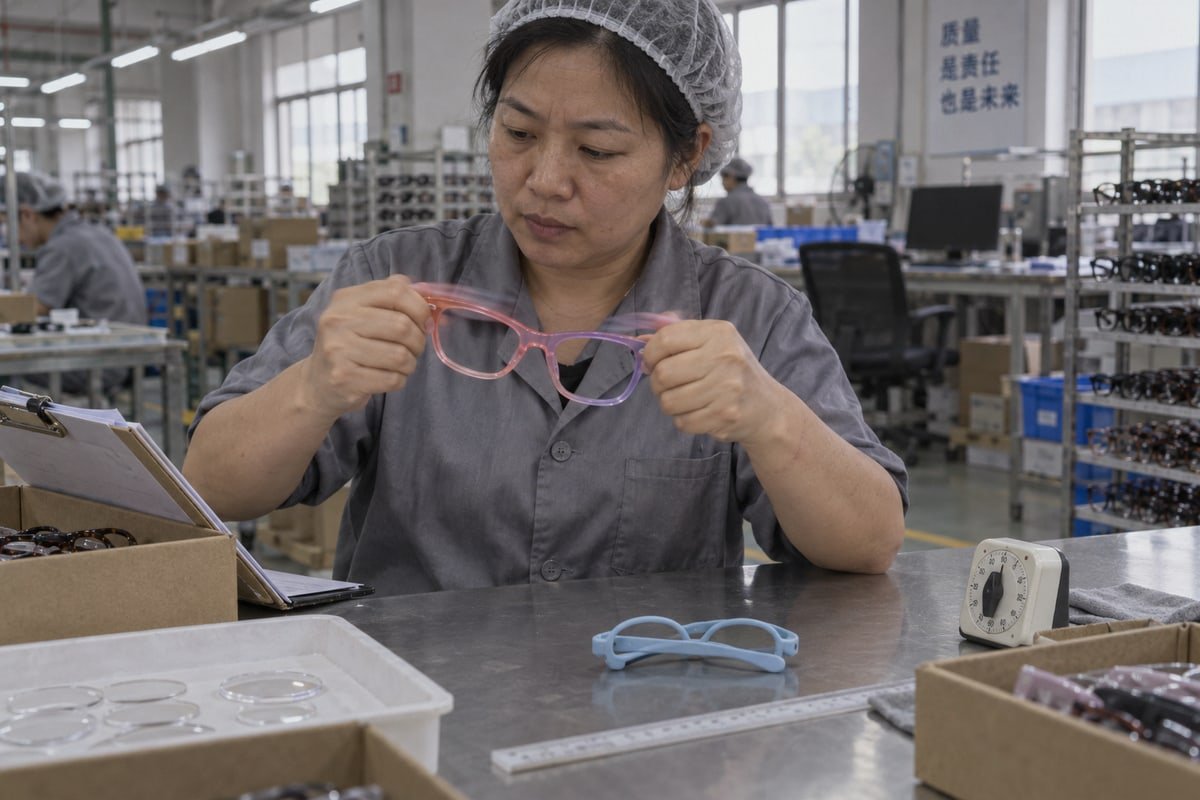
[TR90 vs TPEE kids sunglasses](https://okayeyewear.com/tpee-vs-tr90-pc-material-best-kids-sunglasses/) is the first question buyers bring to our Taizhou factory. Pick wrong, and frames crack or pinch, returns climb. Pick by age, and both work.
TR90 vs TPEE kids sunglasses differ mainly in stiffness. TR90 is a light memory polymer that springs back after bending, suited to active children aged 3–12+. TPEE is a soft thermoplastic polyester elastomer that cushions, suited to 0–3 year olds. Kids’ frames add safety margins adult frames don’t need.
Below, I compare the two materials head to head. Then I explain why a child’s frame cannot simply be a smaller adult frame. After that, I give you an age-based recommendation and a question list for your supplier.
How do TR90 and TPEE actually differ when I compare them for children's sunglasses frames?
On our line, the bend test tells the story. A TR90 front twists and snaps back to shape. A TPEE temple folds flat and rests there until released.
TR90 is a nylon-based thermoplastic polyamide: very light, rigid enough to hold shape, with memory flex that returns after twisting. TPEE is a thermoplastic polyester elastomer: rubber-like, softer, and pliable enough to bend 180 degrees without snapping. TR90 flexes and springs; TPEE flexes and cushions.
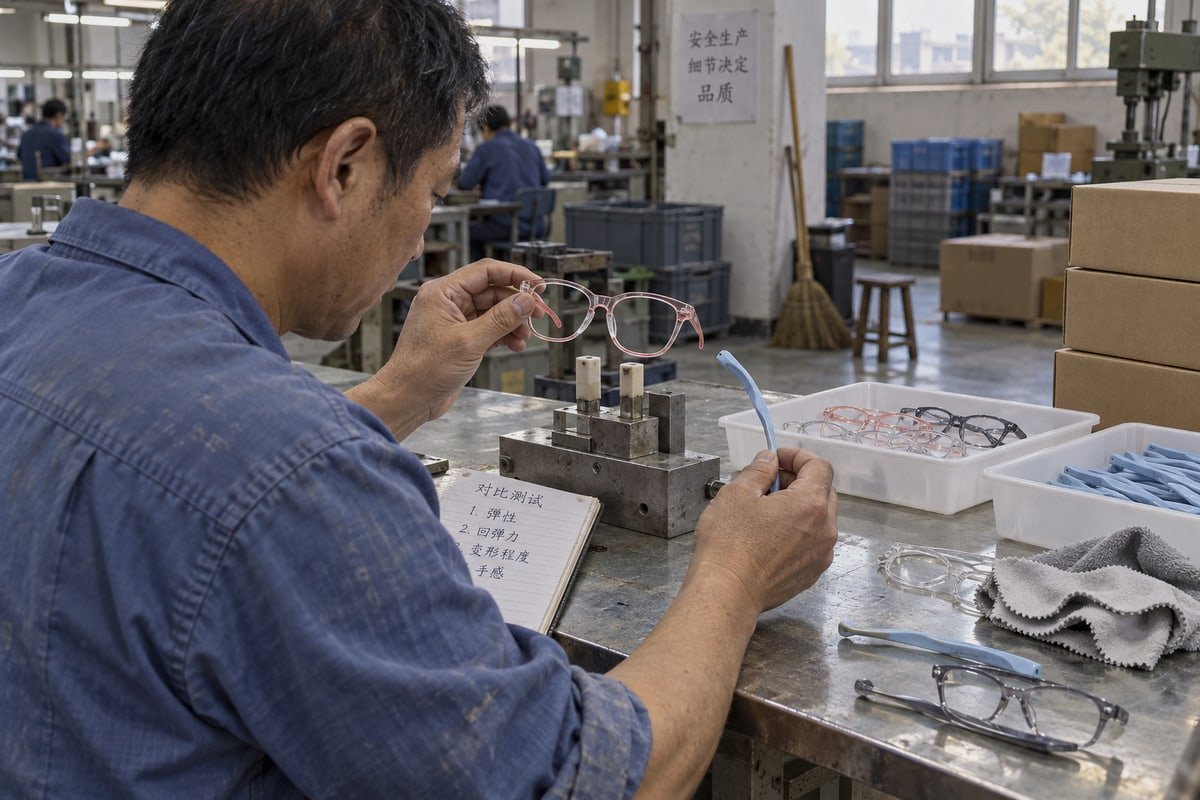
Here is the side-by-side view I share with new buyers before we discuss any single style.
| خاصية | TR90 (thermoplastic polyamide) | TPEE (thermoplastic polyester elastomer) |
|---|---|---|
| Feel in hand | Firm, smooth, light | Soft, rubbery, slightly warm |
| سلوك الانثناء | Bends, then springs back (shape memory) | Bends 180 degrees, cushions, returns slowly |
| Shape retention | High, holds wraparound curves | Moderate, can slump if too thin |
| الوزن | منخفض جدًا | Low, slightly heavier at equal thickness |
| ملامسة الجلد | Comfortable, but firmer on cheeks | Gentle, forgiving against delicate skin |
| Typical age band | Roughly 3–12+ years | Roughly 0–3 years |
| أفضل استخدام | Sports, school, everyday play | Strollers, naps, sandbox, mouthy toddlers |
Flexible does not mean the same thing
Both materials get sold as "flexible" or "unbreakable." That label hides a real difference. TR90 is one of the classic بوليمر ذاكرة 1 frames. You sit on it, and it recovers its alignment. That matters for a seven-year-old who stuffs glasses into a backpack. TPEE is different. It does not fight back. It folds, absorbs, and stays soft. That matters for a one-year-old who grabs the frame and pulls it off sideways.
What we see in production
Our TR90 fronts come out of the mold crisp. The translucent coral-to-lavender gradient on one of our wayfarer styles only looks that clean because the polyamide holds sharp rim edges. TPEE takes color well too, but the surface reads matte and soft. That is why so many of our styles pair a TR90 front with TPEE temples. The front keeps the lens seated and the curve stable. The temples wrap gently behind small ears without pressure points.
Where each material struggles
TR90 is firmer, so it is less ideal for a toddler who chews frames. TPEE is softer, so thin designs 2 can feel unstable during running. Neither weakness is a flaw. Each is a reason to match the material to the child, not to pick a winner.
Why does my child's sunglasses structure need to be different from adult frame designs?
A Japanese baby-brand buyer once sent us an adult wayfarer and asked us to scale it down. We declined the shortcut and explained why proportion alone fails.
Children's sunglasses need shorter temples, a flatter saddle bridge, wraparound coverage, deeper lens grooves, and rough-handling tolerance because kids have larger pupils, developing noses, and frequent hand-to-mouth contact. Adult frames prioritize style, precise anatomical fit, and premium finish, since adults handle eyewear carefully.
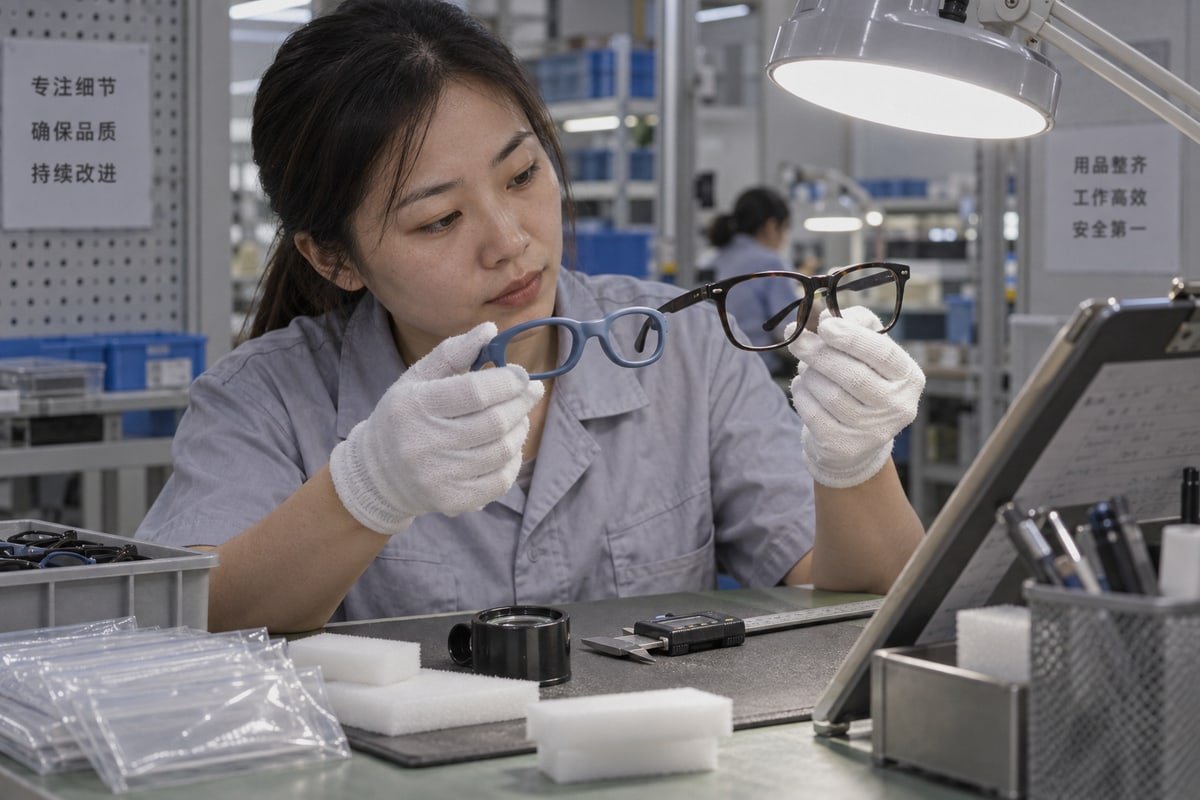
A child's face is not a small adult face. The proportions are different, and the behavior is different. Both change the engineering.
| Design element | Kids' frame priority | Adult frame priority |
|---|---|---|
| الجسر | Saddle bridge or integrated soft pads on a flat nose | Adjustable nose pads or keyhole bridge on a defined nose |
| المعابد | Shorter, wider, wrap behind ear, often TPEE | Longer, slimmer, styled, often acetate or metal |
| شكل العدسة | Wraparound to block peripheral UV leakage | Fashion-led shape, less side coverage |
| مادة العدسة | Shatterproof polycarbonate or TAC | Often CR-39 or glass for scratch resistance and clarity |
| أخدود العدسة | Deeper, engineered for inward-impact safety | Standard depth |
| المفصل | Screwless or flush rivet, no pinch points | Spring hinge, screws, decorative metal |
| Chemical spec | BPA-free materials, phthalate-free, lead-free | Standard eyewear grade |
Why the bridge changes everything
A toddler's nasal bridge is low and flat. Adult-style nose pads dig in or slide off. We mold a هناك ميزة أخرى يجب أن يعرفها المشترون في الأسواق الباردة: مقاومة الطقس البارد. يمكن أن تصبح الأسيتات هشة وتتشقق في درجات حرارة أقل من الصفر خلال اللعب في الهواء الطلق في فصل الشتاء. يحافظ TR90 على مرونته. بالنسبة لعملائنا في شمال أوروبا واليابان، فإن هذه الخاصية وحدها قد حسمت أكثر من مواصفات مادة واحدة. into our TPEE and TR90 fronts so the weight spreads across the whole nose. Our slate-blue chunky style is a good example. It looks bold, but the inside of the bridge is smooth and wide.
Why peripheral coverage matters more for kids
Children's pupils are larger, and their . الأطفال لديهم عدسات بلورية 3 are more transparent. More UV reaches the retina from the sides. That is why our kids' fronts curve further around the face than an adult fashion frame does. The wider temples on our sky-blue crystal style are not just a look. They block side light.
Why the lens groove is engineered differently
In a frontal blow, a lens should pop outward, away from the eye. We cut deeper internal grooves in high-safety kids' fronts so the lens is held from behind and pushed forward under impact. This is a small molding detail, but it is one adults rarely need.
Why hinges and optical stress get extra attention
Screws can loosen and become choking hazards. Metal hinges can pinch fine hair. For our toddler lines, we favor a screwless hinge design or a mono-molded TPEE body. For older kids, flush rivets are acceptable. We also control mold cooling to reduce internal stress in the polymer. Excess birefringence creates subtle peripheral distortion, and a young child's depth perception is still developing.
Which material should I choose if safety and comfort are my top priorities for a new kids' eyewear line?
Every new line forces the same trade-off in our sample room: softness against structure. Push softness too far and frames slump; push structure too far and toddlers complain.
Choose TPEE for infants and toddlers (roughly 0–3), where softness, mouth-safe handling, and hypoallergenic properties matter most. Choose TR90 for school-age and sports use (roughly 3–12+), where lightweight bendable frame durability matters. Many brands run both as age-banded ranges, or combine TR90 fronts with TPEE temples.
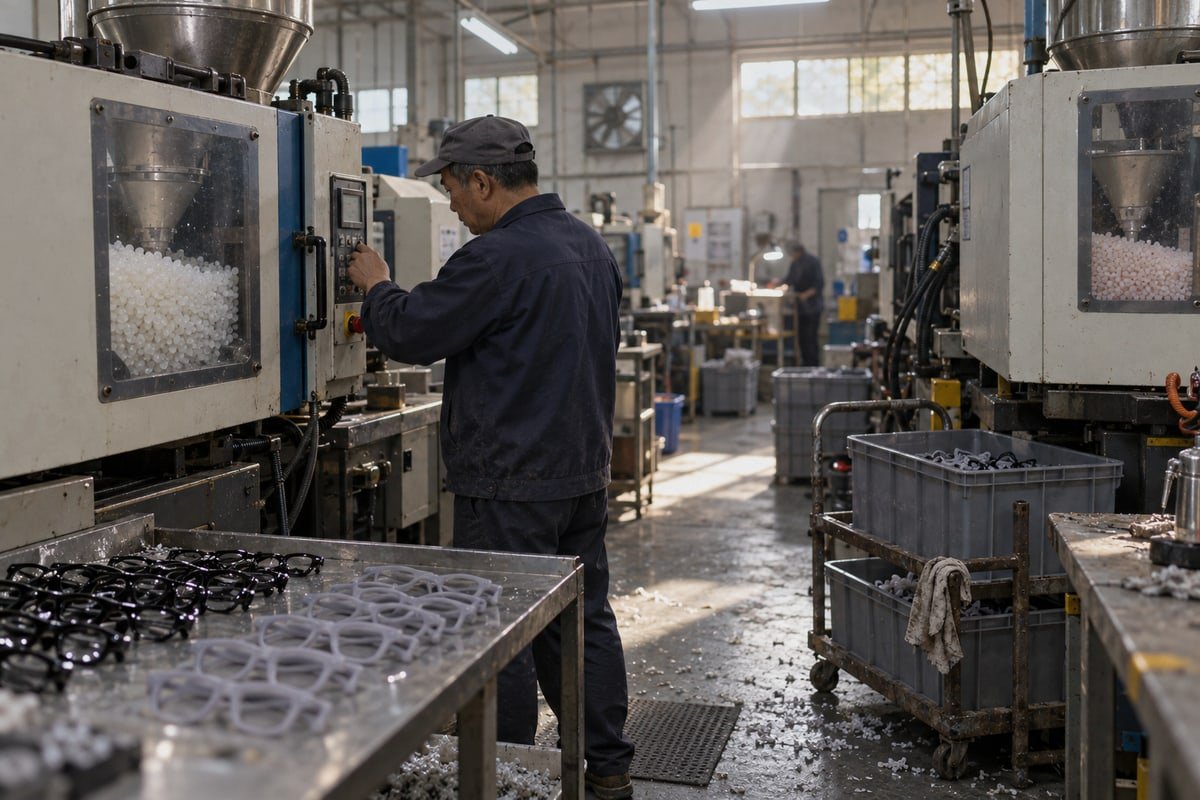
I will walk through the objections we hear most, because the answer to "which material" is really the answer to "which child."
Objection one: "TPEE is too floppy for real use"
I hear this from outdoor brands. It is half right. A thin TPEE front with a heavy lens can feel unstable on a running five-year-old. But that is a design mismatch, not a material fault. For a baby in a stroller, the same softness is the whole point. The frame can be grabbed, chewed, and pushed against a cheek without leaving a mark. So the fix is simple. Keep TPEE for the 0–3 band, and give it a wall thickness that holds the lens.
Objection two: "TR90 is too hard for little faces"
I hear this from baby brands. Also half right. TR90 is firmer, so we do not push it onto mouthy toddlers. But for a child who climbs, bikes, and plays football, TR90 bends instead of snapping into sharp fragments. That is the safety argument that matters at that age. And because it is so light, kids forget they are wearing it.
Our practical age-and-activity map
| الفئة العمرية | Typical behavior | Recommended material | Recommended lens |
|---|---|---|---|
| 0-1 سنوات | Passive wear, grabbing, chewing | Mono-molded TPEE, strap-friendly | Shatterproof polycarbonate or TAC, UV400 |
| 1–3 سنوات | Pulling, dropping, face contact | TPEE, or TR90 front with TPEE temples | UV400, polarized optional |
| 3–7 years | Running, playground, sandbox | واجهة TR90 مع أذرع TPEE | Polarized TAC lenses, UV400 |
| 7–12+ years | Sports, cycling, school | Full TR90 wraparound | Impact-resistant lenses, polarized |
A note on chemistry and skin
Both materials in our range are specified BPA-free and phthalate-free. TPEE has a further advantage for sensitive skin because it needs fewer plasticizers. There is also a shift toward bio-based TPEE made from castor-oil-derived elastomers. It keeps the high-flex safety profile with a lower chemical footprint and fewer skin-sensitizing additives. If your brand has an eco story, this is worth asking about early.
Lens protection is a separate decision
Frame material does not protect eyes from UV. Lenses do. Every kids' style we ship carries عملية تسوية نزاعات رسمية 4 regardless of frame material. Our polarized options use TAC lenses with a manufacturer sticker so retailers can see the spec at a glance. Keep the lens decision separate from the frame decision, and you avoid confusing parents.
What should I ask my manufacturer to confirm these safety and structural standards are met before I place an order?
Fifteen years of shipping kids' frames taught us one hard lesson: buyers who ask precise questions before ordering rarely face surprises after. Vague briefs create vague samples.
Ask for written confirmation of material grade (TR90 or TPEE), BPA-free, phthalate-free, and lead-free status, UV400 lens test reports, lens material (polycarbonate or TAC), hinge type, bend and drop test results, bridge and temple dimensions per age band, and a pre-production sample. Also confirm packaging and QC procedure.
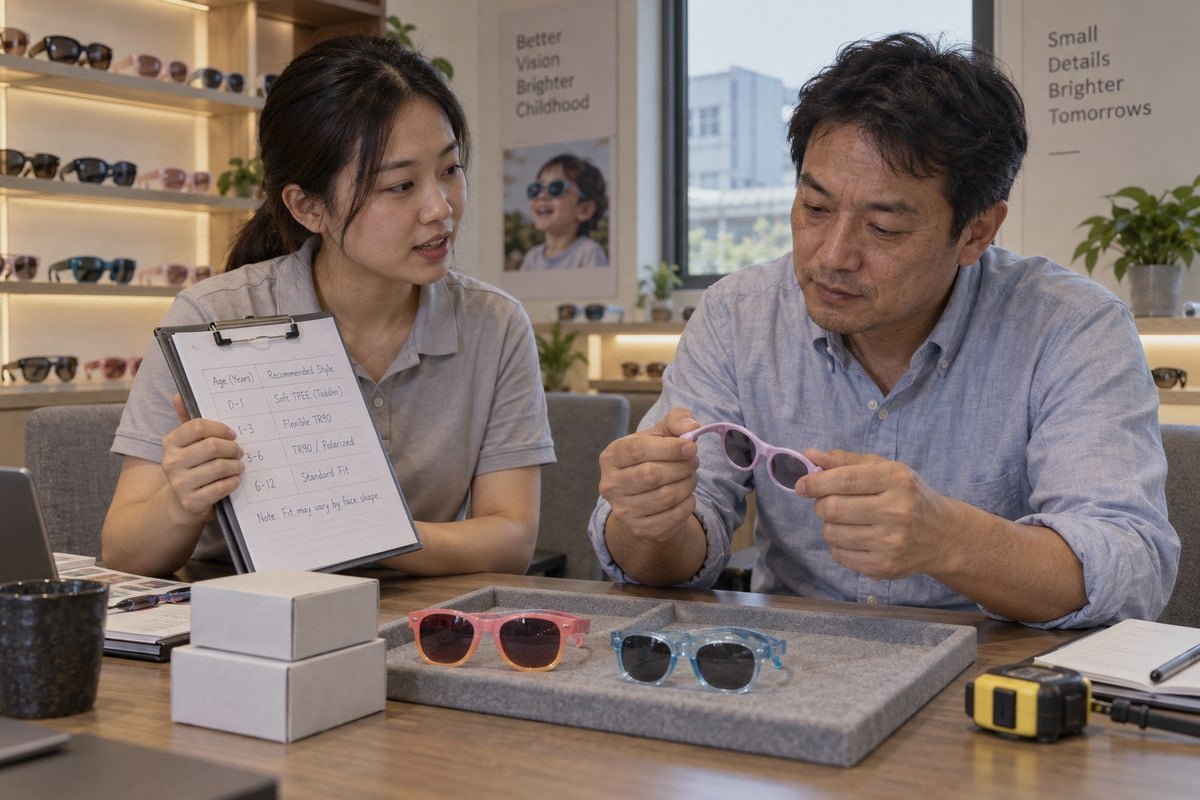
I recommend you send this list before you ask for a quote. A factory that answers quickly and specifically is one that already runs these checks.
The question list, in the order we suggest
- Which exact resin grade is used for the front and for the temples? Ask for the material name, not just "TR90" or "flexible plastic."
- Can you provide documentation that the materials are BPA-free, phthalate-free, and lead-free? Kids' products face stricter chemical rules than adult eyewear because of hand-to-mouth contact.
- What is the lens material and UV rating? Ask for UV400 and a lens spec sheet.
- How does the frame behave in a bend test? For TPEE, ask whether it folds 180 degrees without cracking. For TR90, ask whether it recovers alignment after twisting.
- What hinge is used, and is it screwless for the toddler range?
- What are the bridge width, lens width, and temple length for each age band?
- What is your QC process, and can I get a pre-production sample before mass production?
- Can you supply retail-ready packaging with my logo and my lens sticker?
How to read the answers
| Your question | Weak answer | Strong answer |
|---|---|---|
| Material grade | "It is TR90, very good quality." | Names the resin, states which part uses TPEE and which uses TR90 |
| السلامة الكيميائية | "Our material is safe." | Provides test documents naming BPA, phthalates, and lead |
| مواصفات العدسة | "UV protection included." | States UV400, lens material, and polarized or not |
| المرونة | "Unbreakable frame." | Describes the bend test and what recovery looks like |
| Fit by age | "One size fits all kids." | Gives dimensions for each age band |
| مراقبة الجودة | "We check everything." | Describes inspection stages and offers a sample for approval |
Why we push buyers toward existing styles first
Our catalog holds around 800 existing kids' styles across TPEE, TR90, and hybrid builds. For a new brand, that means you can test the market with custom colors, a logo, and your own packaging before committing to a private mold. Once one style proves itself, we move to full OEM/ODM development. It is a lower-risk route, and the safety engineering is already built into the base design.
The sample step is not optional
We ask every buyer to approve a pre-production sample. Hold it. Bend it. Put it on a child's face if you can. A photo cannot show you whether a saddle bridge sits flat or whether a temple tip presses behind the ear. This step catches more problems than any document.
الخلاصة
Wrong material means broken frames. Right material means happy parents. Match TPEE to toddlers, TR90 to active kids, verify safety in writing, and choose a factory fluent in both.
Interested in sourcing the products mentioned in this article? See details and request a quote here:
ملاحظات ختامية
1. Explains the mechanical properties of memory polymers like TR90 used in eyewear. ↩︎
2. Technical overview of TPEE properties, including flexibility and thermal stability for manufacturing. ↩︎
3. WHO overview of UV radiation risks and the specific vulnerability of children’s eyes. ↩︎
4. Official international standard for sunglasses and related eyewear protection requirements. ↩︎
5. Regulatory guidance on chemical safety standards for children’s products and consumer goods. ↩︎
مقالات أخرى قد تعجبك
هل تبحث عن شريك موثوق به للنظارات للأطفال؟
استكشف أكثر من 800 نمط جاهز ودعم OEM/ODM كامل مصمم خصيصًا لعلامتك التجارية.
اتصل بنا English
  Español de México
  Deutsch
  Français
  日本語
日本語  العربية
  Português do Brasil