Can TR90 Kids’ Sunglasses Temple Arms, Nose Pads, and Lenses Be Replaced Separately?
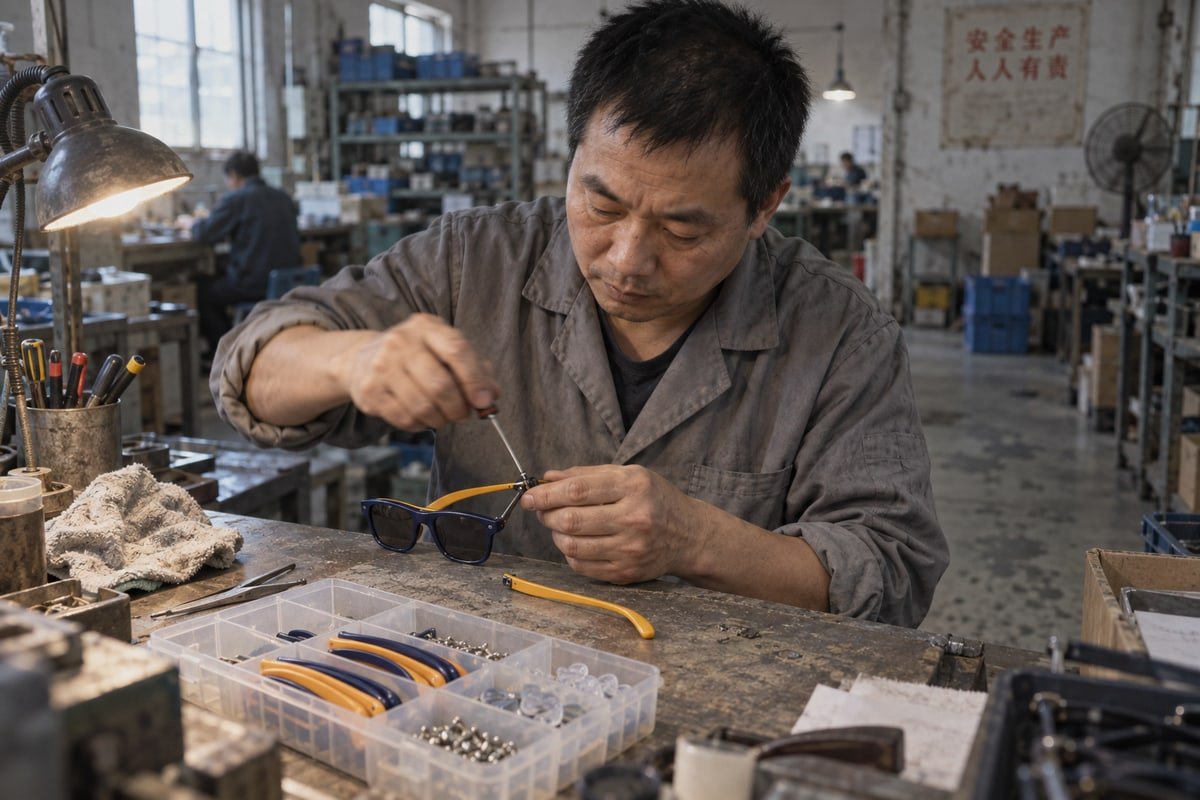
One snapped temple arm on TR90 kids’ sunglasses usually means a full refund. That hurts margins. Our Taizhou production line was set up so brands can offer parts instead.
Yes, TR90 kids’ sunglasses temple arms, nose pads, and lenses can often be replaced separately, but not universally. Temple arms and silicone nose pads are the easiest to swap. Lenses are model-specific and only replace cleanly when the frame was designed for it and the exact style is known.
That short answer hides a lot of detail. Below, I break down each part, explain how to confirm compatibility with your factory, cover the safety and warranty questions, and end with a practical stocking plan.
What parts of my TR90 kids' sunglasses can I actually order as spare components?
Last season our QC team pulled a sample from the line and stripped it to its parts on the bench. Five pieces came off. That exercise shapes our spare-parts list.
Spare components you can typically order for TR90 kids' sunglasses include temple arms, silicone nose pads, hinge screws, and lenses. Temple arms and nose pads are the most reliable spares. Lenses are available only for the exact model, and front frames are rarely sold separately.
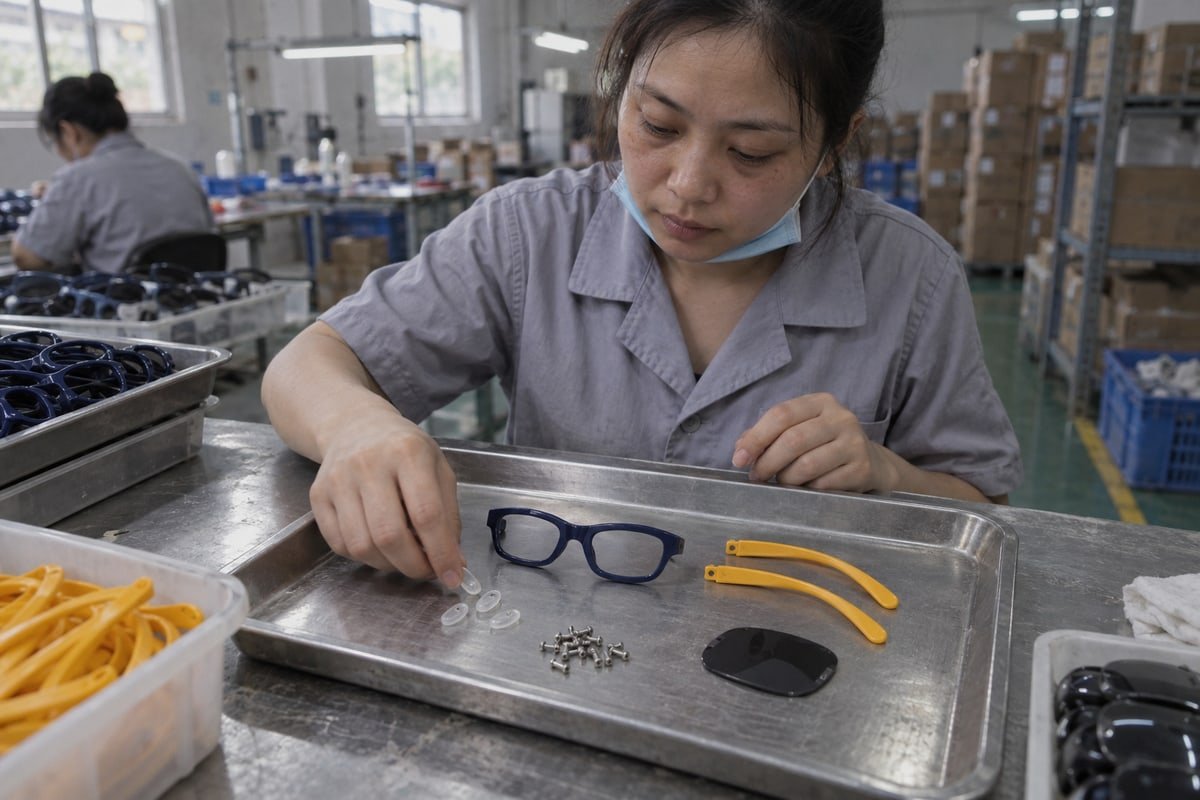
The first thing I tell buyers is simple. TR90 is a material name, not a parts standard. It is a thermoplastic memory polymer 1, sometimes called memory plastic. It bends and springs back to its molded shape. That is why it suits active kids. But the material label says nothing about whether the hinge, the temple width, or the lens groove match another frame. Replaceability depends on construction, not on the letters TR90.
The five components and how replaceable each one is
| المكون | Usually replaceable? | How it attaches | Notes from our production line |
|---|---|---|---|
| أذرع الأذن | Yes, most reliable | Screw hinge or screwless hinge design | Sold as pairs; two-tone styles like our navy front with yellow-orange temples are separate molded parts |
| سيليكون وسادات الأنف 2 | Yes, if not integrated | Screw-in, push-in, snap-on, or adhesive | Integrated bridges on many kids' fashion styles cannot be swapped |
| العدسات | أحيانًا | Popped in and out of the eyewire | Model-specific cut and curve; sport wraparounds are more often designed for swaps |
| Hinge screws | نعم | Threaded metal | Often bundled in an eyewear repair kit with a screwdriver |
| Front frame | نادرًا | Main molded body | Usually the whole product is replaced instead |
أذرع الأذن
Interchangeable temple arms are the biggest spare-part category in the market. Aftermarket listings sell them as universal kits with screws, washers, and a small screwdriver. That tells you the industry treats temples as hardware. Still, a universal arm rarely fits a specific kids' frame well. Width, screw placement, and frame thickness all matter. On our TR90 fronts with TPEE temples, the temple is a distinct part from the start, which makes ordering matching spares straightforward.
وسادات الأنف
Silicone nose pads on children's frames are soft and hypoallergenic. Whether you can replace them depends entirely on the attachment type. Screw-in and push-in pads swap easily. Adhesive pads can be replaced but need care. Pads molded into the bridge cannot be ordered separately at all.
العدسات
Lenses are the least universal part. A lens is cut to one frame shape and one base curve. Some newer modular kids' brands also use hinge systems that let parents swap temples for an elastic headband without tools. That flexibility is growing, but it is still brand-specific.
How do I know if a factory can supply replacement temple arms, nose pads, or lenses that match my original order?
A distributor in Europe once sent us a photo of a broken temple and asked for a few hundred replacements. We asked for the inner-arm code first. That code decided everything.
A factory can match replacement parts when it still holds your original mold, color codes, and lens specifications. Ask for the style number etched inside the temple, confirm hinge type and screw size, and request a physical sample against your retained golden sample before bulk ordering.
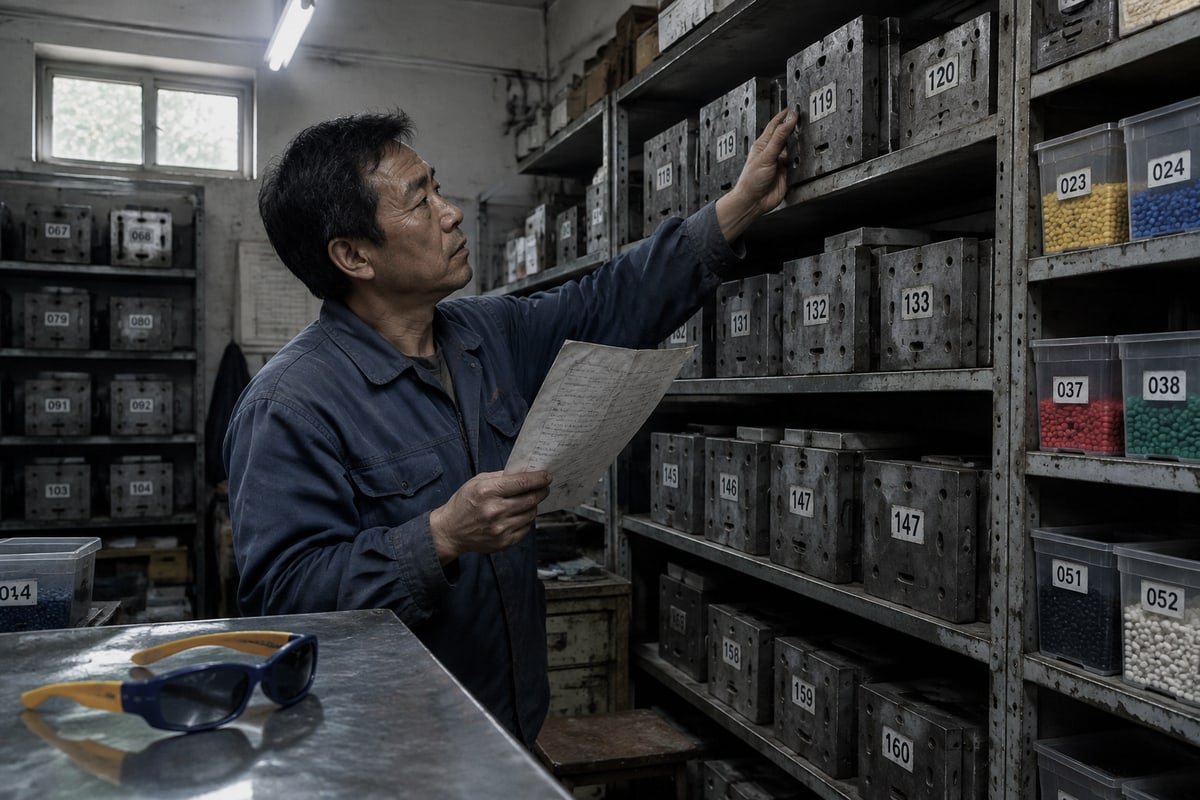
Matching is a records problem before it is a manufacturing problem. Our factory keeps the molds, the color masterbatch codes 3, and the lens specifications for every style we have produced. That is why we can supply spares for orders placed years earlier. A trading company usually cannot promise this, because it does not control the molds. So my first advice is to ask who owns the tooling.
The compatibility checklist I use with buyers
| العامل | What to confirm | لماذا هو مهم |
|---|---|---|
| Style number 4 | Small etched text on the inner temple near the hinge | Links the part to the exact mold |
| نوع المفصلة | Screw hinge, spring hinge, or screwless hinge design | A screwless temple will not fit a screwed front |
| Screw size | Diameter and length | Wrong screws strip TR90 hinge barrels |
| Temple width at hinge | Measure in millimeters | Even a small mismatch leaves a visible gap |
| Lens shape and base curve | Compare against the original lens drawing | Sport wraparounds have deeper curves than flat wayfarer styles |
| Color and finish | Matte, glossy, or rubberized code | A glossy replacement on a matte frame looks like a repair |
| نوع العدسة | UV400 tinted, gradient, or polarized replacement lenses | Tint and polarization must match the other lens |
Why lenses need the most care
Lenses are where mismatches show up fastest. Opticians fit TR90 frames by cold glazing. The lens is cut slightly larger than the eyewire and snapped in without heat. That keeps the frame tension intact. If a replacement lens is cut to the wrong tolerance, it clicks or pops out. There is also a long-term factor. Years of strong sun can cause slight micro-shrinkage of the eyewire. A replacement lens cut to the original spec may then feel loose. For this reason, we prefer to fit lenses at the factory rather than ship loose lenses to parents.
Questions to ask your supplier
- Do you still hold the mold for this style number?
- Can you match the exact color code and finish?
- Can you send one fitted sample before I order spares in bulk?
- Will you fit lenses in-house or ship them loose?
- What is the lead time for a small parts order?
If a supplier can answer all five clearly, you can order with confidence.
Will replaceable parts affect the safety or warranty of my kids' eyewear brand?
Every spare-parts program we design balances two things: easier repairs for parents versus keeping the hinge secure enough for a child's face. We never trade the second for the first.
Replaceable parts do not compromise safety when they are factory-original and fitted correctly. Risk appears with mismatched aftermarket lenses, loose hinges, or glued repairs. Your warranty stays valid if you define approved parts and fitting steps clearly, and exclude unauthorized DIY sunglasses repair from coverage.
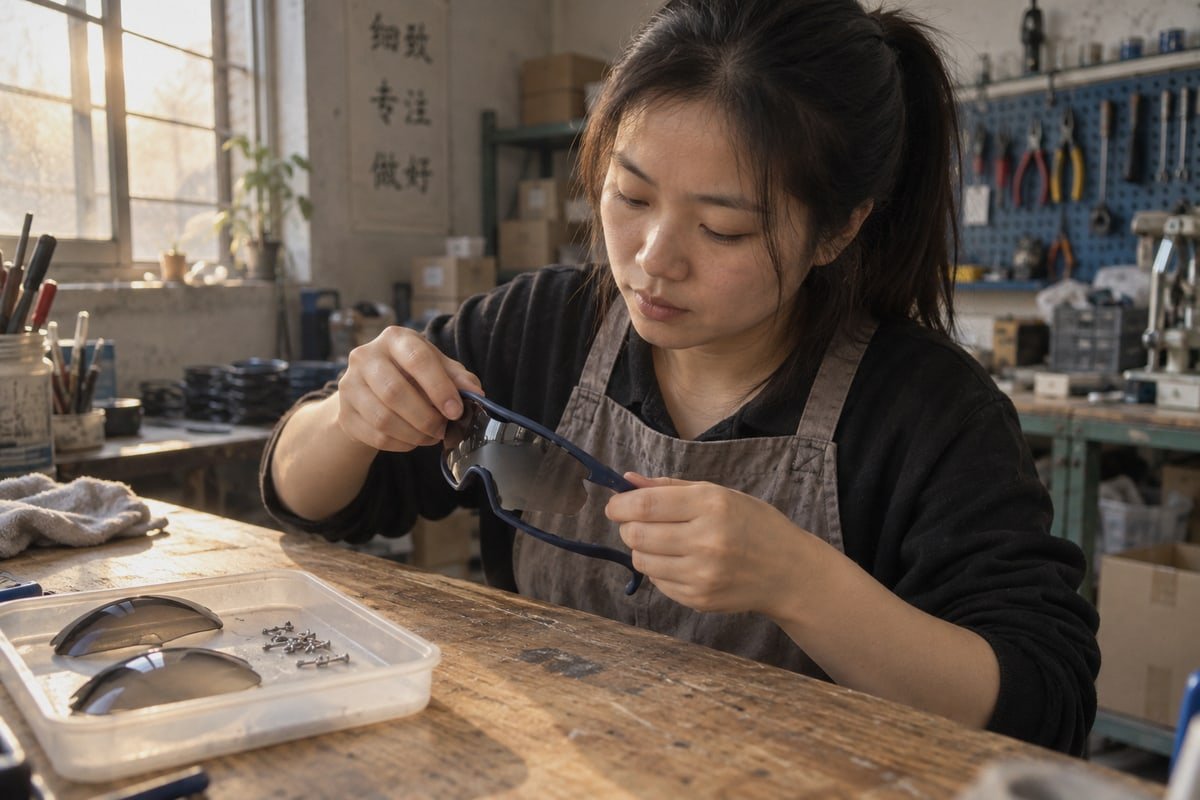
A buyer once pushed back on our spare-parts idea. His concern was fair. If a parent fits a wrong lens or a wobbly arm, the child ends up with uncomfortable or unsafe glasses, and the brand takes the blame. I agree with the concern. I disagree with the conclusion. The answer is not to refuse parts. The answer is to control which parts are used and how.
Where the real safety risks sit
- Loose hinges. A temple that does not seat properly can pinch skin or drop off during play. On a screwless hinge design, the wrong arm simply will not lock.
- Mismatched lenses. A lens that is too small can pop out on impact. A lens that is too large can crack the eyewire. Both undo the مقاومة الصدمات 5 the frame was designed to provide.
- Glued repairs. Standard household superglue creates a brittle bond on TR90 that fails quickly. Industrial cyanoacrylates or two-part epoxies last longer, but still count as temporary. TR90 has very low surface energy, so a permanent bond needs a specialized polyolefin primer. Almost no parent has one.
- Heat adjustments. Traditional heat-bending often fails on TR90. The memory polymer springs back to its molded shape once it cools. A parent who tries this can weaken the frame.
Each of these risks comes from improvised repair, not from factory-original parts. Flexible eyewear frames are safer for kids precisely because the parts are designed to bend and return. Replacing a like-for-like part keeps that behavior. Gluing a cracked bridge does not.
Writing a warranty that protects both sides
I suggest three plain clauses. First, cover defects in materials and workmanship on the original product and on factory-supplied spares. Second, exclude damage caused by non-original parts, adhesives, or heat modification. Third, state that lenses are replaced only by the brand or an authorized optician. This keeps parents confident and keeps your liability tied to parts you actually control.
For our own OEM customers, we also recommend one small packaging step. Print the style number visibly on the case or hang tag. Then a parent can quote it when requesting a part, and nobody guesses.
Should I stock spare parts myself, or rely on my manufacturer for after-sales replacements?
Years of shipping to 20+ countries taught us one thing about after-sales: a brand waiting six weeks for a single temple arm loses that customer. Timing matters more than price.
Stock a small spare-parts inventory yourself, ordered with your main production run, for fast-moving items like temple arms, nose pads, and screws. Rely on your manufacturer for lenses and larger top-ups. This hybrid model gives parents quick replacements without tying up capital in slow-moving components.
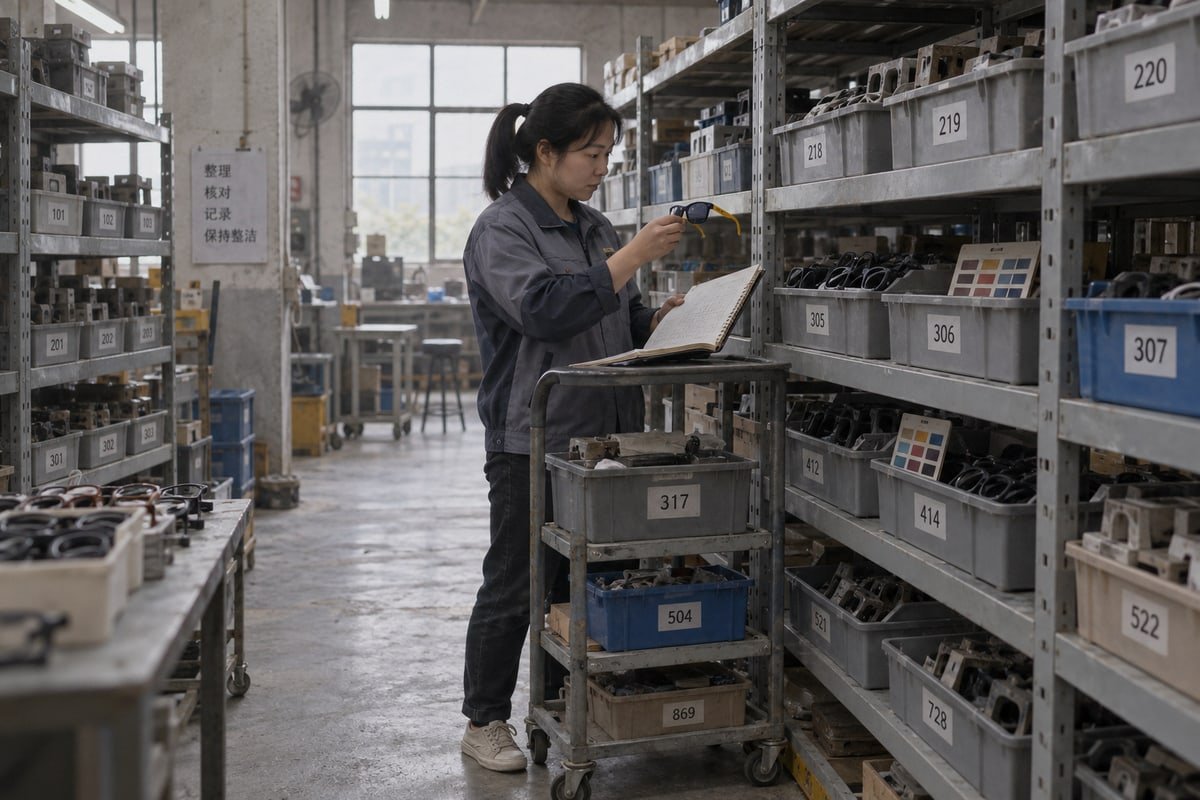
The most common objection I hear is about cost. Kids' sunglasses are inexpensive, the argument goes, so labor, shipping, and trial-and-error compatibility checks will exceed the price of a new pair. This is true for a bargain-bin product bought blind. It is not true for a branded product where the model is known and the parts came from the same mold. A temple arm mailed domestically costs a fraction of a refunded retail pair. It also keeps the product out of landfill, which many of our European and Australian customers now state as a brand value.
Comparing the two approaches
| النهج | نقاط القوة | نقاط الضعف | الدفع الآمن عبر المنصة |
|---|---|---|---|
| Stock spares yourself | Same-week replacements, full control over parent experience | Ties up capital, needs simple inventory tracking | Temple arms, silicone nose pads, screws, an eyewear repair kit per bundle |
| Rely on manufacturer | No inventory cost, factory-fitted lenses, exact color match | Longer lead time, small orders may wait for consolidation | Lenses, front frames, top-ups after the first year |
| Hybrid (recommended) | Fast on common failures, accurate on complex ones | Requires a plan at the time of the main order | Most kids' eyewear brands |
How we set this up during the main order
When a brand places a production order with us, we ask whether they want a spare-parts allowance. A small percentage of temple pairs and nose pads ships in the same carton, boxed separately and labeled by style number. This adds almost nothing to freight. Because we already run the mold, the parts match the batch exactly in color and finish. Our workshop is 5S-managed, so the spares are picked from the same lot, not from an old bin.
For lenses, we keep the cut files and can fit replacements into returned frames or supply fitted front assemblies. Loose lenses shipped to parents cause more problems than they solve.
A simple repair-or-replace guide for your support team
- Repair when the style number is readable, the failure is a temple, nose pad, or screw, and a matching spare is in stock.
- Replace the whole pair when the front frame is cracked at the hinge, the lens is proprietary and no fitted spare exists, or the fit cannot be verified.
- Escalate to the factory when the part is out of stock or the failure looks like a batch defect rather than wear.
This routine turns optical frame maintenance from a headache into a quiet advantage. Parents remember the brand that fixed the glasses in a week.
الخلاصة
Refunding whole pairs for one broken part drains margin and trust. Plan spares at the order stage, verify the style number, and our factory can keep parents loyal.
Interested in sourcing the products mentioned in this article? See details and request a quote here:
ملاحظات ختامية
1. Scientific definition of TR90’s base material properties and engineering applications in eyewear. ↩︎
2. Authoritative medical database for research on hypoallergenic materials used in skin-contact eyewear components. ↩︎
3. Technical overview of the coloring process used in thermoplastic manufacturing for consistent part matching. ↩︎
4. General reference for eyewear components and standard identification markings used in the optical industry. ↩︎
5. Official FDA regulation detailing impact resistance requirements for sunglass lenses. ↩︎
مقالات أخرى قد تعجبك

هل تبحث عن شريك موثوق به للنظارات للأطفال؟
استكشف أكثر من 800 نمط جاهز ودعم OEM/ODM كامل مصمم خصيصًا لعلامتك التجارية.
اتصل بنا English
  Español de México
  Deutsch
  Français
  日本語
日本語  العربية
  Português do Brasil