Are Kids Sunglasses Necessary for Daily School Commutes?
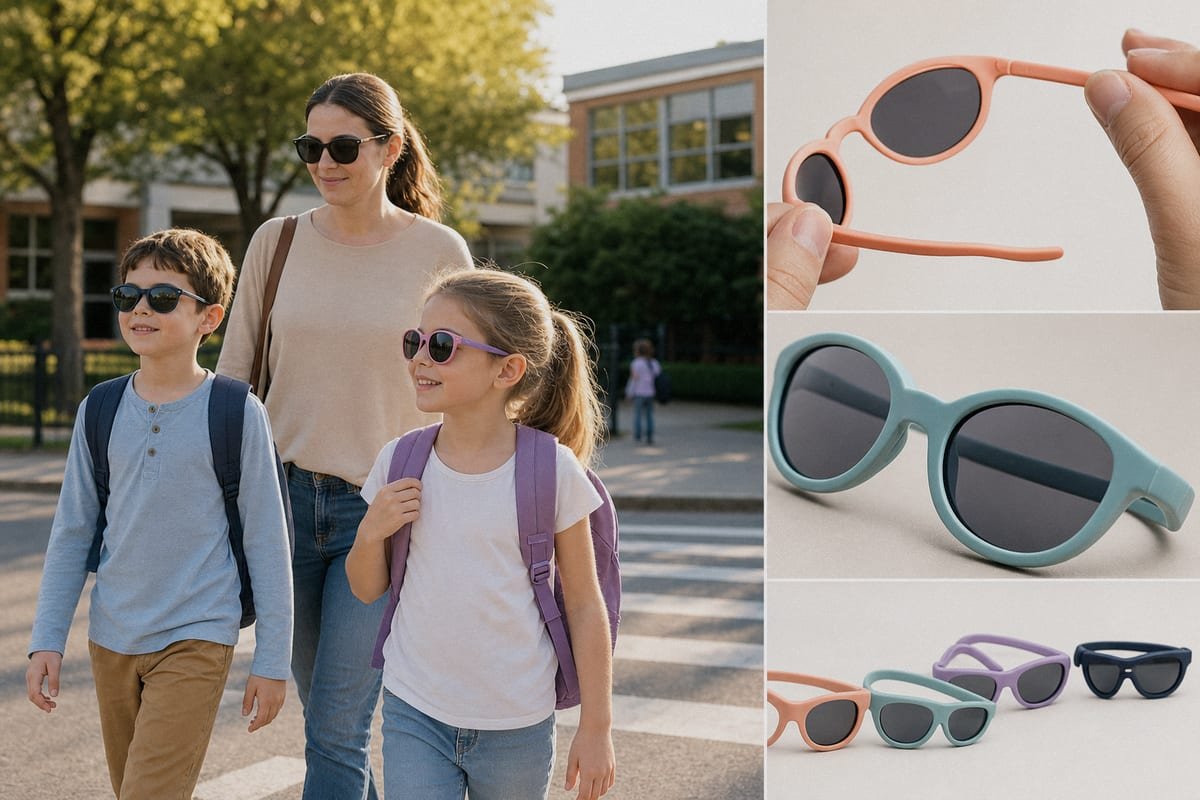
Kids sunglasses for daily school commutes get overlooked far too often. Our factory in Taizhou hears the same worry from brand buyers: parents skip them, kids lose them, and eyes pay the price.
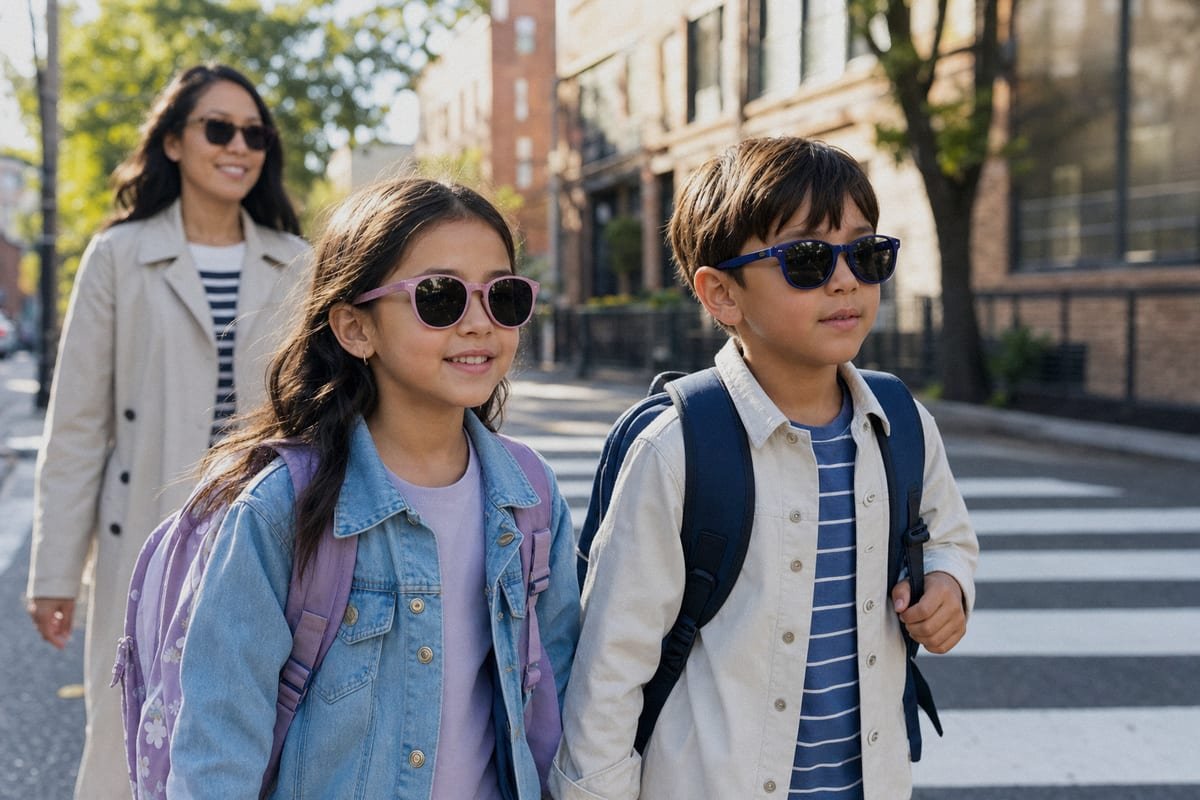
Yes, kids sunglasses are worth wearing on most daily school commutes. Children’s eyes let in more UV radiation than adult eyes, and cumulative UV exposure begins early in life. Sunglasses with 100% UV protection are a simple, low-cost habit for walks, bike rides, and bus-stop waits.
That is the short answer. But if you are building a children’s eyewear line, you need more detail. Let me walk you through what actually matters, from UV science to materials.
How do I know if UV protection matters for my kids' sunglasses line during school commutes?
A buyer from Australia once asked me why her customers should care about a ten-minute walk 1 to school. We pulled out the UV data together, and the answer surprised her.
UV protection matters because children's clearer lenses and larger pupils allow up to 70% more UV radiation to reach the retina than in adults. Roughly 80% of lifetime sun exposure occurs before age 18, so even short daily commutes add up to significant cumulative UV exposure.
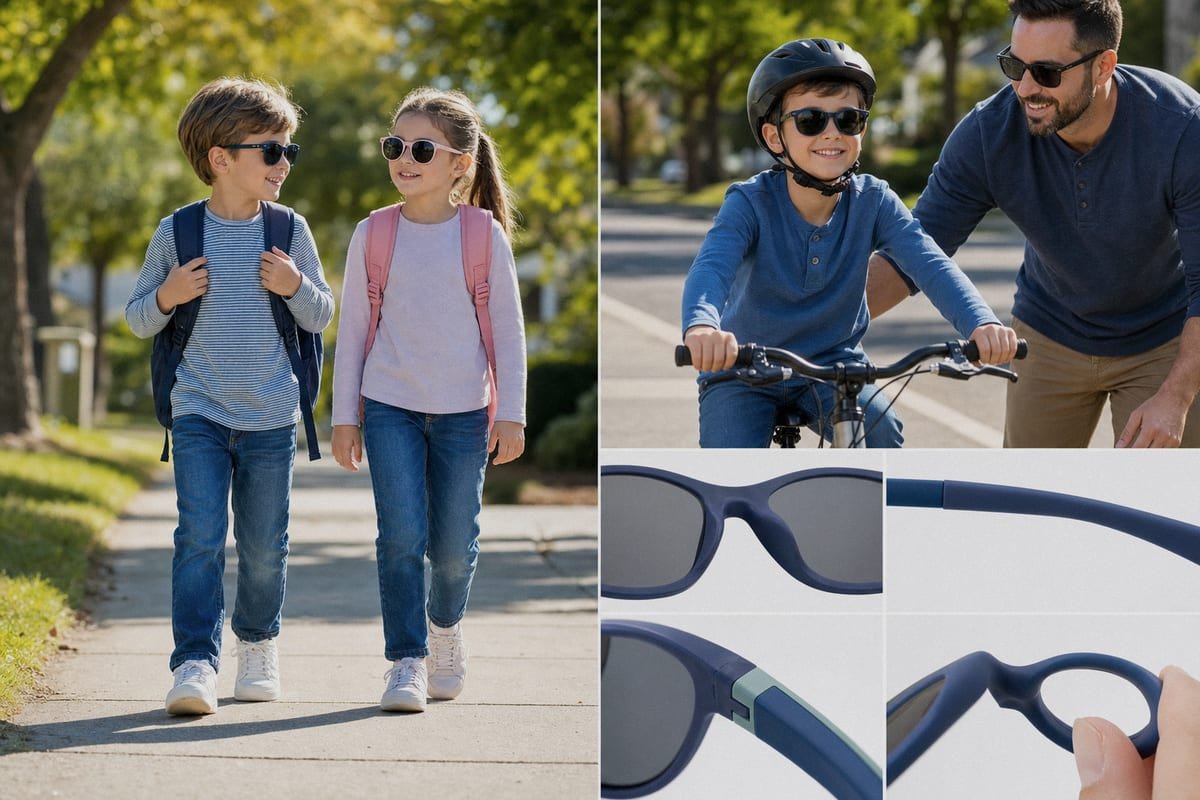
The science here is straightforward, and it is the foundation of any credible children's eyewear line. A child's ocular health is more vulnerable than an adult's for two simple reasons. First, the young lens 2 inside the eye is clearer, so it filters less UV. Second, children's pupils are larger, so more light gets in. Pediatric ophthalmology sources consistently recommend eye protection for outdoor time in all seasons because of this.
Why short commutes still count
A school commute may only take fifteen or twenty minutes each way. But that is ten commutes a week, forty a month, and hundreds a year. Cumulative UV exposure is the key concept. Damage does not happen in one afternoon. It builds over childhood and shows up decades later as cataracts or macular degeneration. Short-term risks are real too. Bright reflected light 3 can cause photokeratitis, which is essentially sunburn of the cornea. It is painful and entirely preventable.
Commute conditions that raise UV risk
Not every commute carries the same exposure. Here is how we break it down for our brand partners:
| Commute scenario | UV risk level | لماذا |
|---|---|---|
| Walking in direct morning sun | مرتفع | Low sun angle sends horizontal rays under hat brims |
| Waiting at an open bus stop | مرتفع | Prolonged stationary exposure, often no shade |
| Cycling on open roads | مرتفع | Wind, glare, and reflection from pavement |
| Cloudy days | معتدل | Clouds do not fully block UV |
| Rainy or foggy days | منخفض | UV radiation drops sharply |
| Fully shaded routes | منخفض إلى معتدل | Reflected UV still reaches the eyes |
The honest editorial position, and the one we advise brands to take, is that sunglasses are recommended for most outdoor commutes but not an absolute necessity in heavy rain or fog. That balanced framing builds trust with parents.
What safety features should I look for when sourcing sunglasses for daily children's wear?
During a QC round last spring, our team rejected a batch of lenses over a coating inconsistency most adults would never notice. That is the level of scrutiny daily-wear children's products deserve.
Prioritize lenses rated UV400 or labeled 100% UVA/UVB, impact-resistant lens materials, flexible hinge and frame construction, no sharp edges, and a snug fit that blocks light from the sides. Lens darkness alone means nothing; UV filtration and physical safety are what protect a child's eyes.
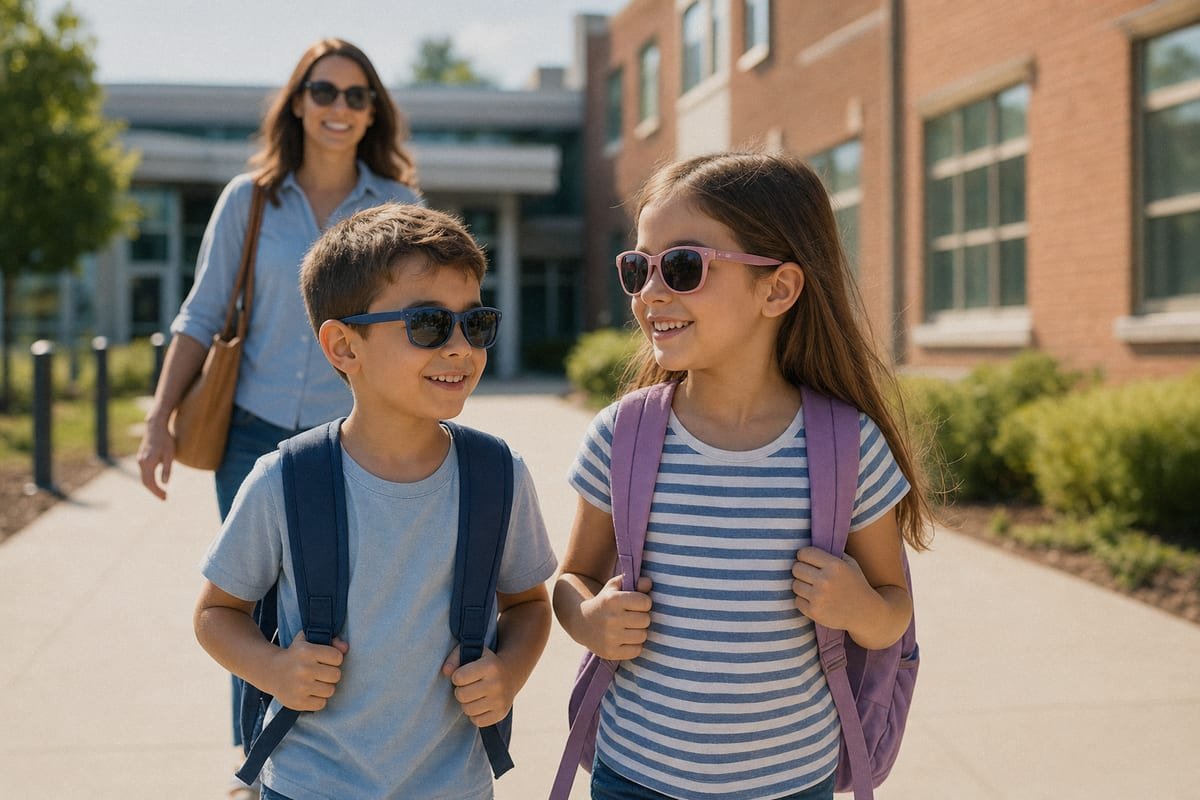
Safety is where a children's eyewear line succeeds or fails. In our fifteen years of building kids' frames, we have learned that parents forgive a scuffed frame but never forgive an injury. So build your sourcing checklist around genuine protection, not marketing gloss.
Start with the lens rating
The single most important specification is 100% UV protection 4 against both UVA and UVB rays. This is often labeled UV400, meaning the lens blocks wavelengths up to 400 nanometers. Critically, this has nothing to do with tint. A cheap dark lens without UV filtration is worse than no lens at all, because the dark tint dilates the pupil and lets more unfiltered UV flood in. This is the misconception we correct most often with new buyers.
Then verify the physical build
Kids drop things. Kids fall. Kids sit on their glasses. Impact-resistant lenses are non-negotiable for daily commuting wear 5, especially for children who cycle. Look for:
- Shatter-resistant lens materials that will not splinter near the eye.
- Flexible frames and temples that bend rather than snap.
- Smooth, rounded edges with no exposed metal points.
- Secure hinges that will not pinch small fingers.
- Coverage that wraps close to the brow and cheeks, since the low morning sun creates horizontal UV exposure that slips past hats.
Consider glare and comfort features
عدسات مستقطبة are a strong upgrade for commute-focused lines. They cut الوهج المنعكس 6 from wet pavement, car windshields, and glass buildings, which are the classic reflection hotspots of an urban school route. Less morning sun glare means less squinting, less visual fatigue, and a child who arrives at school without a glare-induced headache.
Can I offer flexible, comfortable frames that kids will actually wear on their way to school?
Compliance is the trade-off I weigh most carefully when we develop a new style. The safest sunglasses in the world protect nothing if they stay in the backpack.
Yes. Flexible, lightweight frames made from materials like TPEE and TR90 dramatically improve wear compliance. When frames bend without breaking, sit gently without pressure points, and come in styles kids like, children keep them on for the whole commute instead of pulling them off after two minutes.
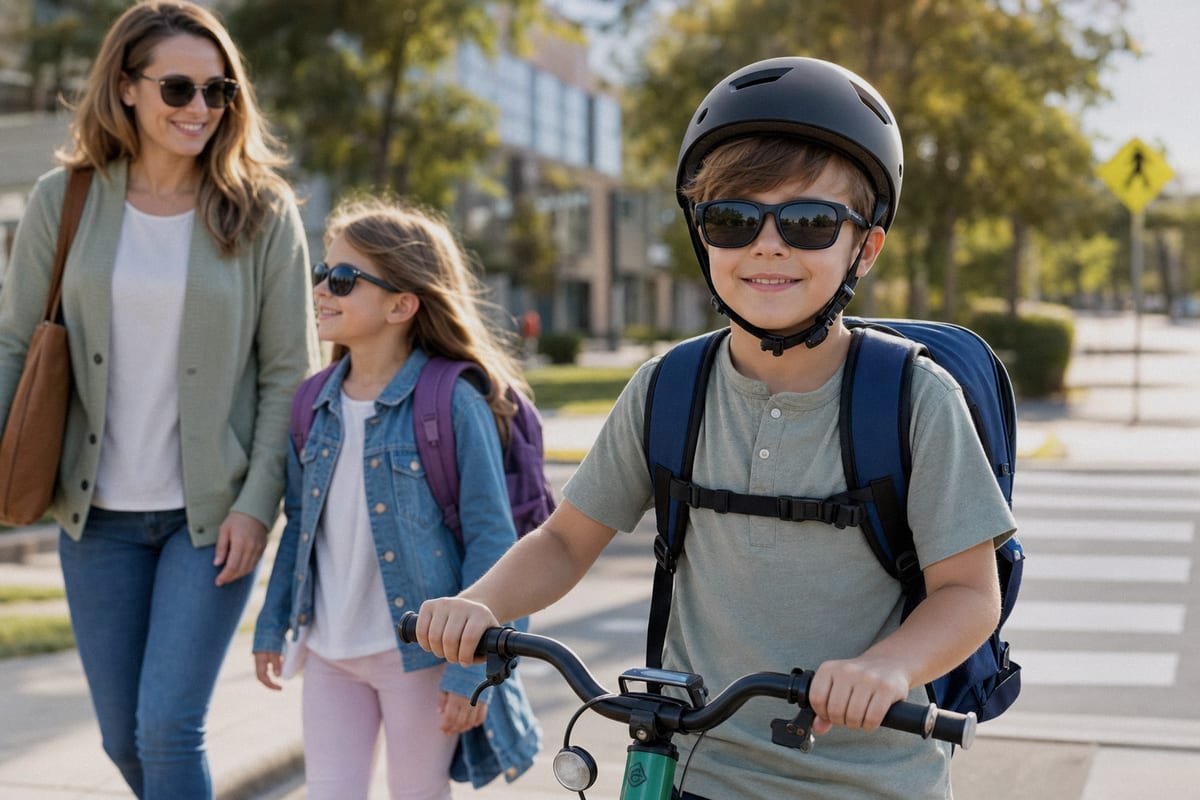
The compliance problem is the quiet failure point of most children's eyewear. Parents buy sunglasses, kids refuse them, and the product ends up in a drawer. When we developed our TR90 frames with TPEE temples, the entire goal was to remove every reason a child has to take the glasses off.
What makes a child keep glasses on
Kids reject eyewear for predictable reasons. The frame pinches behind the ears. The nose bridge presses down. The glasses slide when they run. Or, bluntly, the style embarrasses them in front of classmates. Each of these is a design problem with a design solution.
Flexibility solves the comfort issue. A TPEE temple flexes outward and returns to shape, so it never clamps a growing head. Light weight solves the pressure issue; a child barely notices a frame under a few grams heavier than a feather. Fit retention solves the sliding issue, especially with slightly rubberized temple tips that grip during a bike ride.
Style matters more than adults admit
Across our roughly 800 existing styles, we see a clear pattern in what actually gets worn. Younger children respond to soft, rounded shapes and pastel two-tone palettes, like a periwinkle-blue frame with mint-teal arms. Older kids gravitate to sporty wraparound shields with mirrored gradient lenses that look like performance gear. A wraparound shape is not just fashion, either. It blocks light from the sides, which round-lens styles cannot fully do.
A practical tip for brands
Offer at least two style families in a commute line: a playful round style for toddlers and early primary years, and an athletic shield style for older kids who cycle. One anecdote from our showroom: a European buyer's own son picked the orange-mirrored sport shield over every other sample on the table. He said it made him look fast. That is compliance you cannot engineer with specs alone.
Which materials should I choose to ensure my kids' sunglasses hold up to everyday commuting?
Fifteen years of running twist tests, drop tests, and temple-flex cycles in our workshop taught me one lesson early: material choice decides a product's lifespan before the first unit ships.
Choose TR90 for frame fronts, TPEE for temples, and polycarbonate or equivalent impact-resistant lenses. These materials survive daily drops, twisting, backpack pressure, and temperature swings. They are lightweight, memory-flexible, and environmentally friendlier than brittle standard plastics that crack within weeks of commuting use.
Everyday commuting is a brutal duty cycle for eyewear. Glasses get shoved into bags, sat on during bus rides 7, dropped on pavement, and left on hot windowsills. Standard rigid plastics fail fast under this abuse. That is why we standardized on flexible engineering materials years ago.
How the main materials compare
| المواد | Best use | Key strengths | Weakness |
|---|---|---|---|
| TR90 | واجهات الإطار، إطارات كاملة | Memory flexibility, very light, holds shape | Costs more than basic plastic |
| TPEE | Temples, soft-touch parts | Extreme flex, gentle on skin, eco-friendlier | Too soft for structural rims alone |
| البولي كربونات | Lenses, some polycarbonate frames | High impact resistance, built-in UV blocking | Scratches without a hard coating |
| Standard PC/acrylic plastic | Budget novelty glasses | Cheap | Brittle, cracks, sharp break edges |
The winning combination for a commute-grade product is a TR90 front with TPEE temples. The front keeps optical alignment stable so the UV400 lenses sit correctly over the eyes. The temples absorb the daily twisting and yanking that children inflict. Together they create a frame that a child can bend nearly flat without breakage.
Do not neglect lens durability
Impact-resistant lenses matter as much as the frame. Polycarbonate lenses inherently block UV and resist shattering, which is exactly what you want when a cyclist hits a pothole. Pair them with a scratch-resistant coating, because a scratched lens scatters light and worsens glare instead of controlling it. For premium lines, polarized lenses in an impact-resistant substrate give you both glare control and safety in one component.
Ask your supplier the right questions
Request material certificates, not just verbal claims. Ask how the factory tests temple flex cycles and lens impact. Ask whether colorants and coatings meet the chemical safety expectations of your target market. A factory that answers these questions quickly, with documentation, is a partner. One that hesitates is a risk.
الخلاصة
Skipping eye protection on school commutes lets cumulative UV damage build silently. The fix is simple: UV400 lenses, flexible safe frames, and styles kids genuinely want to wear.
ملاحظات ختامية
1. Expert advice on why children need sunglasses for daily activities. ↩︎
2. Explains the vulnerability of a child’s eye to UV radiation. ↩︎
3. Explains how reflected UV light leads to corneal inflammation. ↩︎
4. Overview of UV protection standards for eyewear. ↩︎
5. Official FDA safety regulations for impact-resistant lenses. ↩︎
6. Correct Wikipedia entry explaining the science of polarized lenses and glare reduction. ↩︎
7. Discusses the durability and impact resistance of polycarbonate lenses. ↩︎
مقالات أخرى قد تعجبك
August 1, 2026
هل يجب على المصنع التعامل مع تغليف ووضع ملصقات نظارات الأطفال الشمسية، أم استخدام مورد مخصص؟

August 1, 2026
مستودع خاص مقابل الوفاء المباشر من المورد: أيهما يقلل تكاليف الإرجاع لعلامات نظارات الأطفال الشمسية؟

August 1, 2026
مباشر إلى ميناء المستودع أو التخزين الخارجي: أيهما يوفر أكثر على شحن نظارات الأطفال الشمسية؟
هل تبحث عن شريك موثوق به للنظارات للأطفال؟
استكشف أكثر من 800 نمط جاهز ودعم OEM/ODM كامل مصمم خصيصًا لعلامتك التجارية.
اتصل بنا English
  Español de México
  Deutsch
  Français
  日本語
日本語  العربية
  Português do Brasil